
Particle Analysis (DPM) GOLDEN Training Course: +160 Simulations (All in One Course)
$1,599.00 Internship
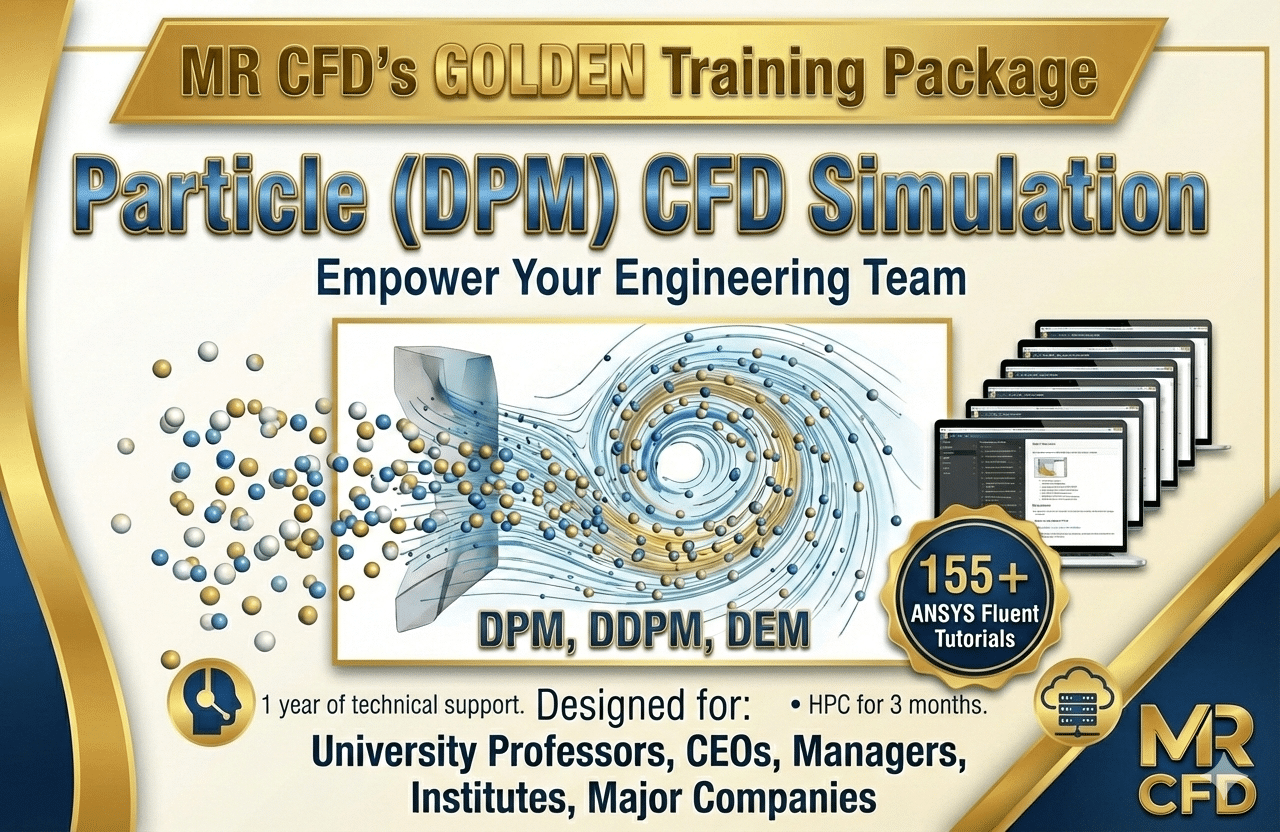
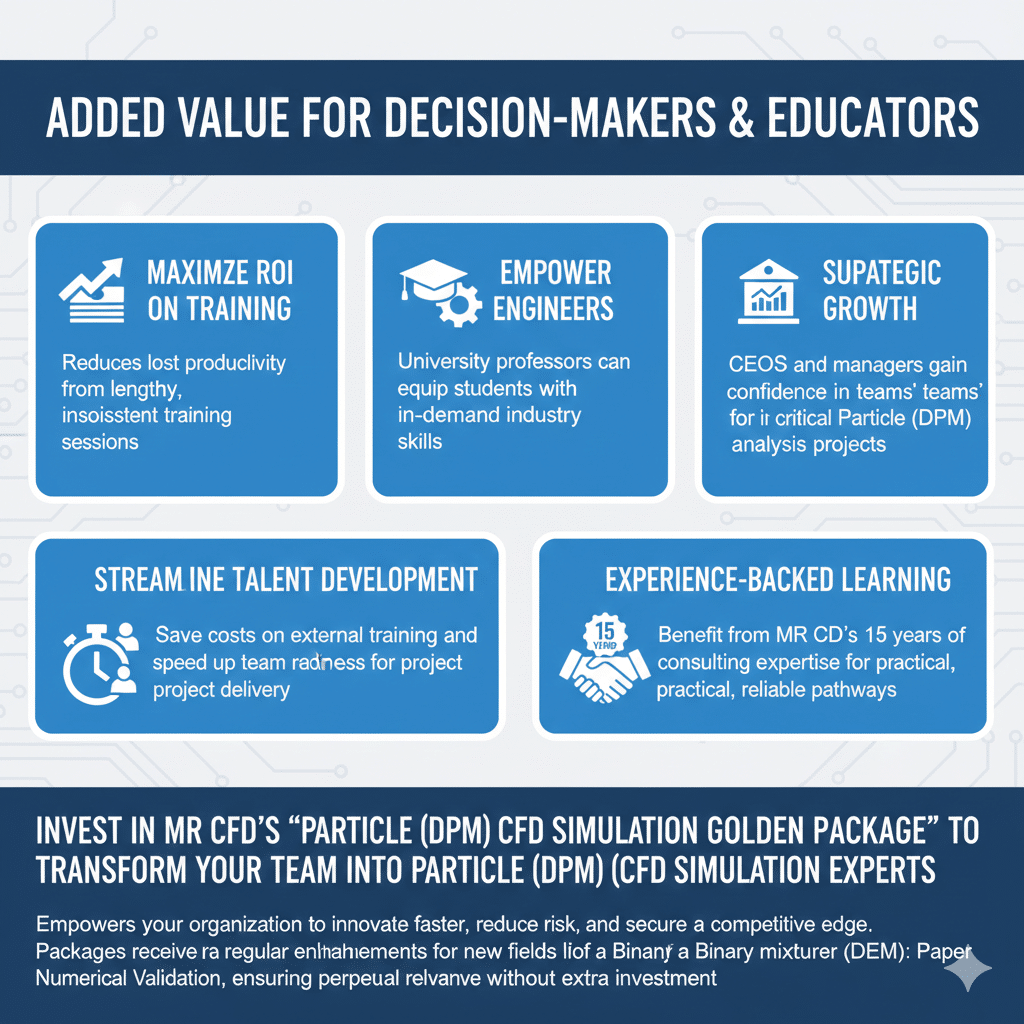
Particle (DPM) CFD Simulation GOLDEN Training Package by MR CFD is a complete learning bundle that turns students and engineers into expert users of particle-based CFD methods in ANSYS Fluent. With more than 155 step‑by‑step tutorials covering DPM, DDPM, and DEM applications from erosion and spray to virus dispersion and HVAC, it equips teams to handle real industrial particle analysis projects with confidence. Backed by 15 years of MR CFD consulting experience, the package includes practical case studies, full workflow training, one year of expert support, and temporary HPC access to fast‑track onboarding and reduce training costs for universities, institutes, and companies.
Click on Add To Cart and obtain the Geometry file, Mesh file, and a Comprehensive ANSYS Fluent Training Video.To Order Your Project or benefit from a CFD consultation, contact our experts via email (info@mr-cfd.com), online support tab, or WhatsApp at +44 7443 197273.
There are some Free Products to check our service quality.
If you want the training video in another language instead of English, ask it via info@mr-cfd.com after you buy the product.
Description
Complete DPM CFD Course for Particle Analysis [2026] DPM, DDPM & DEM
The Complete DPM CFD Course for Particle Analysis: +160 Simulations is a comprehensive training solution for engineers, universities, professors, research institutes, companies, technical managers, and CFD teams that need practical expertise in particle analysis and discrete phase modeling.
Developed by MR CFD, this course is part of MR CFD’s professional CFD Training Online and CFD Comprehensive Courses is designed to help learners move beyond scattered tutorials into a complete, structured, project-based particle CFD training experience. The course is also offered as the Particle Analysis (DPM) GOLDEN Training Course, giving buyers access to a large collection of real-world particle simulations in one all-in-one package.
This complete course covers Discrete Phase Model simulations, DDPM, DEM, particle tracking, particle deposition, spray and injection, erosion, particle combustion, particle reactions, fluidized beds, dryers, abrasive particles, particle traps, rain and snow modeling, aerosol dispersion, HVAC particle transport, and virus particle movement in indoor environments.
Why Choose This Complete DPM CFD Course?
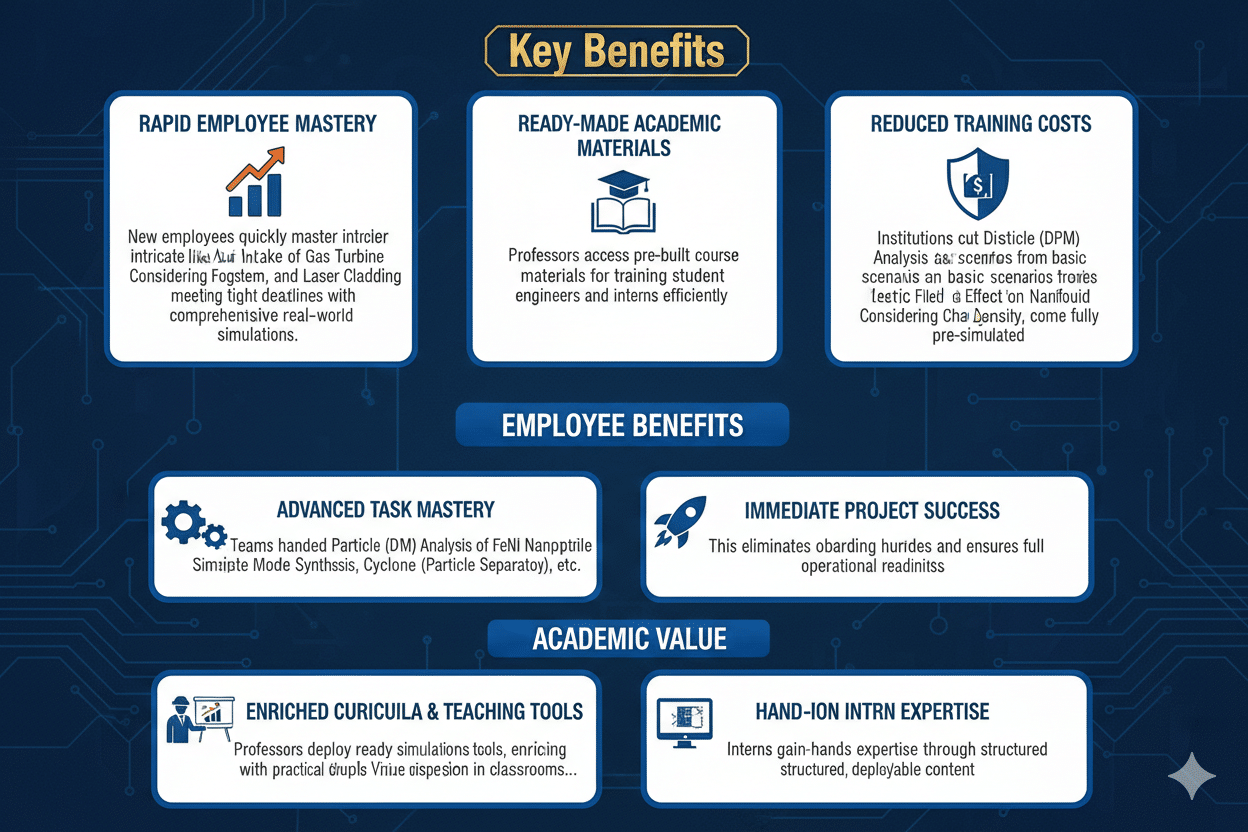
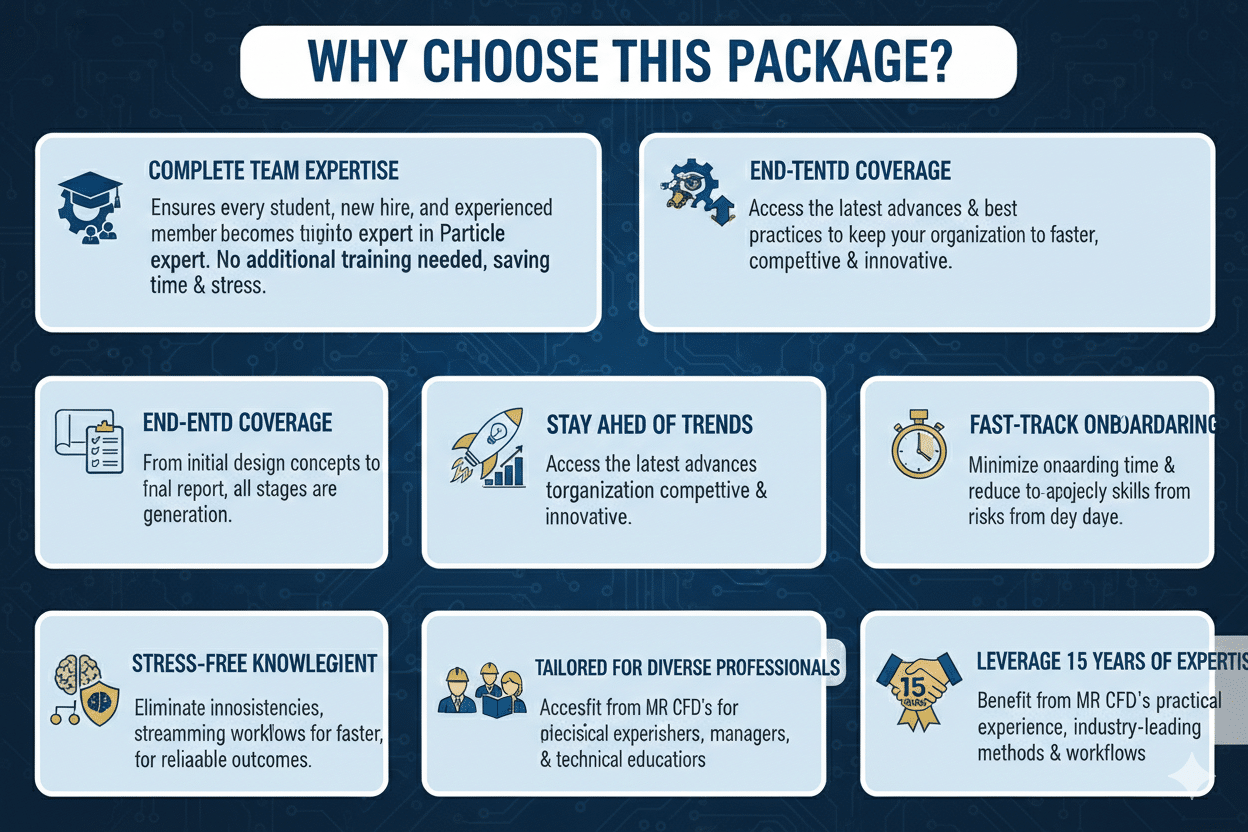
This course is built for buyers who need practical particle simulation capability, not only theoretical knowledge. It helps engineering teams, academic departments, and industrial companies train users faster, reduce modeling uncertainty, and standardize CFD workflows across particle-laden flow applications.
| Business Need | How This Complete CFD Course Solves It |
| Faster DPM onboarding | New engineers can learn from complete, pre-built particle CFD projects instead of disconnected tutorials. |
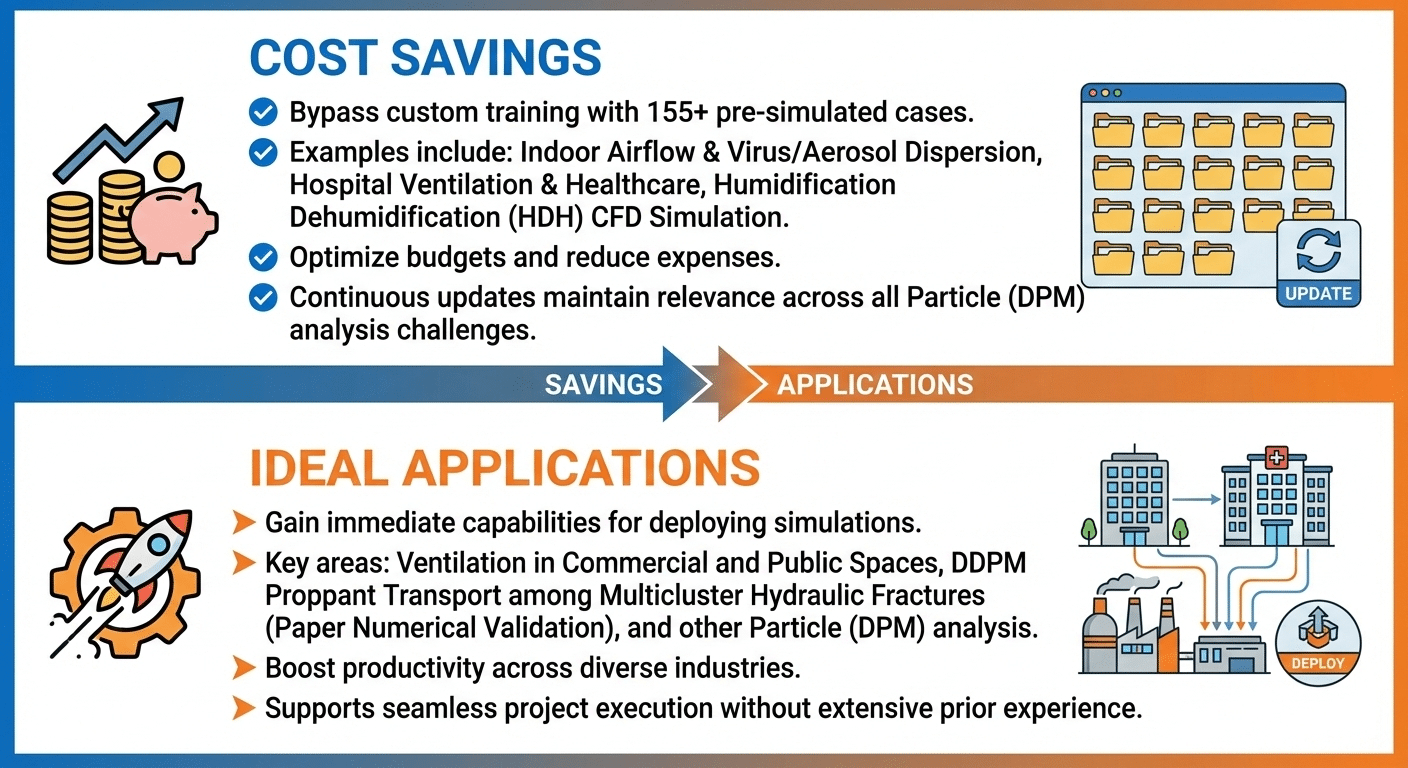
| Reduced training cost | One comprehensive course replaces scattered learning resources, repeated internal training, and multiple single-topic tutorials. |
| Practical particle simulation coverage | The course includes DPM, DDPM, DEM, erosion, sprays, combustion, deposition, particle traps, fluidized beds, and aerosol dispersion. |
| Academic teaching support | Professors can use the simulations as practical teaching material for students, interns, and research assistants. |
| Enterprise workflow consistency | Teams can follow proven simulation workflows for particle tracking, injection modeling, erosion prediction, and particle transport analysis. |
| Real project readiness | Learners work with applied CFD simulations based on industrial, environmental, HVAC, combustion, and multiphase particle applications. |
Complete CFD Training for DPM and Particle Analysis Teams
This course gives your organization a structured path to particle CFD mastery. It supports users who need to simulate particle trajectories, particle deposition, particle separation, spray injection, diesel injection, surface injection, particle combustion, biomass combustion, erosion in elbows and turbines, DDPM sediment transport, DEM particle motion, cyclone separation, aerosol transport, indoor particle movement, and virus dispersion in ventilation systems.
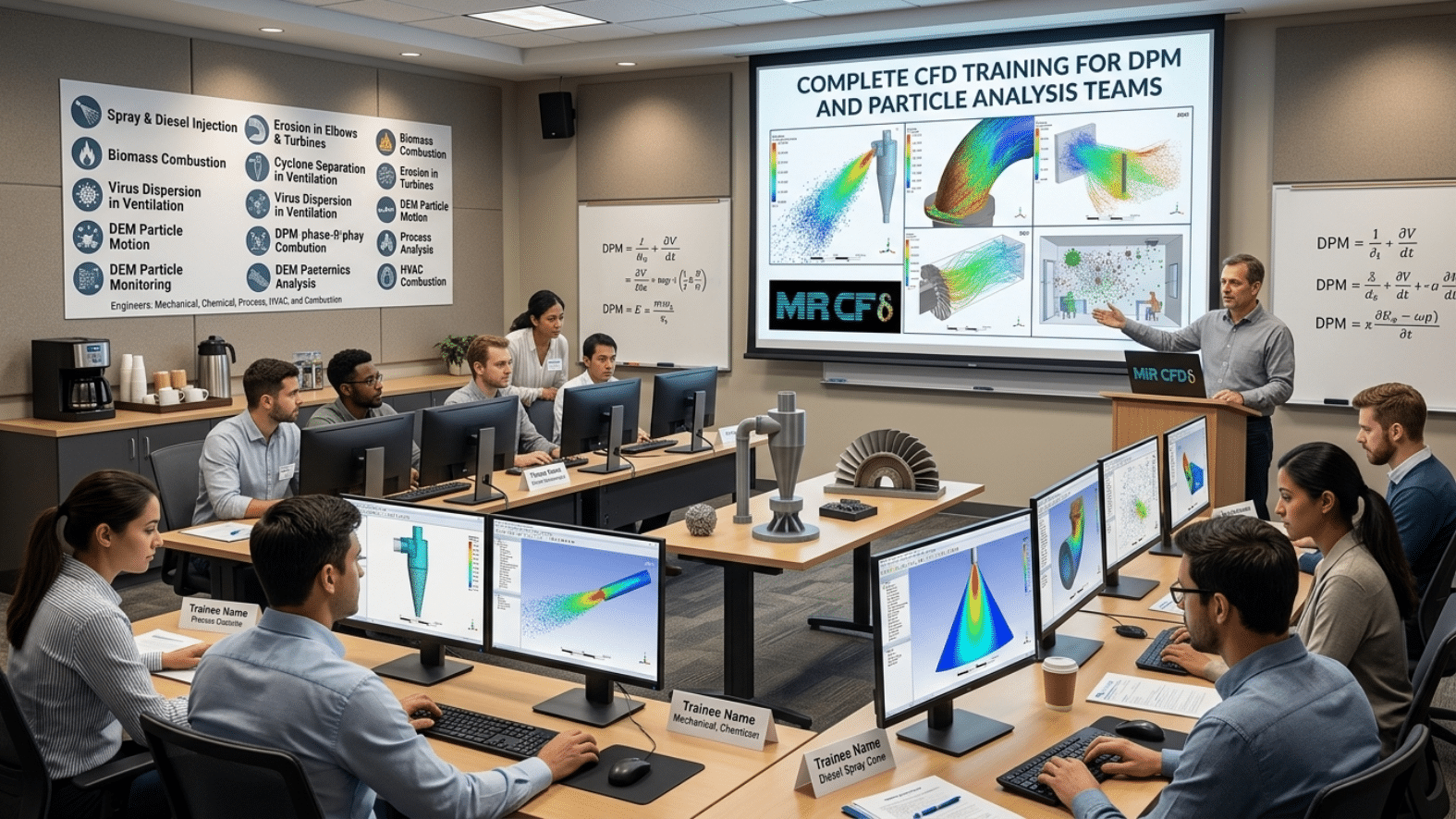
For companies, this complete DPM CFD course reduces dependency on isolated experts and creates a repeatable training pathway for CFD engineers, mechanical engineers, chemical engineers, process engineers, HVAC specialists, combustion engineers, and R&D teams. For universities and institutes, it provides ready-to-use simulation projects that can support lectures, laboratories, workshops, research projects, and advanced CFD training programs.
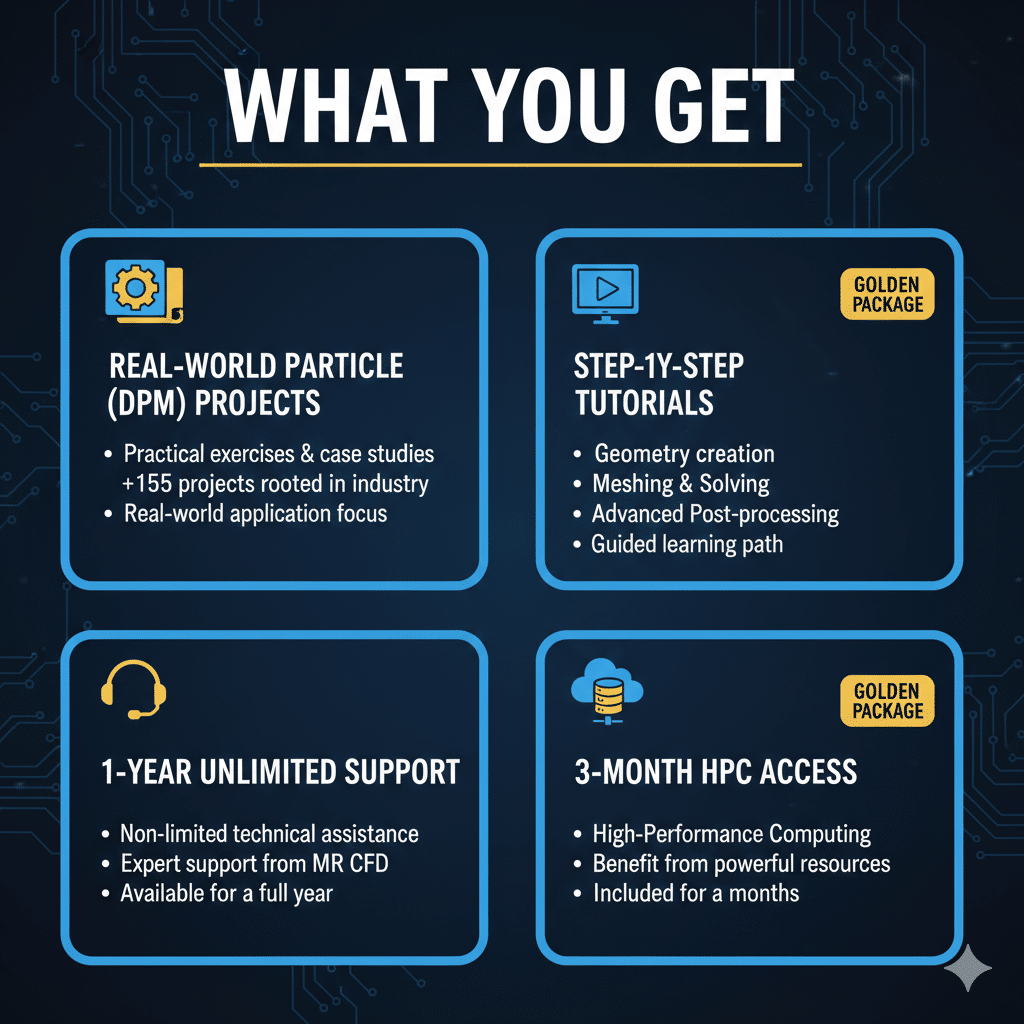
What You Get in This DPM CFD Course
| Included Asset | Value for the Buyer |
| +160 CFD simulation projects | A comprehensive particle analysis CFD library in one course package. |
| Step-by-step tutorials | Practical guidance from geometry creation to final post-processing. |
| Complete simulation workflows | Geometry, meshing, solver setup, particle injection settings, tracking, results analysis, and engineering interpretation. |
| Advanced particle analysis case studies | Coverage of DPM, DDPM, DEM, sprays, erosion, combustion, particle reactions, dryers, fluidized beds, aerosol dispersion, and HVAC particle transport. |
| 1 year of technical support | Direct support from MR CFD experts for course users. |
| 3 months of HPC access | Additional computational resources for selected learning and simulation needs. |
| Regular course enhancements | Continued value through updates for emerging particle CFD topics such as DEM validation, DDPM transport, aerosol control, and advanced particle-laden flows. |
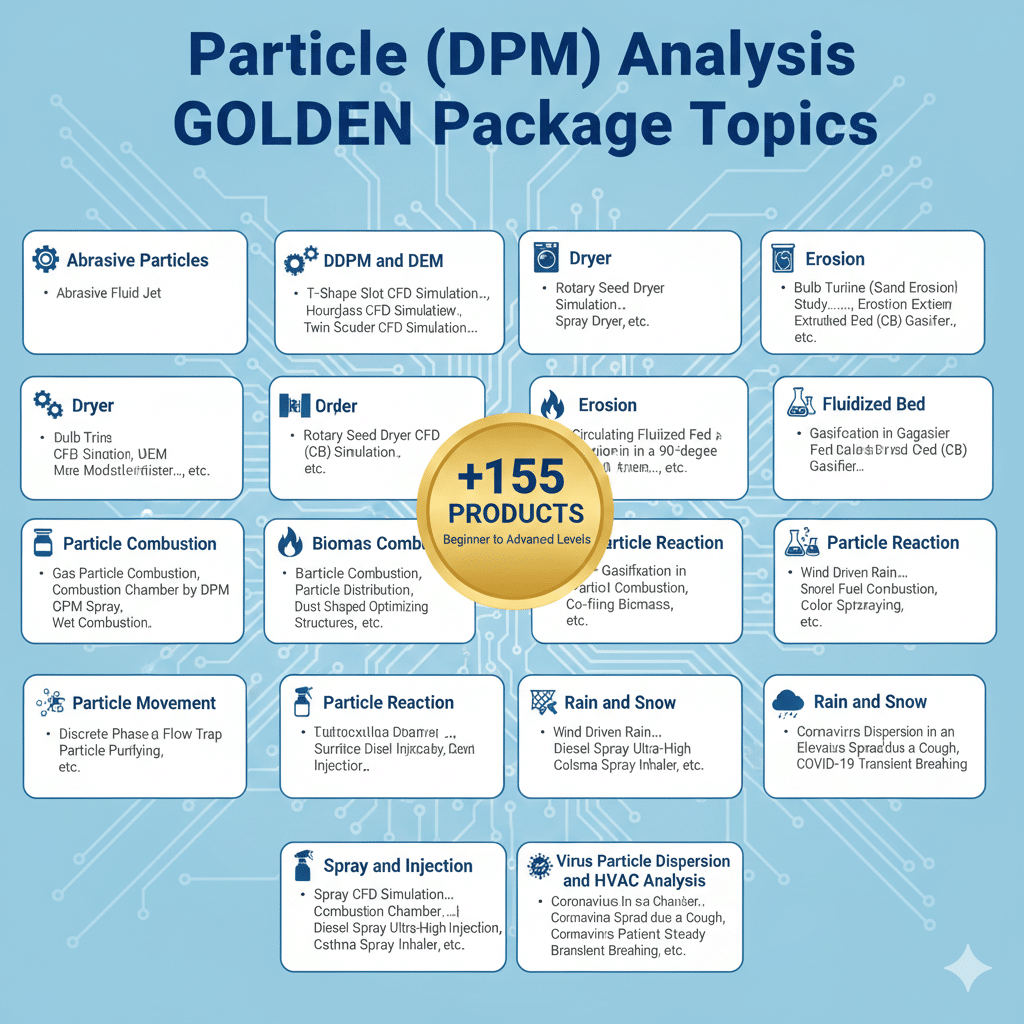
DPM and Particle Analysis CFD Topics Covered in This Complete Course
This complete CFD course covers a broad range of particle analysis applications, from basic discrete phase modeling to advanced DDPM, DEM, erosion, spray, combustion, particle deposition, and aerosol transport workflows.
| Training Area | Covered Topics |
| DPM fundamentals | Introduction to Discrete Phase Model concepts, DPM setup, particle tracking, injection definition, particle-wall interaction, and post-processing. |
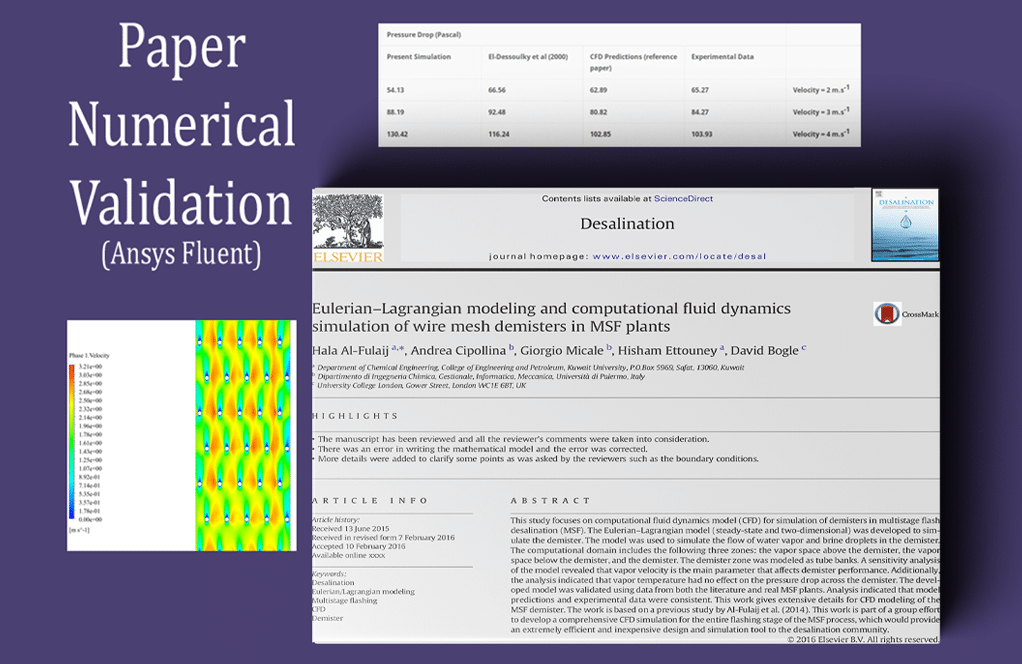
| DDPM and DEM | T-shape water-sand flow using DDPM, hourglass simulations, twin screw extruder DEM with dynamic mesh, four-way coupled particle flow, elbow particle accumulation, and wire mesh demister validation. |
| Spray and injection | DPM spray simulation, surface injection, diesel spray, high-pressure diesel injection, conical color spraying, fuel injection, nanoparticle injection, asthma inhaler injection, and fire extinguisher particle emission. |
| Erosion analysis | Erosion in elbows, 90-degree knees, bent pipes, splitters, bulb turbines, centrifugal pumps, and particle-driven erosion prediction using DPM. |
| Particle combustion | Biomass combustion, DPM spray combustion, wet combustion, combusting particles, time-step effect on particle injection, and co-firing biomass with coal gasification. |
| Particle reactions | Gasification with CHEMKIN and radiation, diesel fuel particle surface reaction, biomass co-firing validation, and reactive particle-laden flow. |
| Particle movement and deposition | Particle distribution in indoor environments, dust entering rooms, gas particle movement through nozzles, particle deposition, and dust-based flow optimization. |
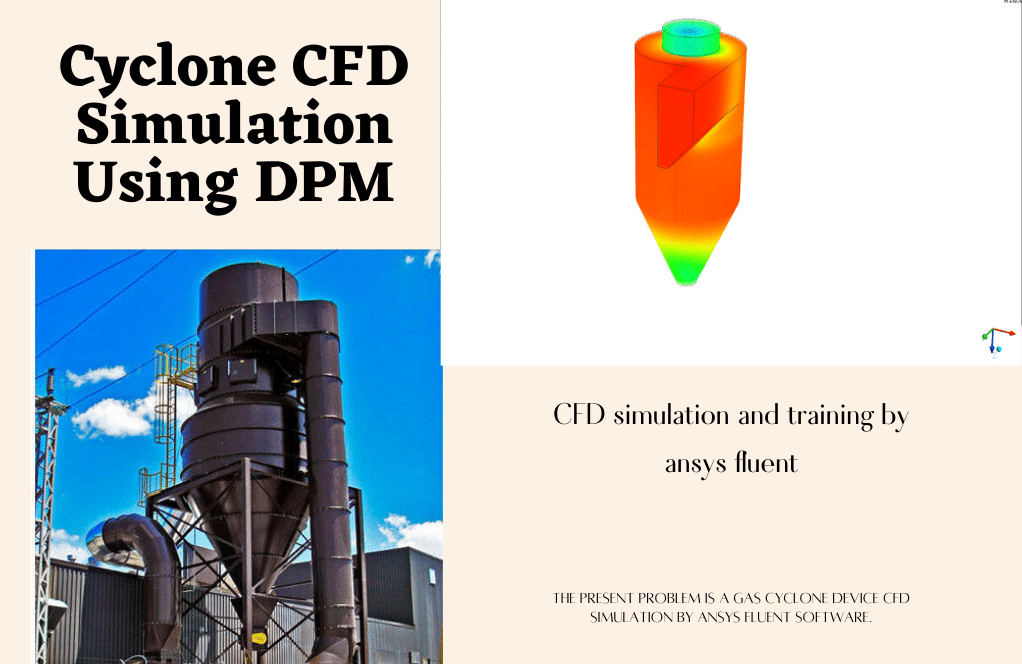
| Particle traps and separators | Gravity-based particle trapping, particle purification in air intake rooms, cyclone particle separators, and particle removal design improvement. |
| Fluidized beds | Circulating fluidized bed boilers, circulating fluidized bed gasifiers, gas-solid interaction, and particle transport in fluidized systems. |
| Drying systems | Rotary seed dryers using DPM and moving mesh, spray dryers, and particle-based drying applications. |
| Rain and snow modeling | Wind-driven rain, one-way versus two-way DPM rain analysis, snowfall simulation, and environmental particle transport. |
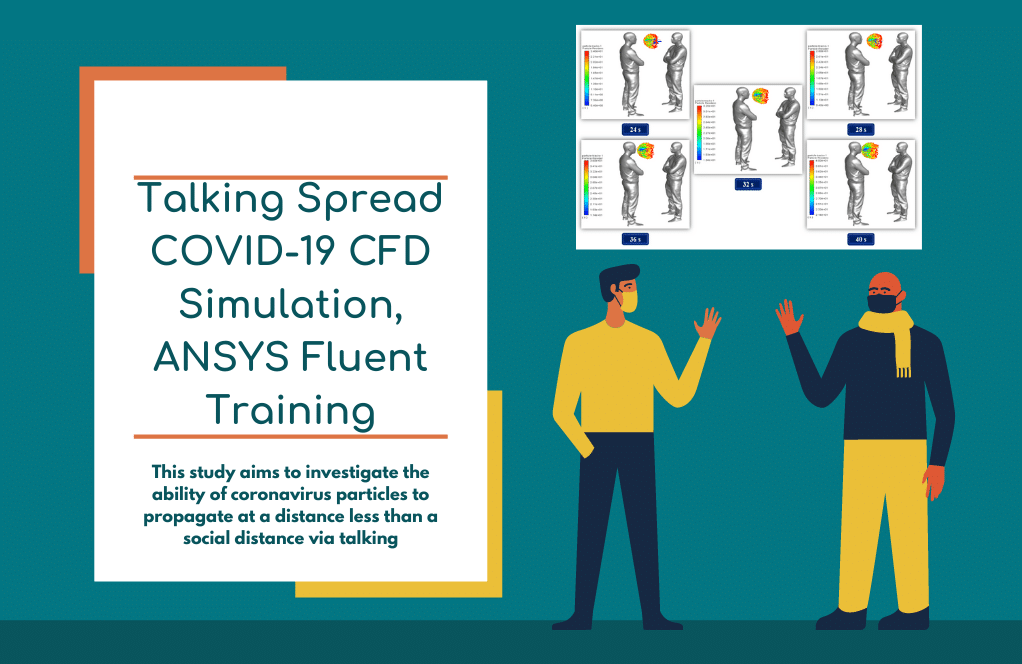
| Virus and aerosol dispersion | Elevator sneeze dispersion, cough spread in open air, clean room breathing, operating room breathing, airplane breathing, classroom airborne risk, face shield studies, and aerosol control ventilation. |
| HVAC particle transport | Human-exhaled particle distribution, hospital airflow and pathogen dispersion, forced ventilation, mixed ventilation, natural ventilation, and indoor particle deposition. |
Advanced DPM CFD Modules Included
This complete course includes advanced simulation categories that help engineers move beyond basic particle tracking and into professional-grade particle-laden flow analysis.
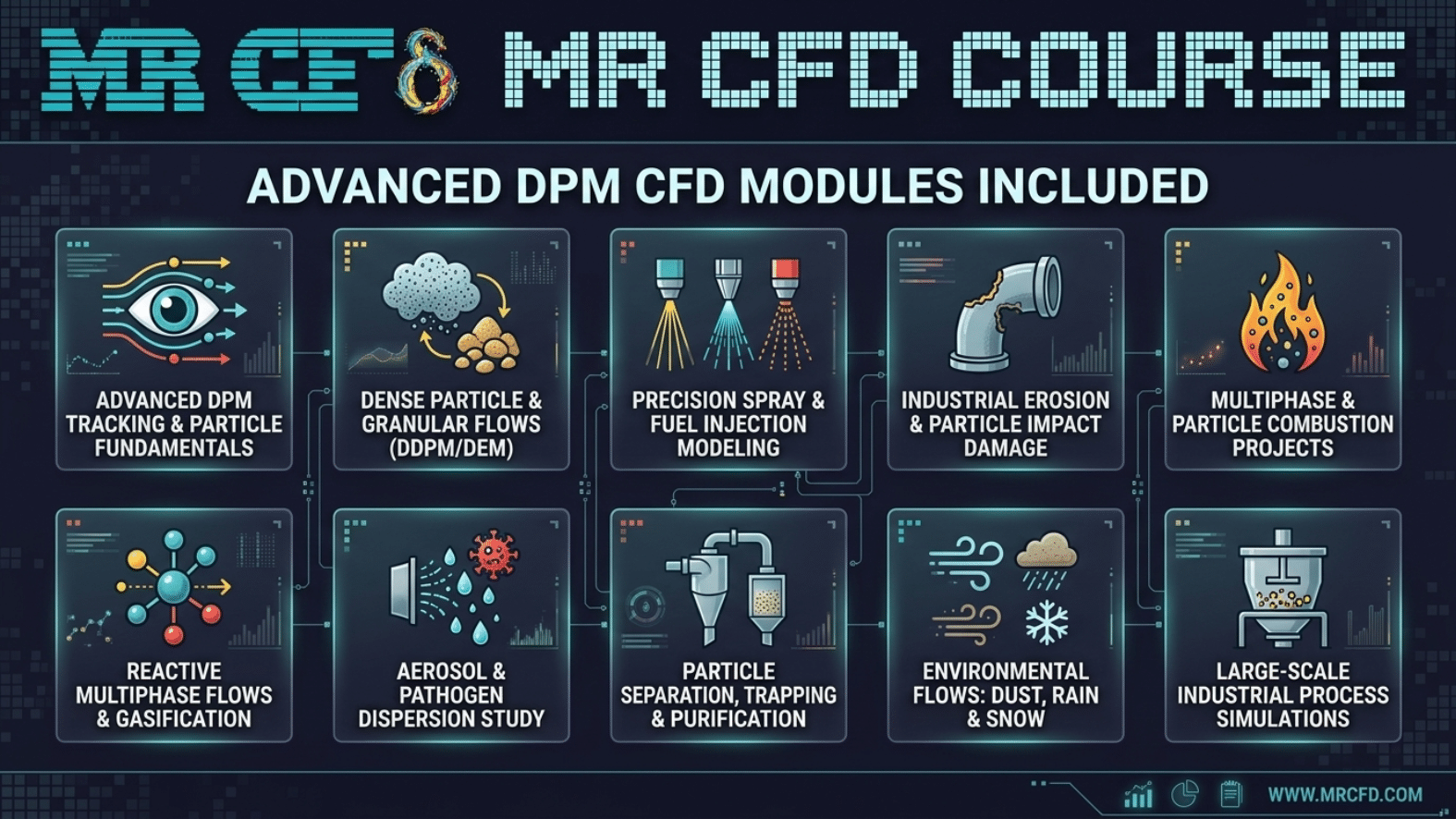
Key advanced modules include:
- Discrete Phase Model simulations for particle tracking, injection, deposition, trapping, wall interaction, and particle-flow coupling.
- DDPM and DEM simulations for dense particle systems, granular flow, particle accumulation, four-way coupling, demisters, and industrial particle transport.
- Spray and injection modeling for diesel sprays, fuel injection, surface injection, conical spraying, nanoparticle injection, inhaler sprays, and evaporating droplets.
- Erosion prediction workflows for elbows, pipes, turbines, pumps, splitters, obstruction paths, and particle-impact damage analysis.
- Particle combustion projects for biomass combustion, DPM spray combustion, wet combustion, combusting particles, and coal-biomass co-firing.
- Particle reaction simulations for gasification, diesel particle surface reactions, CHEMKIN-based reaction workflows, and reactive multiphase systems.
- Aerosol and virus particle dispersion studies for classrooms, elevators, cars, airplanes, clean rooms, operating rooms, hospitals, and public spaces.
- Particle separation and trapping projects for cyclone separators, particle purifiers, demisters, gravity traps, and air intake room design.
- Environmental particle simulations for wind-driven rain, snowfall, dust transport, room particle entry, and particle deposition in indoor environments.
- Industrial particle-laden flow projects for fluidized beds, rotary dryers, spray dryers, twin screw extruders, industrial pipes, and abrasive fluid jets.
Complete DPM CFD Course vs Standard Single-Topic Particle Training
| Feature | Complete DPM CFD Course | Standard Single-Topic Particle CFD Training |
| Main purpose | Comprehensive CFD training for DPM, DDPM, DEM, particle tracking, sprays, erosion, and aerosol dispersion | Focused learning for one narrow particle modeling topic |
| Best for | Companies, universities, professors, CFD teams, process engineers, HVAC specialists, combustion teams, and advanced users | Individual learners studying one particle workflow |
| Content depth | +160 applied particle CFD simulations across industrial, environmental, HVAC, and combustion applications | Limited case studies in one application area |
| Project variety | DPM, DDPM, DEM, erosion, sprays, injection, combustion, dryers, fluidized beds, aerosols, virus dispersion, and particle traps | Usually limited to one model or one equipment type |
| Business value | Reduces training cost, accelerates onboarding, and standardizes team capability | Builds knowledge in a specific technical niche |
| Purchase motivation | Complete particle CFD capability building | Individual skill improvement |
Who Should Buy This Complete DPM CFD Course?
This course is ideal for CFD engineers, mechanical engineers, chemical engineers, process engineers, combustion engineers, HVAC specialists, environmental engineers, university professors, research institutes, technical managers, CEOs, professional instructors, and advanced engineering practitioners.
It is especially valuable for organizations that want to train multiple users, reduce repeated onboarding, support academic programs, standardize DPM workflows, and improve internal simulation capability across particle tracking, spray, erosion, combustion, and aerosol dispersion applications.
Business Benefits of Buying This Complete DPM CFD Course
| ROI Driver | Business Impact |
| Faster onboarding | New engineers become productive sooner on DPM and particle CFD projects. |
| Reduced external training dependency | Teams can learn from a complete internal CFD training resource. |
| Better workflow consistency | Engineers follow proven particle modeling workflows instead of scattered tutorials. |
| Lower project risk | Teams learn from pre-built, practical particle analysis examples. |
| Stronger academic outcomes | Instructors can assign realistic DPM, DDPM, DEM, erosion, spray, and aerosol simulation projects. |
| Faster design improvement | Teams can evaluate particle injection, erosion, deposition, combustion, separation, and ventilation performance more efficiently. |
| Higher long-term value | One complete course supports repeated training across departments, students, interns, and new employees. |
Why This Complete CFD Course Is Built for Direct Purchase
When your team needs serious CFD capability in particle analysis, buying isolated tutorials one by one creates gaps, duplicated effort, and inconsistent learning outcomes. This complete course removes that friction by giving you a structured DPM and particle analysis simulation library in one purchase.
You get practical training built around real engineering applications, including DPM particle tracking, DDPM transport, DEM granular flow, erosion, sprays, injections, dryers, particle combustion, particle reactions, fluidized beds, cyclone separation, aerosol dispersion, virus particle movement, hospital ventilation, and indoor particle deposition. That makes this course a strong choice for buyers who want immediate access to a deep, organized, and commercially valuable CFD learning system.
So…
Invest in the Particle Analysis (DPM) GOLDEN Training Course: +160 Simulations (All in One Course) and give your team a complete DPM CFD training system built for advanced industrial, academic, environmental, HVAC, and research applications.
Whether you manage a university lab, a corporate CFD department, a process engineering team, a combustion analysis group, an HVAC simulation unit, or a technical training center, this course helps you reduce training time, improve simulation quality, and build long-term internal expertise.
Instead of purchasing separate tutorials and managing disconnected learning materials, choose one complete CFD course that delivers depth, breadth, technical support, HPC access, and practical project readiness in a single solution.
FAQ for Complete DPM CFD Course
What is included in the Complete DPM CFD Course?
The course includes +160 CFD simulation projects covering DPM, DDPM, DEM, particle tracking, sprays, injection, erosion, particle combustion, particle reactions, fluidized beds, dryers, rain, snow, aerosol dispersion, and HVAC particle transport.
Who is this DPM CFD course designed for?
This course is designed for CFD engineers, mechanical engineers, chemical engineers, process engineers, combustion specialists, HVAC engineers, environmental engineers, university professors, research teams, and advanced users who need practical particle CFD training.
Is this course suitable for company-wide DPM and particle CFD training?
Yes. This complete CFD course is suitable for team training because it provides a large library of practical particle analysis simulations that help standardize workflows, reduce onboarding time, and improve project readiness.
Can university professors use this course for teaching particle CFD?
Yes. Professors and instructors can use the course as a ready-made library of practical particle CFD case studies for lectures, laboratories, assignments, workshops, research projects, and advanced student training.
Does this course cover DPM, DDPM, and DEM simulations?
Yes. The course covers Discrete Phase Model simulations, Dense Discrete Phase Model projects, and DEM-based particle simulations for granular flow, dense particle systems, industrial pipes, extruders, demisters, and particle accumulation.
Does this course include spray and injection CFD simulations?
Yes. It includes DPM spray simulation, surface injection, diesel injection, high-pressure diesel spray, fuel injection, conical color spraying, nanoparticle injection, asthma inhaler injection, and fire extinguisher particle emission.
Are erosion and particle deposition simulations included?
Yes. The course includes erosion in elbows, knees, bent pipes, splitters, turbines, pumps, and particle deposition in indoor environments, ventilation systems, and industrial flow paths.
Does this course cover virus and aerosol particle dispersion?
Yes. It includes aerosol and virus particle dispersion simulations for elevators, classrooms, cars, airplanes, clean rooms, operating rooms, hospitals, and ventilation systems.
Is technical support included after purchasing the course?
Yes. Buyers receive 1 year of non-limited technical support from MR CFD experts, helping learners and teams resolve technical questions related to the course simulations.
Why should I buy this complete CFD course instead of separate DPM tutorials?
Buying this complete CFD course gives you a broader, more organized, and more cost-effective training solution. It supports team-wide learning, reduces repeated training costs, and gives access to a comprehensive DPM and particle analysis CFD simulation library in one purchase.
You must be logged in to post a review.
 Talk On WhatsApp
Reviews
There are no reviews yet.