
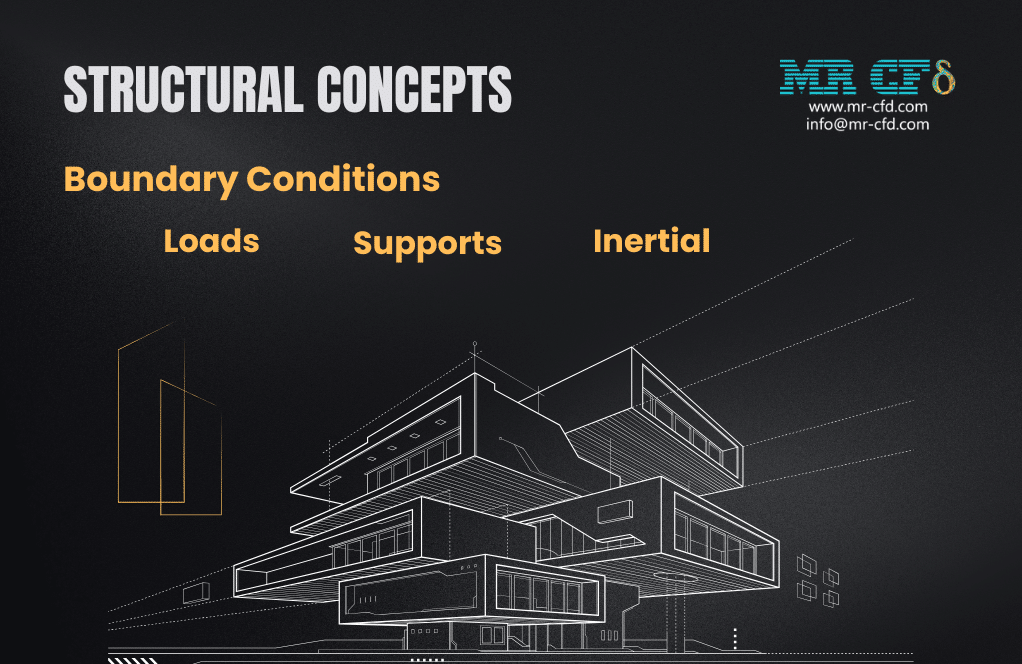
ANSYS Structural Concepts: Boundary Conditions
Free
- Introduction to the Structural Simulations
- Introduction to the Boundary Conditions definition in ANSYS Structural
- Introduction to the Loads category
- Introduction to the Supports category
- Introduction to the Inertial category
To Order Your Project or benefit from a CFD consultation, contact our experts via email (info@mr-cfd.com), online support tab, or WhatsApp at +44 7443 197273.
There are some Free Products to check our service quality.
If you want the training video in another language instead of English, ask it via info@mr-cfd.com after you buy the product.
Description
Structural Concepts: Boundary Conditions
In this training video, we describe the Structural concepts in ANSYS software, focusing on defining Boundary Conditions. We provide you with a detailed and comprehensive tutorial to help you master all concepts of boundary condition definition in structural simulations without any issues.
Whenever a solid domain associated with a case study is simulated in structural analysis, specific boundary conditions need to be defined. These boundary conditions determine how the domain is allowed to undergo displacement or deformation freely, on the one hand, and how it is constrained and without displacement, on the other hand.
There are various boundary conditions available for structural simulations, with three main categories:
- Loads
- Supports
- Inertial
Loads, as the most important and widely used category, specify what is driving the structural displacement. Different types of load boundary conditions available:
- Pressure
- Hydrostatic Pressure
- Fluid Penetration Pressure
- Force
- Remote Force
- Bearing Load
- Bolt Pretension
- Moment
- Line Pressure
- Thermal Condition
- Joint Load
Supports, as an essential category, determine how the structure is constrained from displacement. Different types of support boundary conditions available:
- Fixed Support
- Displacement
- Remote Displacement
- Frictionless Support
- Compression-only Support
- Cylindrical Support
- Elastic Support
Inertial is another required category. Different types of inertial boundary conditions available:
- Acceleration
- Standard Earth Gravity
- Rotational Velocity
- Rotational Acceleration
You must be logged in to post a review.

 Talk On WhatsApp
Reviews
There are no reviews yet.