
Electrochemical Energy Systems GOLDEN Training Package: +45 Simulations (All in One Course)
$2,699.00 Internship
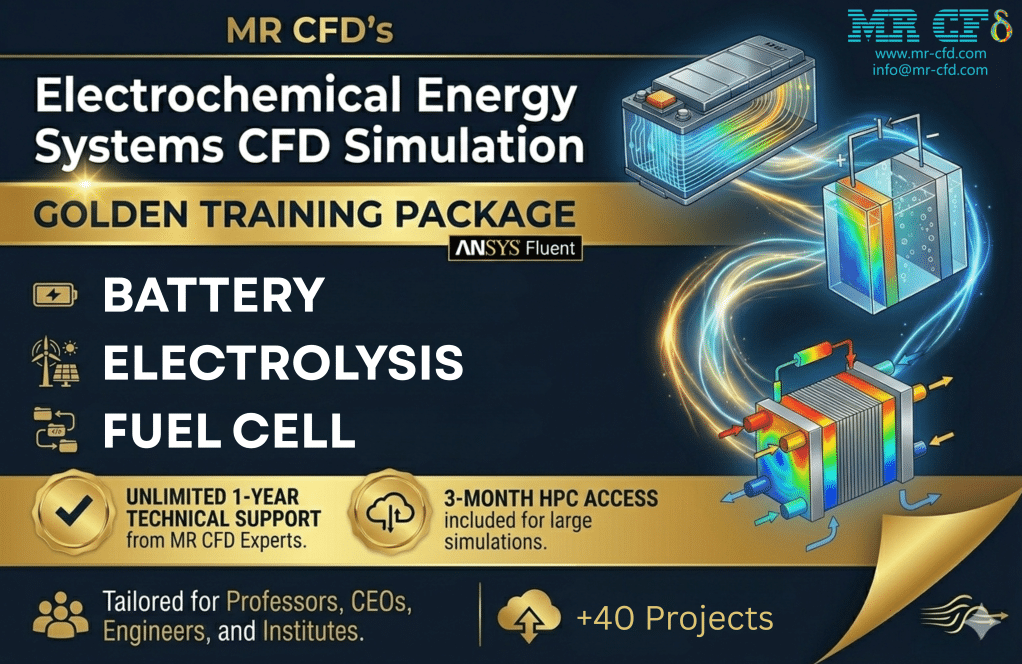
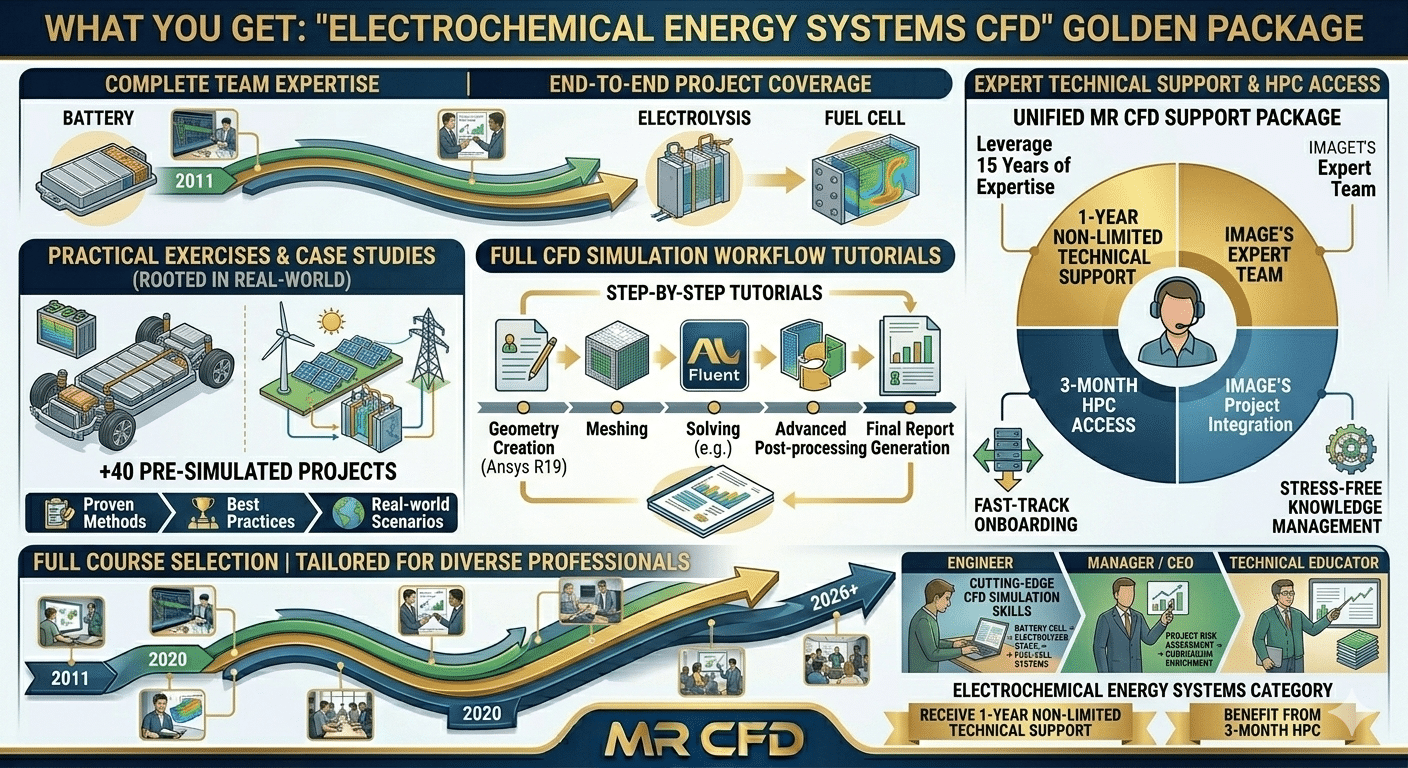
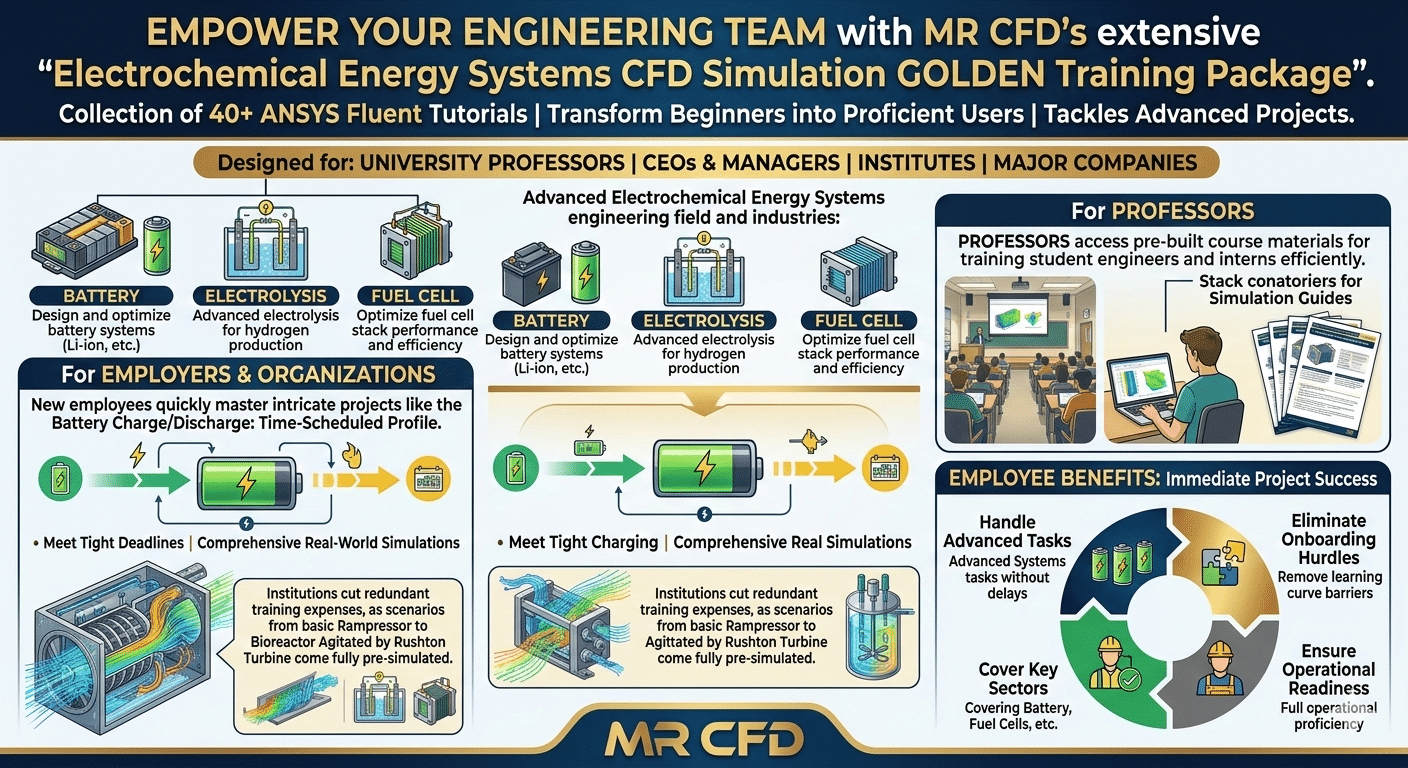
MR CFD’s “Electrochemical Energy Systems CFD Simulation GOLDEN Training Package” for ANSYS Fluent delivers tutorials transforming beginners into experts in Battery, Electrolysis, and Fuel Cell simulations. Tailored for professors, CEOs, engineers, and institutes. This turnkey resource accelerates onboarding, enriches curricula, using MR CFD’s 15 years of expertise.
- Practical exercises and case studies rooted in real-world Electrochemical Energy Systems, +40 pre-simulated projects.
- Step-by-step tutorials from geometry creation, meshing, solving, and advanced post-processing.
- While you obtain the Golden Package, you will receive non-limited 1-year technical support from MR CFD experts.
- By purchasing this Golden package, you can benefit from our 3-month HPC.
To Order Your Project or benefit from a CFD consultation, contact our experts via email (info@mr-cfd.com), online support tab, or WhatsApp at +44 7443 197273.
There are some Free Products to check our service quality.
If you want the training video in another language instead of English, ask it via info@mr-cfd.com after you buy the product.
Description
Electrochemical Energy Systems Complete CFD Course | 45+ ANSYS Fluent Simulations
The global transition toward clean energy has placed electrochemical energy systems—batteries, fuel cells, and electrolyzers—at the center of modern engineering innovation. Designing and optimizing these systems demands far more than theoretical knowledge; it requires the ability to model complex, coupled electrochemical, thermal, and fluid phenomena with precision. This is exactly what the Electrochemical Energy Systems Complete CFD Course by MR CFD delivers.
This course is one of the most comprehensive CFD training courses available for electrochemical simulation, featuring over 45 production-grade ANSYS Fluent simulation projects spanning the full spectrum of battery CFD simulation, PEM and alkaline electrolysis, and PEMFC and SOFC fuel cell CFD modeling. Whether you are entering the field or advancing an existing simulation practice, this structured training program provides the technical depth and practical workflows demanded by today’s energy engineering industry.
The Engineering Imperative Behind Electrochemical Energy Systems CFD Simulation
The accelerating deployment of electric vehicles, grid-scale energy storage, and hydrogen fuel cell infrastructure has created an urgent demand for engineers capable of simulating electrochemical energy systems with industrial-grade accuracy. Physical prototyping alone is no longer a viable development strategy—thermal runaway in lithium-ion battery packs, membrane degradation in PEMFC systems, and efficiency losses in PEM electrolyzers must be predicted and mitigated computationally before hardware is ever manufactured.
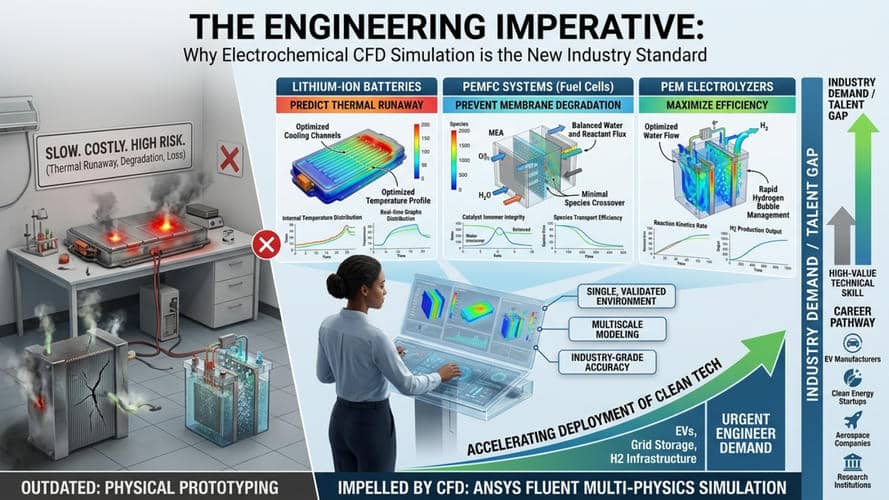
ANSYS Fluent electrochemical simulation has become the industry standard for resolving these challenges. The ability to model battery thermal management, species transport in fuel cells, electrochemical reaction kinetics, and hydrogen production via electrolysis within a single, validated CFD environment is now a core engineering competency. Research institutions, EV manufacturers, clean energy startups, and aerospace companies are actively seeking engineers who can execute these simulations with confidence and rigor. The gap between demand and available talent makes mastery of electrochemical CFD simulation one of the highest-value technical skills in the current engineering job market.
Core Technical Competencies You Will Build in This Electrochemical Full CFD Training
This course is structured to develop a precise, layered set of simulation capabilities across all three major electrochemical domains.
Technical Simulation Skills:
- Setting up ANSYS Fluent electrochemical models including MSMD, ECM, NTGK, and P2D battery sub-models
- Configuring species transport equations for fuel cell and electrolyzer simulations
- Applying Butler-Volmer electrochemical kinetics within CFD solver frameworks
- Modeling phase change material (PCM) thermal behavior using the enthalpy-porosity method
- Simulating nanofluid heat transfer for advanced battery cooling configurations
Modeling and Geometry Skills:
- Building battery pack geometries including 1P6S, 4P6S, and parallel/serial configurations
- Constructing PEMFC flow channel geometries including serpentine and radial designs
- Modeling PEM electrolyzer stacks and SOEC high-temperature electrolysis cells
Solver Configuration Skills:
- Defining electrochemical boundary conditions, charge/discharge time-scheduled profiles, and operating parameters
- Configuring multi-physics coupling between electrochemical, thermal, and fluid solvers
- Implementing high-performance computing (HPC) workflows for large-scale battery pack simulations
Validation and Verification Skills:
- Reproducing published paper numerical validation results for PEMFC, PEM electrolyzer, and battery systems
- Performing mesh independence studies and convergence verification for electrochemical CFD models
- Interpreting polarization curves, current density maps, and temperature distribution contours
Comprehensive Course Modules and Simulated Projects in Electrochemical CFD
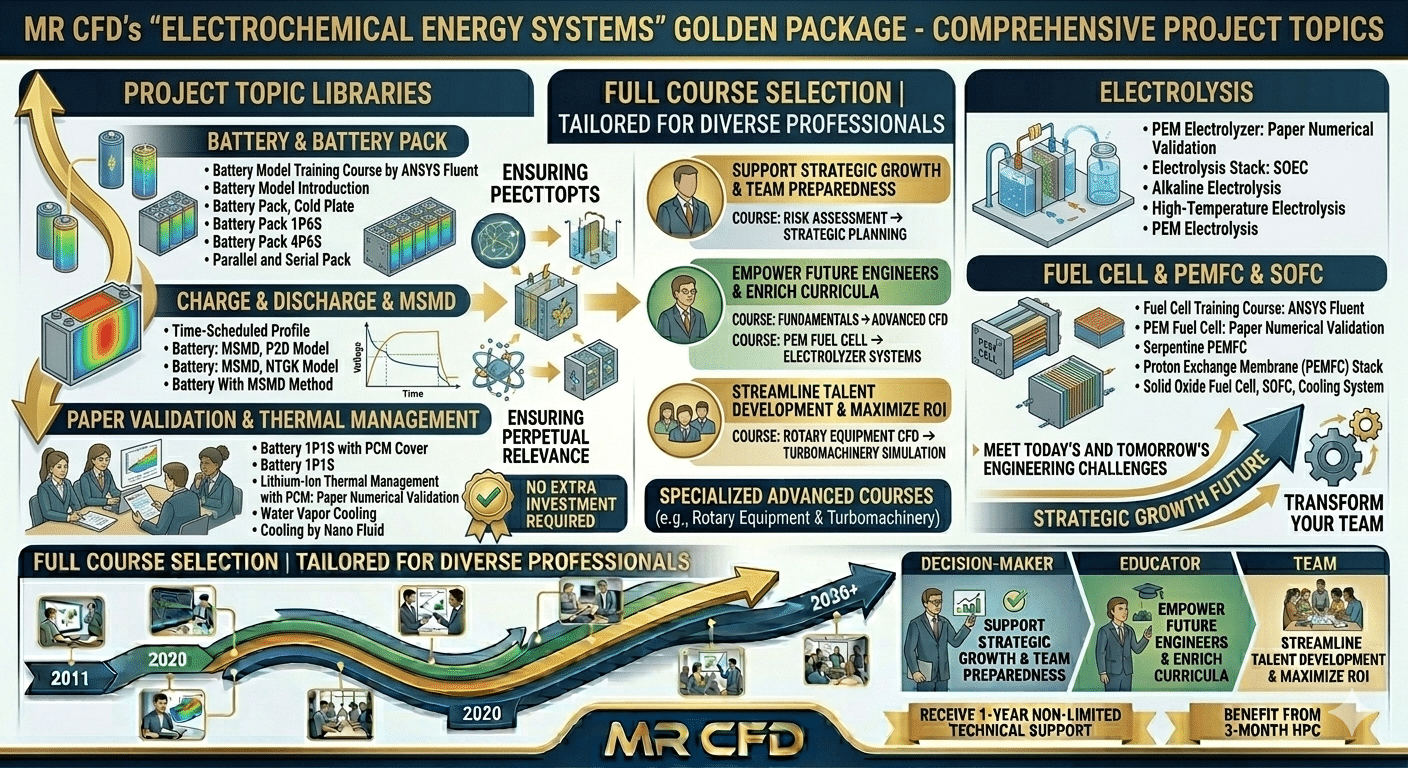
Battery CFD Simulation: Fundamentals, Pack Modeling, and MSMD Methods
This module establishes the complete foundation of battery CFD simulation using ANSYS Fluent, beginning with introductory concepts and progressing through production-level battery pack modeling. Students learn the physical principles governing heat generation in lithium-ion battery cells, including ohmic, electrochemical, and entropic heating mechanisms. Projects include battery pack configurations such as 1P6S, 4P6S, parallel and serial arrangements, and virtual connection setups, providing direct exposure to the geometric and thermal complexity encountered in real EV battery modules. The Pack Builder module is covered in detail, equipping engineers with the skills to construct and simulate scalable multi-cell assemblies. This module is directly applicable to electric vehicle battery system design, stationary energy storage engineering, and consumer electronics thermal management.
MSMD Battery Modeling: P2D, ECM, and NTGK Sub-Models
The Multi-Scale Multi-Domain (MSMD) battery model represents the most rigorous electrochemical simulation framework available within ANSYS Fluent. This module provides deep technical training on all three primary MSMD sub-models: the P2D (Pseudo-Two-Dimensional) electrochemical model, the ECM (Equivalent Circuit Model) for computationally efficient pack-level simulation, and the NTGK model for empirically calibrated charge/discharge behavior. Students simulate time-scheduled charge and discharge profiles, capturing dynamic electrochemical responses under realistic operating cycles. The engineering significance of this module extends to battery management system (BMS) validation, state-of-health prediction, and safety-critical thermal runaway analysis—skills in high demand across the EV and energy storage industries.
Battery Thermal Management: PCM Cooling, Nanofluid, and Water Vapor Systems
Effective battery thermal management is a safety-critical engineering discipline, and this module addresses it with exceptional technical breadth. Students simulate phase change material (PCM) cooling for both 1P1S and multi-cell configurations, including a rigorous paper numerical validation project that benchmarks simulation results against published experimental data. Additional projects cover nanofluid-enhanced heat transfer for battery cooling, water vapor cooling systems, and cold plate thermal management for battery packs. Each simulation develops the student’s ability to evaluate thermal performance metrics—peak temperature, temperature uniformity, and heat dissipation rate—that directly govern battery cycle life and safety margins.
Electrolysis CFD Simulation: PEM, Alkaline, SOEC, and High-Temperature Systems
This module delivers comprehensive training in electrolysis CFD simulation, covering the three primary electrolyzer technologies deployed in industrial hydrogen production. The PEM electrolyzer simulation includes a full paper numerical validation project, ensuring students can reproduce and critically evaluate published research results. Alkaline electrolysis CFD modeling addresses the distinct ionic transport and bubble evolution phenomena characteristic of this mature technology. The SOEC (Solid Oxide Electrolysis Cell) module introduces high-temperature electrochemical modeling, requiring students to configure thermal boundary conditions, ionic conductivity parameters, and reforming reaction kinetics. The high-temperature electrolysis project extends this capability to emerging next-generation hydrogen production systems. These simulations are directly applicable to green hydrogen engineering, Power-to-X technology development, and industrial electrochemical process optimization.
PEMFC Fuel Cell CFD Simulation: Stack, Serpentine, and Radial Configurations
Proton Exchange Membrane Fuel Cell (PEMFC) CFD simulation is one of the most technically demanding topics in electrochemical engineering, and this module addresses it with the depth it requires. Students begin with foundational fuel cell concepts in ANSYS Fluent before progressing to full PEMFC stack system simulations. Dedicated projects cover serpentine flow channel PEMFC and radial PEMFC geometries, enabling direct comparison of flow field designs and their impact on current density uniformity and water management. Two independent paper numerical validation projects—covering both single-cell PEMFC and stack configurations—ensure that students develop the critical ability to validate their simulation methodology against peer-reviewed experimental benchmarks. This module is essential for engineers working in hydrogen mobility, stationary fuel cell power systems, and aerospace auxiliary power unit development.
SOFC Solid Oxide Fuel Cell CFD Simulation and Cooling System Design
The Solid Oxide Fuel Cell (SOFC) CFD simulation module addresses the unique multi-physics challenges of high-temperature electrochemical power generation. Students model the coupled ionic transport, fuel reforming reactions, and thermal stress distributions that govern SOFC performance and durability. A dedicated SOFC cooling system simulation project develops the engineering skills required to design thermal management solutions that maintain structural integrity and electrochemical efficiency at operating temperatures exceeding 800°C. This module is directly relevant to distributed power generation, industrial combined heat and power (CHP) systems, and next-generation clean energy infrastructure.
Professional Engineering Skills You Will Develop
| Skill Category | Specific Competencies |
|---|---|
| CFD Simulation Skills | ANSYS Fluent electrochemical solver setup, multi-physics coupling, HPC workflow execution |
| Battery Engineering | MSMD modeling, PCM thermal management, pack-level thermal analysis, charge/discharge simulation |
| Fuel Cell Engineering | PEMFC/SOFC species transport, water management, polarization curve validation |
| Electrolysis Engineering | PEM/alkaline/SOEC electrolyzer modeling, hydrogen production efficiency analysis |
| Validation & Verification | Paper numerical validation, mesh independence, convergence analysis |
| Post-Processing | Temperature contours, current density maps, species concentration fields, pressure drop analysis |
| Industry Workflows | Geometry creation, structured/unstructured meshing, solver configuration, report generation |
Real-World Industrial Applications of Electrochemical Energy Systems CFD
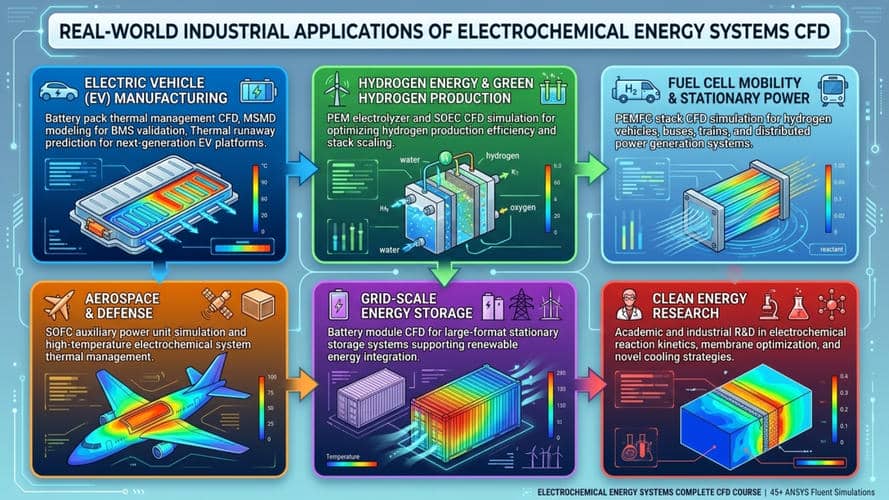
The simulation competencies developed in this course map directly onto active engineering challenges across multiple high-growth industries:
- Electric Vehicle (EV) Manufacturing: Battery pack thermal management CFD, MSMD modeling for BMS validation, and thermal runaway prediction for next-generation EV platforms
- Hydrogen Energy & Green Hydrogen Production: PEM electrolyzer and SOEC CFD simulation for optimizing hydrogen production efficiency and stack scaling
- Fuel Cell Mobility & Stationary Power: PEMFC stack CFD simulation for hydrogen vehicles, buses, trains, and distributed power generation systems
- Aerospace & Defense: SOFC auxiliary power unit simulation and high-temperature electrochemical system thermal management
- Grid-Scale Energy Storage: Battery module CFD for large-format stationary storage systems supporting renewable energy integration
- Clean Energy Research: Academic and industrial R&D in electrochemical reaction kinetics, membrane optimization, and novel cooling strategies
Who Should Enroll in This Electrochemical Energy Systems Complete CFD Course
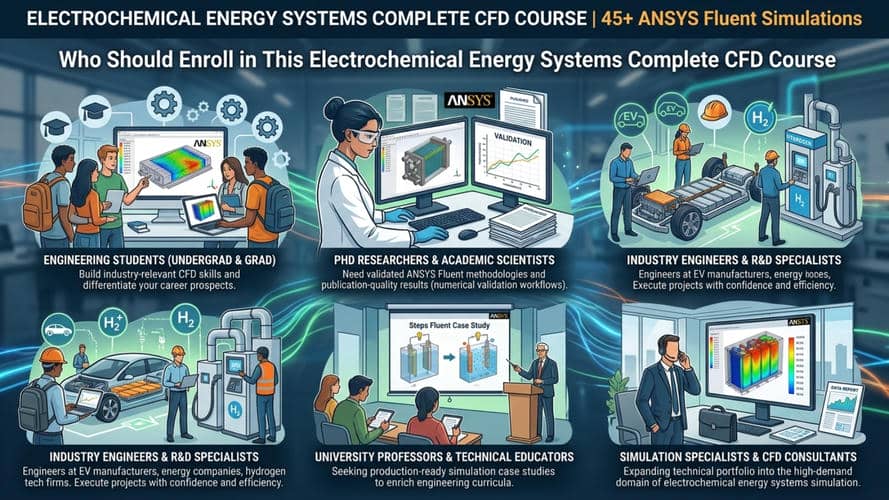
This course is precisely engineered for the following professional profiles:
- Mechanical, Chemical & Electrical Engineering Students: Undergraduate and graduate students seeking to build industry-relevant electrochemical CFD simulation skills that differentiate their academic profile and career prospects
- PhD Researchers & Academic Scientists: Researchers requiring validated ANSYS Fluent simulation methodologies for battery, fuel cell, or electrolysis studies, including paper numerical validation workflows for publication-quality results
- Industry Engineers & R&D Specialists: Engineers at EV manufacturers, energy companies, hydrogen technology firms, and aerospace organizations who need to execute electrochemical energy systems CFD projects with confidence and efficiency
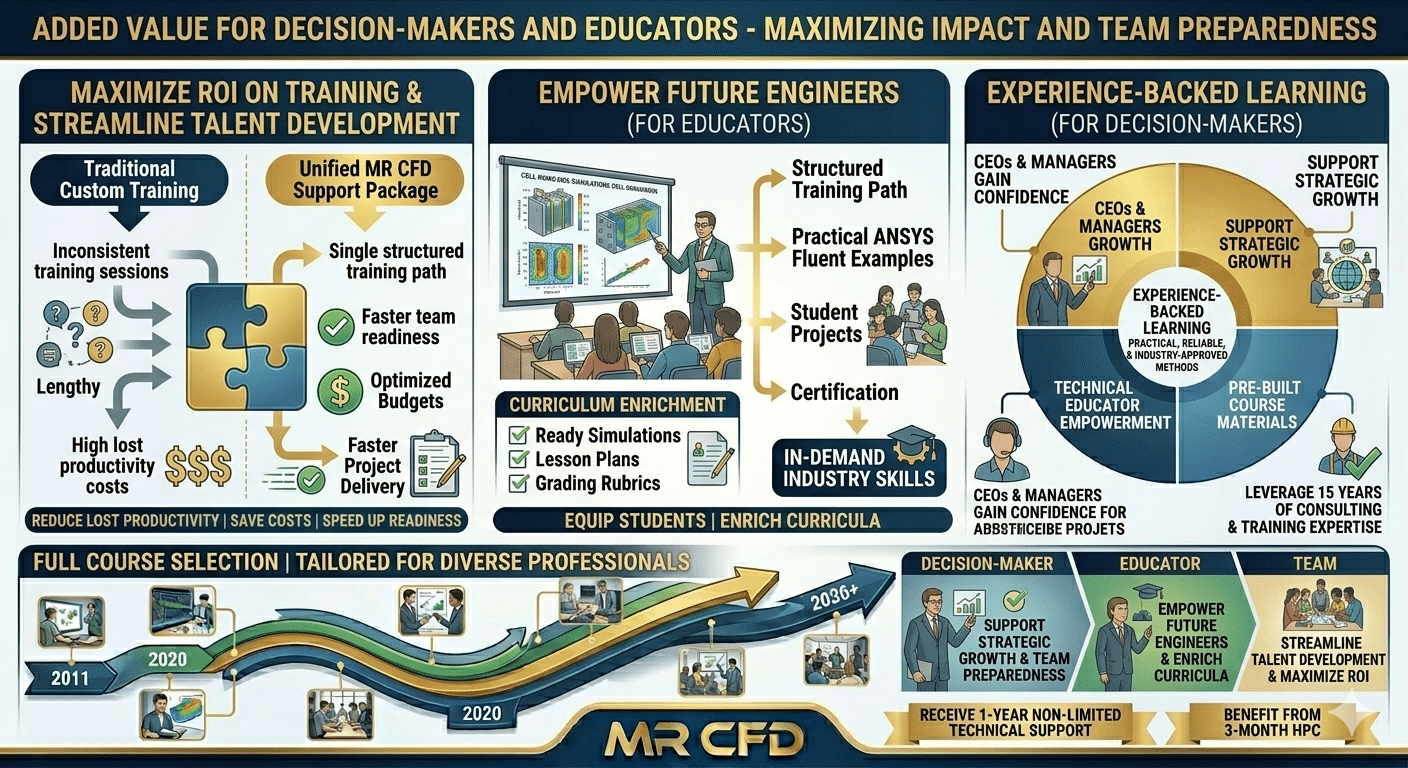
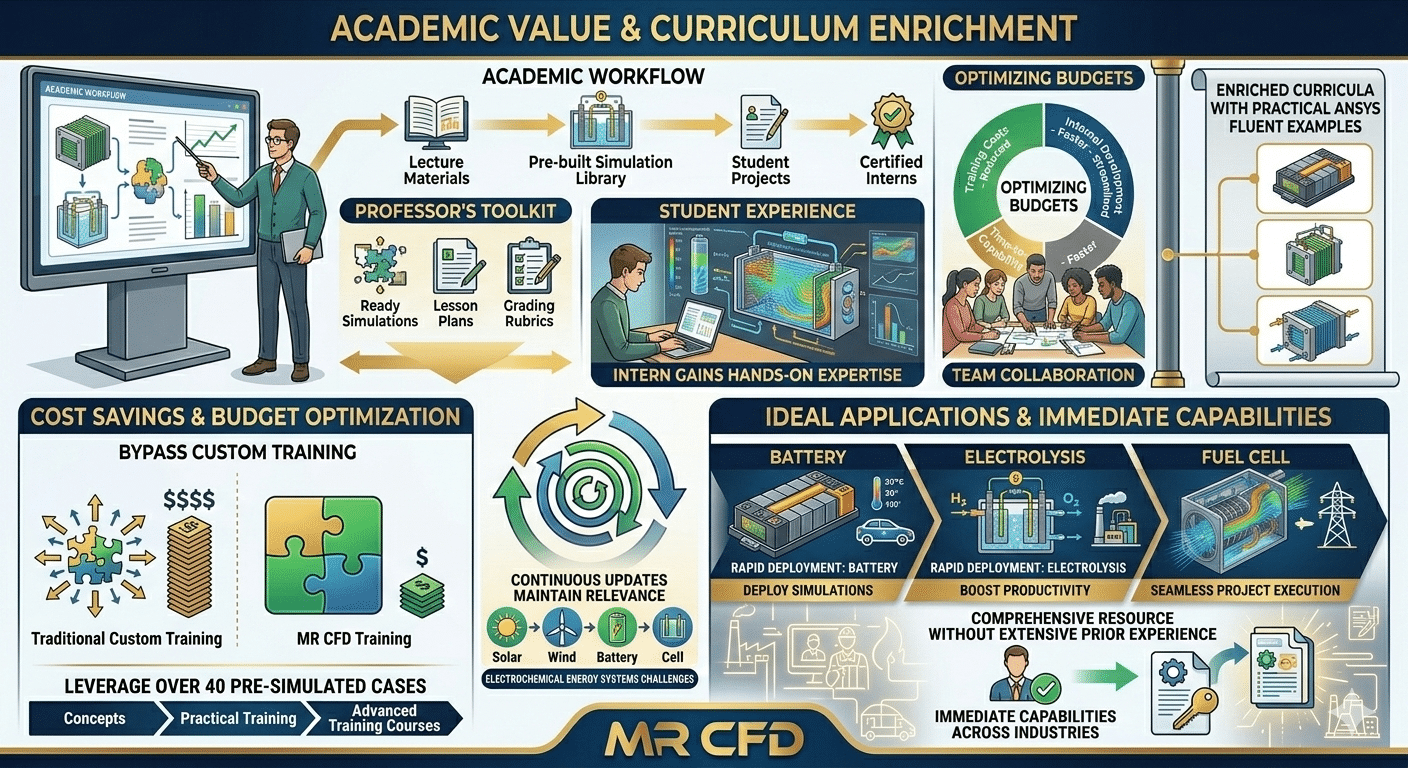
- University Professors & Technical Educators: Academics seeking production-ready simulation case studies to enrich engineering curricula with practical ANSYS Fluent electrochemical examples
- Simulation Specialists & CFD Consultants: Professionals expanding their technical portfolio into the high-demand domain of electrochemical energy systems simulation
Why MR CFD Delivers Unmatched Electrochemical Simulation Training
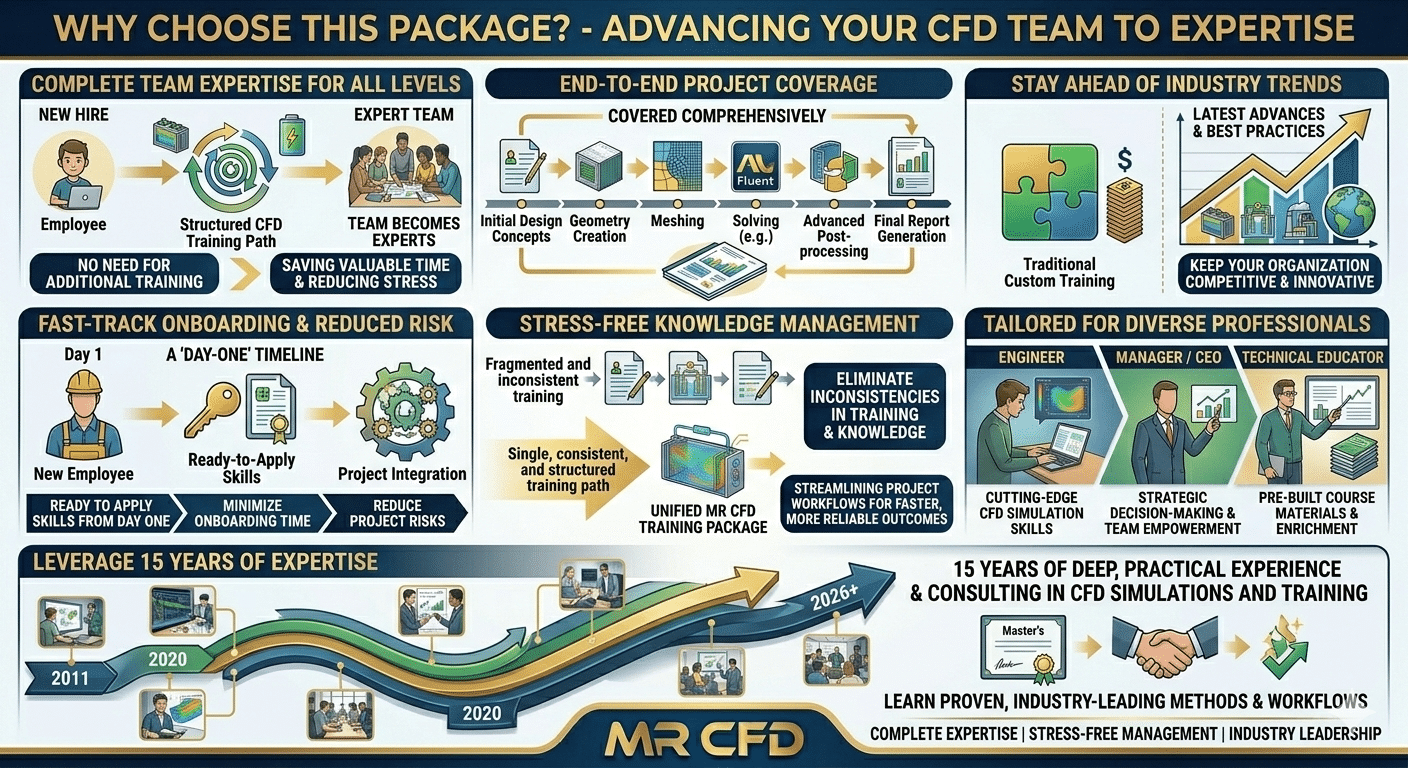
MR CFD brings over 15 years of specialized CFD consulting and engineering education expertise to every course in its catalog. This is not generic software training—every project in this course reflects production-grade simulation methodology developed through real industrial consulting engagements.
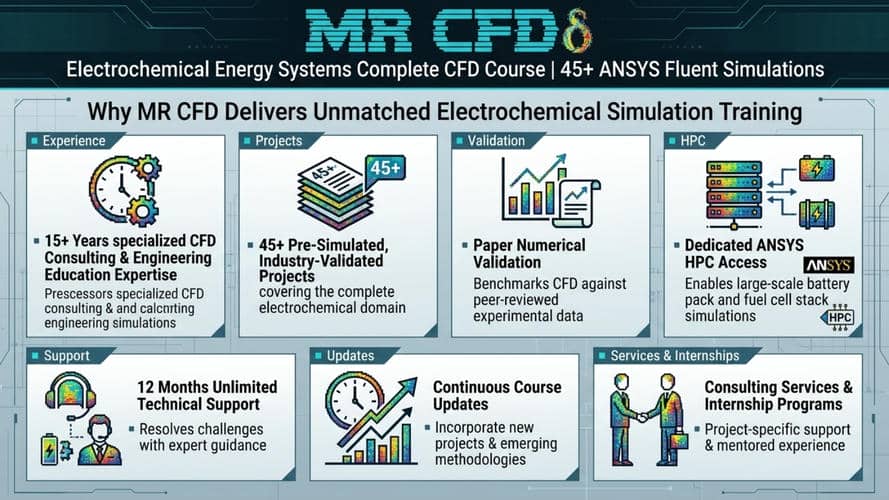
Key differentiators of this training program include:
- 45+ fully pre-simulated, industry-validated projects covering the complete electrochemical energy systems domain
- Paper numerical validation projects that teach engineers how to benchmark their CFD results against peer-reviewed experimental data—a critical professional skill
- Dedicated ANSYS HPC access included with enrollment, enabling large-scale battery pack and fuel cell stack simulations that exceed standard desktop computing capacity
- 12 months of unlimited technical support from MR CFD’s specialist engineering team, ensuring that every simulation challenge is resolved with expert guidance
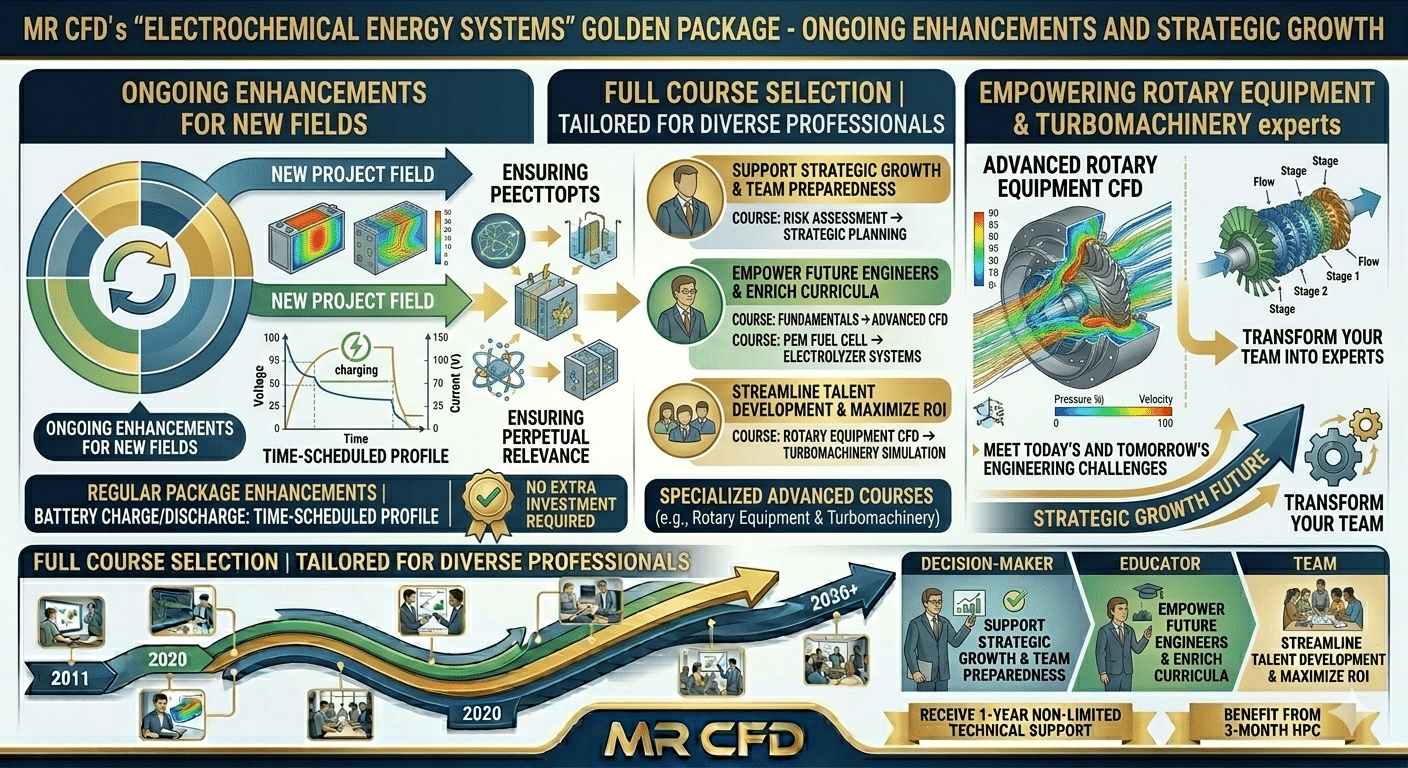
- Continuous course updates that incorporate new project fields and emerging electrochemical simulation methodologies as the technology landscape evolves
- Access to CFD Consulting Services for organizations requiring project-specific simulation support beyond the course framework
- CFD Internship programs for students and early-career engineers seeking structured, mentored simulation experience
Learning Progression and Recommended Next Steps in Electrochemical CFD
This course is structured as a complete vertical learning path from foundational concepts to advanced multi-physics simulation:
| Level | Focus Areas |
|---|---|
| Beginner | Battery model introduction, CFD simulation concepts, basic fuel cell and electrolysis fundamentals |
| Intermediate | Battery pack configurations, PEMFC flow field simulation, PEM electrolyzer modeling, PCM thermal management |
| Advanced | MSMD sub-model implementation, SOFC cooling system design, paper numerical validation, HPC-enabled pack simulation |
Upon completing this course, engineers are well-positioned to pursue advanced training in electrochemical impedance spectroscopy (EIS) modeling, degradation and aging simulation for battery and fuel cell systems, and system-level multi-physics optimization. Exploring the full CFD training course catalog at MR CFD will reveal complementary programs in heat transfer, multiphase flow, and reactive flow simulation that further strengthen an electrochemical engineering simulation practice.
Enroll in the Electrochemical Energy Systems Complete CFD Course and Advance Your Engineering Practice
The engineering challenges surrounding battery thermal management, hydrogen production via electrolysis, and fuel cell system optimization are defining the trajectory of the global energy transition. The engineers and researchers who can simulate these systems with precision using validated ANSYS Fluent electrochemical CFD methodologies—will be the ones driving that transition forward.
This Electrochemical Energy Systems Complete CFD Course provides the structured, technically rigorous, and industrially validated training pathway required to reach that level of competency. With 45+ simulation projects, expert technical support, HPC access, and a curriculum built on 15 years of real-world CFD consulting experience, MR CFD delivers a training investment with measurable, lasting engineering value.
Enroll today through the CFD training course portal and begin building the electrochemical energy systems CFD simulation expertise that modern energy engineering demands.
You must be logged in to post a review.

 Talk On WhatsApp
Reviews
There are no reviews yet.