
Rotary Equipment and Turbomachinery GOLDEN Training Package: +155 Simulations (All in One Course)
$1,499.00 Internship
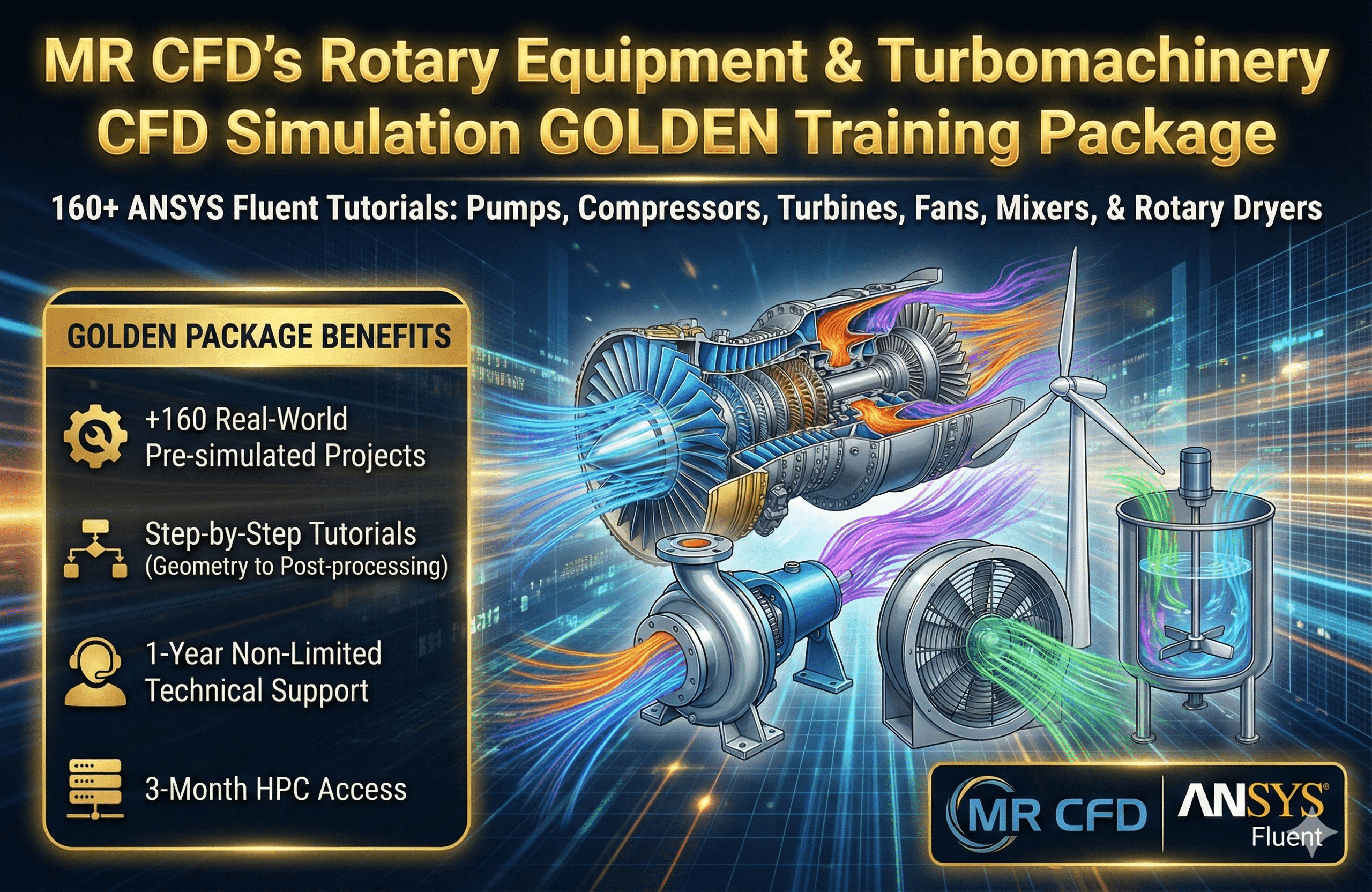
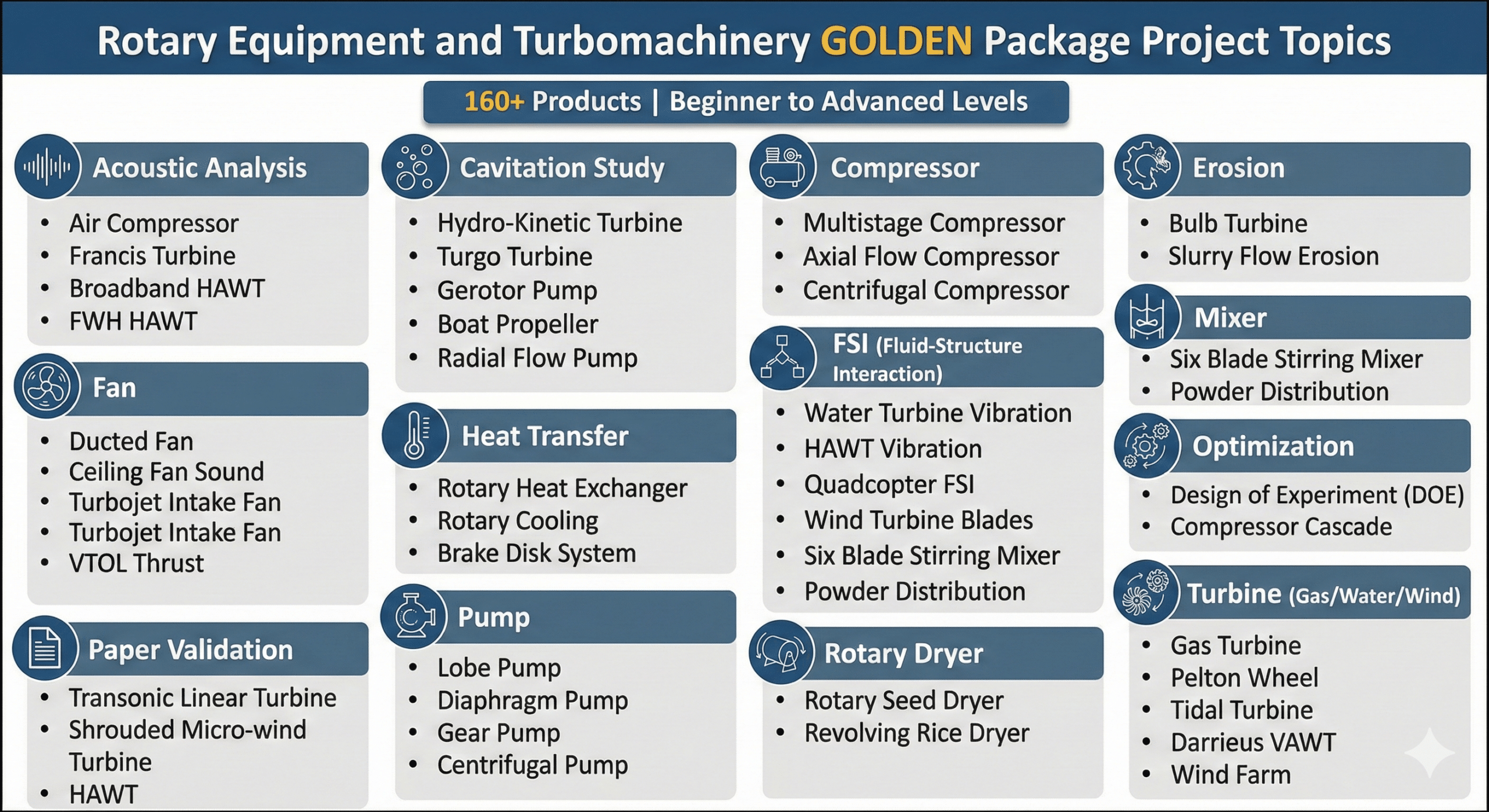
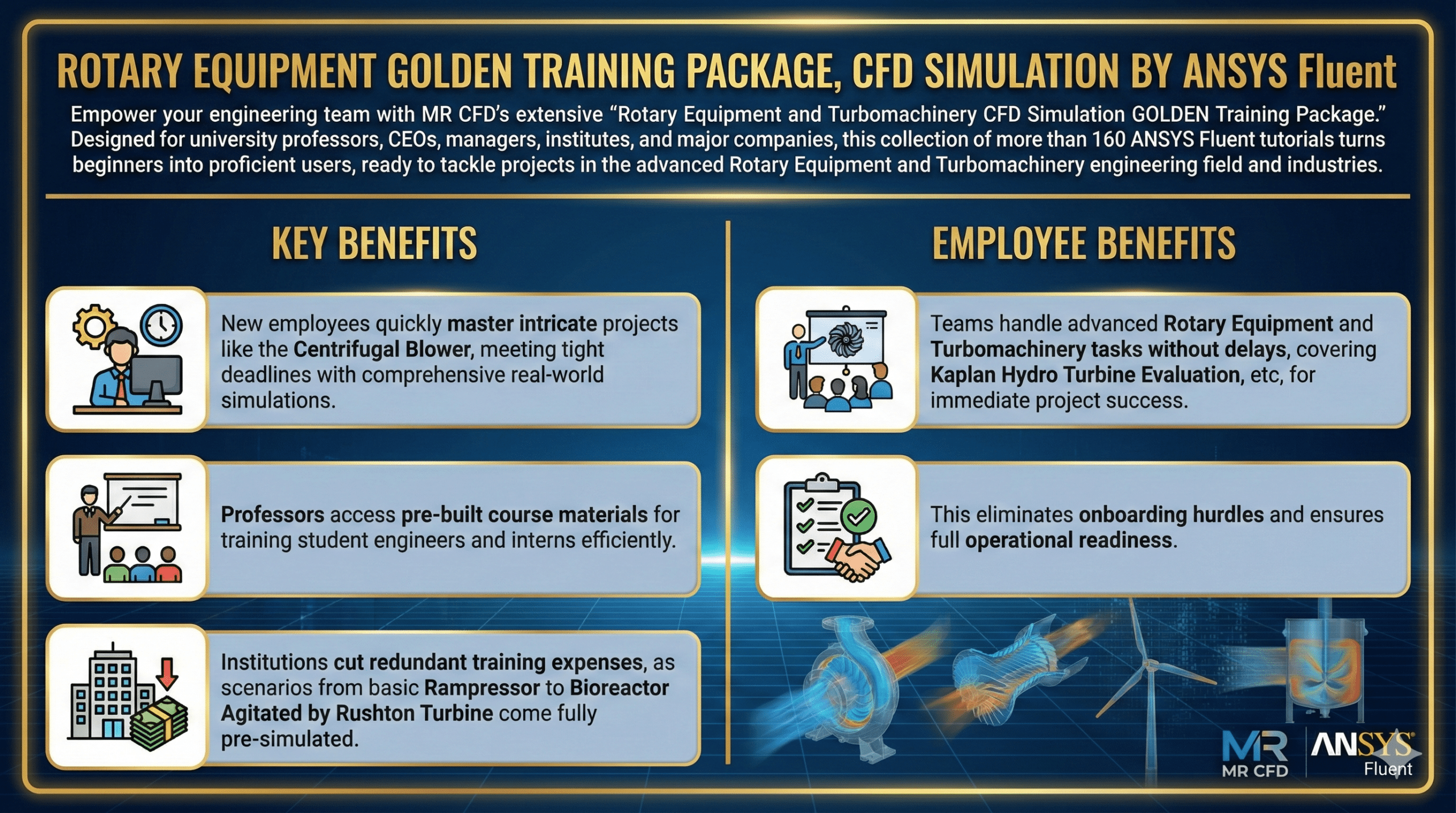
MR CFD’s Rotary Equipment & Turbomachinery CFD Simulation GOLDEN Training Package offers 160+ ANSYS Fluent tutorials on pumps, compressors, turbines (gas, water, wind), fans, mixers, and rotary dryers—ideal for professors, managers, and companies upskilling teams in turbomachinery design.
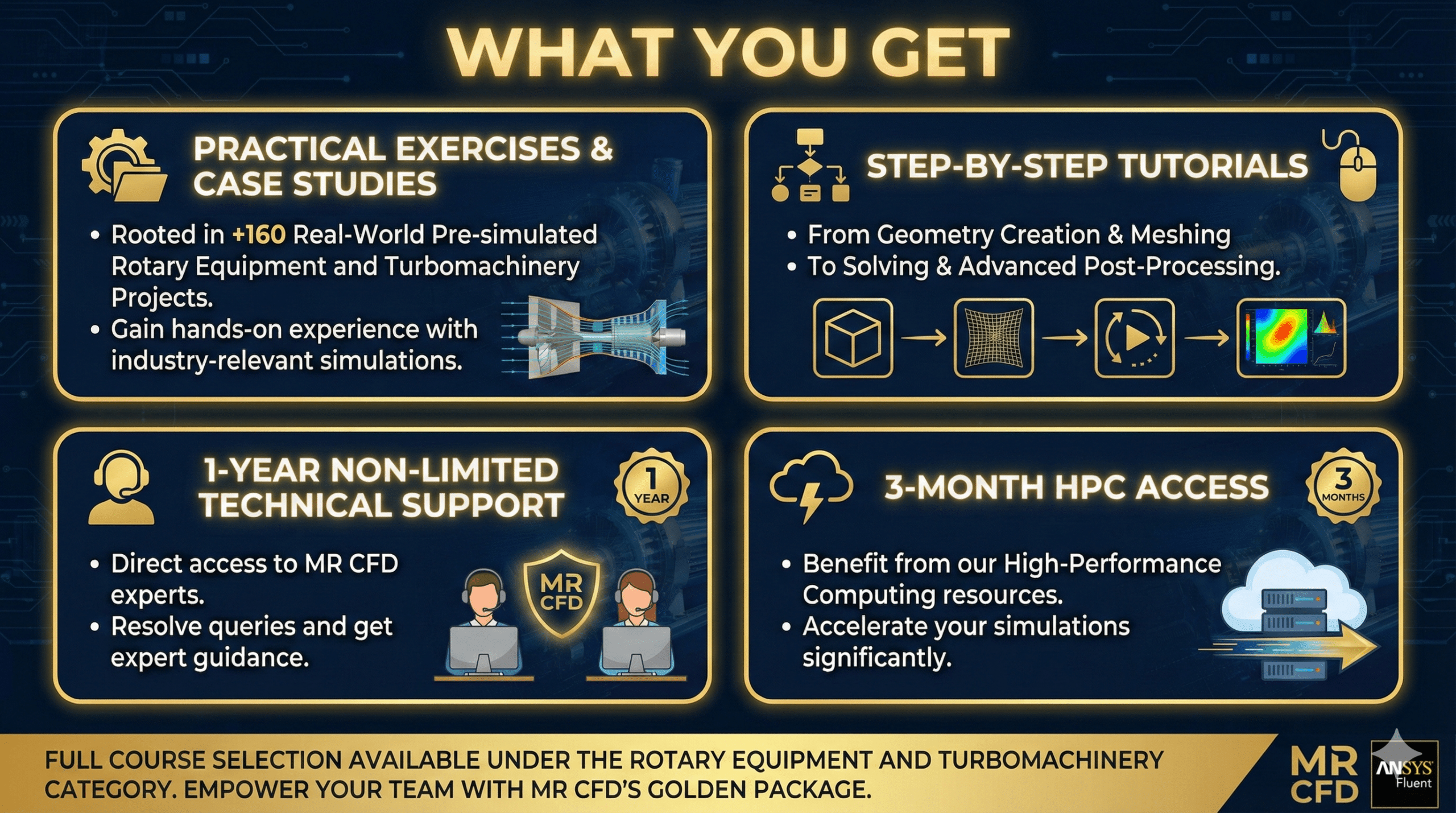
- Practical exercises and case studies rooted in real-world +160 pre-simulated Rotary Equipment and Turbomachinery projects.
- Step-by-step tutorials from geometry creation, meshing, solving, and advanced post-processing.
- While you obtain the Golden Package, you will receive non-limited 1-year technical support from MR CFD experts.
- By purchasing this Golden package, you can benefit from our 3-month HPC.
To Order Your Project or benefit from a CFD consultation, contact our experts via email (info@mr-cfd.com), online support tab, or WhatsApp at +44 7443 197273.
There are some Free Products to check our service quality.
If you want the training video in another language instead of English, ask it via info@mr-cfd.com after you buy the product.
Description
Complete CFD Course on Rotary Equipment & Turbomachinery
The global energy transition, the relentless pursuit of mechanical efficiency, and the accelerating complexity of industrial machinery have placed turbomachinery CFD simulation at the absolute center of modern engineering practice. Whether the objective is designing a more efficient centrifugal compressor for a gas processing plant, optimizing a horizontal axis wind turbine for a renewable energy farm, or extending the service life of a centrifugal pump operating under cavitating conditions, the ability to simulate rotating equipment with precision is no longer optional — it is a core professional competency.
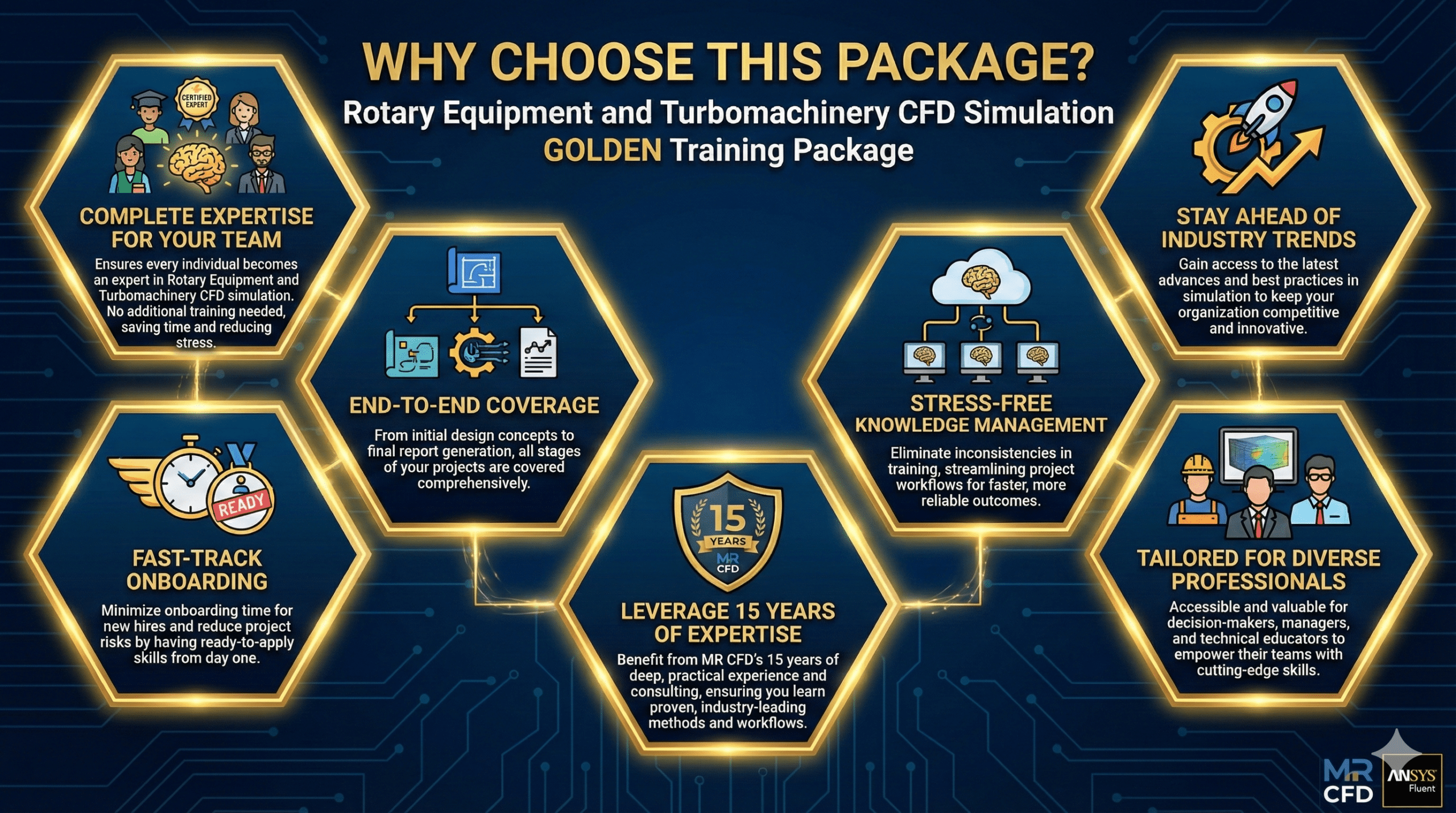
MR CFD presents this Complete CFD Course on Rotary Equipment and Turbomachinery, a rigorously structured, production-grade training program encompassing 155+ ANSYS Fluent simulation projects spanning the full spectrum of rotating machinery engineering. As one of the most expansive CFD Training Courses and CFD Complete Courses available for turbomachinery professionals globally, this program delivers structured progression from foundational rotating domain setup to advanced multi-physics simulations involving Fluid-Structure Interaction (FSI), aeroacoustics, cavitation, erosion modeling, and Design of Experiment (DOE)-based optimization. Engineers, researchers, and academic institutions enrolling in this course gain not just theoretical exposure, but verified, deployable simulation workflows grounded in 15 years of MR CFD consulting and engineering expertise.
The Engineering Imperative Behind Rotary Equipment & Turbomachinery CFD Simulation
Turbomachinery represents the mechanical backbone of global energy infrastructure. Gas turbines power aircraft engines and electricity grids. Centrifugal pumps circulate fluids across oil refineries, water treatment plants, and pharmaceutical facilities. Wind turbines — both horizontal axis (HAWT) and vertical axis (VAWT) — convert atmospheric kinetic energy into electrical power at utility scale. Hydraulic turbines such as the Francis turbine, Pelton wheel, and Kaplan hydro turbine extract energy from waterways, forming the cornerstone of renewable hydropower generation.
The engineering challenge inherent to all rotating equipment lies in the extreme complexity of internal flow physics. Phenomena including rotating stall, surge, cavitation, tip leakage vortices, rotor-stator interaction, aeroacoustic noise generation, and blade fatigue under unsteady aerodynamic loading cannot be adequately characterized through analytical methods or simplified experimental approaches alone. Computational fluid dynamics (CFD) using ANSYS Fluent provides the resolution, physical fidelity, and parametric flexibility required to capture these phenomena accurately — enabling engineers to optimize performance, extend equipment life, and reduce development risk before any physical prototype is manufactured.
Industry demand for engineers proficient in rotating machinery ANSYS Fluent simulation is accelerating across energy, aerospace, automotive, marine, and process industries. This course directly addresses that demand with a structured, comprehensive, and immediately applicable training framework.
Technical Core Competencies Developed Through Rotary Equipment CFD Training
This course builds a rigorous, multi-layered turbomachinery CFD simulation skill set. Upon completion, engineers will be proficient across the following technical domains:
Rotating Domain Modeling & Solver Configuration
- Moving Reference Frame (MRF) method setup for steady-state turbomachinery analysis
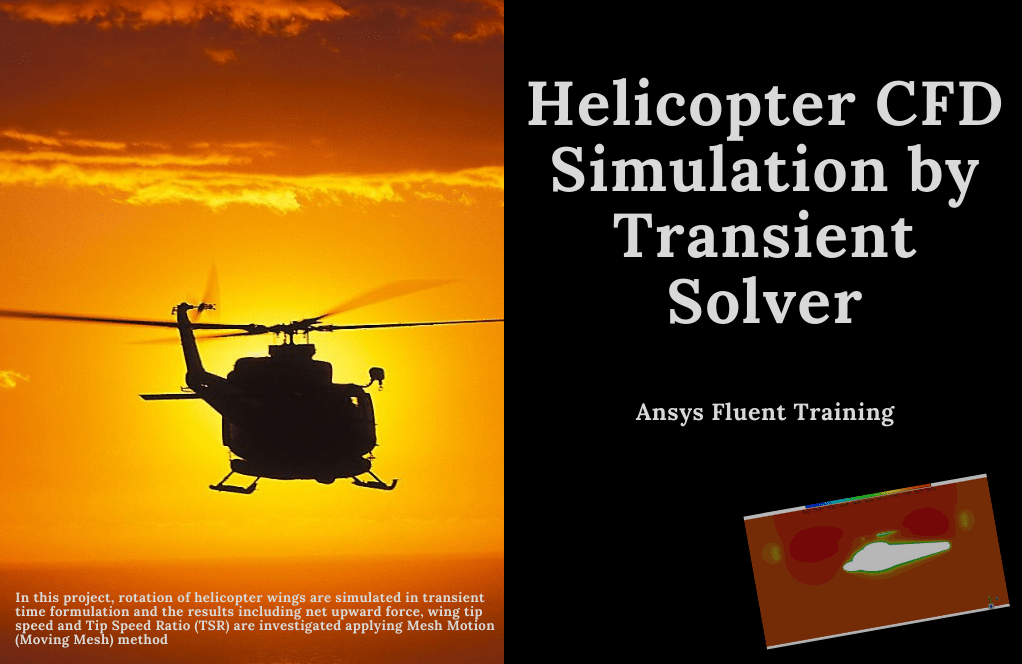
- Dynamic mesh and mesh motion configuration for transient rotating simulations
- 6DOF solver implementation for free-motion turbine studies
- Rotor-stator interface definition and sliding mesh methodology
- Angular velocity boundary condition specification and frame transformation
Turbulence, Multiphase & Acoustic Physics
- k-omega SST turbulence model application for blade boundary layer resolution
- Large Eddy Simulation (LES) for high-fidelity aeroacoustic turbomachinery analysis
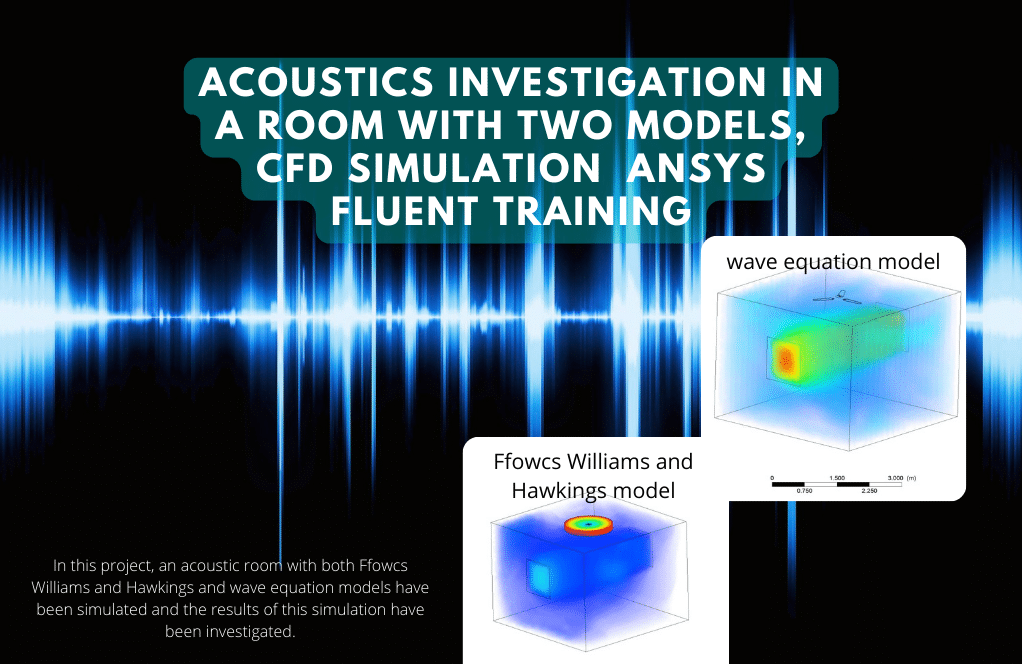
- Ffowcs Williams–Hawkings (FW-H) acoustic model for fan and wind turbine noise prediction
- Cavitation modeling using Schnerr-Sauer and Zwart-Gerber-Belamri frameworks
- Discrete Phase Model (DPM) for particle-laden flows in rotary dryers and separators
- Multiphase mixture model for centrifuge and slurry pump simulations
Fluid-Structure Interaction & Structural Coupling
- One-way and two-way FSI methodology for turbine blade deformation and vibration analysis
- Aerodynamic loading extraction and structural stress mapping
- Quadcopter and drone propeller FSI simulation workflows
Optimization & Validation
- Design of Experiment (DOE) setup and response surface generation in ANSYS Fluent
- Multi-Objective Genetic Algorithm (MOGA) application for compressor cascade optimization
- Response Surface Methodology (RSM) for design space exploration
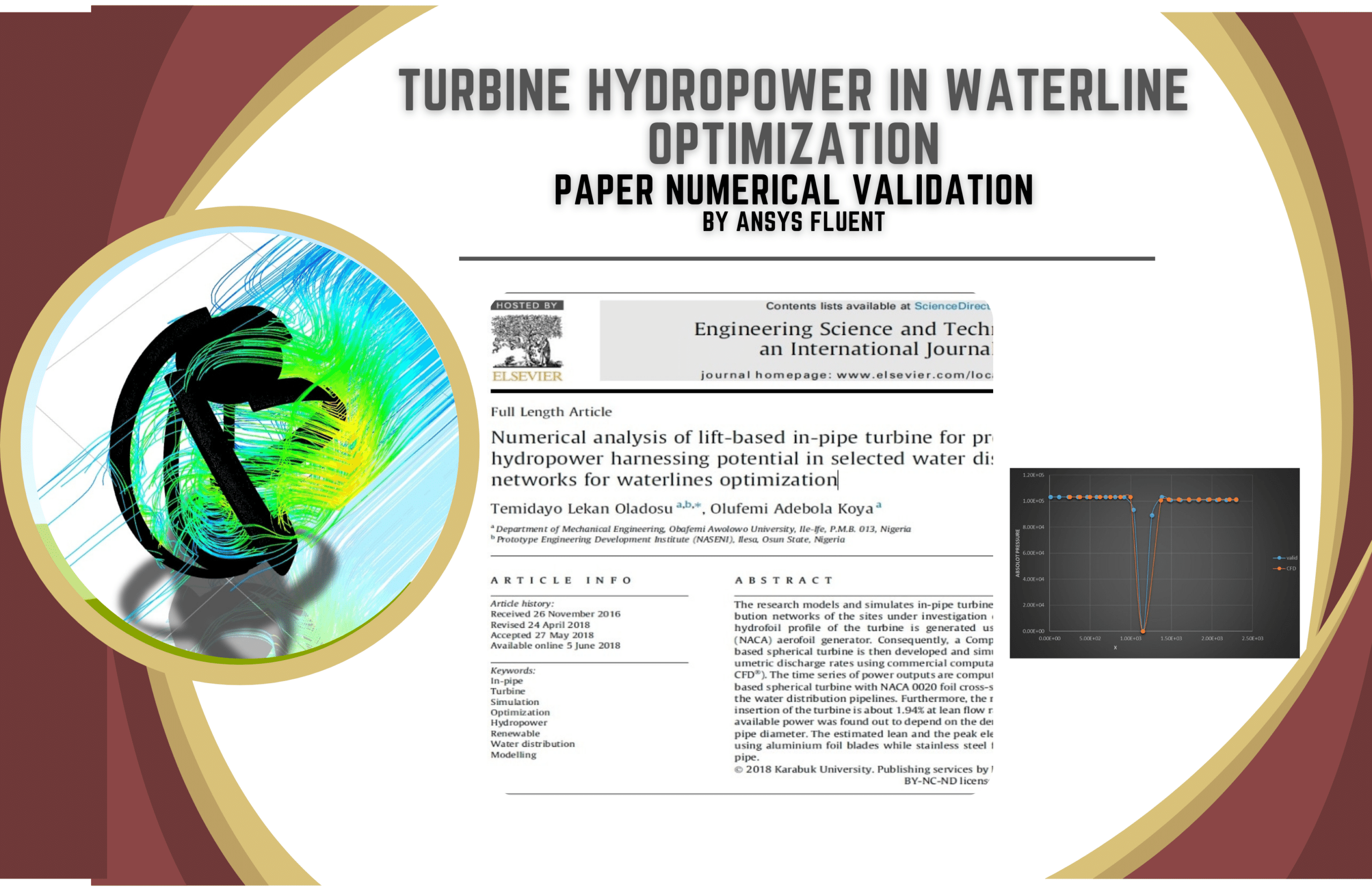
- Paper validation workflows against published experimental and numerical benchmarks
Comprehensive Course Modules & Simulated Engineering Projects
Centrifugal & Axial Pump CFD Simulation Using MRF and Mesh Motion
This module delivers complete training in centrifugal pump CFD simulation using both the Moving Reference Frame (MRF) and mesh motion approaches in ANSYS Fluent. Engineers work through 2D and 3D pump geometries, configuring rotating impeller domains, volute casing interfaces, and outlet pressure boundary conditions. Projects include gear pump (external and internal), lobe pump, diaphragm pump, ram pump, and radial flow pump configurations. The module also addresses slurry flow erosion in centrifugal pumps, applying particle injection and wall erosion models to quantify material loss rates under abrasive operating conditions — a critical concern in mining, dredging, and chemical processing industries.
Gas Turbine Combustion & Performance CFD Analysis
The gas turbine module covers the full thermodynamic and combustion simulation workflow for gas turbine CFD analysis. Projects include multi-stage axial gas turbine performance characterization, gas turbine intake analysis with and without fogging systems, and detailed combustion chamber CFD simulations using diesel fuel, methane-air mixtures, and kerosene flame configurations. The soot formation model is applied to a kerosene-fueled gas turbine combustor, providing engineers with the capability to assess emissions compliance and combustion efficiency — directly applicable to aerospace propulsion and industrial power generation design workflows.
Wind Turbine Aerodynamics & Aeroacoustic CFD Simulation (HAWT & VAWT)
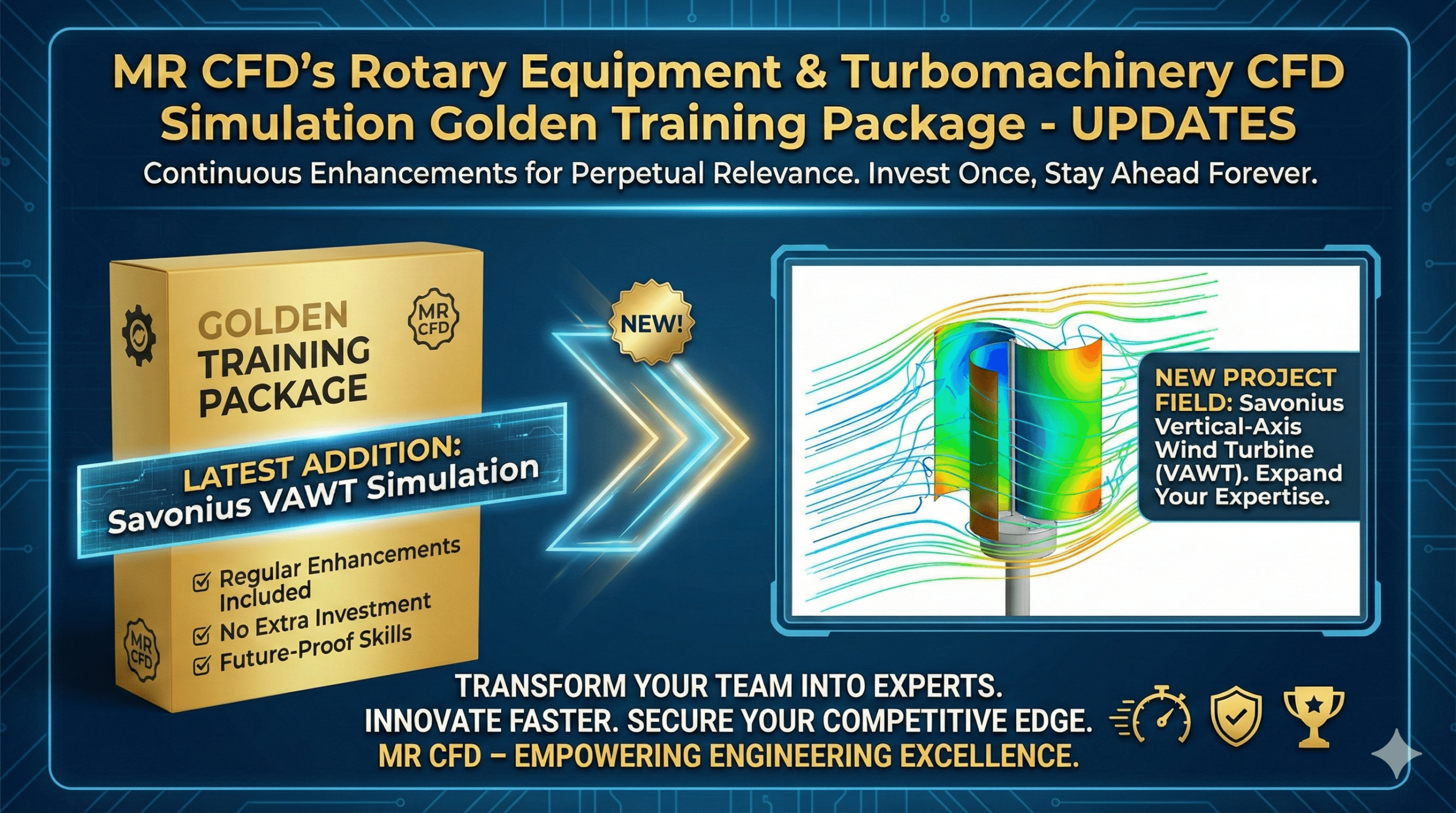
This extensive module addresses both horizontal axis wind turbine (HAWT) and vertical axis wind turbine (VAWT) simulation across multiple methodologies. Engineers simulate Darrieus VAWT configurations using dynamic mesh and 6DOF solvers, compare serrated versus plain airfoil profiles for noise reduction, and analyze duct effects on HAWT aerodynamic performance. The Ffowcs Williams–Hawkings (FW-H) acoustic model is applied for broadband noise investigation, and Fluid-Structure Interaction studies quantify blade deformation and fatigue loading under realistic wind loading conditions. Wind farm wake interaction using series arrangement configurations is also simulated, providing direct applicability to utility-scale wind energy project development.
Hydraulic Turbine CFD Simulation — Francis, Pelton, Kaplan & Archimedes Screw
Hydraulic turbine simulations in this module span the complete range of hydropower technologies. Francis turbine CFD projects examine internal spiral casing flow, runner passage hydraulics, and draft tube performance using MRF and transient mesh motion. Pelton wheel turbine simulations apply free-surface multiphase modeling to characterize jet impingement, bucket filling efficiency, and hydro-abrasive erosion under sediment-laden flow conditions. The Archimedes Screw Turbine (AST), Turgo turbine, bulb turbine, and hydro-kinetic turbine are also simulated, covering the breadth of low-head and micro-hydropower engineering applications increasingly relevant to decentralized energy systems.
Compressor CFD Simulation — Axial, Centrifugal & Multistage Configurations
Compressor simulation training covers axial flow compressor rotor analysis using the NASA Rotor 37 benchmark geometry, centrifugal compressor internal flow characterization, and multistage compressor configurations with 2-rotor and 2-stator row arrangements. Transonic flow phenomena, shock-boundary layer interactions, and compressor cascade optimization using DOE, MOGA, and RSM methodologies are fully covered. These projects provide direct engineering value for aerospace propulsion, gas processing, refrigeration system design, and industrial compressed air system development.
Fan Aerodynamics, Aeroacoustics & Thrust Analysis
Fan simulation projects address ducted fan noise and thrust characterization, ceiling fan sound generation comparing FW-H and wave equation acoustic models, turbojet intake fan acoustic analysis, and VTOL jet engine thrust force generation. Axial flow fan stage aerodynamic performance analysis completes this module, equipping engineers with the skills to design and evaluate industrial ventilation, HVAC, aerospace propulsion, and unmanned aerial vehicle propulsion systems with full aeroacoustic awareness.
Fluid-Structure Interaction (FSI) in Rotating Machinery
The dedicated FSI module for turbomachinery covers one-way and two-way coupling methodologies applied to HAWT wind turbine blade vibration, vertical axis water turbine structural response, and quadcopter propeller FSI analysis. Engineers learn to extract aerodynamic pressure loads from CFD solutions and transfer them to structural solvers, enabling quantification of blade deflection, von Mises stress distribution, and fatigue life estimation. This capability is directly applicable to wind turbine certification, marine propeller design, and UAV structural integrity assessment.
Mixer, Rotary Dryer & Separator CFD Simulation
This module addresses rotating equipment beyond conventional turbomachinery, including six-blade stirring mixer simulations, powder distribution in mixer using transient DPM modeling, side-entry mixing tank analysis at multiple rotational speeds, and Bioreactor agitated by Rushton turbine configurations. Rotary seed dryer and revolving rice dryer projects apply DPM and MRF methods to characterize particle residence time and drying efficiency. Well drilling mud and sand separator simulations complete the module, providing direct applicability to chemical processing, food engineering, pharmaceutical manufacturing, and oil and gas drilling operations.
CFD-Based Optimization of Turbomachinery Using DOE & Genetic Algorithms
This advanced module introduces systematic turbomachinery CFD optimization using ANSYS Fluent’s built-in optimization framework. Engineers implement Design of Experiment (DOE) to sample the design space, construct Response Surface Models (RSM) to approximate objective function behavior, and apply Multi-Objective Genetic Algorithm (MOGA) to identify Pareto-optimal compressor cascade blade geometries. Box-Behnken Design (BBD) is used for experimental plan construction, minimizing computational expense while maximizing design space coverage — a methodology directly transferable to industrial turbomachinery design optimization programs.
Professional Engineering Skills Developed Through Turbomachinery CFD Training
| Skill Category | Specific Competencies Acquired |
|---|---|
| CFD Simulation Skills | MRF setup, dynamic mesh, 6DOF solver, sliding mesh interface, FSI coupling |
| Turbulence Modeling | k-omega SST, LES, Realizable k-epsilon, near-wall treatment |
| Multiphase & Acoustic Physics | Cavitation, DPM, mixture model, FW-H acoustic model, wave equation |
| Combustion & Thermal Analysis | Species transport, combustion modeling, soot formation, rotary heat exchanger |
| Optimization & DOE | DOE, RSM, MOGA, BBD experimental design, design space exploration |
| Validation & Verification | Paper validation against experimental data, benchmark geometry replication |
| Post-Processing | Performance curves, pressure contours, velocity vectors, acoustic spectra, erosion maps |
| Industry Workflows | End-to-end geometry → mesh → solve → report pipeline in ANSYS Fluent |
Real-World Industrial Applications of Rotary Equipment CFD Simulation
The simulation capabilities developed through this course map directly onto high-value engineering challenges across multiple industries:
- Renewable Energy: Wind turbine aerodynamic optimization, HAWT/VAWT noise reduction, hydraulic turbine performance enhancement, tidal turbine hydrodynamic analysis
- Oil & Gas: Centrifugal pump cavitation and erosion prediction, multistage compressor performance, mud separator simulation, slurry flow erosion assessment
- Aerospace & Defense: Gas turbine combustion analysis, turbojet intake fan acoustics, VTOL thrust characterization, quadcopter FSI structural integrity
- Power Generation: Multi-stage axial gas turbine efficiency optimization, Francis and Pelton turbine hydraulic performance, Archimedes screw turbine for micro-hydro
- Process & Chemical Industry: Mixer and bioreactor agitation efficiency, rotary dryer particle residence time, separator performance under varying feed conditions
- HVAC & Ventilation: Axial fan stage performance, ducted fan noise characterization, ceiling fan aeroacoustic optimization
- Marine & Hydraulics: Boat propeller thrust analysis, water turbine FSI, tidal and hydro-kinetic turbine hydrodynamic performance
Who Should Enroll in This Complete Turbomachinery CFD Course
This course is engineered to deliver value across a broad spectrum of professional and academic profiles:
- Mechanical & Aerospace Engineering Students: Build industry-ready turbomachinery CFD simulation skills before entering the job market, with a portfolio of 155+ verified ANSYS Fluent projects
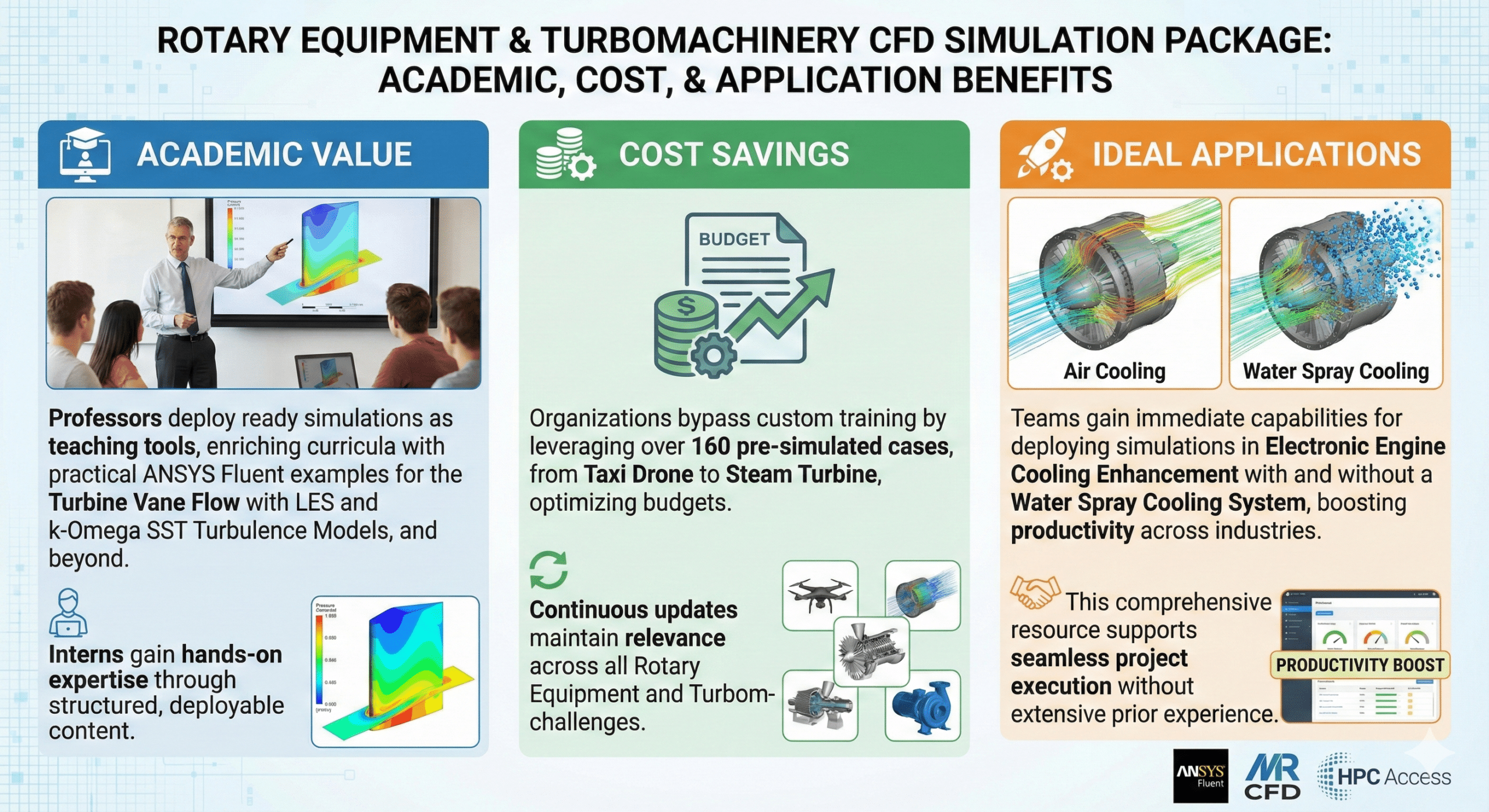
- PhD Researchers & Academic Staff: Access pre-validated simulation frameworks for turbine, pump, and compressor research; deploy structured tutorials as curriculum-ready teaching materials
- Industry CFD Engineers: Rapidly expand rotating machinery simulation capability across gas turbines, hydraulic turbines, compressors, and fans with production-grade project workflows
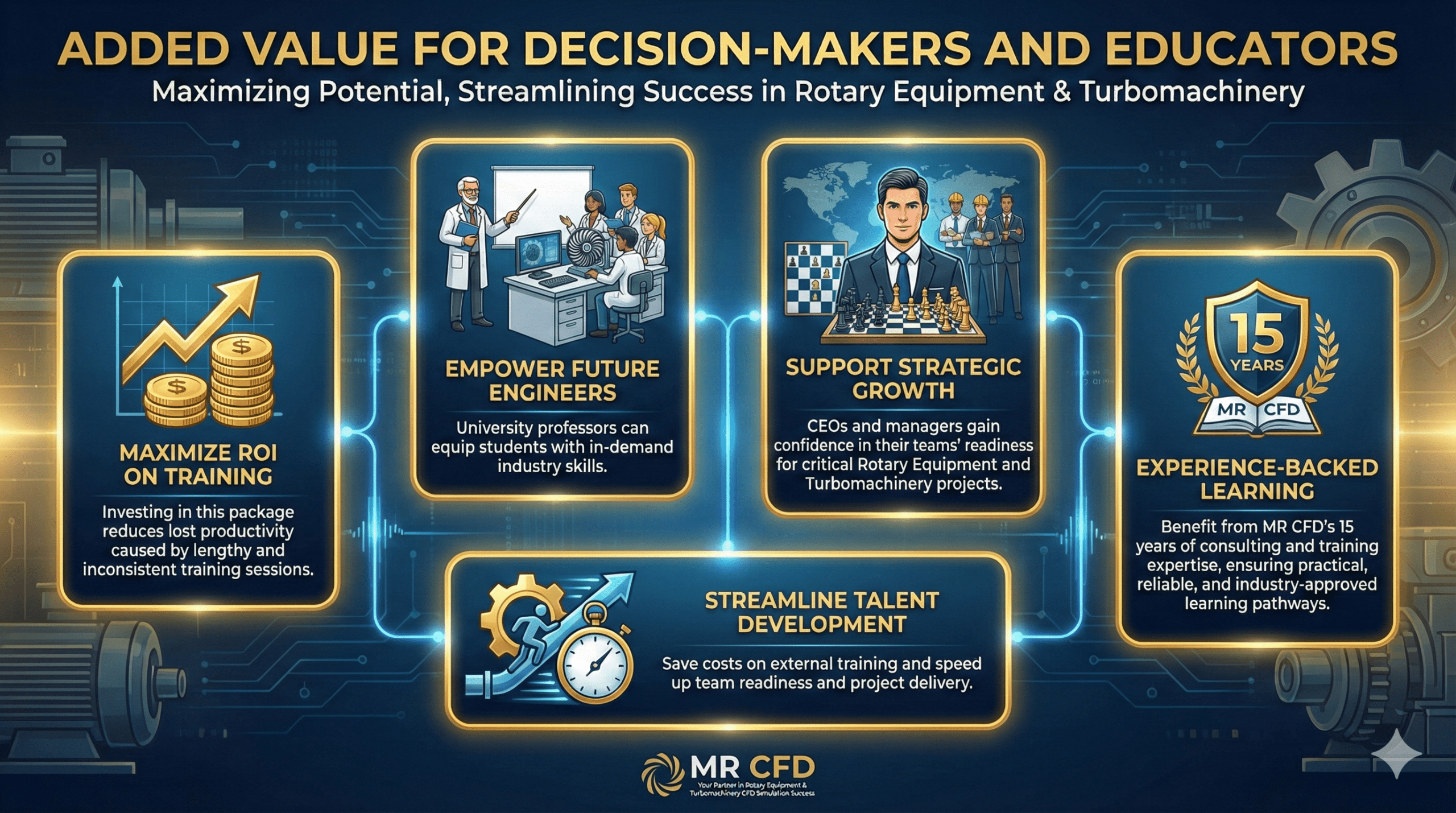
- Engineering Managers & Technical Directors: Equip entire engineering teams with standardized, verifiable rotary equipment CFD capability, eliminating inconsistent onboarding and reducing external training expenditure
- Simulation Specialists Transitioning to Turbomachinery: Leverage structured, physics-rich projects to develop domain-specific competency in rotating machinery ANSYS Fluent simulation efficiently
Engineering Progression Path: From Rotating Domain Fundamentals to Advanced Turbomachinery CFD
This course is structured to support engineers at every stage of their CFD simulation development:
| Level | Focus Areas | Recommended Next Steps |
|---|---|---|
| Beginner | MRF setup, basic pump and fan simulation, steady-state rotating domain | Intermediate turbine and compressor modules |
| Intermediate | Transient mesh motion, cavitation, multiphase rotating flow, FSI one-way coupling | Advanced gas turbine combustion, DOE optimization |
| Advanced | Two-way FSI, aeroacoustic LES, MOGA optimization, paper validation | Related Courses in combustion CFD, multiphase flow, or structural simulation |
Engineers who complete this turbomachinery training are well-positioned to pursue advanced specializations in gas turbine combustion CFD, renewable energy hydrodynamics, compressor aerodynamic design, or FSI-based structural fatigue analysis. Exploring MR CFD’s full library of Related Courses provides a clear, structured pathway for continued simulation mastery across adjacent engineering disciplines.
Enroll Now and Build Verified Turbomachinery CFD Simulation Expertise
The demand for engineers who can simulate, analyze, and optimize rotary equipment and turbomachinery with precision and confidence is accelerating across every energy-intensive industry on the planet. This Complete CFD Course on Rotary Equipment and Turbomachinery from MR CFD provides the most comprehensive, technically rigorous, and industrially validated training pathway available for ANSYS Fluent turbomachinery simulation.
With 155+ pre-simulated projects, structured progression from beginner to advanced, dedicated coverage of FSI, aeroacoustics, cavitation, combustion, and CFD-based optimization, and the full support infrastructure of MR CFD’s expert team, this course is the definitive investment for engineers who are serious about rotating machinery simulation mastery.
Enroll today. Build the turbomachinery CFD simulation competency that industry demands — and that your engineering career requires.
You must be logged in to post a review.
 Talk On WhatsApp
Reviews
There are no reviews yet.