
How Long Does It Take to Learn Ansys? A Realistic Timeline and Proven Roadmap
So, you’re asking, “how long does it take to learn Ansys Fluent?” As a CFD engineer with over 15 years in the trenches, running simulations for everything from F1 cars to nuclear reactors, I can tell you the answer is: it depends entirely on your goal. Are you looking to run a simple pipe flow simulation, or are you aiming to develop a custom combustion model using a User Defined Function (UDF)?
The gap between those two goals is vast—like the difference between learning to drive a car and learning to engineer one. Having personally trained hundreds of engineers, I’ve seen firsthand what works and what doesn’t. This comprehensive guide will give you no-nonsense, realistic timelines for each skill level, break down the factors that accelerate or hinder your progress, and provide a structured, month-by-month roadmap that we at MR CFD have refined through years of delivering industry-leading training.
Why Is Understanding Your Ansys Learning Timeline Critical for Career Success?
Setting realistic expectations before you start your Ansys journey isn’t just about managing your own patience—it’s a critical career strategy. The primary cost of false expectations is wasted time and frustration, which often leads to abandoning the learning process altogether. I’ve seen too many bright engineers quit because they thought they’d be mastering complex multiphase flows in a month, only to get bogged down in meshing fundamentals.
Aligning your learning investment with your career goals is paramount. If you’re a design engineer who needs to run basic flow analyses, a 2-3 month plan is perfect. If you’re aiming for a Senior CFD Specialist role in R&D, you need to budget 1.5 to 2.5 years for deep skill acquisition. Proper timeline planning allows you to allocate resources effectively—your time, your budget for high-quality Ansys CFD courses, and the types of projects you volunteer for at work. Most importantly, understanding the CFD simulation learning curve enables you to communicate realistic project timelines to managers, building trust and demonstrating your professional maturity.
What Factors Determine How Quickly You Can Learn Ansys Fluent?
Your personal learning speed is a unique equation with several key variables. Let’s break down the most influential factors that will shape your Ansys Fluent learning timeline.
How Does Your Engineering Background Affect Ansys Learning Speed?
Your foundation in engineering physics is the single biggest accelerator. An engineer with a strong grasp of fluid mechanics, thermodynamics, and numerical methods will learn Ansys dramatically faster than someone who has to learn both the physics concepts and the software simultaneously.
For instance, a mechanical engineer who already understands the principles behind the Navier-Stokes equations and turbulence models like and SST can grasp the practical application in Fluent in about two weeks. In contrast, someone learning these concepts from scratch might spend two months on theory alone before they can confidently apply them. Your background doesn’t just help you click the right buttons; it helps you understand why you’re clicking them, which is the key to effective troubleshooting and validated CFD simulation methodology.
What Role Does Daily Practice Time Play in Mastering Ansys?
Consistent, focused practice is non-negotiable. The learning trajectories are starkly different based on daily time investment:
- Accelerated Pace (4+ hours/day): You can reach intermediate proficiency in just 2-3 months. This is typical for graduate students or engineers on a dedicated training assignment.
- Standard Pace (1-2 hours/day): A more common scenario for professionals balancing learning with a full-time job. Expect to reach the intermediate level in 6-8 months.
There’s also a “minimum effective dose” for skill acquisition. Anything less than 3-4 hours of practice per week, and you’ll likely forget as much as you learn. The science of skill acquisition shows that spaced repetition and consistent application are essential for embedding complex software workflows into your long-term memory.
How Do Structured Courses Compare to Self-Learning for Ansys Mastery?
The path you choose has a massive impact on your timeline. Here’s a data-driven comparison based on my experience:
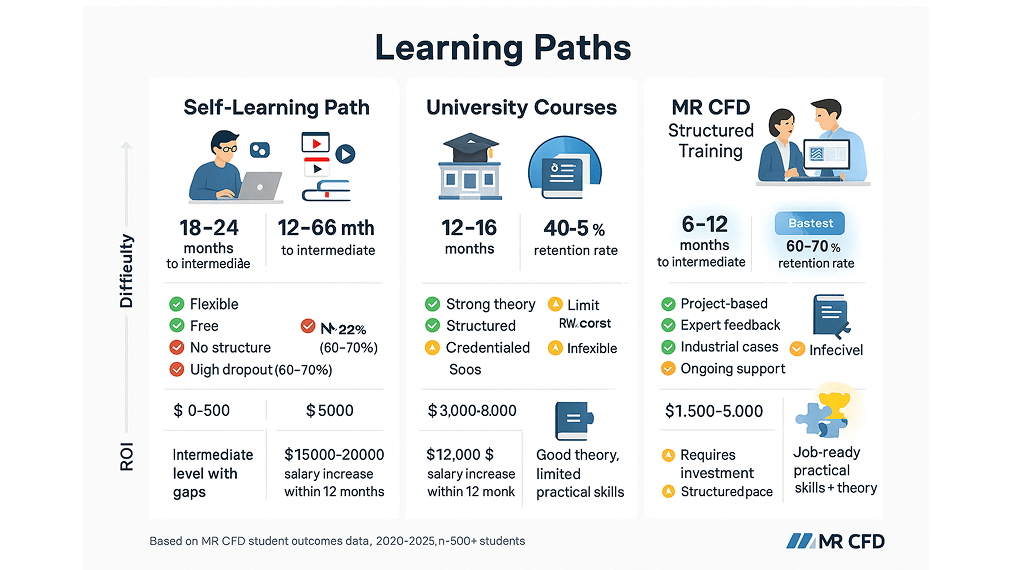
- Self-Learning (YouTube, Forums): This path can take 12-18 months to reach intermediate proficiency, and that’s for the disciplined few. The dropout rate is incredibly high, easily 60-70%. The hidden costs are significant: you’ll waste countless hours on outdated tutorials, adopt bad habits that need to be unlearned, and have no one to ask when you hit a wall.
- Structured Courses (like MR CFD’s curriculum): A structured path can get you to the same intermediate level in 4-6 months. Why? Because a well-designed course provides a systematic progression, immediate feedback from a certified Ansys Fluent instructor, and curated projects that build skills logically. It eliminates the guesswork and prevents you from reinforcing common beginner mistakes.
Why Does Your Specific Application Domain Impact Learning Duration?
The complexity of your target application is a major factor. Learning how to learn ANSYS Fluent for basic external aerodynamics on a car is a different challenge than modeling multiphase combustion in a gas turbine.
- Simpler Domains (External Aero, HVAC, Pipe Flow): You can become proficient enough for industrial projects in 3-4 months. The physics are generally well-understood and single-phase.
- Complex Domains (Multiphase, Combustion, FSI, UDFs): Mastering these areas can take 18-24 months or more. These applications require a much deeper understanding of both the underlying physics and the advanced numerical schemes in Fluent. An aerospace engineer transitioning to turbomachinery CFD, for example, needs to budget extra time just to learn the specific concepts of rotating frames of reference and blade interaction modeling.
What Are the Distinct Skill Levels in Ansys Fluent and Their Realistic Timelines?
To build a realistic plan, we need to break down the journey into measurable stages. Think of it like a video game: you can’t fight the final boss on day one. Here is the framework we use at MR CFD to define progression from novice to expert.
 Level 1 – Basic User: How Long to Run Your First Successful Simulation?
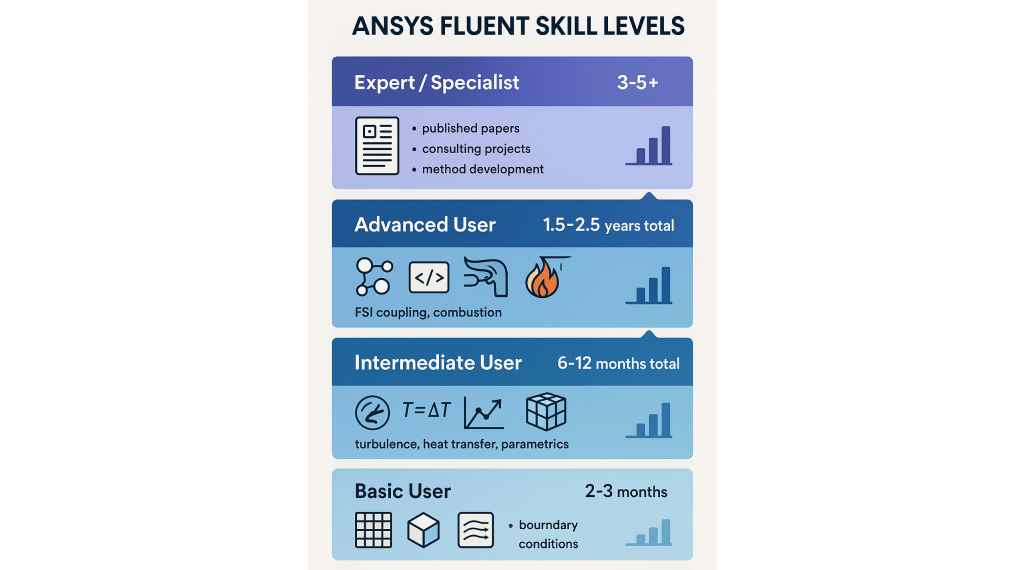
A “basic user” can confidently navigate the Ansys Workbench environment, set up a simple 2D or 3D single-phase flow problem, apply standard boundary conditions, run the solver, and extract fundamental results. This is the crucial first step on your Ansys Fluent tutorial roadmap.
🎯 Timeline: 2-3 months with a structured learning program; 4-6 months if self-taught.
What Specific Skills Should You Master at the Basic Level?
At this level, you should have a solid checklist of competencies:
- Navigating the Ansys Workbench interface and understanding the project schematic.
- Importing geometry and performing basic meshing in Ansys Meshing.
- Understanding core mesh quality metrics like skewness and orthogonality.
- Selecting appropriate turbulence models for simple flows (e.g., vs. ).
- Correctly setting up velocity inlet and pressure outlet boundary conditions.
- Interpreting residual plots to monitor simulation convergence.
- Creating basic contour plots, vector plots, and streamlines in CFD-Post.
- Example Project: Simulating the external flow over a 2D cylinder to calculate its drag coefficient.
What Are Common Beginner Mistakes That Extend Learning Time?
Many beginners get stuck because they make predictable mistakes. A structured approach helps you avoid these pitfalls:
- Skipping Mesh Independence Studies: This is the #1 error. Without verifying that your results don’t change with a finer mesh, your solution is unreliable, forcing you to rework the entire project.
- Ignoring Convergence Criteria: Seeing residuals flatten is not enough. Beginners often accept a poorly converged solution, leading to false confidence in physically incorrect results.
- Attempting Complex Cases Too Early: Jumping into a multiphase problem before mastering single-phase flow is a recipe for frustration and will kill your motivation.
- Not Validating Against Known Solutions: You must compare your results to analytical solutions or experimental data (a process known as benchmark case study validation) to build confidence and hone your skills.
Level 2 – Intermediate User: How Long Until You Handle Real Engineering Projects?
An intermediate user can tackle common industrial single-phase problems independently. You can perform mesh sensitivity studies, select and justify your choice of turbulence models, run parametric studies to optimize a design, and validate your results against experimental data. This is where you start adding real value to an engineering team.
🎯 Timeline: 6-12 months total (including the basic level) with consistent, dedicated practice.
What Advanced Physics Models Should Intermediate Users Understand?
Your toolkit expands significantly at this stage. You should aim to learn:
- Heat Transfer: Including convection, conduction, and especially Conjugate Heat Transfer (CHT) between fluids and solids.
- Species Transport: For modeling mixing and simple reactions.
- Discrete Phase Modeling (DPM): To track the trajectories of small particles, droplets, or bubbles in a continuous flow.
- Sliding Mesh: For modeling rotating equipment like pumps, fans, or mixing impellers.
- Porous Media: For simulating flow through filters or packed beds.
Each of these models requires a dedicated learning investment of about 2-4 weeks, including practice projects. Our MR CFD Ansys courses for intermediate users cover these topics with industrial case studies.
How Do You Develop Engineering Judgment for Simulation Setup?
This is the critical leap from being a software operator to becoming a simulation engineer. Engineering judgment is the intuition that helps you decide:
- When is a 2D simplification acceptable versus when a full 3D model is necessary?
- What physical effects can be ignored to simplify the problem without compromising accuracy?
- How do you estimate the required mesh resolution in critical areas like boundary layers?
- How do you choose an appropriate time step size for a transient simulation to capture the physics correctly?
This judgment isn’t magic; it’s pattern recognition built from experience. It typically comes after analyzing 20-30 diverse simulation cases. Project-based courses, like those at MR CFD, are designed to accelerate this accumulation of experience.
Level 3 – Advanced User: What’s the Timeline for Mastering Complex Multiphysics?
An advanced user is someone who can handle complex, coupled-physics problems that often require customization. This includes multiphase flows, combustion, Fluid-Structure Interaction (FSI), advanced turbulence modeling (LES, DES), and implementing custom physics using User Defined Functions (UDFs). This skill level is typically required for R&D roles and for developing new simulation methodologies.
🎯 Timeline: 1.5-2.5 years total from day one, with a focused 8-12 month period dedicated specifically to these advanced topics.
How Long Does It Take to Learn UDF Programming for Ansys Fluent?
Learning to write UDFs is a significant step that unlocks the full power of Fluent. Here’s a realistic Ansys UDF programming time breakdown:
- Prerequisite: Assumes you have a functional knowledge of the C programming language. If not, add 2-3 months to learn C basics first.
- Month 1: Understanding Fluent’s UDF macros, data structure, and compilation process.
- Month 2: Implementing simple custom boundary conditions (e.g., a parabolic velocity profile) and post-processing functions.
- Months 3-4: Writing source terms (e.g., for custom reactions) and modifying material properties dynamically.
- Months 5-6: Tackling advanced topics like memory management, parallel UDF considerations, and interacting with user-defined scalars.
Our specialized UDF course at MR CFD provides over 50 practical, copy-paste-ready examples to fast-track this process, built on our 15+ years of CFD consulting experience.
What Multiphase Modeling Expertise Can You Develop and How Long Does It Take?
Multiphase flow is a world unto itself. Each model is a specialization:
- Volume of Fluid (VOF): For free-surface flows (e.g., dams, ship hulls, tank sloshing). Plan for 2-3 months of dedicated study and practice.
- Eulerian Multiphase: For interpenetrating fluid systems (e.g., bubble columns, fluidized beds). Requires 2-3 months to master the complex closure models.
- Discrete Phase Model (DPM): While introduced at the intermediate level, advanced DPM includes erosion, breakup, and two-way coupling, requiring another 1-2 months.
- Discrete Element Method (DEM): For dense granular flows where particle-particle collisions dominate. This is a highly specialized skill that takes 2-3 months to learn effectively.
Level 4 – Expert/Specialist: How Do You Reach Mastery Level in Ansys Fluent?
An expert or specialist is a recognized authority in a specific domain. They don’t just solve problems; they develop new simulation methodologies, publish peer-reviewed turbulence modeling approaches, lead complex consulting projects, and train the next generation of engineers.
🎯 Timeline: 3-5+ years of dedicated, high-volume practice and continuous learning.
Expertise is almost always domain-specific. An world-class expert in gas turbine combustion might only be an intermediate user when it comes to FSI in biomedical devices. This level is defined by depth, not breadth.
What Does the Path to CFD Consulting Expertise Look Like?
The journey to becoming a Principal CFD Engineer involves several key milestones beyond software proficiency:
- Accumulating experience across 100+ diverse industrial projects.
- Developing deep, industry-specific knowledge (e.g., understanding automotive aero regulations or turbomachinery performance metrics).
- Building personal validation databases from published simulation verification results.
- Mastering advanced concepts like uncertainty quantification.
- Learning the crucial soft skill of communicating complex simulation results to non-technical stakeholders.
This is the level where our senior staff at CFD consulting services operate, and we often mentor advanced users to help them bridge this final gap.
What Is the Proven Month-by-Month Roadmap to Learn Ansys Fluent Effectively?
Here is an actionable, structured Ansys learning path that translates the timelines above into concrete monthly objectives. This is the same framework we use to guide students in our programs.
Months 1-2: What Should Your Foundation-Building Phase Include?
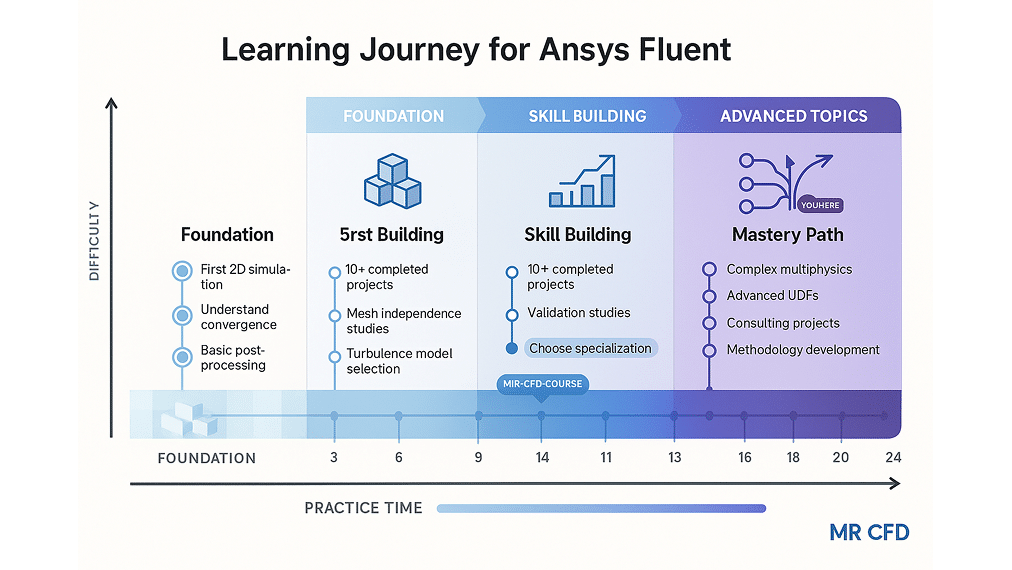
This phase is all about mastering the fundamentals of the simulation workflow. ⚙️
- Weeks 1-2: Get comfortable with the Ansys Workbench interface. Learn the core concepts of the CFD workflow: Geometry -> Meshing -> Setup -> Solve -> Post-processing.
- Weeks 3-4: Complete your first 2D simulations. Start with laminar pipe flow (Poiseuille flow) and validate against the analytical solution. Then, move to turbulent flow over a flat plate.
- Weeks 5-6: Move to 3D. Import a simple 3D geometry (like a valve or bend), learn about different boundary condition types in detail, and understand the concept of solver convergence.
- Weeks 7-8: Get a practical introduction to turbulence models. Run the same case with both and SST to see the differences. Master essential post-processing techniques in CFD-Post.
Months 3-6: How Do You Transition to Independent Problem-Solving?
The goal here is to build confidence and engineering judgment by tackling a variety of projects. 🚀
- Project Variety: Complete at least 10-15 full simulation projects. Examples include a simple heat exchanger (CHT), a mixing tank with a rotating impeller (Sliding Mesh), and the classic Ahmed body benchmark for external aerodynamics.
- Methodology Focus: For every project, conduct a proper mesh independence study. Don’t just follow tutorials; experiment by changing turbulence models and justifying your final choice.
- Parametric Studies: Learn how to use Ansys DesignXplorer to run parametric studies. For example, find the optimal angle of attack for an airfoil or the best inlet velocity for a heat exchanger.
This phase is where the CFD intermediate course package, with its library of over 30 industrial cases, becomes invaluable.
Months 7-12: What Advanced Topics Should You Tackle Next?
Now you specialize. Based on your career goals, choose 2-3 advanced areas to focus on.
- Specialization: Pick your path. Is it multiphase flow, combustion, FSI, or turbomachinery?
- Theory Deep Dive: Go back to the textbooks. If you’re learning VOF, read up on interface tracking schemes. If you’re learning combustion, study chemical kinetics.
- First UDFs: Start with simple UDFs to customize boundary conditions or material properties.
- Advanced Meshing: Learn to use more advanced meshing techniques like polyhedral or overset meshes for complex geometries.
- Formal Validation: Conduct at least one formal validation study where you replicate a published experiment and write a report comparing your CFD results to the experimental data.
Year 2 and Beyond: How Do You Maintain Growth and Achieve Mastery?
Expertise is a moving target. Continuous learning is key.
- Stay Current: Keep up with new features in annual Ansys releases.
- Specialize Further: Become the go-to person in your company for a niche application.
- Contribute: Share your knowledge on forums like CFD-Online or by publishing your work.
- Certify: Pursue formal Ansys Fluent certification to validate your skills.
- Mentor: The best way to solidify your knowledge is to teach it to others.
- Real-World Projects: Aim to complete 20-30 diverse, challenging industrial projects. This is where the deepest learning occurs, and where our consulting and HPC services can provide the support and resources for large-scale simulations.
How Can You Accelerate Your Ansys Learning Journey Without Compromising Quality?
Learning faster doesn’t mean taking shortcuts that create knowledge gaps. It means using proven, efficient learning strategies to maximize your retention and understanding.
What Learning Techniques Maximize Ansys Skill Retention?
Leverage learning science to make your efforts stick:
- Spaced Repetition: Don’t just do a project and forget it. Revisit key concepts and simulations at increasing intervals (e.g., 1 day, 1 week, 1 month later).
- Deliberate Practice: Always work at the edge of your current ability. If you can complete a simulation easily, it’s not a good learning project. Tweak it to make it more challenging.
- Interleaving: Instead of practicing one topic (e.g., heat transfer) for a week straight, mix in projects from different areas. This forces your brain to recall and apply different concepts, strengthening your memory.
- Active Recall: After watching a tutorial, close it and try to replicate the entire workflow from memory. This is far more effective than passively following along.
How Does Project-Based Learning Compare to Tutorial Following?
There’s a massive difference in effectiveness between passive and active learning:
- Passive Tutorial Following: Leads to only 20-30% retention. You fall into the “tutorial trap,” where you feel like you’re learning because you can follow steps, but you can’t solve a new problem independently.
- Project-Based Problem-Solving: Boosts retention to 60-70%. When you are forced to solve a problem from start to finish, you truly internalize the process.
I recommend the 70-30 rule: spend 70% of your learning time working on independent projects and only 30% on guided tutorials to learn new features. This is the core philosophy behind MR CFD’s project-centric curriculum.
Why Is Validation Against Experimental Data Critical for Learning?
Validation is not just an academic exercise; it’s the single most important habit for developing true competency.
- It forces you to understand the physics, not just operate the software. If your results don’t match the experiment, you have to dig into why.
- It develops your engineering judgment about model limitations and sources of error.
- It builds confidence in your simulation results, which is essential for professional practice.
- It teaches you about uncertainty quantification.
A great example is validating the drag coefficient for the Ahmed body against wind tunnel data. This simple-looking case is a masterclass in turbulence modeling and mesh refinement. All CFD courses include validation exercises against published experimental datasets.
How Can Mentorship and Community Reduce Your Learning Time by 40-50%?
You can’t overstate the value of human guidance. Access to an experienced mentor or a supportive community can slash your time to master Ansys simulation.
- Mistake Prevention: An expert can spot a flawed approach in minutes, saving you weeks of wasted effort on a bad simulation setup.
- Immediate Feedback: Instead of being stuck for days, you can get an answer that unblocks you in hours.
- Best Practices: A mentor shares years of accumulated wisdom on industry-standard Ansys best practices, which you can’t find in textbooks.
Comparing solo learning (18 months to intermediate) vs. mentored learning (10-12 months) shows a clear 40-50% time savings. This is why we built a comprehensive support ecosystem at MR CFD, including forums, live office hours, and mentorship from our consulting team.
What Are the Most Common Obstacles That Slow Ansys Learning and How Do You Overcome Them?
Every learner hits roadblocks. Knowing what they are and how to navigate them is key to staying on track.
How Do You Push Through the “Intermediate Plateau” in CFD Learning?
Around the 6-9 month mark, many learners feel their progress stall. Basic tutorials feel too easy, but advanced topics feel impossibly complex. This is the intermediate plateau.
- Cause: The easy wins are over. Progress now requires deeper theoretical understanding and more complex problem-solving skills.
- Breakthrough Strategies:
- Take on a challenging project that is slightly beyond your current comfort zone.
- Seek out a formal code-to-code or code-to-experiment validation study.
- Learn a complementary skill, like basic Python scripting for post-processing or starting to learn C for UDFs.
- Get a portfolio review from an expert to identify your specific knowledge gaps.
Our structured curriculum is designed to prevent these plateaus by providing a clear ladder of progressively challenging projects.
What Should You Do When Simulations Don’t Converge or Give Unexpected Results?
Troubleshooting is where the real learning happens. A diverging simulation is a learning opportunity, not a failure.
- The Systematic Debugging Checklist:
- Mesh Quality: This is always the first suspect. Check for high skewness, non-orthogonality, or sudden jumps in cell size.
- Boundary Conditions: Double-check the values, types, and locations. A simple typo here can ruin a simulation.
- Physics Model Selection: Are you using the right turbulence model? Is your fluid compressible when it should be incompressible?
- Initialization: A bad initial guess can cause a simulation to diverge immediately. Try a hybrid initialization or solve a simpler version of the problem first.
- Solver Settings: As a last resort, adjust under-relaxation factors or switch to a more robust solver scheme.
From my 15+ years of CFD consulting experience, I can say that solving 10-15 genuinely difficult, non-converging cases builds more expertise than running 50 simulations that work perfectly on the first try.
How Do You Balance Learning Theory Versus Practical Software Skills?
This is a classic dilemma. How much fluid mechanics do you really need to know?
- The 60-40 Rule: I recommend a balance of 60% hands-on software practice and 40% dedicated theory study (fluid mechanics, numerical methods, turbulence).
- Why Theory Matters: Theory accelerates your software mastery. Knowing why the model struggles with flow separation helps you instantly know to switch to the SST model, saving you hours of trial and error.
- Integrated Learning: The best approach is to study theory in the context of your current simulation projects. If you’re modeling heat transfer, spend that week reviewing the fundamentals of convection and radiation. Our MR CFD courses are built on this principle, integrating clear theoretical explanations directly within the practical project workshops.
How Does MR CFD’s Structured Learning Path Compare to Alternative Approaches?
Let’s do an honest, objective comparison of your learning options to help you choose the best path for your goals and resources.
What Are the Pros and Cons of Self-Learning Ansys Through Free Resources?
Self-directed learning using free content from YouTube, forums, and university websites is a popular starting point.
- Pros: It’s free, completely flexible, and offers a huge variety of content. It’s great for highly disciplined, self-motivated learners who have a strong theoretical background and unlimited time.
- Cons: It’s a lonely and inefficient path. There is no structured progression, leading to a 60-70% quit rate. You will spend a huge amount of time curating content, and much of it may be outdated or based on poor practices. The lack of feedback means you can practice mistakes for months without realizing it. The timeline is typically twice as long.
How Do University CFD Courses Compare to Industry-Focused Training?
Academic courses provide an essential foundation but often differ in focus from professional training.
- University Courses: These are excellent for building a strong theoretical foundation in fluid dynamics and numerical methods. They typically span one or two semesters. However, they often focus more on theory than on deep software expertise and tend to use simplified, academic case studies.
- Industry Training (like MR CFD): This training is intensely practical and results-oriented. The timeline is compressed, and the focus is on mastering the software to solve real industrial problems using industry-standard Ansys best practices. The goal is job-readiness.
The ideal approach is to combine them: use your university education for the “why” and professional training for the “how.”
What Makes MR CFD’s Course Structure Uniquely Effective for Ansys Learning?
We’ve spent years refining our pedagogical approach based on what actually works for professional engineers.
- Project-Based Curriculum: You learn by doing, with a library of over 30 industrial-grade projects.
- Progressive Difficulty: Our pathways guide you logically from beginner to advanced topics, preventing plateaus.
- Validation Emphasis: Every project is compared against experimental or analytical data, building real confidence.
- UDF Specialization: We offer one of the most comprehensive UDF training modules available, with 50+ practical examples.
- Ongoing Support: You’re never alone. You get access to our expert-monitored forums and live office hours with instructors.
- HPC & Consulting Integration: We provide pathways to use high-performance computing and even participate in real CFD consulting projects.
Our student success metrics speak for themselves: our students achieve intermediate proficiency in an average of 6 months (compared to the 12-18 month industry average) with a course completion rate of over 75%.
What Realistic Career Outcomes Can You Expect at Each Ansys Skill Level?
Learning Ansys isn’t just an academic pursuit; it’s a direct investment in your career and earning potential. Here’s what you can expect at each level.
What Job Opportunities Open Up at the Basic Ansys User Level?
After 2-3 months of focused learning, you can qualify for entry-level positions.
- Roles: Junior CFD Analyst, Simulation Support Engineer, CAE Technician.
- Responsibilities: Running predefined simulation templates, generating meshes for senior engineers, and performing basic post-processing.
- Salary Range (US Market, 2025): $50,000 – $65,000.
- Outlook: This gets your foot in the door but offers limited advancement without progressing to the intermediate level.
How Does Intermediate Ansys Proficiency Impact Your Career Trajectory?
This is the career inflection point where you become a valuable, independent contributor.
- Roles: CFD Engineer, Thermal Analysis Specialist, Aerodynamics Engineer.
- Responsibilities: Executing entire simulation projects from start to finish, contributing to design optimization, and communicating results to project teams.
- Salary Range: $70,000 – $95,000.
- Outlook: At this level (achieved in 6-12 months), you can start specializing in an industry (automotive, aerospace) or physics domain (thermal, aero), which will shape your long-term career.
What Senior Roles Require Advanced Ansys Expertise and UDF Skills?
After 1.5 to 2.5 years, you can target senior and leadership positions.
- Roles: Senior CFD Engineer, Simulation Team Lead, Methodology Developer.
- Responsibilities: Tackling complex multiphysics R&D projects, developing custom simulation tools with UDFs, mentoring junior engineers, and making key technical decisions.
- Salary Range: $100,000 – $140,000.
- Outlook: Advanced skills like UDF programming and multiphase modeling are major differentiators. Only about 20-30% of CFD users reach this level of proficiency, making you a highly sought-after expert.
What Does the Path to Principal Engineer or CFD Consultant Look Like?
This expert tier is for those who lead and innovate in the field, typically after 3-5+ years of dedicated experience.
- Roles: Principal CFD Engineer, Independent Consultant, R&D Specialist, Technical Director.
- Responsibilities: Developing novel simulation methodologies, leading cross-functional teams, driving business development, and establishing thought leadership.
- Salary/Billing Range: $130,000 – $200,000+ (as an employee) or $100 – $250/hour (as a consultant).
- Outlook: At this stage, you are known for your deep specialization in a specific domain. This is the level where you can join a team like our CFD consulting services or build your own successful practice.
What Investment (Time and Money) Should You Budget for Ansys Mastery?
A successful learning journey requires a realistic budget for both your time and your financial resources. Let’s break down the costs and the return on investment.
How Much Time Should You Realistically Allocate Weekly to Learn Ansys?
Your pace determines your timeline. Choose the path that fits your life and career goals.
- Accelerated Path (15-20 hours/week): Reach intermediate in 4-6 months, advanced in 12-18 months. Ideal for full-time students or those on a dedicated training plan.
- Standard Path (8-10 hours/week): Reach intermediate in 8-12 months, advanced in 20-24 months. The most common path for working professionals.
- Casual Path (3-5 hours/week): Reach intermediate in 15-18 months, advanced in 30+ months. Progress is slow, and there’s a high risk of knowledge decay.
Pro Tip: I strongly advise against going below 3 hours per week. At that rate, you’ll struggle to retain information, and progress can stall completely.
What Are the Financial Costs of Different Ansys Learning Paths?
Here’s a transparent comparison of the typical financial investments:
- Self-Learning: $0 – $500 (for books, etc.). The main cost is your time, which is typically 2x longer than structured paths.
- University Course: $3,000 – $8,000 per semester. Excellent for theory but often light on practical software depth.
- Professional Training (like MR CFD): $1,500 – $5,000 for a comprehensive beginner-to-advanced pathway. This typically offers the fastest and highest return on investment.
- Ansys Official Training: $3,000 – $6,000 per course. High-quality content but can be very expensive to build a complete skill set.
ROI Calculation: A typical $3,000 investment in a professional training program can lead to a $20,000-$30,000 salary increase within 12-18 months as you move from a junior to a mid-level role. The investment pays for itself many times over.
How Do You Justify the Learning Investment to Employers or Yourself?
Whether you’re asking your boss or convincing yourself, you need to build a solid business case.
- For Employers: Quantify the value. A CFD-skilled engineer is 3-5 times more efficient at design optimization than one relying on intuition alone. Simulation reduces the need for expensive physical prototypes by 40-60%, saving tens or hundreds of thousands of dollars.
- For Yourself: Frame it as career insurance. CFD is a high-demand, portable skill across nearly every engineering industry. It future-proofs your career and dramatically increases your earning potential. Investing in yourself is the best investment you can make.
How Do You Know You’re Making Good Progress in Your Ansys Learning Journey?
Objective self-assessment is key to staying on track and identifying areas that need more work. Here’s how to gauge your progress.
What Are the Key Milestones That Indicate You’re on Track?
Look for these measurable checkpoints to confirm you’re making solid progress:
- ✅ Month 2: You can independently set up, run, and post-process a simple 2D simulation (like flow over an airfoil) from a blank slate.
- ✅ Month 4: You can systematically troubleshoot a simulation that fails to converge without panicking.
- ✅ Month 6: You can confidently select an appropriate turbulence model for a given problem and write a paragraph justifying your choice.
- ✅ Month 9: You can perform a complete mesh independence study and validate your results against a known benchmark case.
- ✅ Month 12: You can tackle a new physics model (like CHT or DPM) with minimal guidance by reading the Ansys Help documentation.
How Can You Self-Assess Your Ansys Competency Level?
Use these practical methods to test your skills:
- Benchmark Cases: Attempt a classic validation case (e.g., flow over a backward-facing step) without following a tutorial. Compare your results to the published experimental data. If you’re within 5-10%, you’re at a competent level.
- Troubleshooting Speed: Time yourself. A typical convergence issue (e.g., reversed flow at an outlet) should be something you can diagnose and fix in under 2 hours as an intermediate user.
- The “Teach It” Test: If you can explain a concept (like wall Y+ or the difference between VOF and Eulerian multiphase) clearly to a colleague, you have truly mastered it.
What Should You Do If You’re Falling Behind Your Learning Timeline?
It’s normal to hit speed bumps. Don’t get discouraged—get diagnostic.
- Identify the Bottleneck: Is it a gap in your theory? Insufficient practice time? Are you stuck on a particularly difficult topic?
- Adjust Your Approach: If you’re struggling, switch from passive learning (watching videos) to active learning (doing projects). Seek feedback from a mentor or a community like the MR CFD forum.
- Reset Expectations: Be realistic. Learning combustion modeling will take longer than learning simple aerodynamics. It’s okay to adjust your timeline as you discover the true complexity of a topic. Remember that learning is not linear; plateaus are a normal part of the process.
What Advanced Resources and Next Steps Will Accelerate Your Ansys Expertise?
Once you’ve built a solid foundation, these resources can propel you toward true mastery.
Which Ansys Certifications Are Worth Pursuing and When?
Ansys certifications are a great way to formally validate your skills.
- Ansys Certified User: A good goal after 6-8 months of learning. It validates your basic competency and is great for entry-level resumes.
- Ansys Certified Professional: Target this after 12-18 months. It demonstrates your ability to handle real-world projects from start to finish.
ROI: Certifications can increase your credibility, especially as a consultant, and may command a 5-10% salary premium. However, they validate your experience—they don’t replace it.
How Can You Leverage MR CFD’s Consulting Projects for Real-World Learning?
For our most advanced students, we offer a unique apprenticeship model: the opportunity to work on actual client projects under the direct supervision of our principal engineers.
- Benefits: You get exposure to complex, industrial-scale problems that you can’t find in tutorials. You learn project management, client communication, and how to deliver results on a deadline.
- Impact: Six months of this kind of experience can accelerate your learning by an amount equivalent to 12-18 months of independent practice. It’s the ultimate bridge from advanced user to professional consultant.
What Specialized MR CFD Masterclasses Should You Take for Your Career Goals?
Our advanced masterclasses are designed for deep specialization.
- Automotive Engineer? Take our External Aerodynamics + DES Turbulence Masterclass.
- Working in the Energy Sector? Our Combustion Modeling + Multiphase Flow Masterclass is for you.
- Aerospace Focus? The Turbomachinery + FSI Masterclass will align with your goals.
- HVAC or Built Environment? The Heat Transfer + Species Transport Masterclass is a perfect fit.
Our subscription model provides unlimited access to over 50 specialized courses, allowing you to build a custom learning path.
How Does Access to HPC Resources Transform Your Ansys Learning?
You can only get so far on a laptop. To tackle truly complex problems, you need High-Performance Computing (HPC).
- The HPC Advantage: Run large-scale simulations with 10M+ cells, use advanced turbulence models like LES/DES that are too computationally expensive for a workstation, and complete large parametric studies in hours instead of weeks.
- MR CFD’s HPC Service: We provide our students and clients with cloud-based access to powerful computing clusters, eliminating the need for a massive hardware investment. Experience with HPC is increasingly a requirement for senior CFD roles.
Frequently Asked Questions About Learning Ansys Fluent
Can I learn Ansys Fluent without a mechanical engineering degree?
Yes, but you must be proactive about learning the fundamentals. While anyone can learn the software’s operations, effective CFD analysis requires a solid understanding of fluid mechanics, thermodynamics, and heat transfer. If you don’t have an engineering degree, I strongly recommend completing an online fluid mechanics course (like those on MIT OpenCourseWare or Coursera) before you start your Ansys training. This will add 2-3 months to your timeline but is absolutely essential for success.
Is Ansys Fluent harder to learn than other CFD software like OpenFOAM or COMSOL?
They each have different learning curves. COMSOL is generally the fastest to get your first simulation running (1-2 months) due to its multiphysics-first interface, but it can be less powerful for highly complex, specialized CFD. OpenFOAM has the steepest learning curve, requiring 4-6 months just to become functional with its command-line interface and case structure, but it offers ultimate customization. Ansys Fluent strikes the best balance for professional work; its GUI makes it accessible for beginners (2-3 months to first results), while its depth and UDF capabilities satisfy the needs of experts. It’s the industry standard for a reason, holding over 40% of the market share.
How much programming knowledge do I need to learn Ansys Fluent effectively?
For 80% of industrial applications, from the basic to the intermediate level, you need zero programming knowledge. The entire workflow is managed through the graphical user interface (GUI). However, to reach the advanced level and write User Defined Functions (UDFs), you will need proficiency in the C programming language. If you’re learning C from scratch, budget an extra 2-3 months for that before starting on UDFs. Python knowledge is also very helpful for automating post-processing and data analysis, but it is not required to use the core software.
What computer hardware do I need to learn Ansys Fluent efficiently?
For the learning phase, you don’t need a supercomputer. Here are the recommended specs for a learning machine:
- RAM: 32GB (16GB is the absolute minimum)
- CPU: 6-8 core processor
- Storage: 100GB of free space on an SSD
- OS: Windows 10/11 or a supported Linux distribution
This setup will comfortably handle the learning cases (typically 100k to 1M cells) available in the free Ansys Student version. For larger, more complex projects, I recommend using a cloud-based service like MR CFD’s HPC resources rather than investing thousands in a personal workstation.
Can I get a job after completing an Ansys Fluent course, or do I need a degree?
The honest answer is that most full-time CFD engineer positions require an engineering degree (Mechanical, Aerospace, Chemical, etc.) as a baseline qualification. The Ansys skill is the differentiator that gets you the job. However, some CAE technician or simulation support roles may hire based on demonstrated software competency and a strong portfolio. If you don’t have a degree, your path is to build an exceptional portfolio of 10-15 validated projects, get an Ansys certification, and demonstrate your expertise through practical results. It’s a harder path, but it is possible.
How often does Ansys Fluent update, and do I need to relearn everything?
Ansys releases new versions annually (e.g., 2025 R1, 2025 R2), but you absolutely do not need to relearn everything. The core physics, solver theory, and fundamental workflows have been stable for decades. Your knowledge of turbulence models, meshing principles, and boundary conditions is a long-term investment. Updates typically add new features or improve the user interface. You should budget about 2-4 hours per year to familiarize yourself with the new additions relevant to your work.
What’s the difference between learning Ansys Workbench vs. Ansys Fluent standalone?
Ansys Workbench is the modern, integrated platform that connects your entire simulation workflow: geometry (SpaceClaim), meshing (Ansys Meshing), the solver (Fluent), and post-processing (CFD-Post). The Fluent standalone application is the traditional, solver-focused interface. For 95% of new users, the learning recommendation is clear: start with the Workbench approach. It’s more intuitive and represents the standard industry workflow. Learning this way adds maybe 1-2 weeks to your initial learning but saves you countless hours in the long run.
How do I stay motivated during the long Ansys learning journey?
Motivation is a challenge, especially when simulations fail. Here are some strategies that work:
- Set Micro-Goals: Focus on completing one project this week, not on “becoming an expert.”
- Celebrate Small Wins: Your first converged simulation? Your first validated result? Acknowledge and celebrate it!
- Join a Community: Engage with other learners in the MR CFD forum or other online groups. Shared struggle is a powerful motivator.
- Track Your Progress: Keep a portfolio of your completed projects. Looking back at how far you’ve come is a great boost.
- Find an Accountability Partner: Pair up with another learner to keep each other on track. Remember that the learning curve is not linear. Expect plateaus, and know that pushing through them is what builds real expertise.
Is it better to specialize in one Ansys module or learn multiple CFD tools?
My advice follows a clear progression. Early Career (Years 0-3): Specialize deeply in Ansys Fluent. Employers hire experts. A deep understanding of one tool is far more valuable than surface-level knowledge of five. Mid-Career (Years 3-7): Add complementary tools based on your industry’s needs. This could be Ansys Mechanical for FSI, Ansys CFX for turbomachinery, or an open-source tool like OpenFOAM for deep customization. Senior Level: At this stage, you become tool-agnostic. Your deep understanding of physics and numerical methods allows you to solve problems, regardless of the specific software.
What should I do if I can’t afford paid Ansys courses right now?
A limited budget doesn’t have to stop you from learning. Here is a free and low-cost learning path:
- Download the free Ansys Student version.
- Start with the MR CFD free tutorial library, which has over 20 beginner-friendly projects with validation data.
- Supplement this with the free courses on the official Ansys Learning Hub.
- Study fluid mechanics theory using free resources like MIT OpenCourseWare.
- Join the CFD-Online and MR CFD forums to ask questions and learn from the community.
This path will take longer (expect 12-18 months to reach an intermediate level), but it is absolutely achievable with dedication and discipline. When your budget allows, investing in even one high-quality intermediate course will provide the structure and feedback to significantly accelerate your progress.
Related Posts
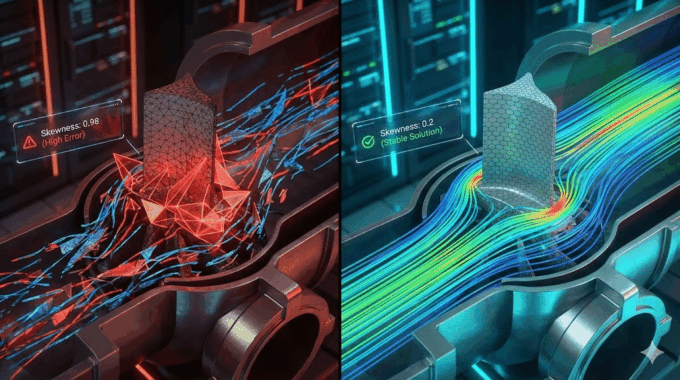
Errors Occurring in Simulations with ANSYS Fluent: A Technical Guide to Convergence & Stability
ANSYS Fluent simulates engineering problems based on the Finite Volume Method (FVM). Consequently, the errors…
How Ansys HPC Servers Accelerate Your Fluent Dynamic Simulations
We have all been there. You hit “Calculate” on a transient simulation, and the estimated…
Ansys HPC Case Study: Accelerating a 120-Million Cell Simulation Using MR CFD’s Ansys HPC Service
In the high-stakes world of aerodynamics, fidelity is everything. But as engineers, we often hit…
 Talk On WhatsApp
 Talk On WeChat

Comments (0)