
Agricultural and Food GOLDEN Training Course: +60 Simulations (All in One Course)
$599.00 Internship
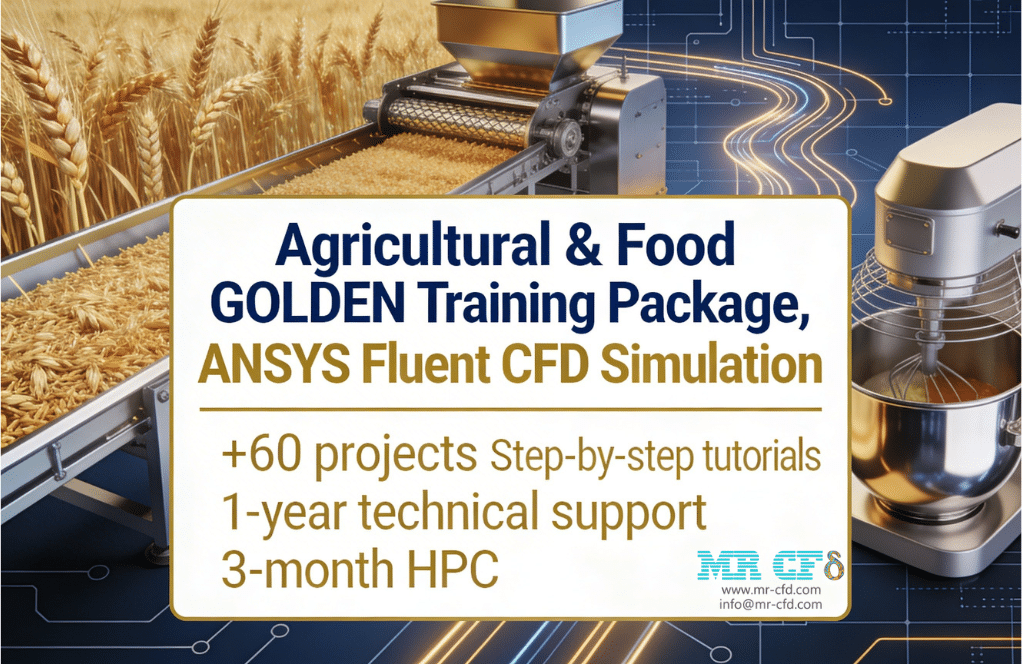
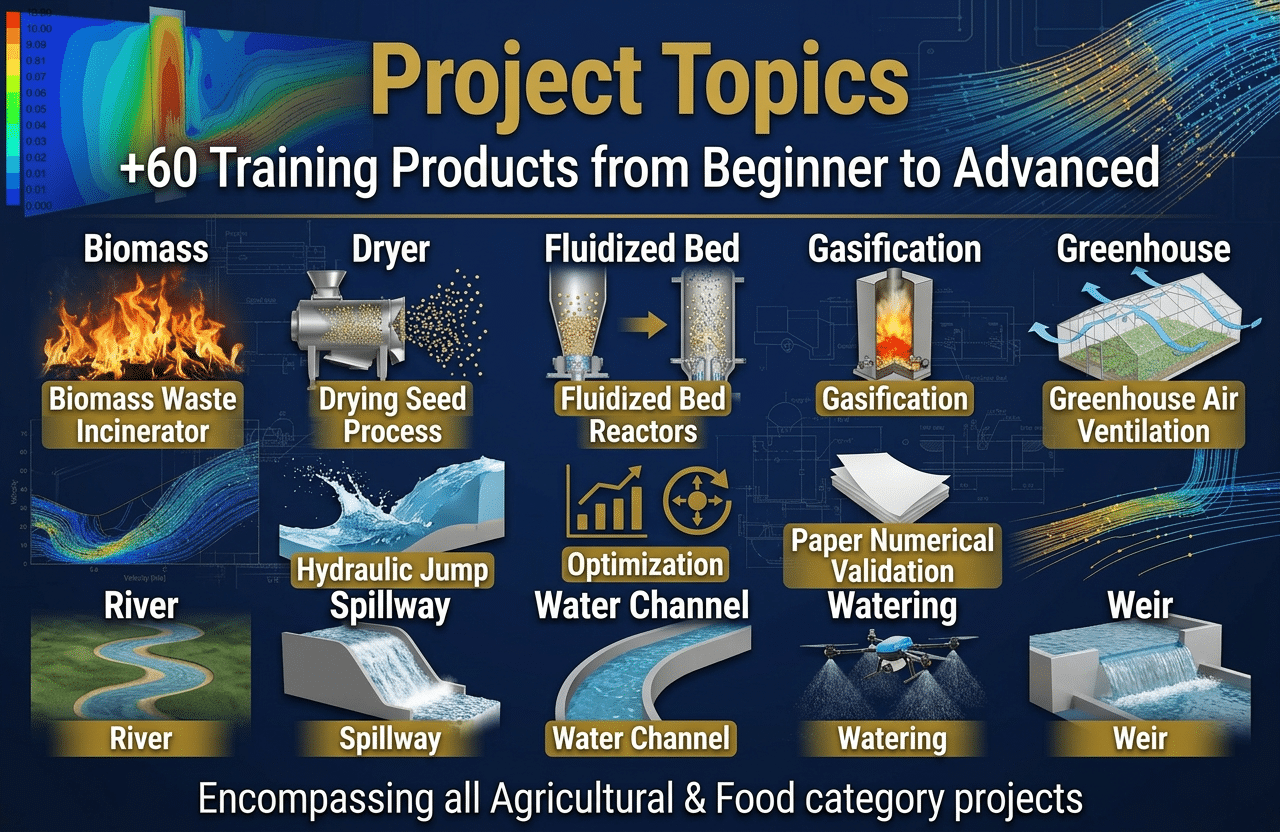
Empower your team with MR CFD’s comprehensive Agricultural & Food GOLDEN Training Package, featuring ANSYS Fluent CFD Simulation projects in real‑world applications such as biomass systems, dryers, fluidized beds, gasifiers, greenhouses, rivers, spillways, weirs, watering, and optimization. Perfect for professors, researchers, engineers, managers, and major companies, this package turns beginners into confident CFD users, accelerates onboarding, cuts training costs, and ensures your team can immediately tackle advanced Agricultural & Food engineering challenges with industry‑leading methods.
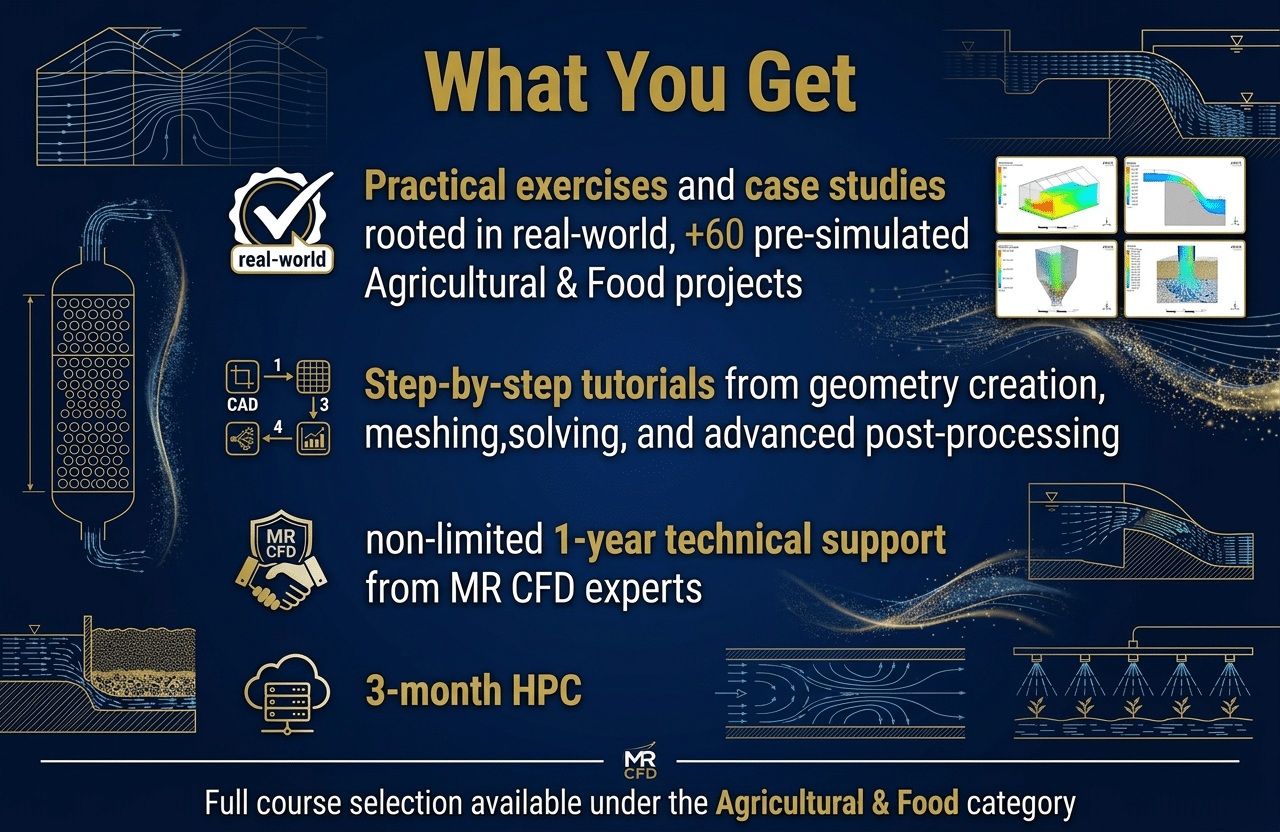
- Practical exercises and case studies rooted in real-world, +60 pre-simulated Agricultural & Food projects.
- Step-by-step tutorials from geometry creation, meshing, solving, and advanced post-processing.
- While you obtain the Golden Package, you will receive non-limited 1-year technical support from MR CFD experts.
- By purchasing this Golden package, you can benefit from our 3-month HPC.
- Full course selection available under the Agricultural & Food category.
To Order Your Project or benefit from a CFD consultation, contact our experts via email (info@mr-cfd.com), online support tab, or WhatsApp at +44 7443 197273.
There are some Free Products to check our service quality.
If you want the training video in another language instead of English, ask it via info@mr-cfd.com after you buy the product.
Description
Agricultural & Food Engineering Complete CFD Course: 60+ Simulations
The intersection of computational fluid dynamics and agricultural and food engineering represents one of the most technically demanding and industrially consequential frontiers in modern simulation practice. From modeling greenhouse ventilation and hydraulic spillway flows to simulating biomass gasification and spray drying chambers, engineers operating in this domain face complex, multi-physics challenges that demand both theoretical rigor and hands-on simulation proficiency. This Agricultural and Food Engineering Complete CFD Course, developed by MR CFD, delivers a structured, production-grade training pathway built around more than 60 fully pre-simulated ANSYS Fluent projects — spanning beginner to advanced competency levels.
Whether you are a graduate student building foundational simulation skills, a practicing engineer solving real-world agricultural hydraulics problems, or an academic professional seeking deployable course materials, this course provides an unmatched combination of technical depth, industrial relevance, and methodological precision. Accessible through MR CFD’s CFD training course, this program is engineered to close the gap between theoretical fluid mechanics and the computational tools that define professional agricultural and food engineering practice today.
The Critical Role of CFD in Modern Agricultural and Food Engineering Systems
The agricultural and food sectors are undergoing a profound technological transformation driven by resource scarcity, climate variability, and the global demand for efficient, scalable food production systems. Computational fluid dynamics has emerged as an indispensable engineering tool across this transformation — enabling precise modeling of open channel hydraulics, greenhouse climate control, food drying thermodynamics, and bioenergy conversion systems without the prohibitive cost and time constraints of physical experimentation.
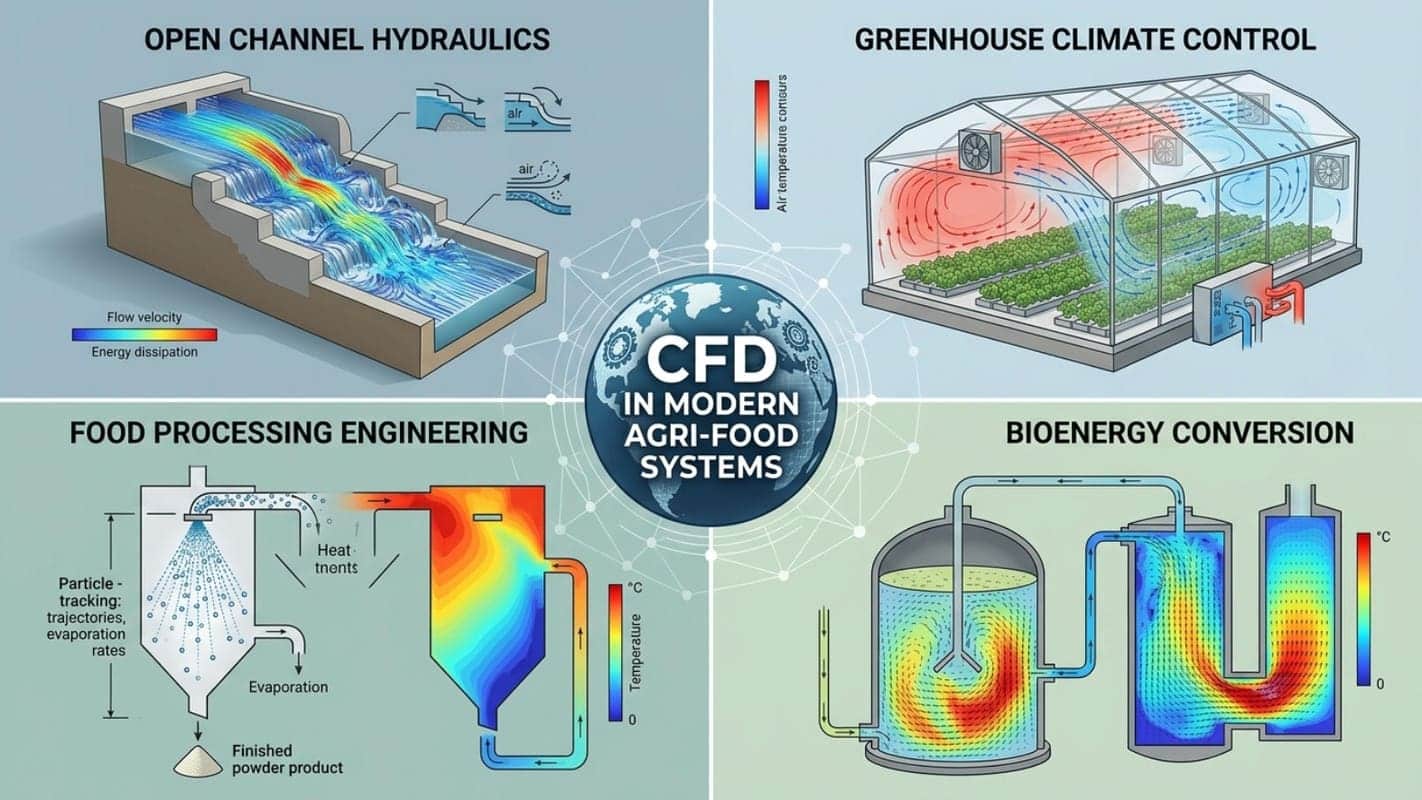 Consider the engineering complexity embedded in a single stepped spillway design: flow regime transitions, energy dissipation across stair geometries, air entrainment, and downstream scour all interact simultaneously. Or the multi-physics challenge of a spray drying chamber, where droplet evaporation, particle trajectory, wall impingement, and outlet moisture content must all be predicted accurately to ensure product quality. ANSYS Fluent CFD simulation provides the solver framework to address these challenges with validated, industry-standard accuracy.
The global precision agriculture market, the expanding bioenergy sector, and the growing regulatory pressure on water resource management are collectively driving unprecedented demand for engineers proficient in agricultural CFD simulation. Organizations that equip their teams with these capabilities gain measurable competitive advantages in project delivery speed, design optimization quality, and regulatory compliance confidence.
Core CFD Competencies Delivered by This Agricultural Engineering Simulation Training
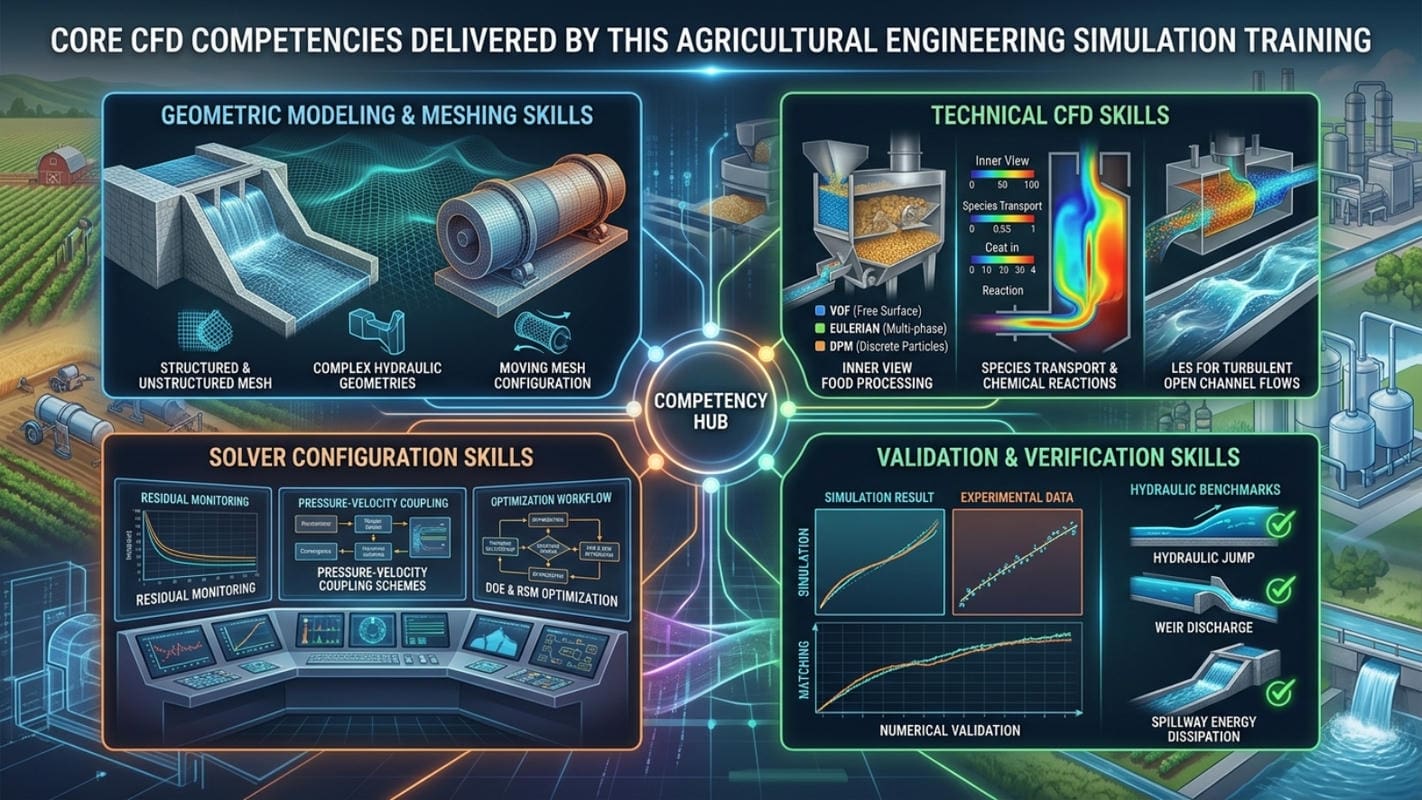
This course systematically builds a comprehensive set of simulation competencies directly applicable to agricultural and food engineering practice:
- Technical CFD Skills: Multiphase flow setup using VOF, Eulerian, and DPM frameworks; transient and steady-state solver configuration; species transport and chemical reaction modeling with CHEMKIN integration; P1 radiation model setup for combustion and gasification scenarios; Large Eddy Simulation (LES) for turbulent open channel flows.
- Geometric Modeling & Meshing Skills: Structured and unstructured meshing for complex hydraulic geometries (spillways, weirs, channels); moving mesh configuration for rotary dryer simulations; porous zone definition for packed beds and filter cake structures.
- Solver Configuration Skills: Pressure-velocity coupling schemes; transient solver setup for two-phase free-surface flows; convergence monitoring and residual management for reactive flow cases; DOE and RSM optimization workflow configuration within ANSYS Fluent.
- Validation & Verification Skills: Numerical paper validation against published experimental data; mesh independence studies; comparison of simulation results with analytical hydraulic relationships for hydraulic jump, weir discharge, and spillway energy dissipation benchmarks.
Comprehensive Course Modules & Simulated Engineering Projects
Biomass Energy Conversion: Combustion and Gasification CFD Simulation
This module addresses the rapidly expanding bioenergy engineering sector through detailed simulation of biomass combustion and gasification processes. Learners configure species transport models, integrate CHEMKIN chemical kinetics, and apply the P1 radiation model to capture thermal radiation in high-temperature reactive flows. Projects include biomass waste incinerator simulation, co-firing biomass with coal gasification, and circulating fluidized bed (CFB) gasifier modeling — all directly applicable to renewable energy plant design and agricultural waste valorization engineering workflows.
Industrial Drying Process CFD: Seed, Grain, Spray, and Wood Drying Simulations
The drying module is one of the most industrially comprehensive sections of this course, covering the full spectrum of food and agricultural drying technologies. Using DPM for particle tracking and porous medium models for bed resistance, learners simulate seed drying processes, rotary seed dryers, grain drying devices, spray drying chambers, heat pump dryers for wood, and solar indirect dryers. The Meat Drying Process Simulation uniquely combines the VOF model with porous media to capture moisture migration at the food surface — a technically sophisticated scenario directly relevant to food processing industry quality control.
Fluidized Bed Reactor Engineering: Hydrodynamics and Reactive Flow Modeling
Fluidized bed reactor CFD simulation is a cornerstone competency for engineers working in food processing, pharmaceutical manufacturing, and bioenergy. This module covers fluidized bed bio-reactors, fluidized bed reactors with chemical reactions, horizontal fluidized bed dryers, and fluidized bed polymerization reactors — each requiring careful configuration of Eulerian-Eulerian multiphase models, drag law selection, and reaction source term implementation. The circulating fluidized bed (CFB) boiler project extends this knowledge to power generation applications, providing a direct bridge to industrial-scale bioenergy system design.
Greenhouse Climate Engineering: Ventilation, Thermal, and Humidity CFD Analysis
Greenhouse CFD simulation is one of the highest-value applications in modern precision agriculture engineering. This module delivers four distinct greenhouse simulation projects, progressively increasing in complexity: basic greenhouse air ventilation, thermal and humidity distribution analysis, ventilation design improvement for industrial-scale greenhouses, and a comparative study of thermal and airflow performance with and without heating systems. Learners gain direct competency in optimizing crop environment control, reducing energy consumption in controlled agriculture, and validating design modifications through simulation before physical implementation.
Hydraulic Jump and Open Channel Hydraulics CFD Simulation
The hydraulic jump module addresses one of the most fundamental and practically important phenomena in agricultural water management and irrigation system design. Projects include hydraulic jump simulation in rectangular channels and stepped structures, using VOF two-phase flow to capture the turbulent air-water interface, energy dissipation coefficients, and sequent depth ratios. These results directly inform the design of stilling basins, check structures, and energy dissipators in irrigation canals and drainage networks.
Spillway Hydraulics: Multi-Type CFD Simulation for Water Resource Engineering
This module provides one of the most extensive spillway simulation libraries available in any CFD training course — covering ogee spillways, stepped spillways, stair spillways, labyrinth spillways, wide-edge spillways with lateral slope, and energy dissipation analysis using baffle blocks. Each project applies transient VOF two-phase flow solvers to capture air entrainment, nappe formation, and downstream energy dissipation — critical parameters for dam safety assessment, flood control infrastructure design, and hydraulic structure optimization in agricultural water resource systems.
Open Channel Flow and Water Channel CFD: Advanced Free-Surface Modeling
Building directly on hydraulic jump fundamentals, this module expands into complex open channel flow scenarios including channels with side outlets, 180-degree bend flow analysis, and U-shaped channel LES simulation using VOF multiphase modeling. The inclusion of Large Eddy Simulation (LES) for turbulent free-surface flows represents the advanced technical frontier of this module, equipping learners with the solver configuration skills required for high-fidelity hydraulic research and precision irrigation channel design.
Agricultural Irrigation and Spray Systems: Drone Sprayer and Lawn Watering CFD
This applied module simulates agricultural irrigation delivery systems including lawn watering flow distribution, water spraying from greenhouse roof structures, and — most distinctively — agricultural drone sprayer CFD simulation. The drone sprayer project is of significant industrial relevance, modeling droplet distribution, spray coverage uniformity, and downwash airflow interaction — directly applicable to precision pesticide application, crop protection engineering, and autonomous agricultural equipment development.
Weir and River Hydraulics: Pollution Transport and Multi-Phase Flow Modeling
The weir simulation module covers circular weirs modeled with the Eulerian three-phase framework (air, water, and sand) and broad-crested weir flow analysis — providing comprehensive coverage of both measurement weirs and diversion structures. The river hydraulics section extends this to environmental engineering, simulating pollution spread in stagnant rivers and water pollution transport in meandering river geometries — skills directly applicable to agricultural runoff impact assessment, irrigation water quality management, and environmental compliance engineering.
CFD Optimization Methods: DOE and RSM in Agricultural Engineering Applications
This methodologically critical module teaches Design of Experiment (DOE) and Response Surface Methodology (RSM) as implemented within ANSYS Fluent’s optimization framework. Learners understand how to construct parametric study matrices, define objective functions, and generate response surfaces for engineering design optimization — with direct application to agricultural equipment performance optimization, greenhouse design parameter studies, and hydraulic structure geometry refinement. A paper numerical validation project on a compound channel with non-prismatic floodplain further develops rigorous validation methodology skills.
Professional Engineering Skills Developed Through This Agricultural CFD Training
| Skill Category | Specific Competencies Developed |
|---|---|
| CFD Solver Skills | VOF, DPM, Eulerian multiphase; transient and steady-state solvers; LES turbulence; CHEMKIN reactive flow |
| Physics Modeling | Free-surface flow, heat and mass transfer, species transport, radiation modeling, porous media |
| Geometric & Mesh Skills | Hydraulic geometry meshing, moving mesh for rotary systems, porous zone definition |
| Optimization Methods | DOE parametric studies, RSM response surface generation, ANSYS Fluent optimization workflows |
| Validation Methodology | Mesh independence studies, paper numerical validation, experimental benchmark comparison |
| Post-Processing | Contour and vector visualization, quantitative data extraction, report-ready result presentation |
| Engineering Judgment | Physics model selection rationale, solver convergence assessment, result interpretation |
Real-World Industrial Applications of Agricultural and Food CFD Simulation
The competencies developed in this course map directly to high-value engineering applications across multiple industries:
- Precision Agriculture & Irrigation Engineering: Optimizing open channel flow, weir discharge, drone spray distribution, and irrigation system hydraulics for water-efficient farming infrastructure.
- Food Processing & Drying Technology: Designing spray drying chambers, fluidized bed dryers, heat pump drying systems, and rotary dryers for improved energy efficiency and product quality in the food manufacturing industry.
- Bioenergy & Renewable Energy: Engineering biomass gasification systems, CFB boilers, and co-firing combustion chambers for agricultural waste-to-energy conversion in the clean energy sector.
- Water Resource & Hydraulic Engineering: Designing and validating spillways, hydraulic jump stilling basins, labyrinth weirs, and flood control structures for dam safety and agricultural water management.
- Environmental & Agricultural Science: Modeling river pollution transport, agricultural runoff impact, and greenhouse gas distribution for environmental compliance and sustainable farming practice.
- Controlled Environment Agriculture (CEA): Optimizing greenhouse ventilation, thermal distribution, and humidity control systems for vertical farming, hydroponics, and commercial greenhouse operations.
Who Should Enroll in This Agricultural and Food Engineering CFD Complete Course
This course is precisely designed for the following professional profiles:
- Engineering Students & Graduate Researchers: Those pursuing degrees in agricultural engineering, food process engineering, hydraulic engineering, or environmental engineering who require structured, software-specific CFD training to support thesis research and academic projects.
- PhD Candidates & Academic Researchers: Researchers requiring validated ANSYS Fluent simulation workflows for biomass energy, hydraulic structure analysis, greenhouse climate modeling, or food drying process optimization — including paper numerical validation methodology.
- Practicing Agricultural & Hydraulic Engineers: Professional engineers working on irrigation infrastructure, water resource projects, food processing plant design, or bioenergy system development who need to integrate CFD simulation into their engineering workflow.
- University Professors & Technical Educators: Academics seeking production-ready, pre-simulated case studies deployable directly into undergraduate or postgraduate CFD courses and agricultural engineering curricula.
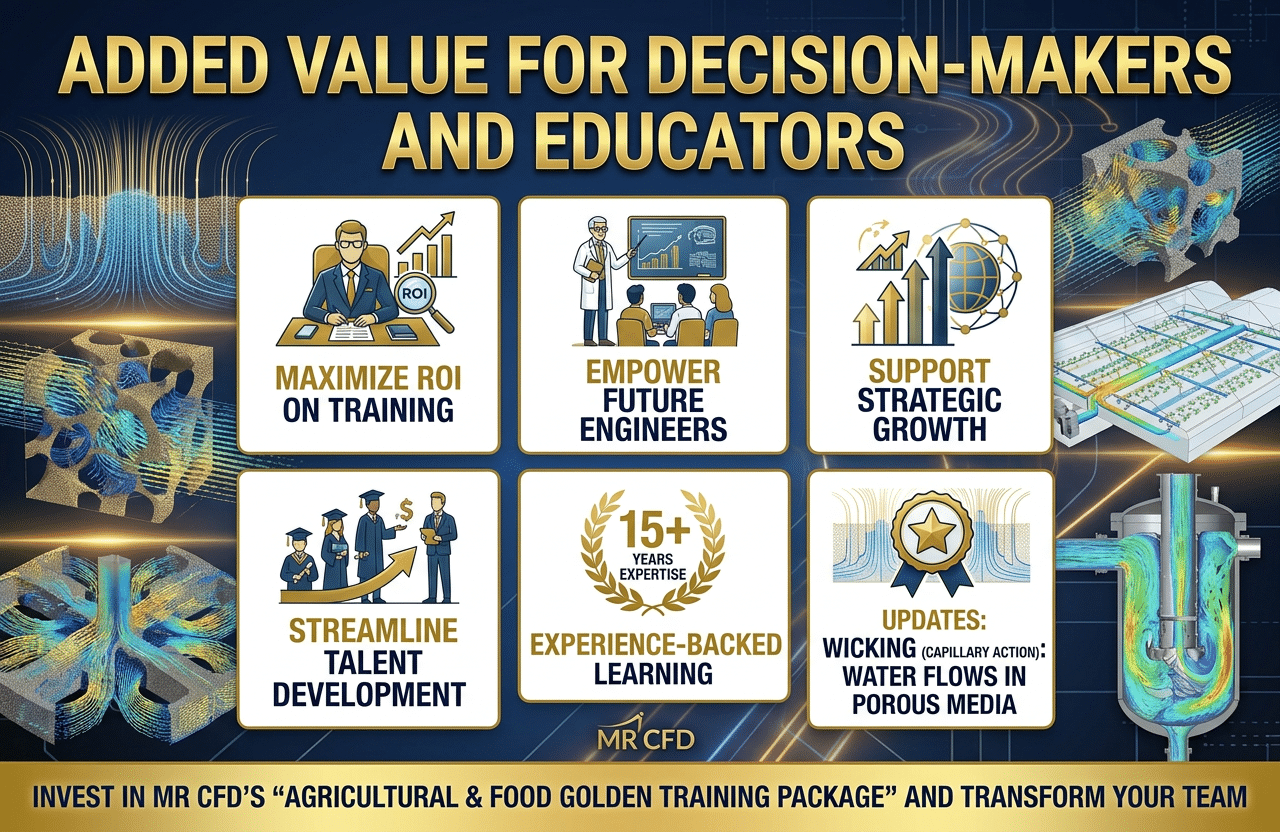
- Engineering Managers & Technical Decision-Makers: Organizational leaders seeking to rapidly upskill engineering teams in agricultural CFD simulation capabilities without the cost and time burden of custom training program development.
Why MR CFD Delivers Unmatched Agricultural Engineering Simulation Training
MR CFD brings over 15 years of focused CFD consulting and simulation training expertise to every course in its portfolio. This agricultural and food engineering course reflects that depth through several defining quality standards:
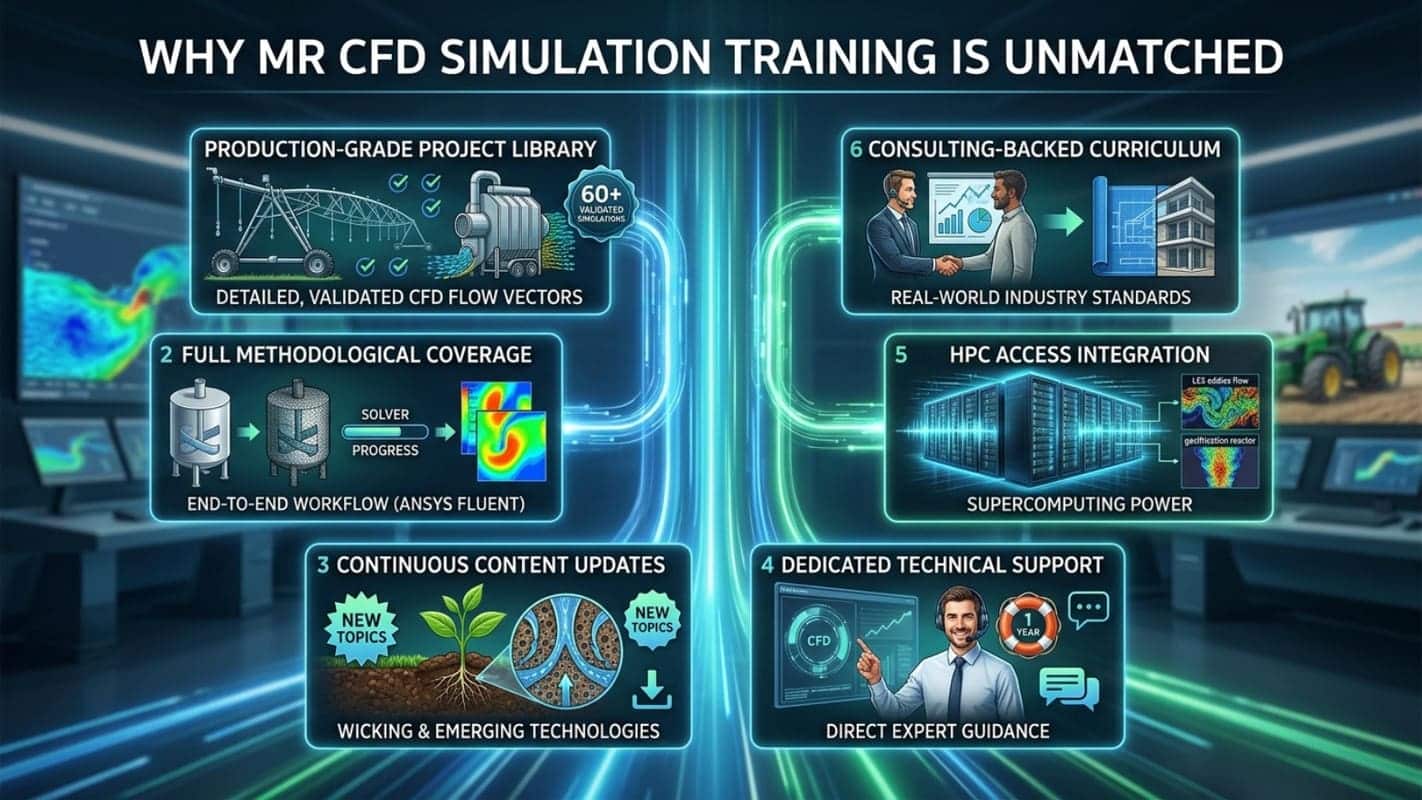
- Production-Grade Project Library: Every one of the 60+ simulations is built to industry-standard quality, with verified solver settings, validated mesh configurations, and professionally documented results — not simplified academic demonstrations.
- Full Methodological Coverage: From geometry creation and meshing through solver configuration, convergence management, and advanced post-processing, every stage of the ANSYS Fluent simulation workflow is explicitly taught.
- Continuous Content Updates: The course library receives ongoing additions — including emerging topics such as wicking and capillary action in porous agricultural media — ensuring perpetual relevance to evolving industry practice.
- Dedicated Technical Support: Enrolled learners receive one year of non-limited technical support from MR CFD’s expert simulation engineers — providing direct access to professional guidance on course content and project-specific challenges.
- HPC Access Integration: Course enrollment includes access to MR CFD’s ANSYS HPC, enabling learners to run computationally intensive simulations — such as LES open channel flows and reactive gasification cases — at professional processing speeds.
- Consulting-Backed Curriculum: MR CFD’s active CFD consulting services practice directly informs course content, ensuring that simulation methodologies reflect current industrial standards and real client project requirements.
Learning Progression Path and Advanced CFD Training Continuation
This course is architected to serve learners across a defined competency progression:
- Beginner Level: Foundational projects including open channel flow, greenhouse ventilation, and basic hydraulic jump simulation build core solver familiarity and physical intuition.
- Intermediate Level: Projects such as fluidized bed reactor with reactions, spray drying chamber DPM simulation, and stepped spillway VOF analysis develop multi-physics modeling confidence.
- Advanced Level: LES turbulence modeling for open channel flows, CHEMKIN-integrated gasification, RSM optimization workflows, and paper numerical validation projects develop research-grade simulation proficiency.
Upon completing this course, learners are well-positioned to advance into specialized training tracks in multiphase flow modeling, reactive flow and combustion CFD, hydraulic structure optimization, or advanced turbulence modeling — all available through MR CFD’s expanding CFD course online. Engineers seeking to apply these skills in a structured professional context may also explore MR CFD’s CFD internship, which provides mentored project experience in live engineering simulation environments.
Begin Your Agricultural and Food CFD Simulation Training Today
The demand for engineers proficient in agricultural CFD simulation and food engineering computational modeling is accelerating across every sector of the global agricultural and food technology economy. This Agricultural and Food Engineering Complete CFD Course from MR CFD provides the most comprehensive, technically rigorous, and industrially validated training pathway available — built on 60+ real-world ANSYS Fluent simulation projects and backed by 15 years of professional consulting expertise.
Enroll today through MR CFD’s CFD training course portal and begin building the computational fluid dynamics competencies that define engineering excellence in agricultural hydraulics, food process simulation, bioenergy system design, and precision agriculture technology — from your first simulation to your most advanced research project.
You must be logged in to post a review.

 Talk On WhatsApp
Reviews
There are no reviews yet.