
FSI GOLDEN Training Course: +45 Simulations (All in One Course)
$899.00 Internship
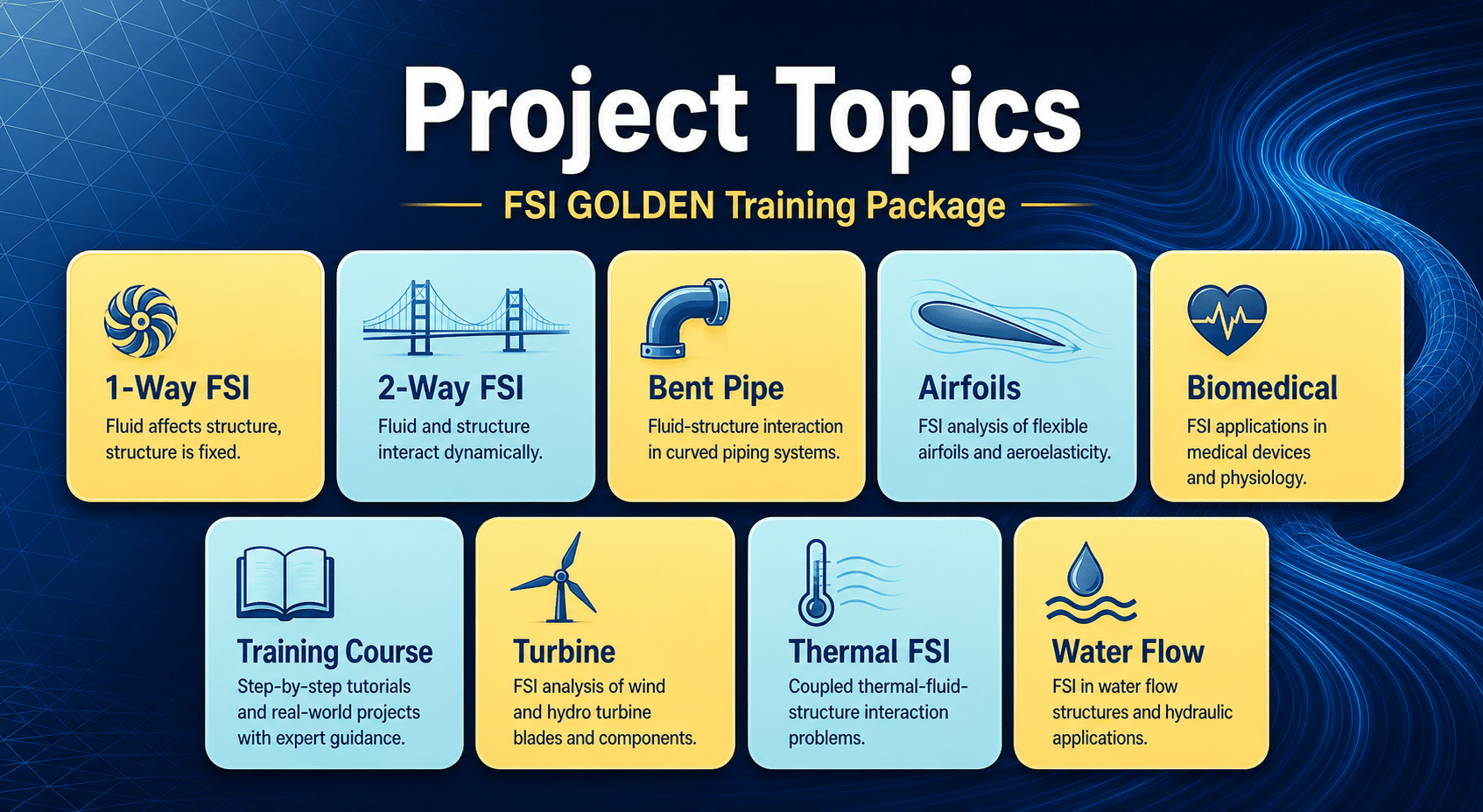
MR CFD’s FSI GOLDEN Training Package is a comprehensive library of 45+ ready-to-run ANSYS Fluent Fluid–Structure Interaction tutorials that enables engineers, professors, and decision-makers to quickly master FSI simulations—from basic concepts to advanced rotating machinery, airfoils, thermal FSI, biomedical flows, bent‑pipe slug flow, and water‑structure interaction cases—each covering geometry, meshing, solver setup, and advanced post‑processing, while offering rapid onboarding, consistent training materials for universities and companies, immediate project capability, cost savings versus custom training, plus 1‑year technical support and a 3‑month HPC credit to accelerate FSI project execution and research.
To Order Your Project or benefit from a CFD consultation, contact our experts via email (info@mr-cfd.com), online support tab, or WhatsApp at +44 7443 197273.
There are some Free Products to check our service quality.
If you want the training video in another language instead of English, ask it via info@mr-cfd.com after you buy the product.
Description
Fluid Structure Interaction Complete CFD Course: +45 ANSYS Fluent Simulations
In modern engineering, the boundary between fluid mechanics and structural analysis is not a wall — it is a dynamic, physics-rich interface that governs the performance, safety, and longevity of critical systems. Fluid-structure interaction (FSI) simulation has become an indispensable competency for engineers working on wind turbines, cardiovascular devices, aerospace structures, and industrial piping systems. Yet mastering FSI CFD simulation demands more than theoretical knowledge — it requires structured, hands-on exposure to real-world coupled CFD-FEA workflows using industry-standard tools.
The FSI Comprehensive Training Course by MR CFD delivers exactly that. With over 45 fully pre-simulated ANSYS Fluent projects spanning beginner to advanced levels, this course is the most complete fluid-structure interaction training resource available for engineering professionals, researchers, and simulation specialists. Explore the full library of CFD training courses and position yourself at the forefront of multiphysics simulation expertise.
Why Fluid Structure Interaction Simulation Is a Non-Negotiable Engineering Competency
Fluid-structure interaction governs the behavior of virtually every engineering system where a fluid contacts a deformable solid. Ignoring this coupling in design and analysis leads to catastrophic underestimation of fluid-induced vibration, thermal stress, fatigue loading, and structural failure risk. Industries from renewable energy to biomedical engineering are demanding engineers who can execute two-way FSI analysis, validate aeroelastic behavior, and interpret structural deformation under fluid loading with precision.
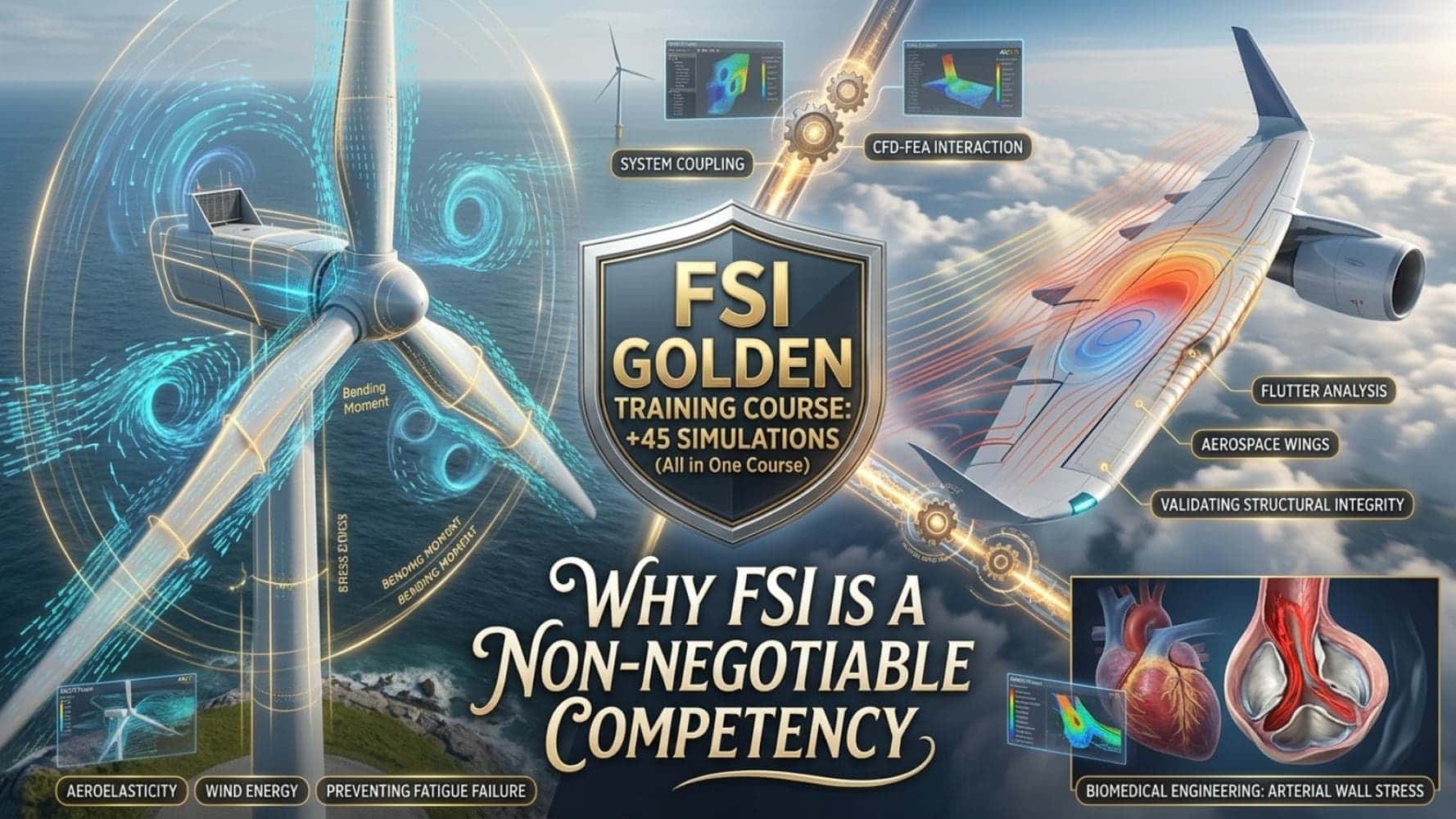
The global push toward lighter, more flexible structures in aerospace and wind energy has made FSI simulation ANSYS Fluent workflows a standard requirement in engineering teams. Simultaneously, the biomedical sector’s reliance on biomechanical flow simulation for cardiovascular device design has created a parallel demand for FSI-competent researchers. According to industry hiring trends, proficiency in coupled CFD-FEA analysis and ANSYS System Coupling is now listed as a required — not preferred — skill in simulation engineering roles across aerospace, energy, and medical device sectors.
For academic institutions, FSI CFD course content that covers both one-way FSI and two-way FSI methodologies is increasingly required to prepare graduates for immediate industrial contribution. The gap between traditional fluid mechanics curricula and the multiphysics simulation workflow demands of modern employers is substantial — and this course is engineered to close it.
Core Technical Competencies Delivered by This FSI Simulation Training
This FSI comprehensive training course builds a structured, layered skill set across four critical engineering dimensions:
Technical Simulation Skills:
- Configuring one-way FSI and two-way FSI coupling setups in ANSYS Fluent and ANSYS Structural
- Implementing ANSYS System Coupling for bidirectional data exchange between fluid and structural solvers
- Applying dynamic mesh techniques including spring-based smoothing, diffusion smoothing, and local remeshing
- Setting up thermal FSI analysis with conjugate heat transfer and thermally induced structural deformation
Modeling & Geometry Skills:
- Constructing FSI-compatible geometries in ANSYS SpaceClaim and DesignModeler
- Defining fluid-structure interface boundaries for accurate load transfer
- Handling moving boundary fluid simulation for large-deformation FSI problems
Solver Settings & Convergence:
- Configuring pressure-velocity coupling schemes appropriate for FSI transient simulations
- Selecting turbulence modeling strategies (k-ω SST, k-ε) for FSI applications
- Managing FSI convergence criteria and coupling iteration controls in ANSYS System Coupling
- Applying non-Newtonian fluid simulation models for biomedical FSI cases
Validation & Verification Skills:
- Performing mesh independence studies for coupled solver validation
- Comparing FSI results against published experimental and numerical benchmarks
- Interpreting fluid-induced stress analysis outputs including displacement, von Mises stress, and pressure contours
Comprehensive Course Modules & Simulated FSI Projects
Foundational FSI Concepts and System Coupling Architecture
The course opens with a rigorous treatment of fluid-structure interaction concepts within the ANSYS Fluent environment. Learners are introduced to the physics of structural deformation under fluid loading, the mathematical formulation of the FSI interface condition, and the architectural differences between one-way FSI and two-way FSI coupling strategies. Dedicated modules cover ANSYS System Coupling configuration from the ground up — including solver sequencing, data transfer mapping, and convergence monitoring. This foundational layer ensures that every subsequent simulation project is approached with a complete understanding of the underlying multiphysics simulation workflow, not merely procedural button-clicking.
One-Way FSI Simulation: Flow Probe and HAWT Turbine Vibration
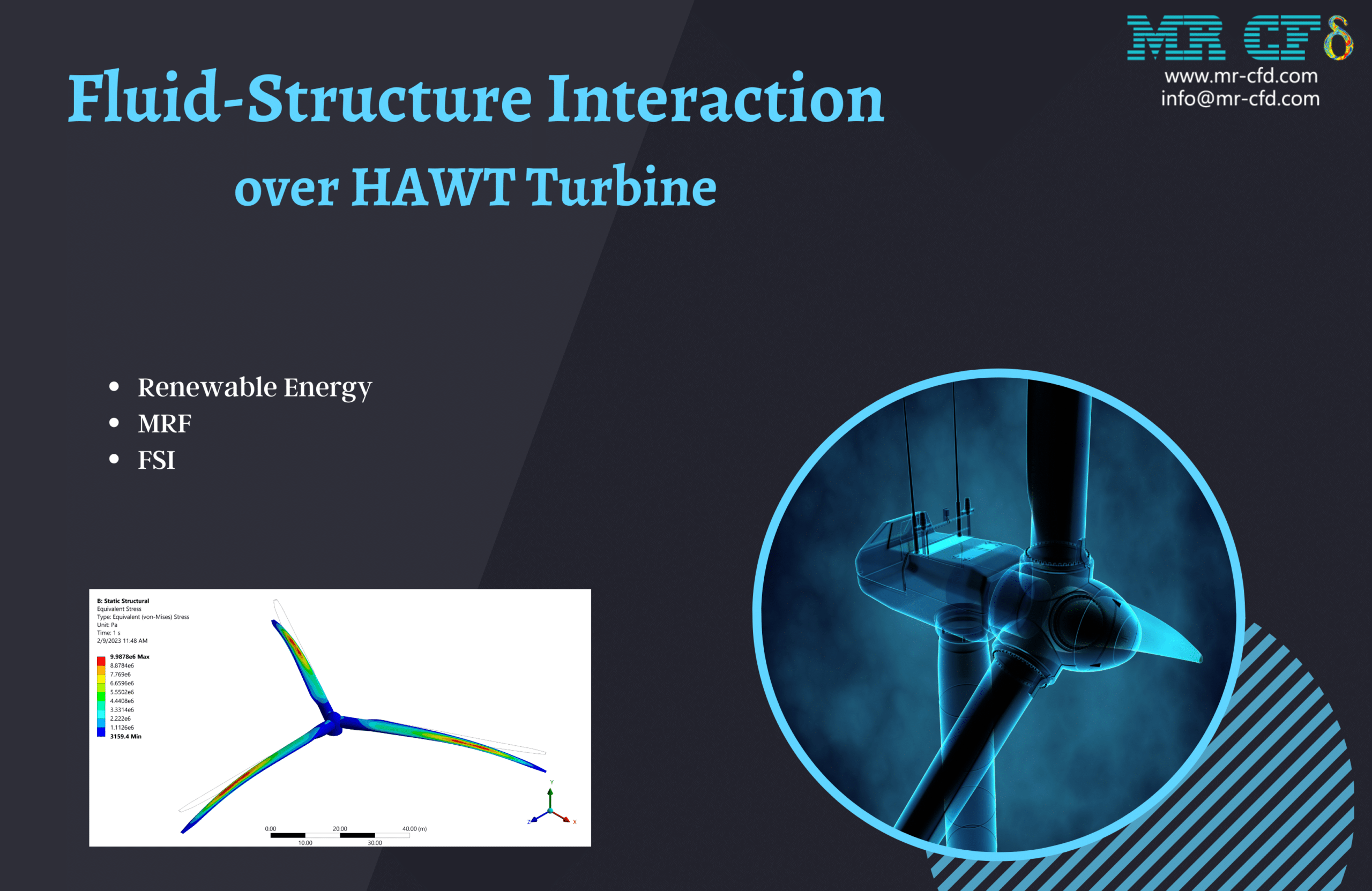
One-way FSI modules introduce learners to the most computationally efficient form of fluid-structure interaction simulation. The Flow Probe project demonstrates how fluid pressure fields are extracted from ANSYS Fluent and mapped onto structural meshes to compute deformation and stress without iterative coupling. The HAWT (Horizontal Axis Wind Turbine) turbine vibration one-way case applies this methodology to a full-scale wind turbine blade, computing fluid-induced vibration and structural response under aerodynamic loading. These projects establish the workflow discipline required before progressing to fully coupled two-way FSI analysis.
Two-Way FSI Analysis: Wind Turbine Blades, Flaps, and Bent Pipe Systems
The two-way FSI module suite represents the technical core of this course. Projects include wind turbine blade aeroelastic analysis — where blade deformation feeds back into the aerodynamic solver through dynamic mesh updates — and a flap deflection FSI simulation modeling control surface aeroelasticity. The bent pipe two-way FSI project simulates slug flow CFD simulation and fluid-structure interaction in a curved pipe geometry, capturing pressure surge-induced pipe wall deformation with full bidirectional coupling. Each project details the FSI convergence criteria, coupling timestep selection, and mesh morphing strategies required for stable, accurate two-way solutions.
Thermal FSI Analysis: Gas Turbines, T-Junctions, and Manifold Systems
Thermal FSI analysis modules address the coupling of heat transfer and structural mechanics — a critical requirement for high-temperature engineering systems. The gas turbine thermal FSI project simulates hot combustion gas flow over turbine blades, computing thermally induced stress and displacement using ANSYS System Coupling with conjugate heat transfer. The T-junction thermal FSI case models thermal mixing and the resulting thermal fatigue loading on pipe walls. The manifold two-way thermal FSI project extends this to a multi-branch flow geometry, demonstrating how thermal FSI workflows scale to complex industrial geometries. These modules directly address the engineering bottlenecks in power generation, process engineering, and HVAC system design.
Airfoil Aeroelastic FSI: NACA 0014, High-Speed Airfoils, and Vibration Analysis
The airfoil FSI module cluster delivers specialized training in aeroelastic analysis CFD — one of the most demanding and industrially critical FSI simulation domains. The NACA 0014 FSI analysis project computes aerodynamic forces and the resulting structural response across a range of angles of attack. A dedicated high-speed airfoil FSI project addresses compressibility effects and their interaction with structural deformation. The airfoil vibration FSI case models flutter onset and limit-cycle oscillation, providing learners with direct exposure to the fluid-induced vibration phenomena that govern aerospace structural design limits. All airfoil projects use dynamic mesh and pressure-velocity coupling configurations appropriate for transient aeroelastic regimes.
Biomedical and Cardiovascular FSI Simulation
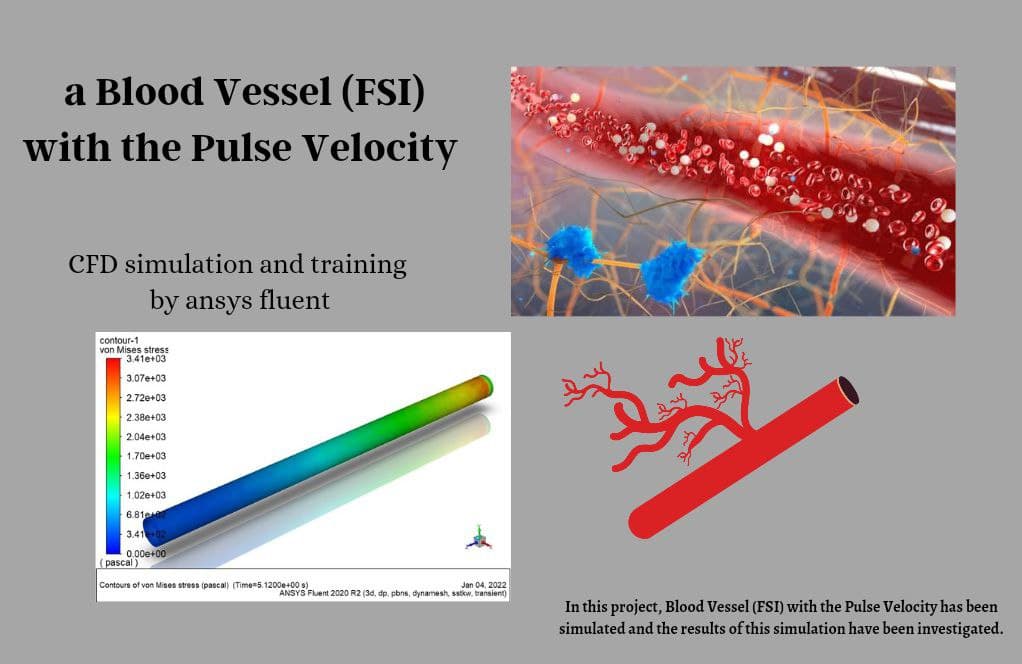
This module addresses the rapidly growing field of biomechanical flow simulation applied to cardiovascular engineering. Projects include aortic valve displacement CFD simulation, where fluid pressure drives valve leaflet deformation through a fully coupled two-way FSI setup. The blood vessel FSI with pulse velocity project models pulsatile hemodynamic loading on compliant arterial walls, computing wall shear stress and displacement under physiological flow conditions. The lumen blood vessel non-Newtonian FSI case introduces non-Newtonian fluid simulation using the Carreau or Power-Law viscosity model, capturing the shear-thinning behavior of blood in small-diameter vessels. The artery FSI project integrates all these elements into a clinically representative simulation of arterial wall mechanics under pathological flow conditions.
Turbine FSI Simulations: Pelton, Vertical Axis Water Turbines, and MRF Method
The turbine FSI module covers both hydraulic and wind energy conversion systems. The Pelton turbine FSI project simulates high-velocity water jet impact on turbine buckets, computing structural stress and deformation under impulsive hydraulic loading. Vertical axis water turbine (VAWT) FSI projects implement the MRF (Multiple Reference Frame) method in ANSYS Fluent to model rotational effects while capturing blade-fluid coupling. The FSI method for water turbine vibration project focuses on resonance prediction and fatigue-critical operating conditions. These modules provide direct preparation for engineering roles in hydropower, tidal energy, and wind energy sectors.
Water Flow FSI: Open Channel Structures, Net Panels, and Marine Applications
The water flow FSI module addresses hydroelastic analysis simulation in open-channel and marine environments. The rope and sphere structural response project models a coupled CFD-FEA analysis of flexible structures in open channel flow, computing drag-induced deformation and tension. The net panel displacement project simulates hydrodynamic loading on aquaculture net structures, directly applicable to offshore fish farming engineering. The FSI analysis for a ball in water flow provides a canonical validation case for structural deformation under fluid loading. The fish cage floating on seawater FSI project integrates buoyancy, wave loading, and structural flexibility into a comprehensive marine FSI simulation — one of the most complex projects in the course.
Professional Engineering Skills Developed Through FSI CFD Simulation Training
| Skill Category | Specific Competencies Developed |
|---|---|
| CFD Simulation Skills | One-way FSI setup, two-way FSI coupling, dynamic mesh configuration, transient solver management |
| Structural Analysis Skills | Thermal stress computation, fluid-induced deformation analysis, fatigue load interpretation |
| Multiphysics Workflow | ANSYS System Coupling orchestration, interface mapping, convergence monitoring |
| Turbulence Modeling | k-ω SST, k-ε selection and configuration for FSI-relevant flow regimes |
| Post-Processing | Displacement contours, von Mises stress visualization, pressure-structure correlation |
| Validation & Verification | Mesh independence studies, benchmark comparison, coupled solver validation |
| Industry Workflows | Biomedical FSI, aeroelastic analysis, hydroelastic simulation, thermal FSI |
Real-World Industrial Applications of Fluid-Structure Interaction Simulation
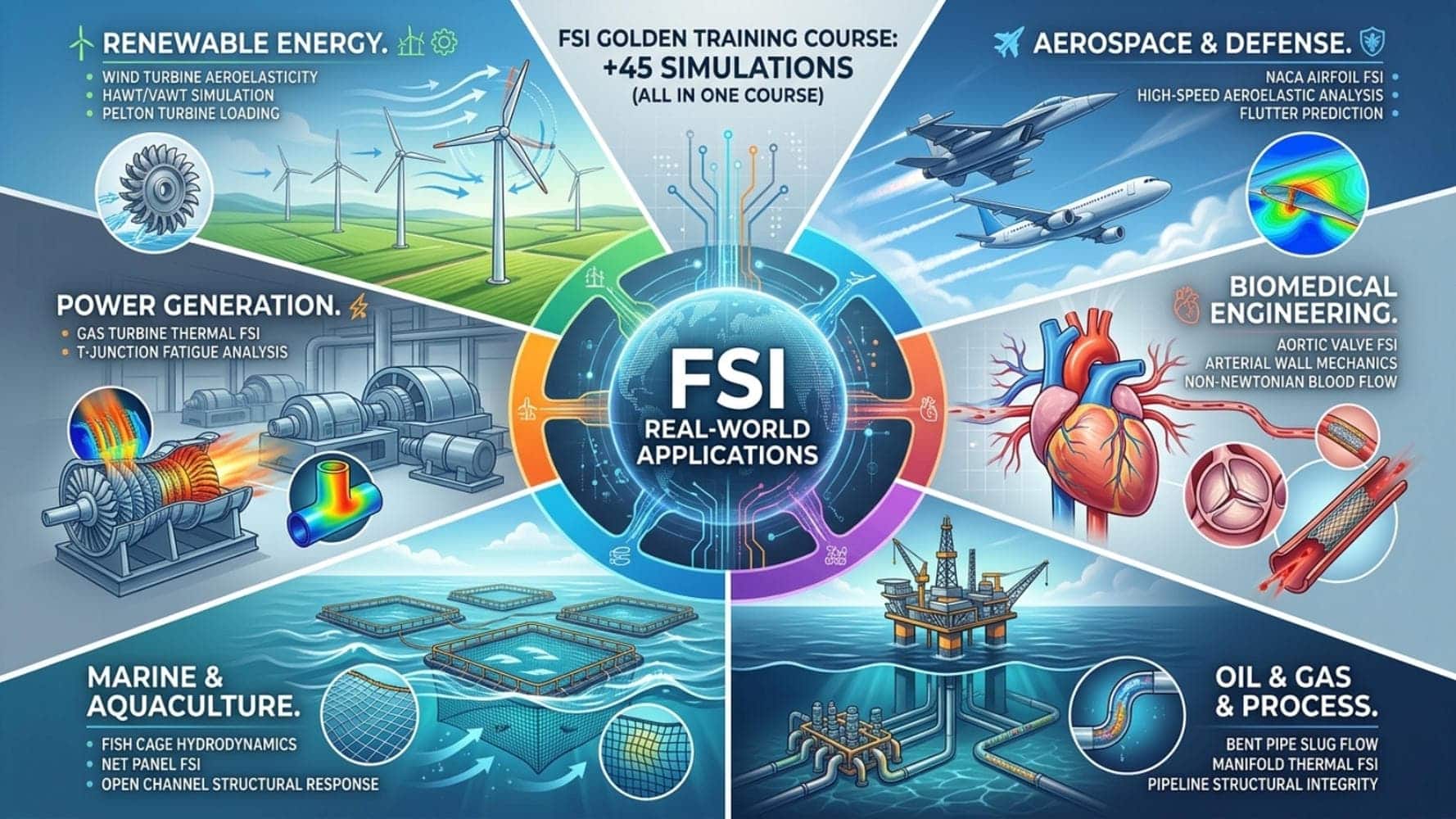
The engineering competencies delivered by this FSI comprehensive training course map directly to high-value industrial applications:
- Renewable Energy: Wind turbine blade aeroelastic analysis, VAWT and HAWT FSI simulation, Pelton turbine hydraulic loading — directly applicable to wind and hydropower engineering teams
- Aerospace & Defense: NACA airfoil FSI, high-speed aeroelastic analysis, flutter prediction — essential for aircraft structural design and certification workflows
- Biomedical Engineering: Aortic valve FSI, arterial wall mechanics, non-Newtonian blood flow simulation — critical for cardiovascular device development and regulatory simulation submissions
- Oil & Gas & Process Engineering: Bent pipe slug flow FSI, manifold thermal FSI, pipeline structural integrity — directly applicable to subsea and process plant engineering
- Marine & Aquaculture: Fish cage hydrodynamics, net panel FSI, open channel structural response — relevant to offshore structure and aquaculture infrastructure design
- Power Generation: Gas turbine thermal FSI, T-junction fatigue analysis — applicable to power plant component life assessment and maintenance engineering
Who Should Enroll in This FSI Comprehensive CFD Training Course
This course is precisely calibrated for professionals who require production-grade FSI simulation competency:
- Engineering Students & Recent Graduates: Build the coupled CFD-FEA analysis skills that distinguish candidates in competitive simulation engineering job markets
- PhD Researchers & Academics: Access fully pre-simulated FSI CFD case studies for curriculum development, research validation, and graduate student training
- Industry Simulation Engineers: Accelerate project delivery by mastering ANSYS System Coupling, dynamic mesh, and two-way FSI workflows without extended self-learning periods
- Technical Managers & Engineering Leads: Evaluate and deploy this course as a structured onboarding and upskilling resource for FSI-capable engineering teams
- CFD Consulting Professionals: Expand service offerings into thermal FSI, biomedical FSI, and aeroelastic analysis with verified, production-tested simulation workflows
For engineers looking to extend their capabilities beyond simulation into professional project delivery, the CFD consulting services offered by MR CFD provide a direct pathway from training to applied industrial engagement.
Why MR CFD Delivers Unmatched FSI Simulation Training Authority
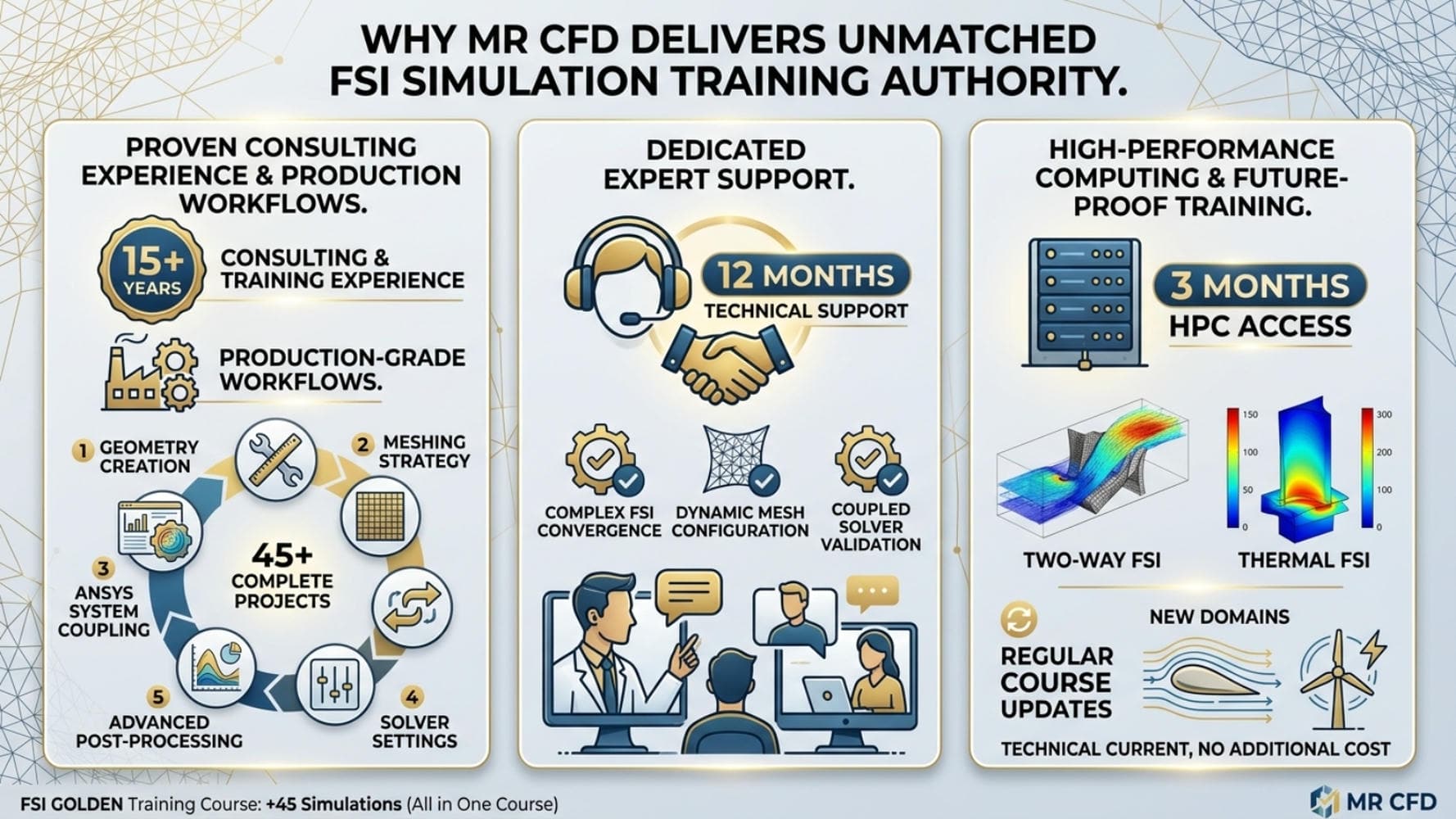
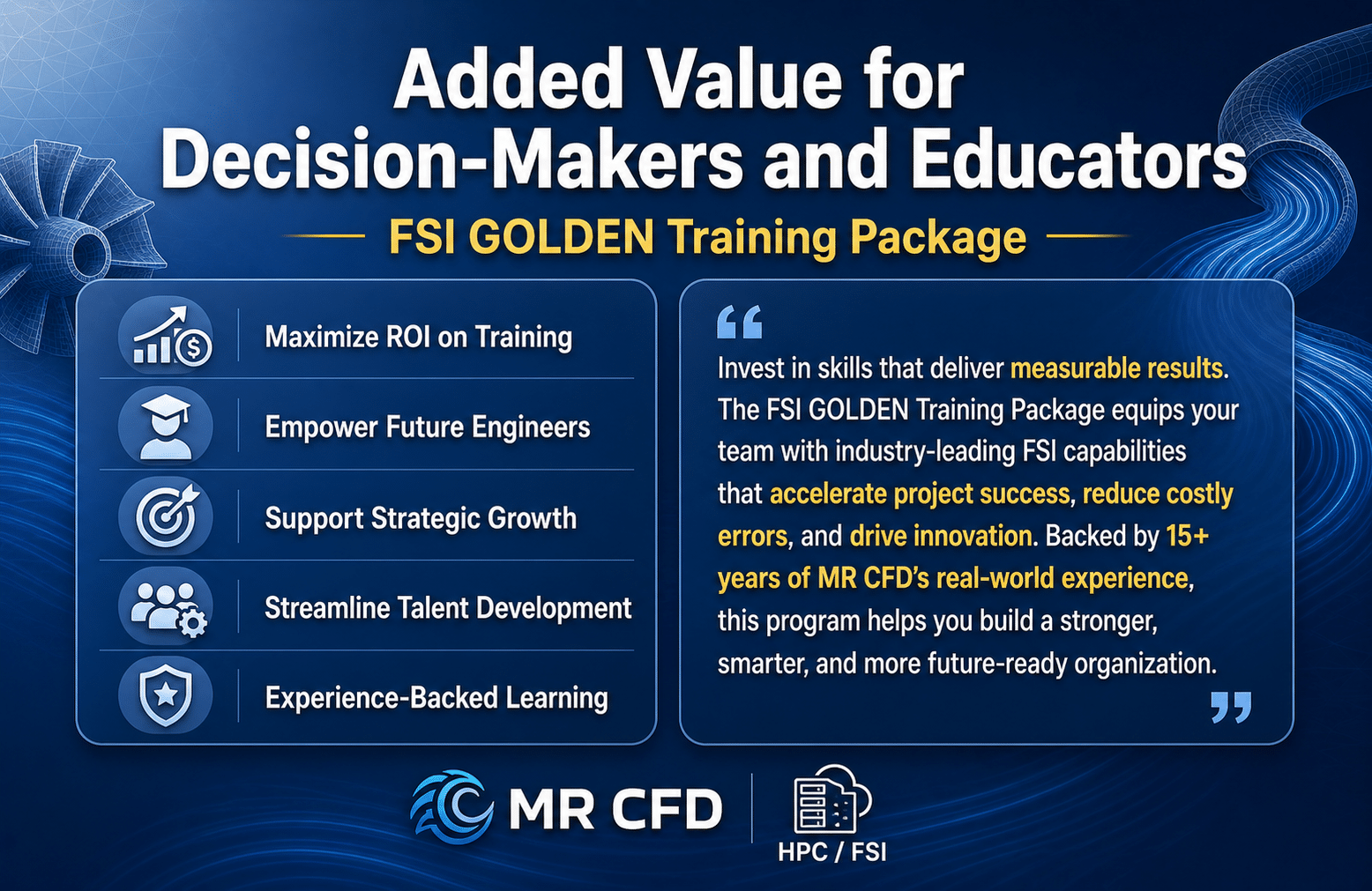
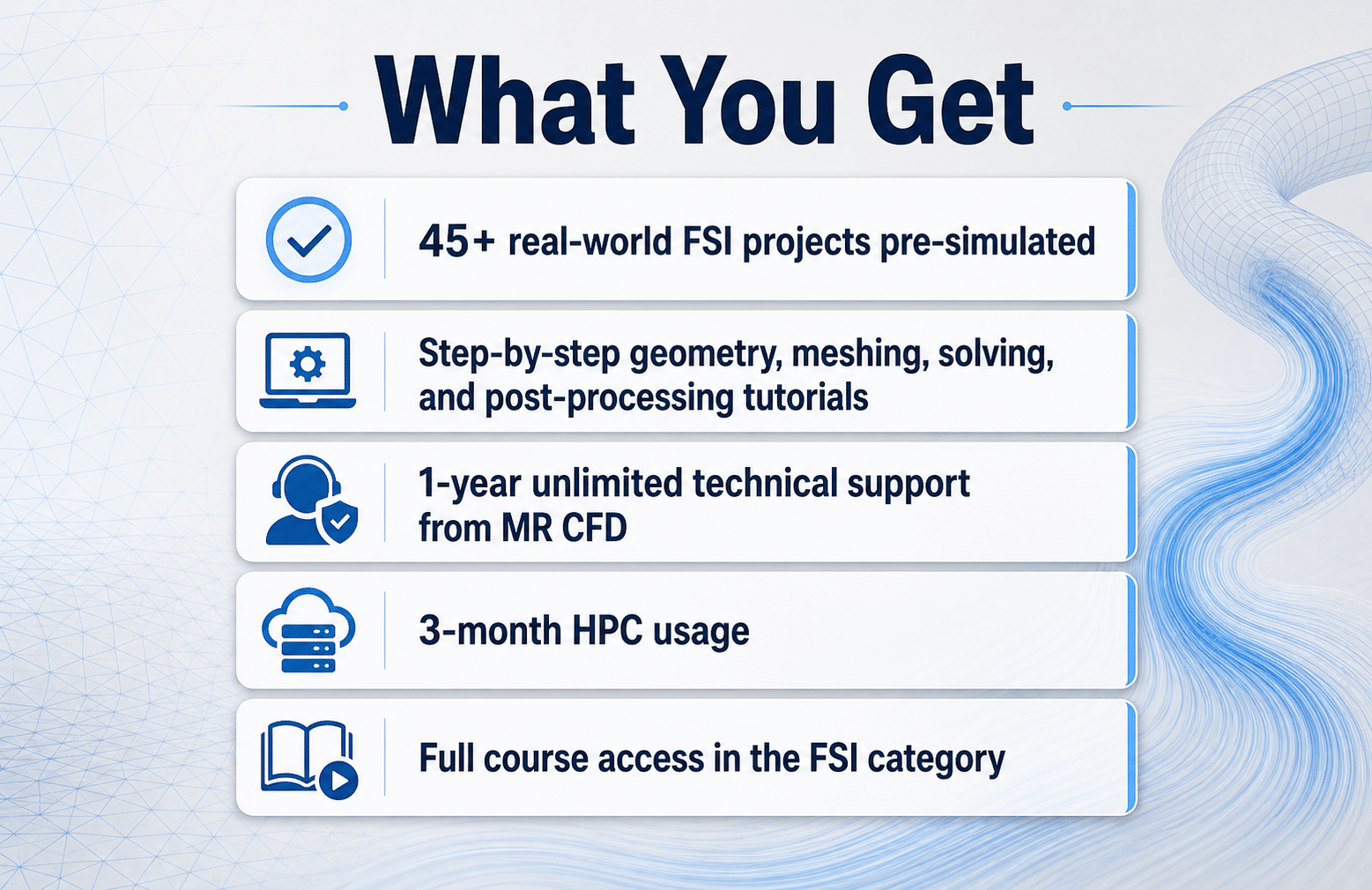
MR CFD brings over 15 years of applied CFD simulation consulting and training experience to every course in this library. The FSI comprehensive training course is not an academic exercise — every one of the 45+ projects is built from production-grade simulation workflows used in real engineering consulting engagements. All projects include step-by-step tutorials covering geometry creation, meshing strategy, ANSYS System Coupling configuration, solver settings, and advanced post-processing — the complete multiphysics simulation workflow from problem setup to engineering interpretation.
Enrolled learners receive 12 months of dedicated technical support from MR CFD simulation experts, ensuring that complex FSI convergence issues, dynamic mesh configuration challenges, and coupled solver validation questions are resolved with professional-grade guidance. Additionally, course enrollment includes access to 3 months of HPC (High-Performance Computing) resources, enabling learners to execute computationally intensive two-way FSI and thermal FSI simulations at full resolution without hardware limitations. Learn more about ANSYS HPC available to enrolled students.
The course library receives regular updates incorporating new FSI project domains — including FSI analysis on airfoils and emerging renewable energy applications — ensuring that your investment remains technically current without additional cost.
Educational Progression Path: From FSI Fundamentals to Advanced Multiphysics Mastery
This course is structured across three progressive competency tiers:
Beginner Level: FSI physics fundamentals, ANSYS System Coupling architecture, one-way FSI setup, basic dynamic mesh configuration, and introductory structural response interpretation
Intermediate Level: Two-way FSI analysis for turbines and bent pipe systems, thermal FSI workflows, non-Newtonian fluid simulation for biomedical cases, and aeroelastic airfoil analysis
Advanced Level: Full coupled CFD-FEA analysis for complex geometries (fish cage marine FSI, gas turbine thermal FSI, VAWT with MRF), advanced FSI convergence criteria management, and production-grade coupled solver validation
Engineers who complete this course are prepared to pursue advanced simulation specializations including high-fidelity aeroelastic certification workflows, biomechanical device simulation, and large-scale renewable energy FSI projects. The CFD internship program at MR CFD provides a structured pathway for applying these skills in a professional consulting environment, building a verified simulation portfolio under expert mentorship.
Enroll in the FSI Complete CFD Course and Engineer With Precision
Fluid-structure interaction simulation is not an optional advanced topic — it is a foundational competency for any engineer working on systems where fluid and structural physics are inseparably coupled. The FSI Comprehensive Training Course by MR CFD provides the most complete, industrially grounded, and technically rigorous FSI CFD training available, with 45+ ANSYS Fluent projects, 12 months of expert support, and HPC access included.
Every project in this course was built to solve real engineering problems — from wind turbine blade aeroelastic analysis to cardiovascular FSI simulation to gas turbine thermal FSI. The skills you develop here are directly transferable to engineering roles, research programs, and consulting engagements on day one.
Access the complete course catalog and begin your FSI simulation training through the MR CFD learning hub. Transform your engineering simulation capability, validate your expertise with production-grade projects, and master the coupled CFD-FEA workflows that define modern multiphysics engineering practice.
You must be logged in to post a review.
Related products
-
Sale

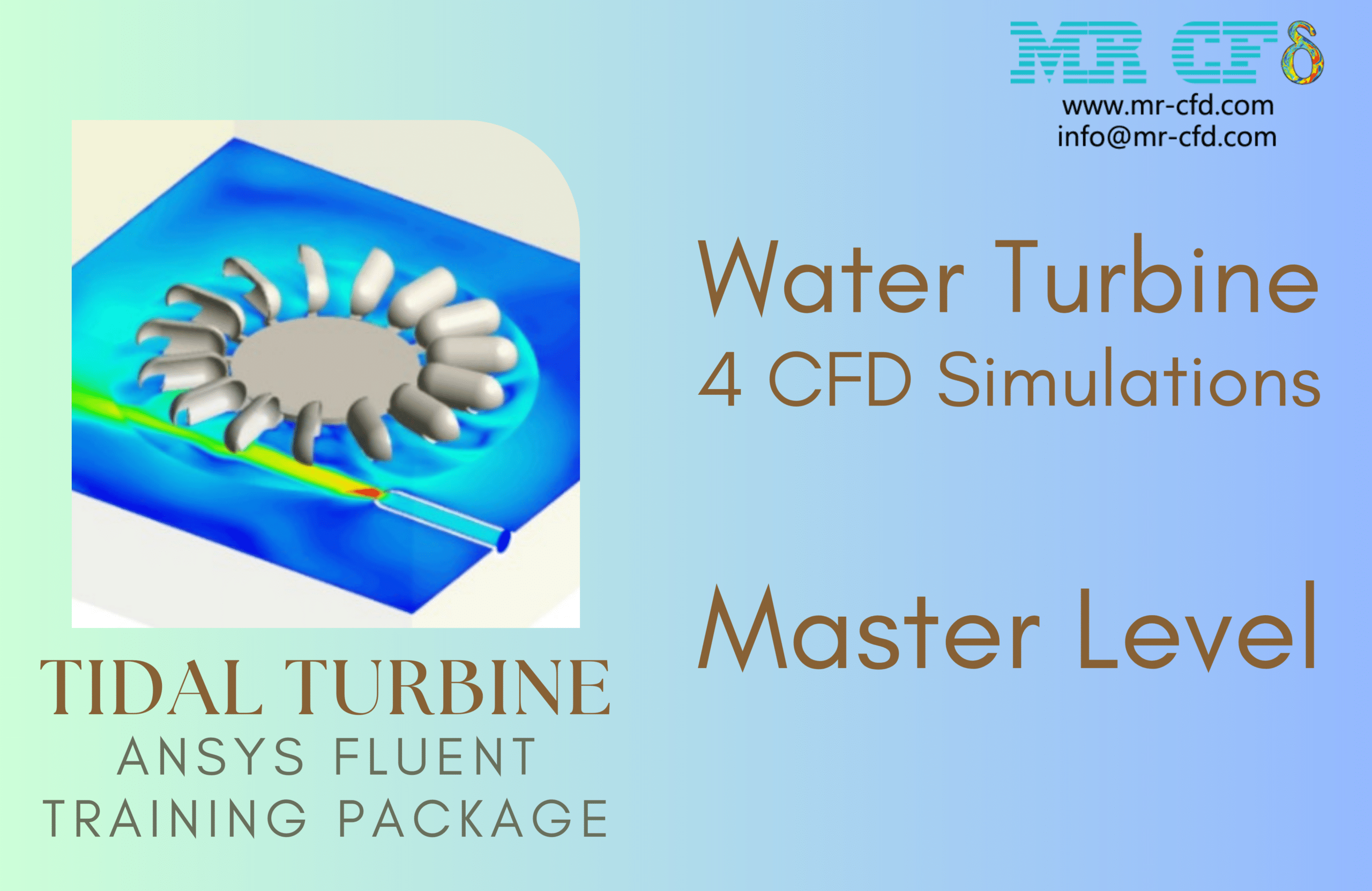
Water Turbine (Tidal Turbine): ANSYS Fluent Training Package, 4 Master CFD Simulations
Original price was: $1,110.00.$399.00Current price is: $399.00. Internship
 Talk On WhatsApp
Reviews
There are no reviews yet.