
Gas Turbine: Thermal FSI ANSYS Fluent CFD Simulation
$240.00 Internship
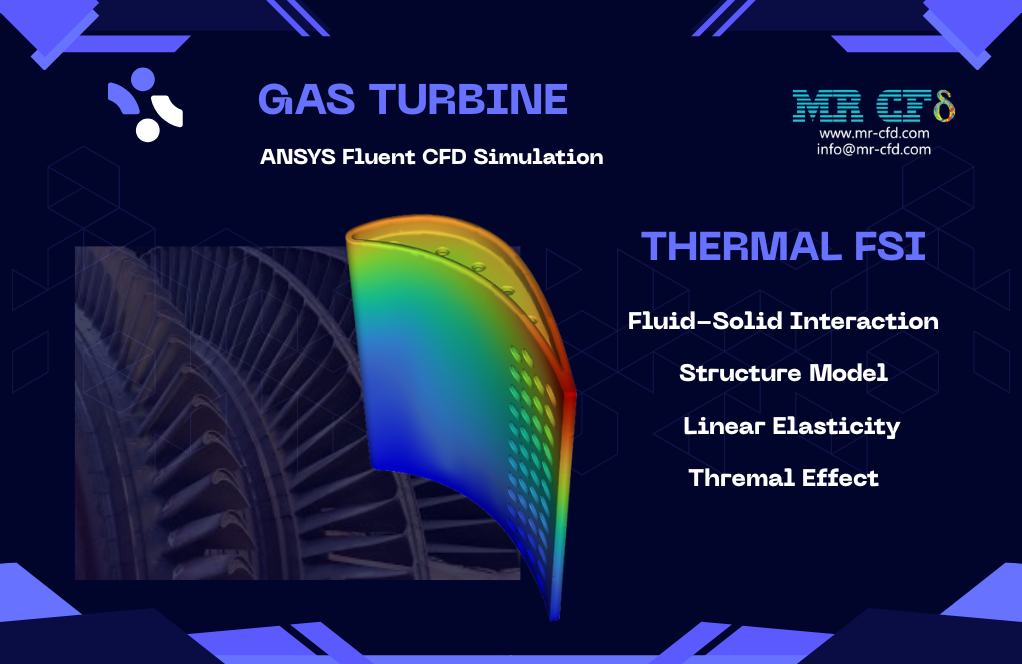
- This product numerically simulates a Turbine Gas Blade deformation using ANSYS Fluent software.
- This project is implemented as a Thermal Fluid-Structure Interaction (FSI) approach.
- We design the 3-D model in the Design Modeler software and mesh it in the ANSYS Meshing software.
- We use the Structure Model to consider the computation between the fluid and the structure.
- We use the Linear Elasticity method to define the solid deformation.
To Order Your Project or benefit from a CFD consultation, contact our experts via email (info@mr-cfd.com), online support tab, or WhatsApp at +44 7443 197273.
There are some Free Products to check our service quality.
If you want the training video in another language instead of English, ask it via info@mr-cfd.com after you buy the product.
Description
Description
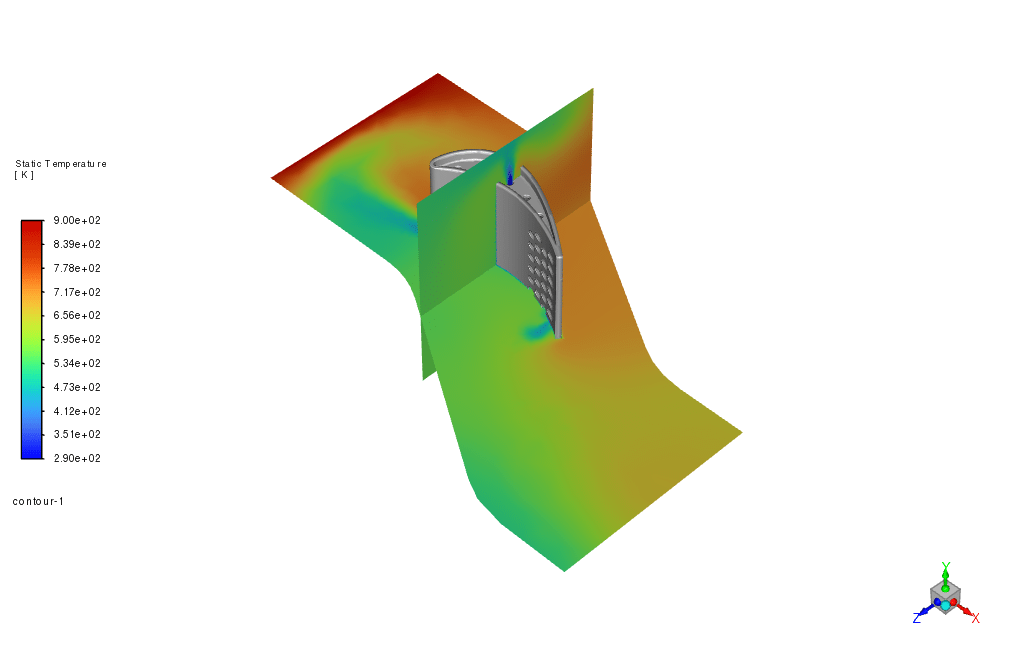
In this project, we present the CFD simulation of a Gas Turbine Blade under Thermal FSI in ANSYS Fluent software.
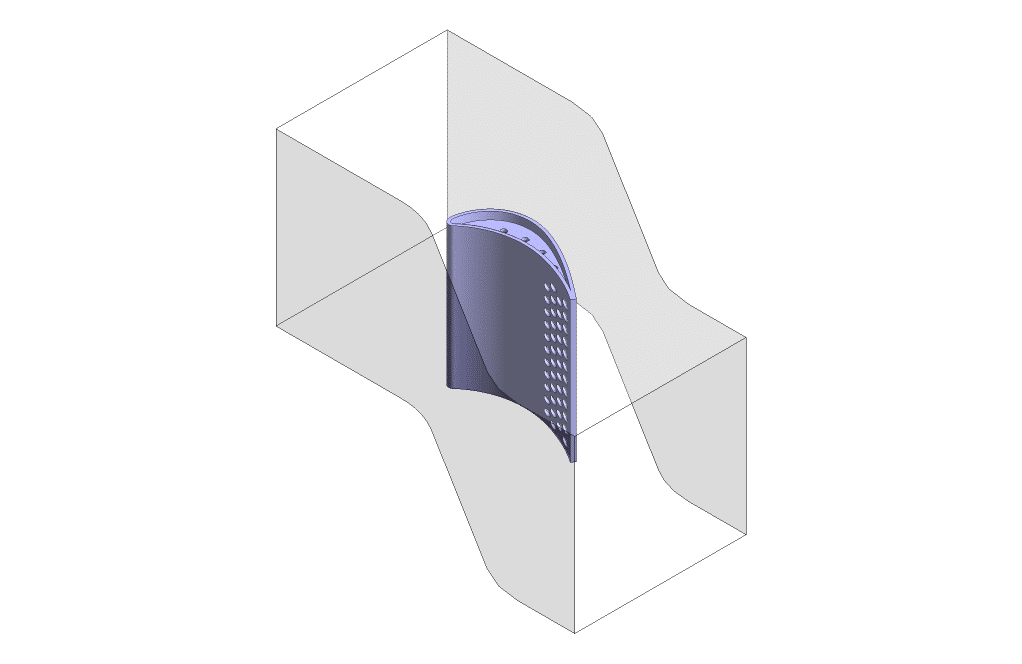
We studied a gas turbine. Since the gas turbine has a symmetrical construction and the blade stages have a uniform configuration, we limited to studying a single blade. This blade has an internal channel with fine holes for cooling.
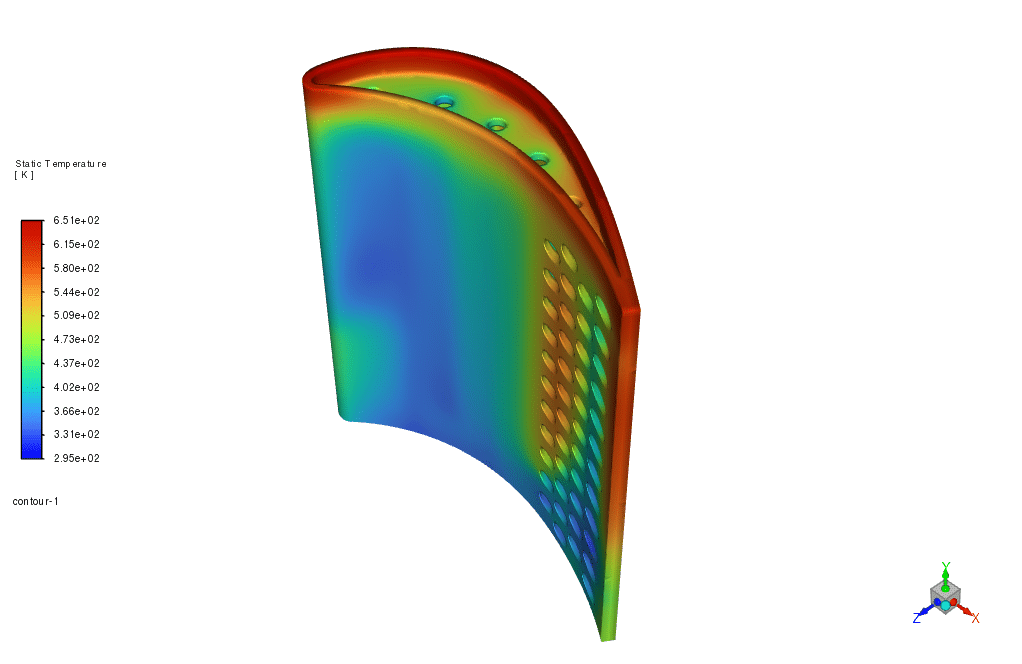
On the one hand, hydraulic fluid flow can generate a pressure load on the inner wall of the blade, and on the other hand, hot fluid flow may produce a thermal load on the blade wall.
Therefore, we intend to analyze the fluid-structure interaction, which is known as FSI. As we also aim to take into account the thermal effect, it is called the thermal FSI.
Note that since we want to just analyze the effect of the fluid’s motion and thermal loads on the blade wall, without the effect of blade deformation on the neighboring fluid flowing, we use a one-way FSI approach.
Methodology
First, we modeled the computational domain in Design Modeler software. We designed a domain corresponding to the airflow, with a blade inside it, and air can flow inside the blade for the purpose of cooling.
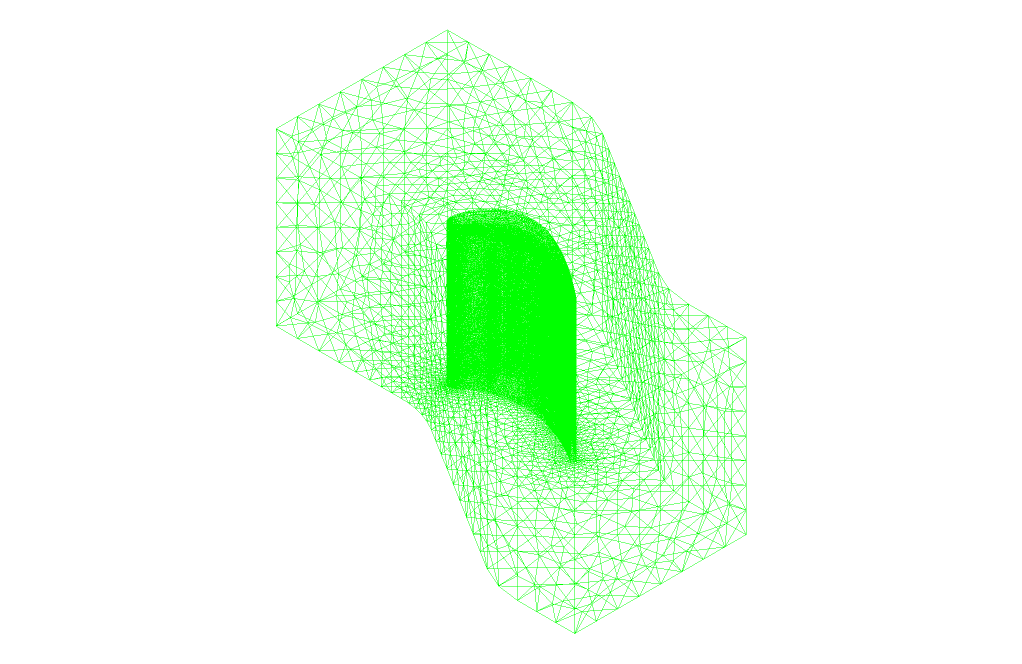
Next, we meshed all domains in ANSYS Meshing software, so that about 1,665,000 elements were generated.
Finally, we performed the numerical simulation of the flow pipe in ANSYS Fluent.
Typically, an external solver is used as a system coupling to define data transfer between the fluid and structural solvers. However, in this project, we utilized the Fluent solver to model the fluid and solid interaction (without the need for an extrinsic solver).
This approach is known as intrinsic FSI. For this purpose, we used the Structure model to analyze FSI. Then, we used the linear elasticity method for structural analysis, meaning that the structure’s deformation is proportional to the amount of force exerted by the fluid.
Conclusion
After the calculation process, we represent the analysis from the perspective of the interaction between fluids and solids.
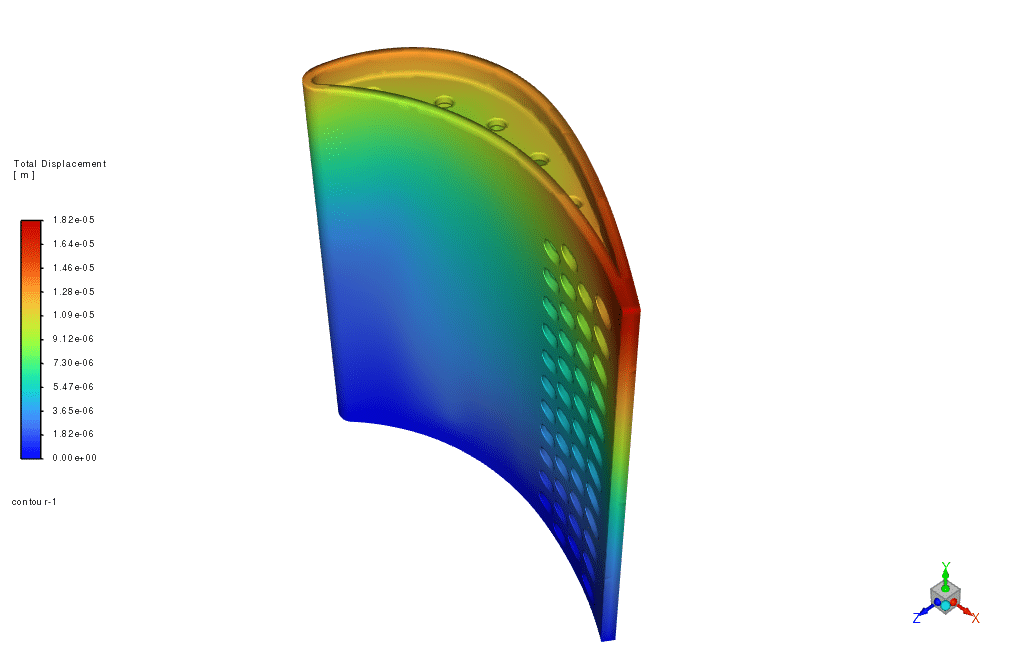
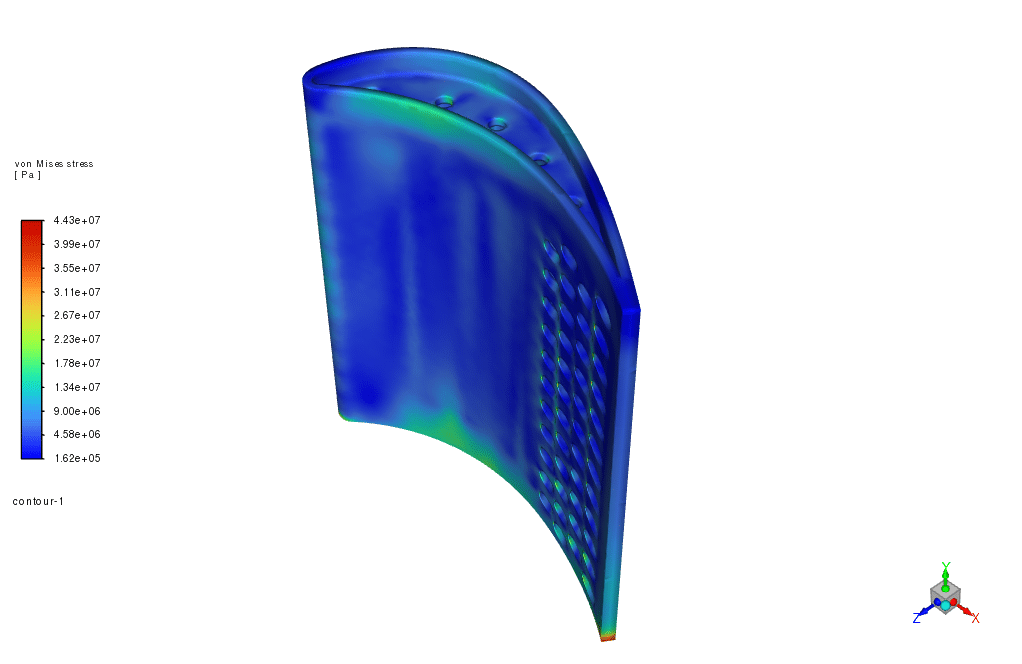
Therefore, we obtained the contour of distribution of the total displacement and von Mises stress for the inner wall of the blade.
The results showed that the highest deformation and stress appear in the upper regions of the blade, where it is farthest from the blade’s bottom support. In addition, since the upper part of the blade is exposed to the least internal cooling, the highest thermal stress may appear.
You must be logged in to post a review.

 Talk On WhatsApp
Reviews
There are no reviews yet.