
Radiation GOLDEN Training Package: +70 Simulations (All in One Course)
$1,399.00 Internship
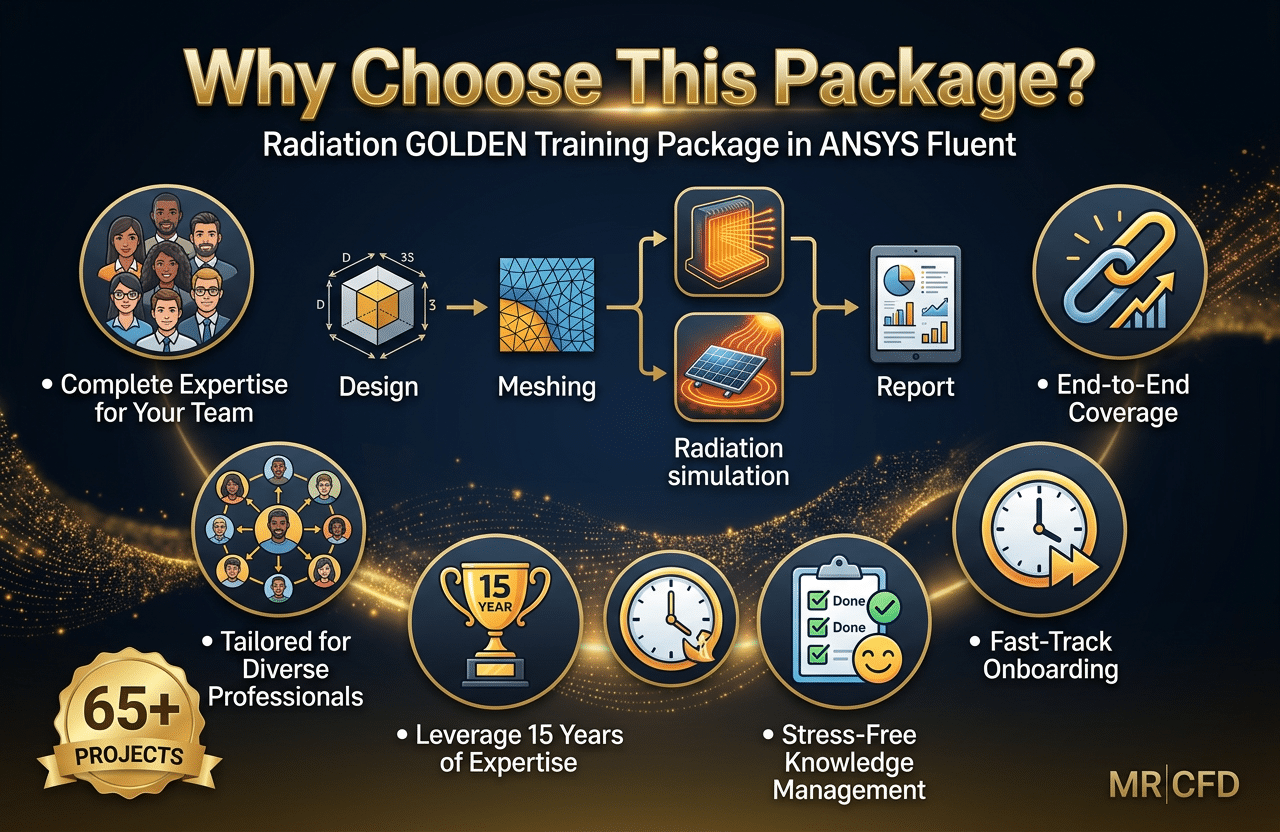
MR CFD’s Radiation GOLDEN Training Package offers mastering all major radiation models: Discrete Ordinates (DO), DTRM, P1, Rosseland, S2S, and Monte Carlo.
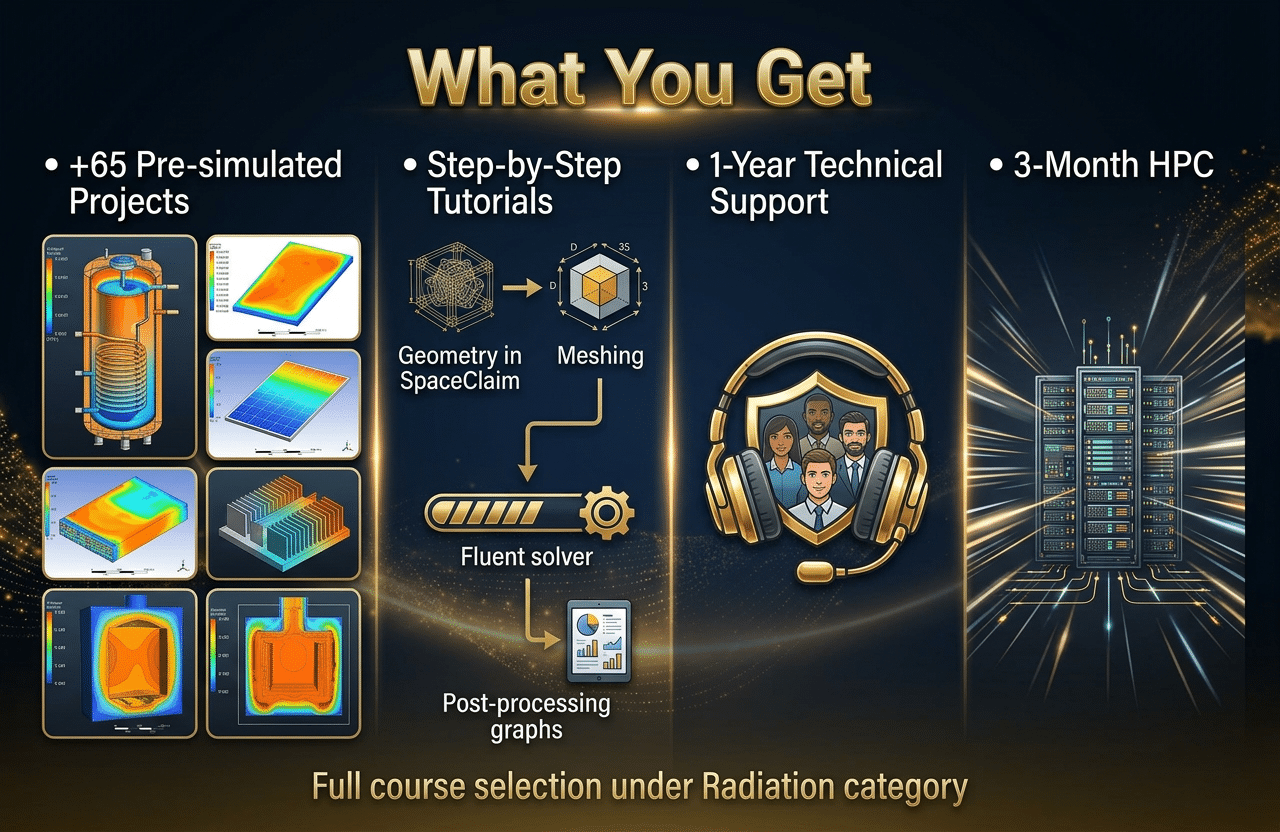
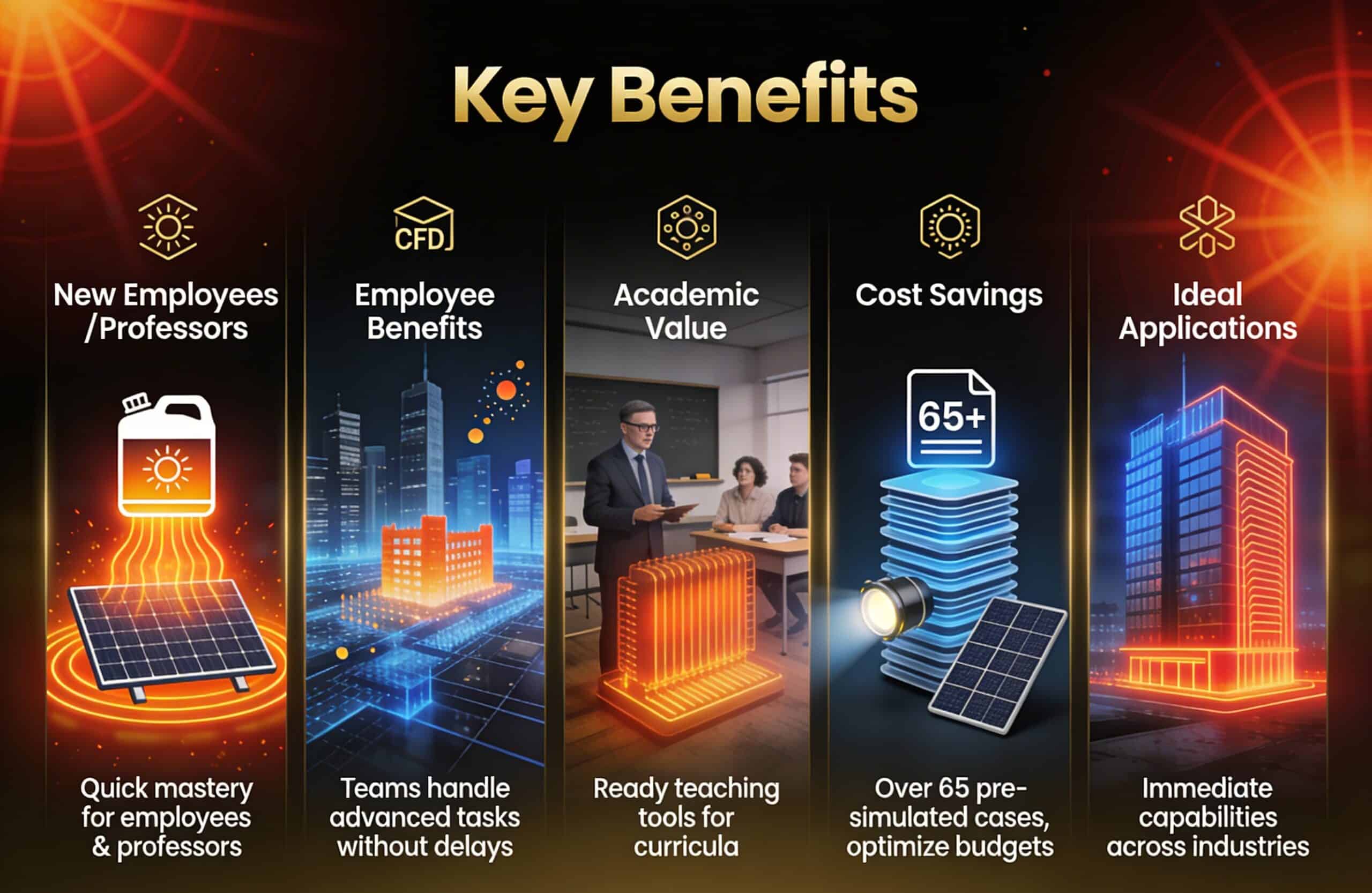
- Practical exercises and case studies rooted in real-world, +65 pre-simulated Radiation projects.
- Step-by-step tutorials from geometry creation, meshing, solving, and advanced post-processing.
- While you obtain the Golden Package, you will receive non-limited 1-year technical support from MR CFD experts.
- By purchasing this Golden package, you can benefit from our 3-month HPC.
To Order Your Project or benefit from a CFD consultation, contact our experts via email (info@mr-cfd.com), online support tab, or WhatsApp at +44 7443 197273.
There are some Free Products to check our service quality.
If you want the training video in another language instead of English, ask it via info@mr-cfd.com after you buy the product.
Description
Radiation Complete CFD Course: 70+ ANSYS Fluent Simulations | Comprehensive Training
Thermal radiation is one of the most physically complex and computationally demanding phenomena in engineering simulation. Unlike conduction and convection, radiation operates through electromagnetic wave propagation and is governed by non-linear, direction-dependent equations that challenge even experienced CFD practitioners. As industrial demand for accurate radiation heat transfer CFD simulation continues to accelerate across solar energy, combustion engineering, building physics, and advanced manufacturing, the ability to model radiation with precision in ANSYS Fluent has become a non-negotiable professional competency.
The Radiation Complete CFD Course from MR CFD is the most comprehensive radiation CFD training resource available, consolidating over 70 pre-built, production-grade simulation projects into a single unified learning path. Spanning every major radiation solver available in ANSYS Fluent — including Discrete Ordinates (DO), P1, Rosseland, DTRM, Surface to Surface (S2S), and Monte Carlo — this course delivers structured, industry-validated training from foundational model physics to advanced multi-physics radiation coupling. Whether you are beginning your simulation journey or expanding into specialized radiation domains, this course from CFD Training Courses provides the technical depth and breadth required for real-world engineering readiness.
Why Radiation Heat Transfer CFD Simulation Is a Critical Engineering Discipline
Radiative heat transfer accounts for a dominant share of total thermal energy exchange in high-temperature systems, solar-driven applications, and large-scale architectural environments. In combustion chambers, radiation from hot gases and soot particles can represent over 40% of total heat transfer, directly influencing wall temperatures, material fatigue, and NOx formation. In solar energy systems, the accuracy of solar radiation modeling determines the viability of collector designs, PV panel thermal management strategies, and passive cooling architectures.
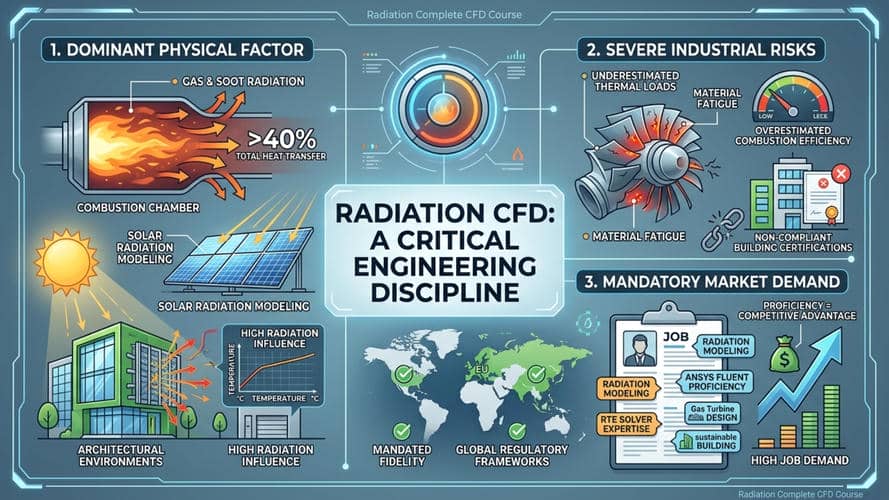
From an industrial standpoint, the consequences of ignoring or oversimplifying radiation in CFD models are severe: overestimated combustion efficiency, underestimated thermal loads on structural components, and non-compliant building energy certifications. Regulatory frameworks across the European Union, North America, and Asia increasingly mandate high-fidelity thermal radiation simulation as part of building performance certification, industrial safety analysis, and renewable energy product validation.
The engineering job market reflects this urgency. Roles in solar energy systems design, gas turbine thermal management, sustainable building engineering, and nuclear thermal analysis consistently list ANSYS Fluent radiation modeling and radiative transfer equation (RTE) solver proficiency among their core technical requirements. Engineers who can confidently configure optical thickness, scattering coefficients, view factor calculations, and non-gray radiation models in production-grade CFD environments command a measurable competitive advantage.
Core Technical Competencies in Radiation CFD Simulation You Will Master
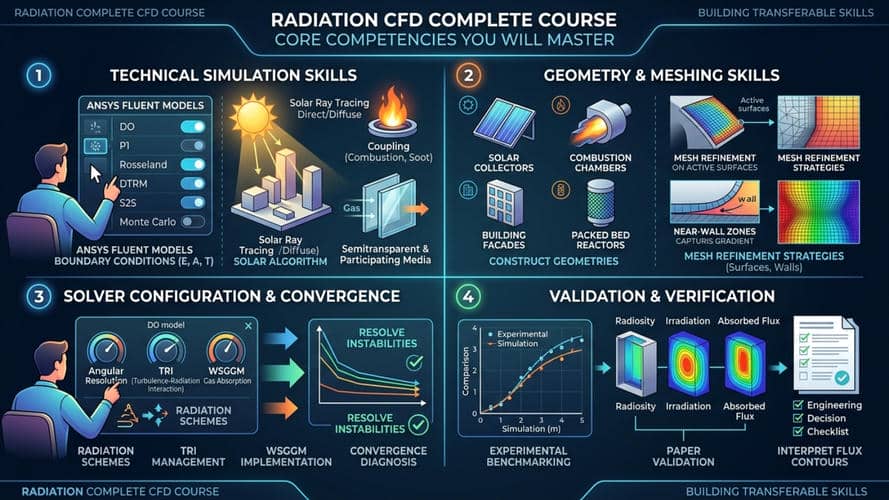
This course builds a complete and transferable technical skill set across four critical competency domains:
Technical Simulation Skills:
- Configuring and activating all six ANSYS Fluent radiation models (DO, P1, Rosseland, DTRM, S2S, Monte Carlo) with appropriate physical justification
- Setting radiation boundary conditions including emissivity, absorptivity, transmissivity, and internal emissive power
- Applying the solar ray tracing algorithm for direct and diffuse irradiation in architectural and solar energy simulations
- Coupling radiation with species transport, combustion, and soot formation models
- Implementing semitransparent media and participating media physics for glass, gases, and packed beds
Geometry & Meshing Skills:
- Constructing geometries for solar collectors, combustion chambers, building façades, and packed bed reactors
- Applying mesh refinement strategies at radiation-active surfaces and near-wall zones to capture radiative heat flux gradients accurately
Solver Configuration & Convergence Skills:
- Selecting appropriate radiation discretization schemes and angular resolutions for the DO model
- Managing turbulence-radiation interaction (TRI) in reacting flow simulations
- Applying WSGGM (Weighted Sum of Gray Gas Model) for accurate gas-phase absorption in combustion scenarios
- Diagnosing and resolving radiation-related convergence instabilities
Validation & Verification Skills:
- Benchmarking simulation results against published experimental data and peer-reviewed paper validation cases
- Interpreting radiosity, irradiation, and absorbed radiation flux contour outputs for engineering decision-making
Comprehensive Course Modules & Simulated Projects in Radiation CFD
Buildings, HVAC & Architectural Radiation Simulation
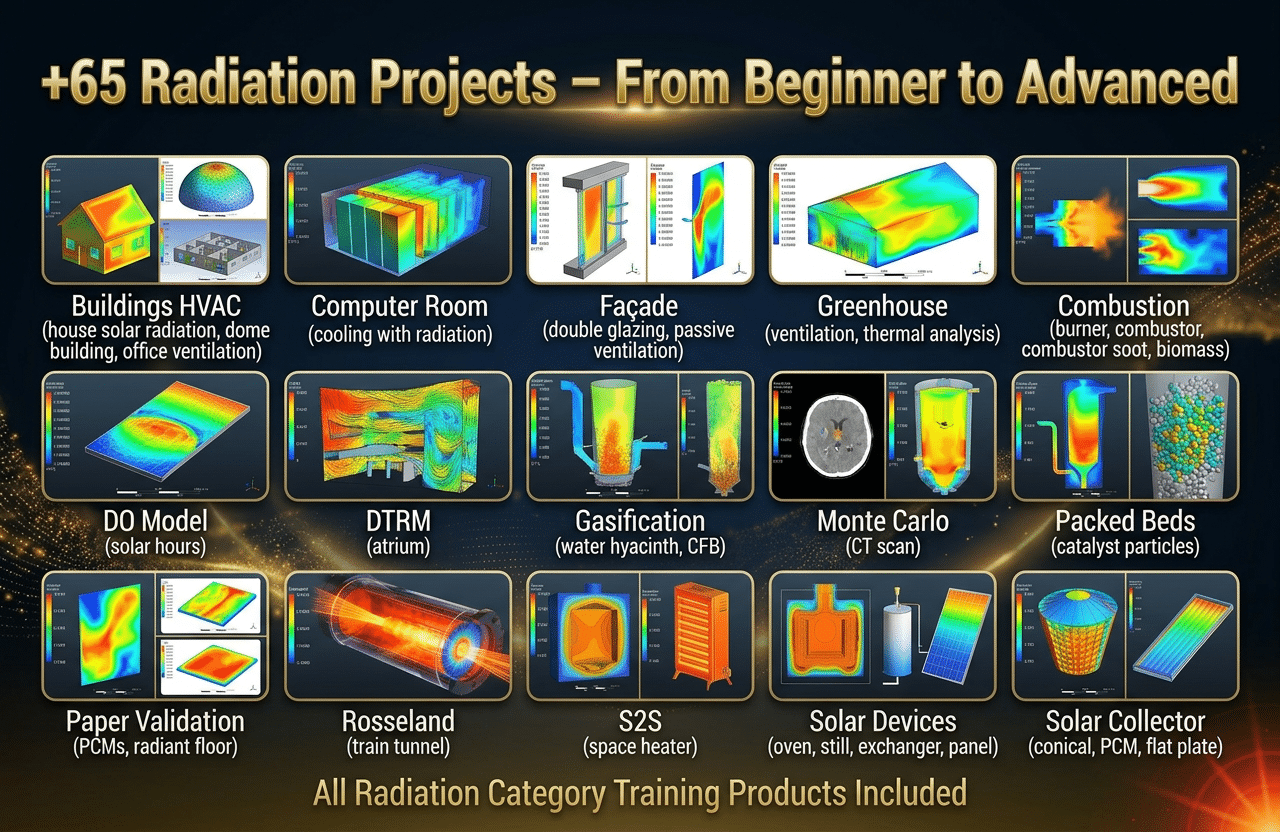
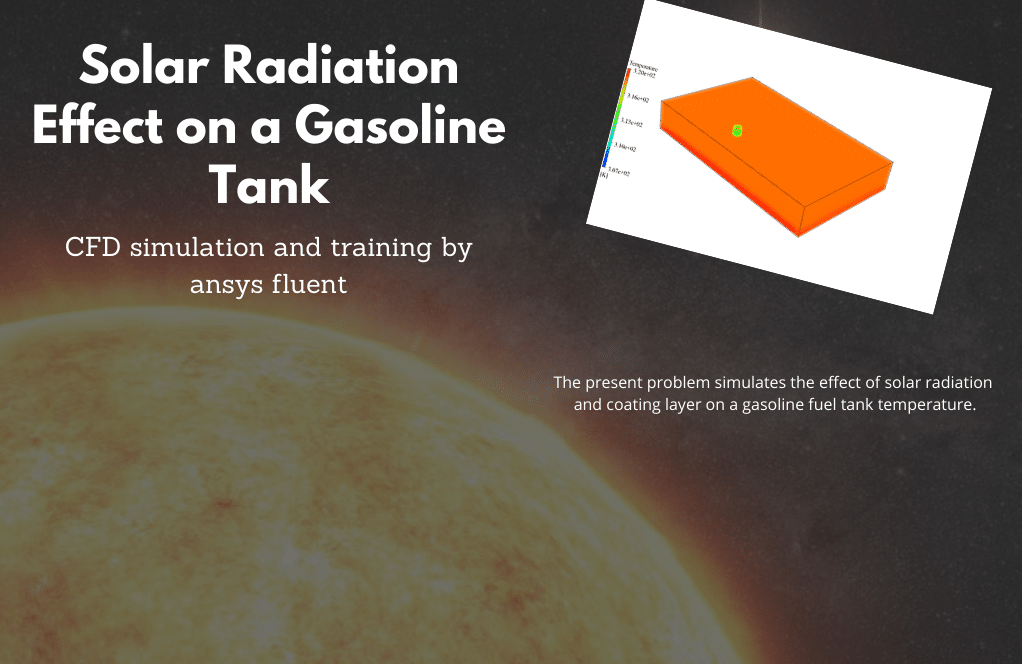
This module addresses the growing demand for solar radiation CFD simulation in buildings, covering residential, commercial, and heritage architectural typologies. Projects include Solar Radiation Effect on a House, Office Ventilation and Heating by Solar Radiation, Air Conditioning of a Room with a Balcony by Solar Radiation, and Internal and External Ventilation in an Ancient Architecture. Students learn to configure solar position vectors, apply glazing transmissivity, and evaluate passive thermal performance metrics. The Radiation Effect on a Dome-Shaped Building project demonstrates how curved geometry influences solar gain distribution — a critical consideration in sustainable architecture. These simulations directly support building energy compliance workflows and architectural CFD consulting.
Façade Engineering & Solar Shading Analysis
Façade radiation simulation is a high-demand specialization within sustainable building design. This module covers Solar Shading Double Glazing Façade, Façade Considering Radiation, and Façade Design Effect on Passive Ventilation of Buildings. Students learn to model multi-layer glazing systems with wavelength-dependent absorptivity and transmissivity properties, evaluate shading coefficient impacts on interior thermal comfort, and quantify radiative heat flux through transparent building envelopes. These skills are directly applicable to LEED certification workflows, green building consulting, and urban microclimate analysis.
Greenhouse Thermal & Humidity Radiation Modeling
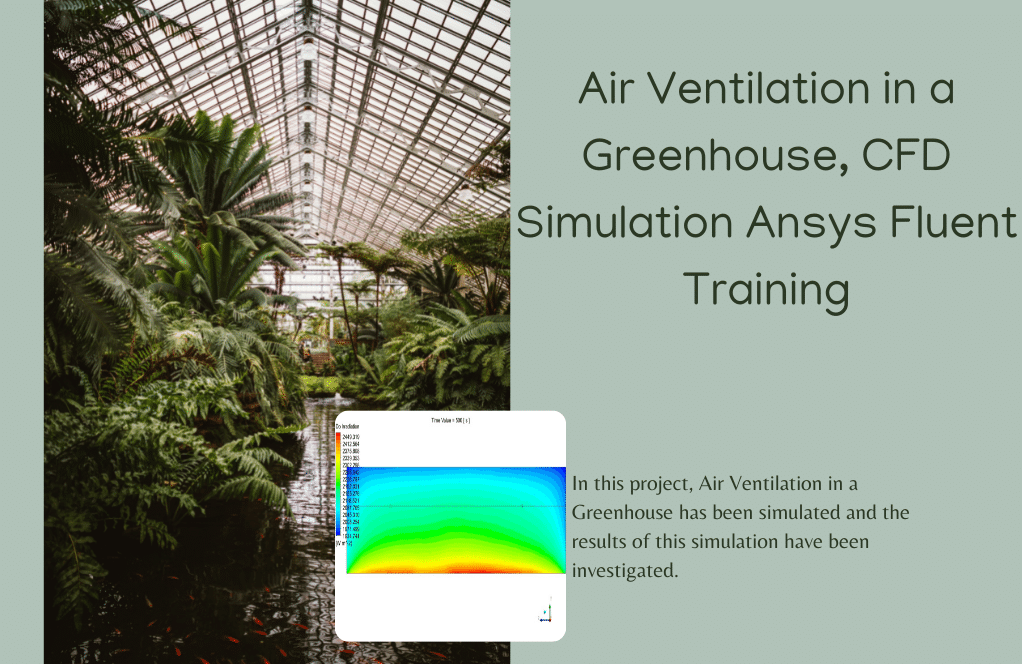
Greenhouse environments represent a uniquely coupled radiation problem involving solar irradiation, longwave re-radiation, moisture transport, and ventilation dynamics. Projects in this module include Greenhouse Air Ventilation, Greenhouse Thermal and Humidity Analysis, and Greenhouse Thermal and Airflow Performance with and without Heating System. Students configure the DO radiation model with spectral properties representative of polycarbonate and glass cover materials, and analyze the thermal stratification, condensation risk, and crop-zone temperature uniformity — outcomes with direct agricultural engineering and controlled environment agriculture (CEA) industry relevance.
Combustion Radiation & High-Temperature Reacting Flows
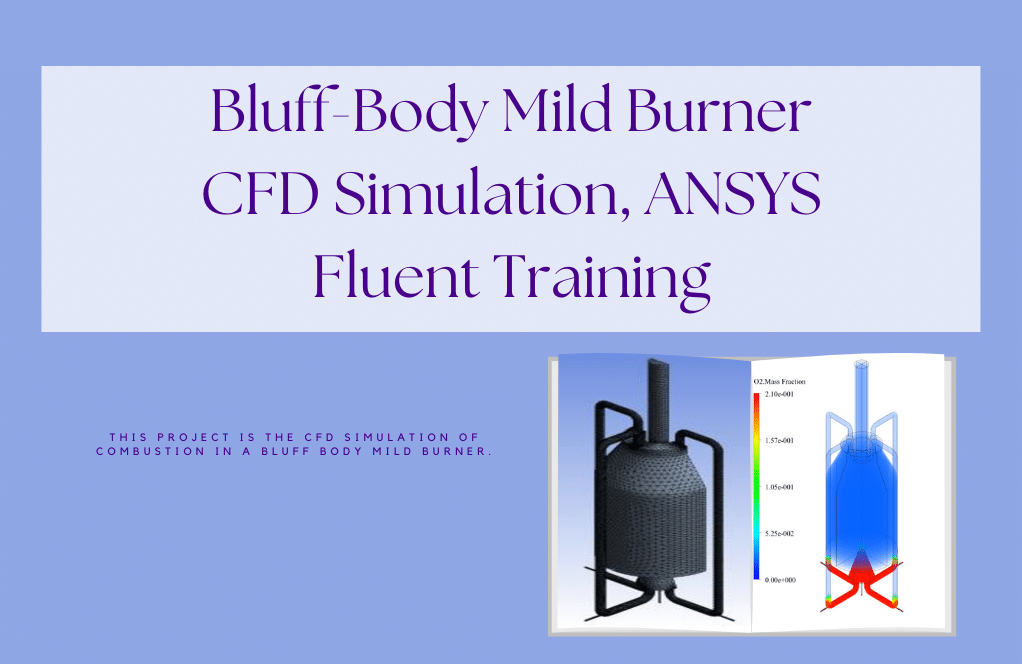
Radiation in combustion systems is among the most technically demanding CFD specializations. This module covers Radiation Heat Transfer in a Combustion Chamber, Soot Formation in Kerosene Flame Within a Model Gas Turbine Combustor, Bluff-Body Mild Burner, Syngas Fuel Combustion in a Gas Turbine Can Combustor, FCC Regenerator for Coke Combustion, Biomass Combustion, and Porous Medium Effects on Combustion Considering Radiation. Students learn to couple the DO radiation model with Fluent’s combustion species transport framework, configure WSGGM for gas-phase radiative absorption, and analyze soot-radiation feedback loops. These competencies are directly transferable to gas turbine thermal management, industrial furnace design, and clean combustion research.
Gasification & Thermochemical Conversion Radiation
This module bridges radiation heat transfer with thermochemical reaction engineering. Projects include Water Hyacinth Gasification, Circulating Fluidized Bed (CFB) Gasifier, Gasification in the Gasifier Chamber by CHEMKIN, and Co-firing Biomass with Coal Gasification. Students learn to model high-temperature participating media in gasification reactors, configure radiation-chemistry coupling, and evaluate the influence of optical thickness and scattering on reactor temperature profiles and syngas yield distributions. These skills are essential for biomass energy research, waste-to-energy engineering, and industrial decarbonization projects.
Solar Energy Devices & Collector Simulation
Solar thermal engineering represents one of the fastest-growing application domains for radiation CFD simulation. This module includes an extensive library of solar device projects: Solar Oven, Step Solar Still by Solar Ray Tracing with Species Transport, Solar Heat Exchanger, Solar Indirect Dryer, Floating Solar Panel, Solar Collector, Conical Solar Collector, Solar Collector with FMHPA, Solar Collector CFD Simulation Considering Parabolic Trough Reflector, PCM Solar Collector, and Flat Plate Solar Collector with Conjugate Heat Transfer (CHT). Students master solar ray tracing configuration, parabolic trough reflector geometry setup, and phase change material (PCM) thermal storage coupling — skills directly applicable to concentrated solar power (CSP) design and renewable energy R&D.
Radiation Model-Specific Training: DO, DTRM, P1, Rosseland, S2S, Monte Carlo
Dedicated model-specific modules ensure students develop discriminative judgment in radiation model selection. The DO Model module covers Solar Radiation at Different Hours with time-dependent sun angle variation. The DTRM module addresses Atrium Natural Ventilation with directional radiation tracing. The P1 Model explores Gasification in the Gasifier Chamber by CHEMKIN. The Rosseland Model simulates Combustion of a Train in a Tunnel, demonstrating optically thick media behavior. The S2S Model covers S2S Radiation Heat Transfer and Radiative Space Heater projects. The Monte Carlo Model is applied to CT Scan radiation simulation — an interdisciplinary application bridging thermal engineering and medical imaging physics.
Packed Beds, PCM Systems & Radiant Heating Applications
This module addresses packed bed radiation simulation for catalytic and energy storage applications, including Packed Bed with Catalyst Particles and Packed Bed Reactor with Radiative Quartz Spheres. Additional projects cover Microencapsulated PCMs for Energy Saving (a peer-reviewed paper validation case), Radiant Floor Heating System, and Impact of Geometry on Heat Sink Performance. Students learn to configure porous media radiation in Fluent, validate results against published experimental data, and interpret radiative heat flux distributions in complex heterogeneous media — skills essential for thermal energy storage design and process intensification engineering.
Urban Heat Island & Environmental Radiation Analysis
The Urban Heat Island (UHI) and Urban Air Quality CFD Simulation on a Real Zone project provides students with large-scale environmental radiation modeling experience. This project integrates solar ray tracing, surface emissivity variation across urban materials, and convection-radiation coupling to quantify UHI intensity and identify mitigation strategies. This capability is increasingly demanded by urban planning consultancies, environmental agencies, and smart city engineering teams.
Professional Engineering Skills Developed Through This Radiation CFD Training
| Skill Category | Skills Acquired |
|---|---|
| CFD Radiation Modeling | DO, P1, Rosseland, DTRM, S2S, Monte Carlo model configuration and selection |
| Solar Energy Simulation | Solar ray tracing, parabolic trough modeling, PCM thermal storage coupling |
| Combustion & Reacting Flows | WSGGM gas absorption, soot-radiation coupling, turbulence-radiation interaction |
| Building Physics | Façade radiation, HVAC solar gain, urban heat island quantification |
| Participating Media | Scattering, absorption, optical thickness configuration in semitransparent media |
| Validation & Verification | Paper-based experimental benchmarking, residual convergence analysis |
| Post-Processing | Radiosity, irradiation, and absorbed radiation flux visualization and reporting |
| Multi-Physics Coupling | Radiation-species transport, radiation-CHT, radiation-porous media integration |
Real-World Industrial Applications of Radiation CFD Simulation
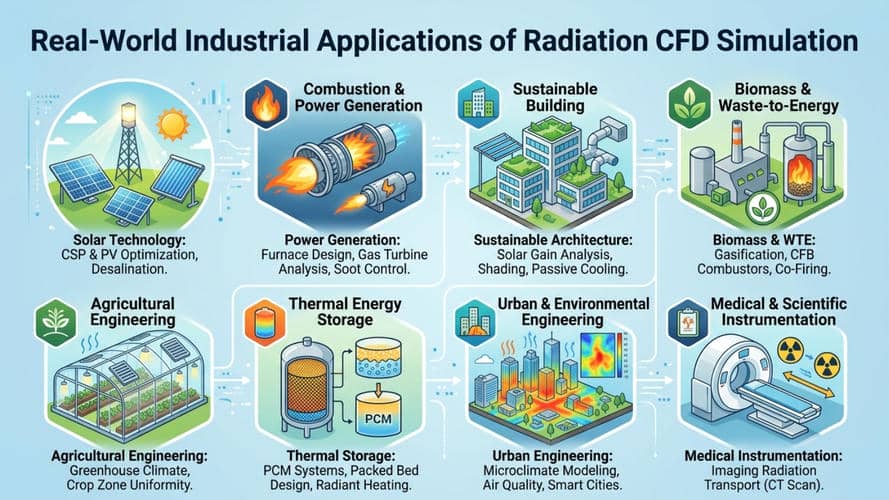
The simulation competencies developed in this course apply directly across the following high-value engineering industries:
- Renewable Energy & Solar Technology: Solar collector optimization, PV thermal management, concentrated solar power (CSP) system design, and solar still desalination engineering
- Combustion & Power Generation: Gas turbine combustor thermal analysis, furnace design, soot control in industrial burners, and coke combustion in refinery regenerators
- Sustainable Building & Architecture: HVAC solar gain analysis, façade shading optimization, passive cooling design, and urban heat island mitigation
- Biomass & Waste-to-Energy: Gasification reactor design, CFB combustor optimization, and biomass co-firing thermal performance analysis
- Agricultural Engineering: Greenhouse climate control, crop zone thermal uniformity, and controlled environment agriculture (CEA) system design
- Thermal Energy Storage: PCM system design, packed bed thermal storage, and radiant heating system optimization
- Urban & Environmental Engineering: Urban microclimate modeling, air quality simulation, and smart city thermal planning
- Medical & Scientific Instrumentation: Radiation transport in CT scan geometries bridging thermal and ionizing radiation physics
Who Should Enroll in This Radiation Comprehensive CFD Training Course
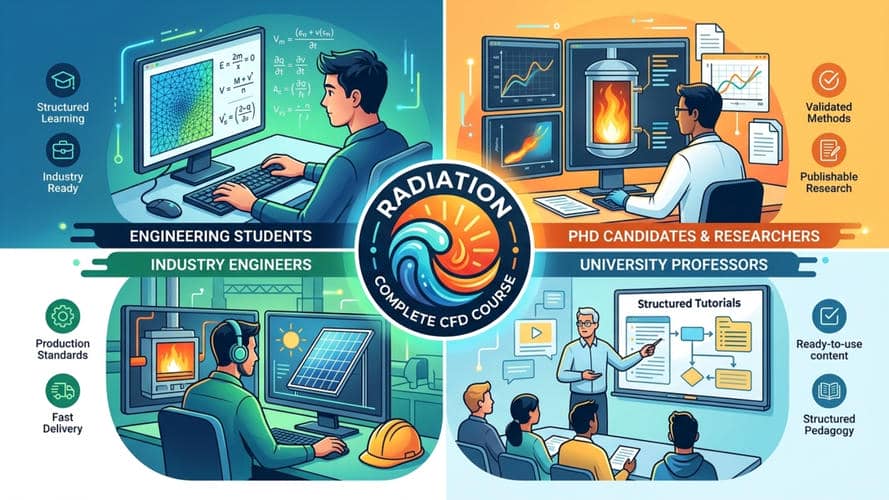
Engineering Students & Graduates: Undergraduate and postgraduate students in mechanical, chemical, energy, and environmental engineering who need structured, hands-on radiation CFD simulation training aligned with current industry and research standards.
PhD Candidates & Academic Researchers: Researchers requiring validated simulation frameworks for radiation heat transfer studies in combustion, solar energy, packed beds, or building physics. The included paper validation projects provide directly publishable simulation methodologies.
Industry Engineers & Simulation Specialists: Practicing engineers in solar energy, HVAC, combustion systems, and process engineering who need to expand their ANSYS Fluent radiation modeling proficiency to production-grade standards. Those seeking to accelerate project delivery timelines through pre-validated simulation templates will find immediate practical value.
University Professors & Technical Educators: Academics seeking ready-to-deploy, pre-simulated CFD radiation tutorial content for integration into engineering curricula. All 70+ projects include structured pedagogical progression from foundational to advanced complexity levels.
Why MR CFD Delivers Unmatched Authority in Radiation Simulation Training
MR CFD has established itself as a globally recognized authority in CFD simulation training through over 15 years of continuous consulting, research, and educational content development. The Radiation Complete CFD Course reflects this depth through several distinguishing characteristics:
- Production-Grade Projects: Every simulation is built to industry standards, not simplified academic approximations. Geometry, mesh quality, solver settings, and post-processing outputs reflect real engineering consulting workflows.
- Verified Against Published Research: Multiple projects are validated against peer-reviewed experimental data, ensuring students learn simulation practices that meet academic and industrial quality benchmarks.
- Comprehensive Model Coverage: No other single course resource covers all six ANSYS Fluent radiation models with dedicated, contextually appropriate simulation projects for each.
- 15 Years of Consulting Expertise: Course content is informed by MR CFD’s extensive portfolio of industrial CFD consulting engagements, embedding practical engineering judgment that textbooks cannot replicate.
- 12-Month Technical Support: Enrolled students receive one year of direct technical support from MR CFD simulation experts, ensuring no learning obstacle goes unresolved.
- HPC Access Included: Three months of High-Performance Computing (HPC) access is provided, enabling students to execute computationally intensive radiation simulations at full industrial scale. Learn more about ANSYS HPC available through MR CFD.
For organizations seeking tailored simulation solutions beyond training, MR CFD’s CFD consulting services provide expert-led project support across all radiation engineering domains.
Educational Progression Path & Advanced Training Roadmap
This course is structured to accommodate learners across all experience levels through a deliberate three-stage progression:
| Stage | Focus Area | Representative Projects |
|---|---|---|
| Beginner | Radiation model fundamentals, boundary condition setup, basic solar simulation | Solar Radiation Effect on a House, S2S Radiation Heat Transfer, Radiant Floor Heating |
| Intermediate | Multi-physics coupling, combustion radiation, solar device simulation | Combustion Chamber Radiation, Flat Plate Solar Collector CHT, Greenhouse Thermal Analysis |
| Advanced | Gasification, packed bed radiation, paper validation, Monte Carlo applications | CFB Gasifier, Packed Bed with Radiative Quartz Spheres, PCM Validation, CT Scan Monte Carlo |
Upon completing this course, students are positioned to pursue advanced specialization tracks in combustion CFD, solar energy system simulation, or building energy analysis. The CFD Internship at MR CFD provides a structured pathway for graduates to apply these radiation simulation competencies in real consulting project environments, building a verifiable professional portfolio.
Enroll in the Radiation Complete CFD Course and Advance Your Simulation Expertise
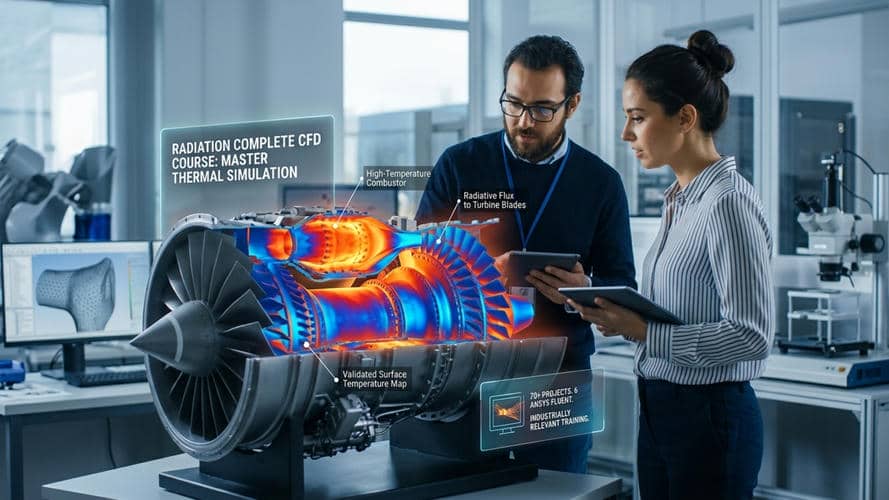
The ability to accurately model thermal radiation in engineering systems is a technical skill that directly determines simulation credibility, project success, and career differentiation. This course provides the most complete, validated, and industrially relevant radiation CFD training available in a single resource — 70+ ANSYS Fluent projects, six radiation model modules, and 15 years of MR CFD engineering expertise, all structured for immediate professional application.
Whether your goal is to master solar radiation CFD simulation, develop combustion radiation analysis capabilities, or build a validated research simulation framework, the Radiation Complete CFD Course delivers the technical foundation and practical competency to achieve it.
Access the full course library and begin your structured learning path through CFD Training Courses. Your investment in radiation heat transfer simulation mastery starts today.
You must be logged in to post a review.
 Talk On WhatsApp
Reviews
There are no reviews yet.