
ScanEagle UAV: CFD Simulation Training Package
$3,999.00 Internship
- Every UAV simulation campaign begins with aerodynamics, the force and moment data captured here anchor every stability, structural, and acoustic analysis that follows.
- A platform that cannot hold course in gusty conditions is operationally worthless; stability derivative analysis turns CFD results into the damping ratios and control margins autopilot engineers actually design against.
- Acoustic assessment goes beyond peak decibel numbers. it reveals how sound disperses with distance and direction, guiding engineers toward quieter blade shapes and smarter RPM selections.
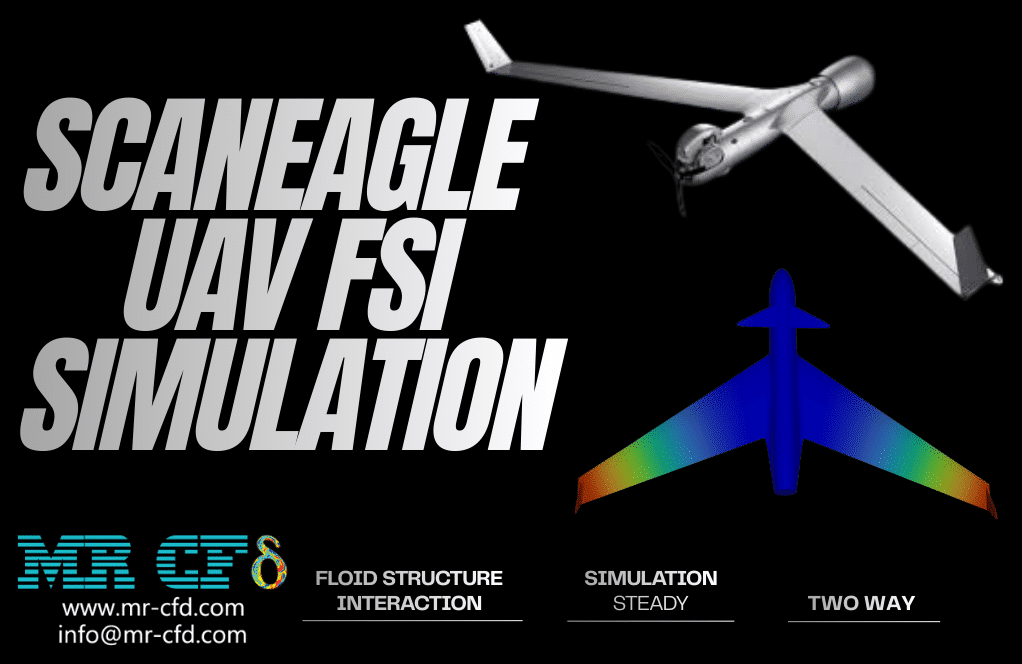
- FSI simulation bridges the gap between idealized rigid geometry and real flexible behavior, exposing stress hotspots, elastic twist, and vibration modes invisible to aerodynamic or structural solvers working alone.
To Order Your Project or benefit from a CFD consultation, contact our experts via email (info@mr-cfd.com), online support tab, or WhatsApp at +44 7443 197273.
There are some Free Products to check our service quality.
If you want the training video in another language instead of English, ask it via info@mr-cfd.com after you buy the product.
Description
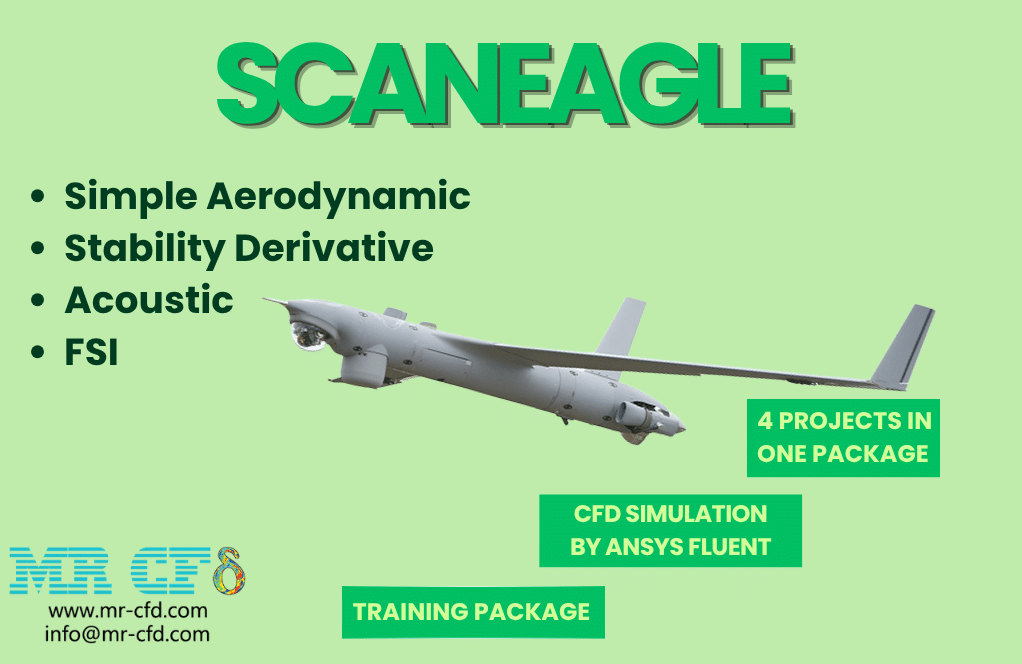
ScanEagle CFD Simulation: 4 Projects In One Package
Build Professional-Grade UAV Simulation Skills from Aerodynamics to FSI
Small tactical platforms such as the ScanEagle have become indispensable assets in intelligence, surveillance, and reconnaissance missions and the engineers who can simulate their behavior computationally are in high demand. This package comprises four standalone ANSYS Fluent projects, each focused on a critical performance domain: aerodynamic load mapping, flight stability quantification, noise footprint evaluation and aeroelastic coupling. Completing all four gives you a multidisciplinary simulation portfolio that reflects the same analysis chain practiced at tier-one defense contractors and UAV research labs.
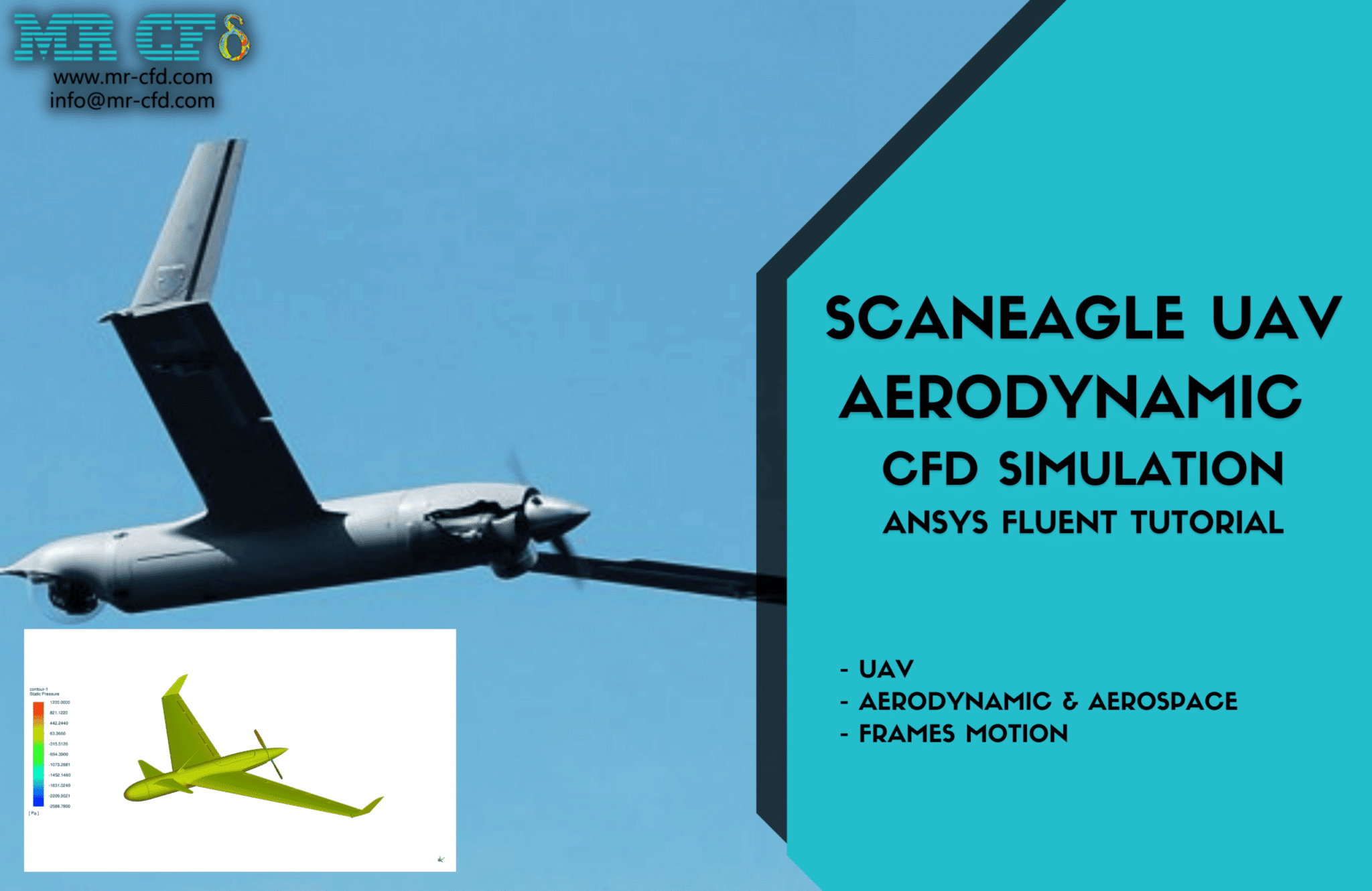
Aerodynamic Load Mapping and Performance Characterization ScanEagle Aerodynamic Analysis
Accurate force and moment data underpin every downstream analysis without them, stability models drift, structural margins lose meaning, and acoustic predictions start from the wrong flow field. This project has you import the full ScanEagle geometry into ANSYS Fluent, configure rotating domains for the pusher propeller, and execute a parametric sweep across angles of attack and sideslip angles. You will define freestream velocity boundaries, back-pressure outlets, and solid-wall treatments, then post-process the results into a structured aerodynamic database. That database becomes the single source of truth for every project that follows.
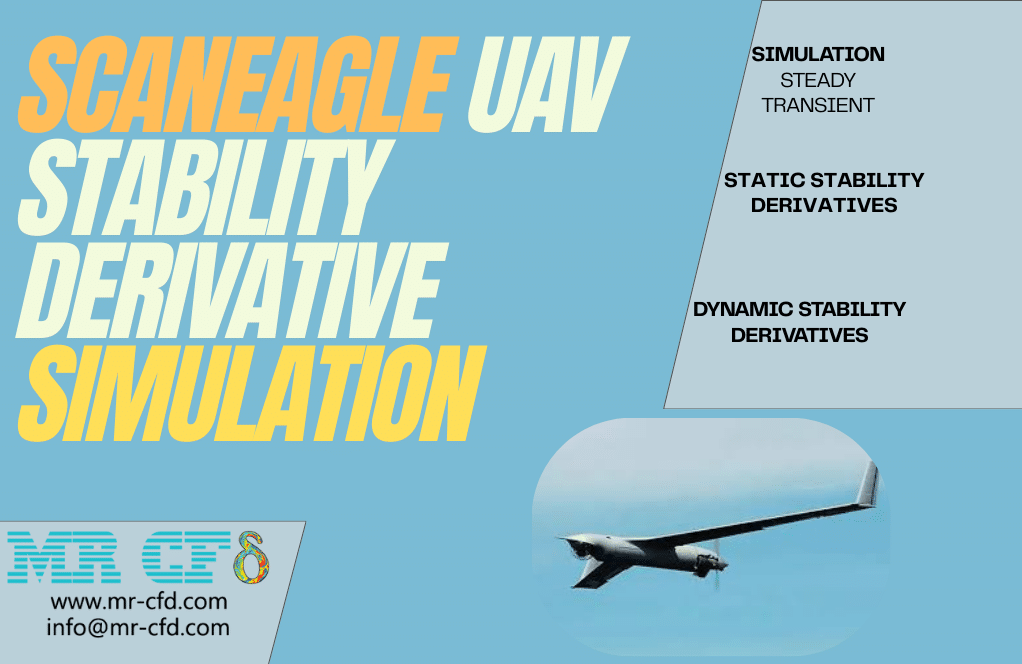
Flight Stability Quantification and Control-Law Support ScanEagle Stability Derivatives
Long-endurance ISR platforms must hold steady flight paths under turbulence, wind shear, and rapid command inputs requirements that demand precise knowledge of how forces and moments change with small perturbations in attitude and rate. Here you will impose incremental variations in pitch, roll, and yaw around the trimmed baseline, record the resulting moment shifts, and assemble a full derivative set covering longitudinal and lateral-directional modes. You will also adapt the mesh density in wake-dominated and tip-vortex regions to ensure derivative accuracy. The finished matrix plugs directly into flight dynamics models, autopilot tuning tools, or airworthiness documentation.
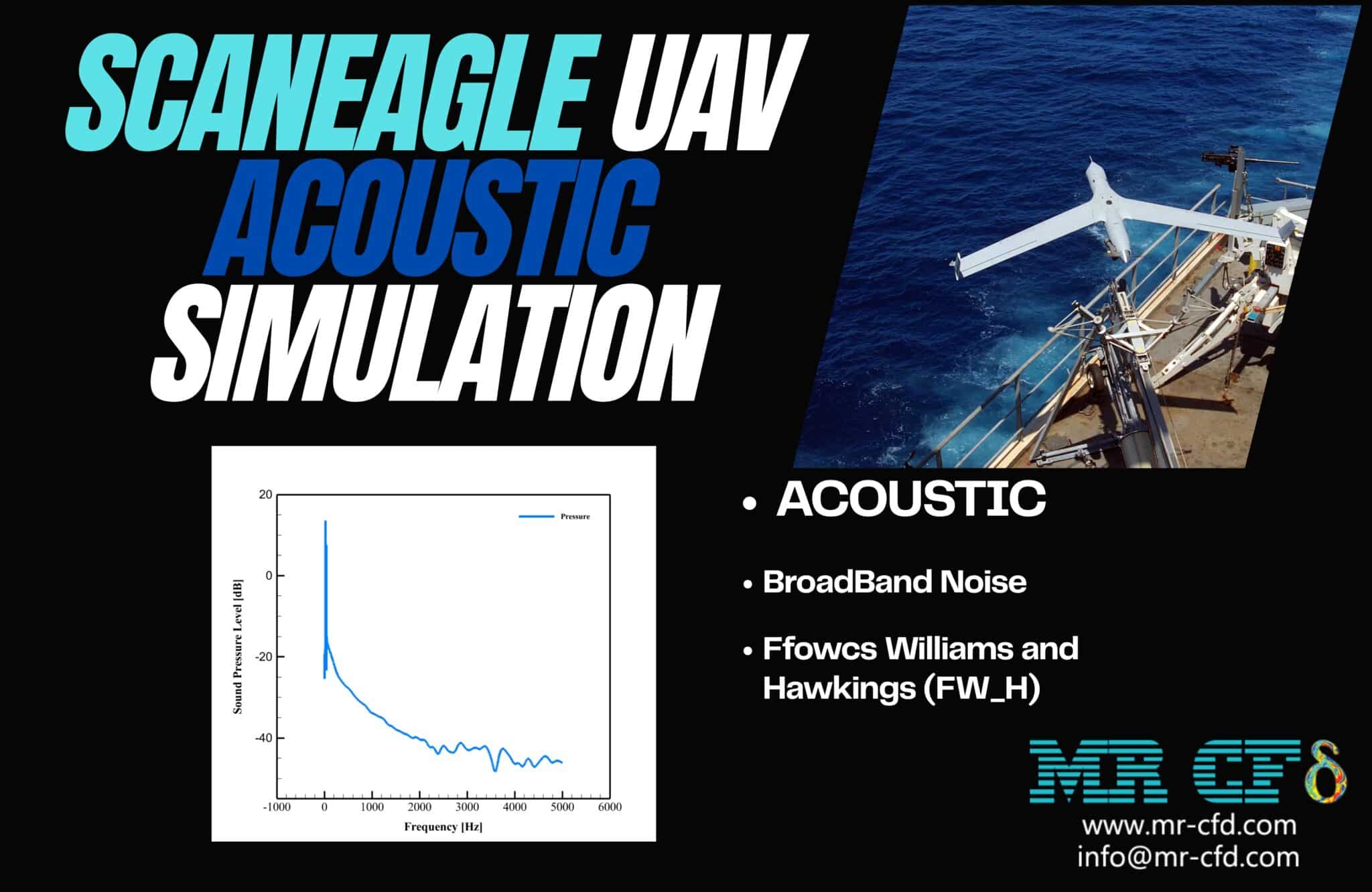
Acoustic for Mission and Regulatory Compliance ScanEagle CFD Simulation
Whether the concern is avoiding acoustic detection over a surveillance zone or satisfying noise ordinances near a launch-and-recovery site, understanding how sound radiates from the vehicle is essential. This final project guides you through ANSYS Fluent’s acoustic framework: you will resolve the transient pressure field on propeller blades and airframe panels, apply analogy-based propagation methods to compute far-field sound pressure levels, and compare spectral content across different throttle settings and flight phases. The outcome is a noise map you can overlay on mission profiles or community exposure limits giving you the evidence needed to refine propeller pitch, adjust cruise speed, or reroute flight corridors without compromising the aerodynamic and structural integrity verified in the preceding projects.
Aeroelastic Coupling and Fluid-Structure Interaction (FSI) Tracking ScanEagle
Lightweight composite airframes flex more than metal ones, and even modest wing bending can redistribute pressure loads, alter trim drag, and shift natural frequencies toward excitation bands. In this project you will establish a two-way data in Fluent solver: surface pressures drive deformation, and the deformed shape feeds an updated geometry back to the flow domain each iteration. You will monitor spanwise deflection, track frequency shifts in primary bending and torsion modes, and assess whether any operating condition brings the structure dangerously close to resonance all computationally, well ahead of any flight-test campaign.
You must be logged in to post a review.
Related products
-
Sale

Chemical Engineering Training Package for Beginners, 10 Practical Exercises
Original price was: $1,120.00.$299.00Current price is: $299.00. Internship -
Sale
Electrical and Power Training Package for Beginners, 10 Practical Exercises
Original price was: $1,080.00.$299.00Current price is: $299.00. Internship -
Sale
HVAC Training Package for Beginners, 10 Practical Exercises
Original price was: $780.00.$199.00Current price is: $199.00. Internship



 Talk On WhatsApp
Reviews
There are no reviews yet.