
ANSYS STRUCTURAL: Crane Hook Static Simulation
$180.00 Internship
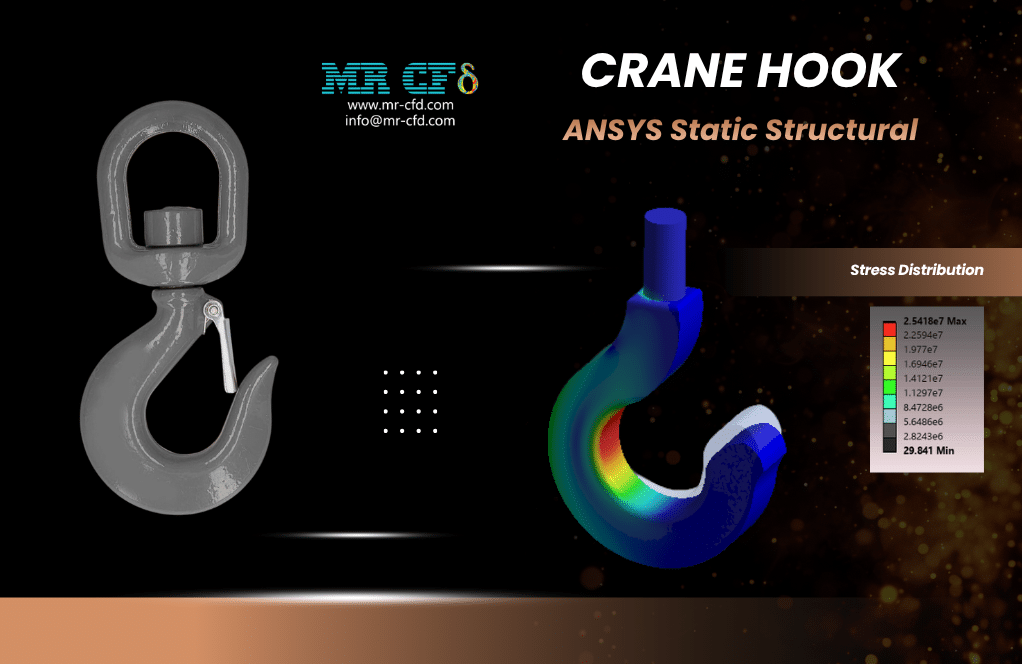
- This product simulates a Crane Hook using ANSYS Static Structural software.
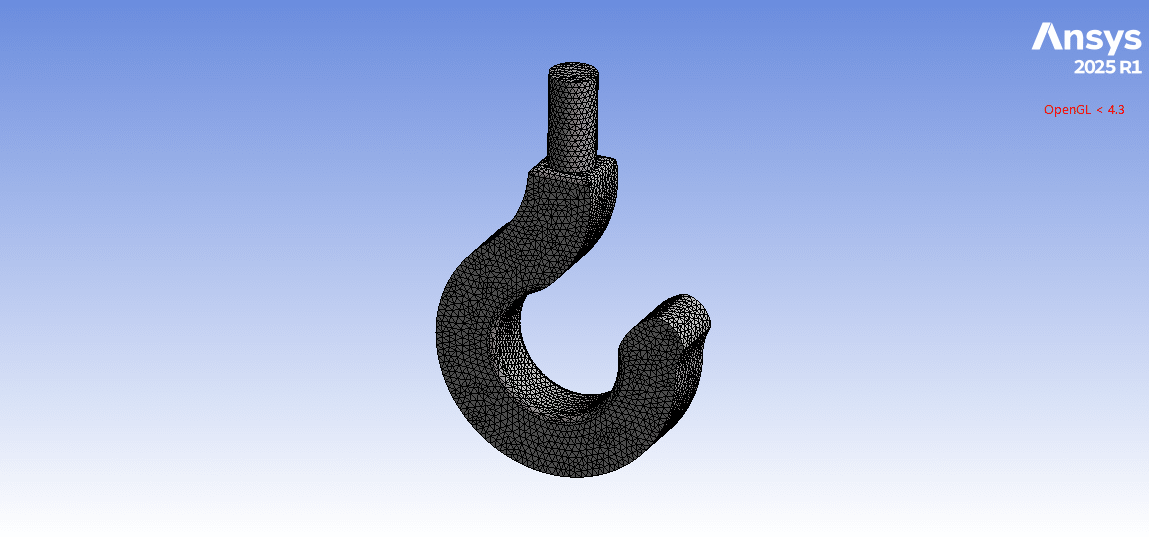
- We model the 3D geometry with the Design Modeler software and mesh it as an unstructured grid.
- We use Fixed Support and Force Load as the boundary load conditions.
To Order Your Project or benefit from a CFD consultation, contact our experts via email (info@mr-cfd.com), online support tab, or WhatsApp at +44 7443 197273.
There are some Free Products to check our service quality.
If you want the training video in another language instead of English, ask it via info@mr-cfd.com after you buy the product.
Description
ANSYS Static Structural: Crane Hook Analysis under Force Load and Fixed Support
Description
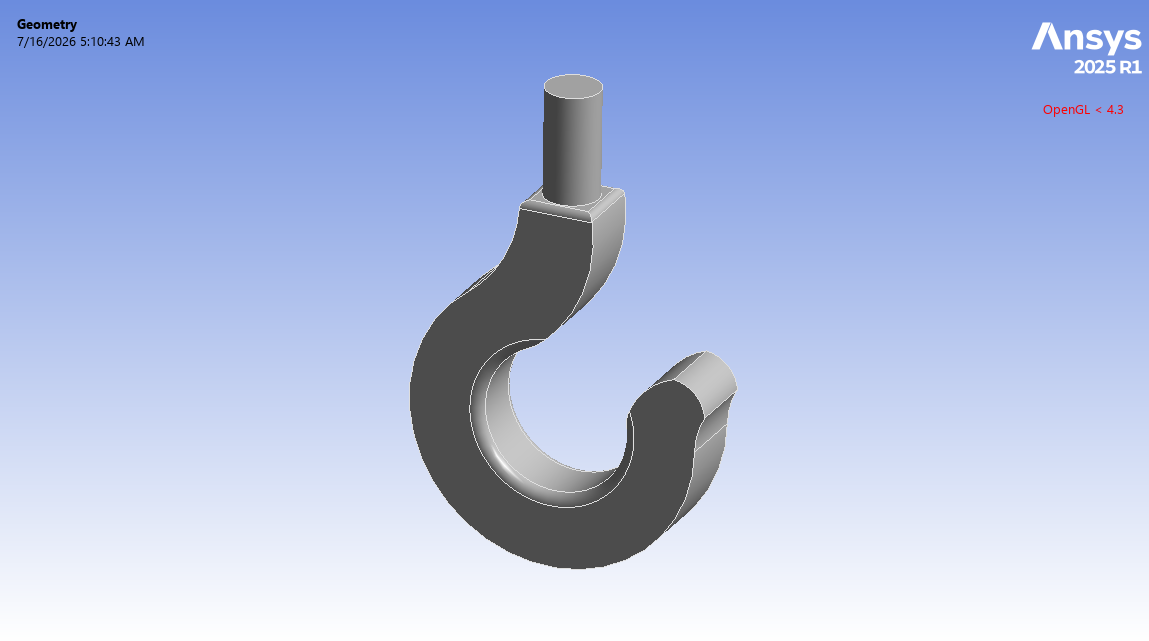
In this project, we present a structural simulation of a Crane Hook in ANSYS Static Structural.
A crane hook is a lifting device used to carry heavy loads in cranes, elevators, or other handling equipment. Note that the crane hook is one of the most important safety components in any lifting system because, if it is damaged, it can cause the sudden release of a suspended load.
Crane hooks are manufactured in different types, including single (standard) hooks, double (ramshorn) hooks, C-hooks, eye hooks, and shank hooks. In the present study, a simple single-crane hook is modeled. This is the typical type consisting of a curved body whose profile resembles a question mark.
The goal of this simulation is to evaluate the deformation and the stress distribution in the hook under applied load. This analysis is necessary because any excessive stress exceeding the safety limit in a lifting hook is unacceptable.
Methodology
First, we modeled the crane hook geometry using Design Modeler software. The computational domain corresponds to a single crane hook. It consists of a straight shank and a curved main bend. Second, we meshed the domain. As a result, an unstructured mesh was created, generating about 85,000 elements. Finally, we completed the simulation and calculations with ANSYS Static Structural software.
The structural steel was determined as the material for this crane hook. We considered that the top shank operates as a constraint, representing the hook being rigidly attached to the crane, which holds it and prevents any freedom of motion. So, we defined a fixed support as the load boundary condition.
On the other hand, a vertical downward force is applied on the inner curved surface of the hook, representing the weight of the suspended load transmitted into the hook through the chain or rope. So, we defined a force load on the inner curved surface as the load boundary condition.
Conclusion
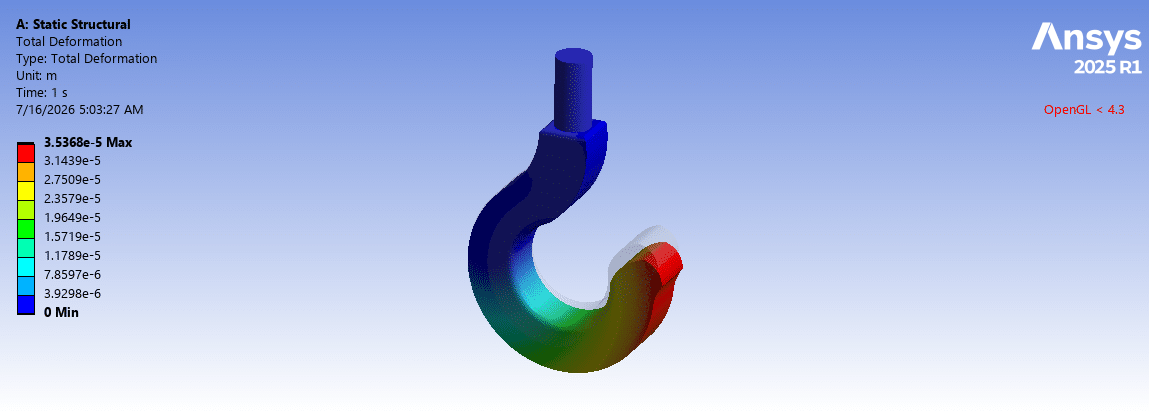
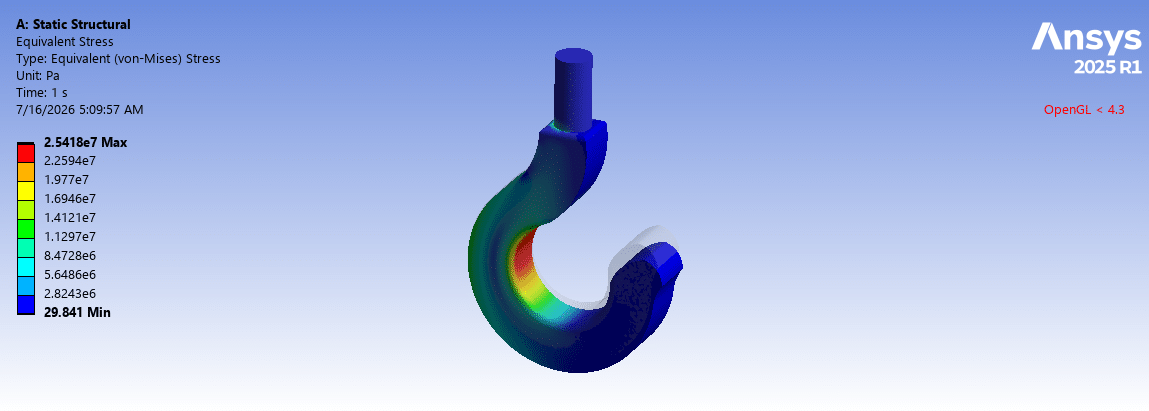
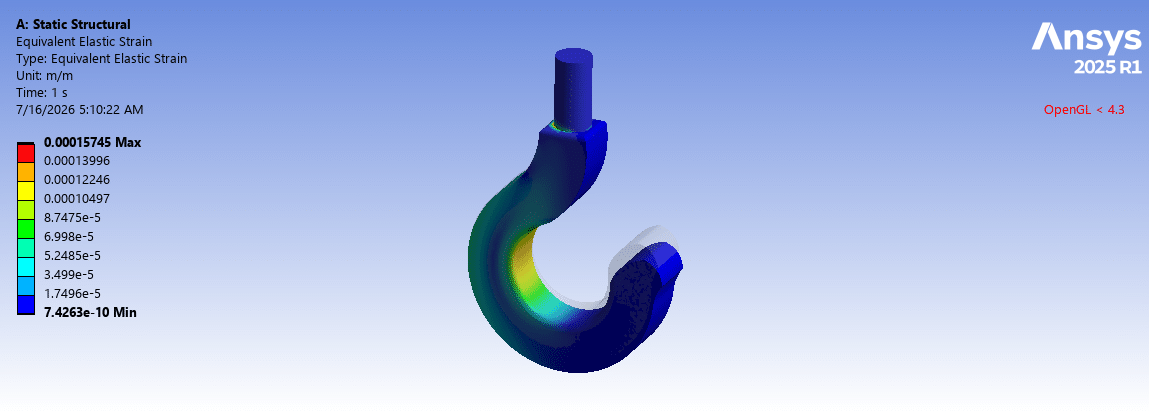
After the calculations, we obtained the contours of total deformation, equivalent strain, and equivalent (von Mises) stress over the crane hook body.
The total deformation distribution shows that maximum deflection occurs at the free tip of the hook, while the upper regions remain stationary. Since the free tip of the hook is farthest from the fixed shank, this hook tends to open slightly due to the downward load pulling.
The stress distribution indicates that the maximum stress appears at the critical region of the bend (concentrating on the inner face). This is because the applied load generates a large bending moment about the bend. In addition, the curvature concentrates the tensile stress on the inner face.
You must be logged in to post a review.

 Talk On WhatsApp
Reviews
There are no reviews yet.