
Bayraktar UAV: CFD Simulation Training Package
$3,999.00 Internship
- Aerodynamic evaluation is the starting point of any UAV program without reliable force and moment data, every downstream stability, structural, and acoustic study rests on shaky ground.
- Maneuverability and gust tolerance are essential for any operational UAV; stability derivative extraction converts raw CFD data into the exact coefficients control engineers need to confirm safe flight across the full envelope.
- Acoustic analysis does more than measure loudness. it tracks how sound propagates, reflects, and attenuates through the atmosphere, turning that knowledge into concrete design improvements for quieter UAVs.
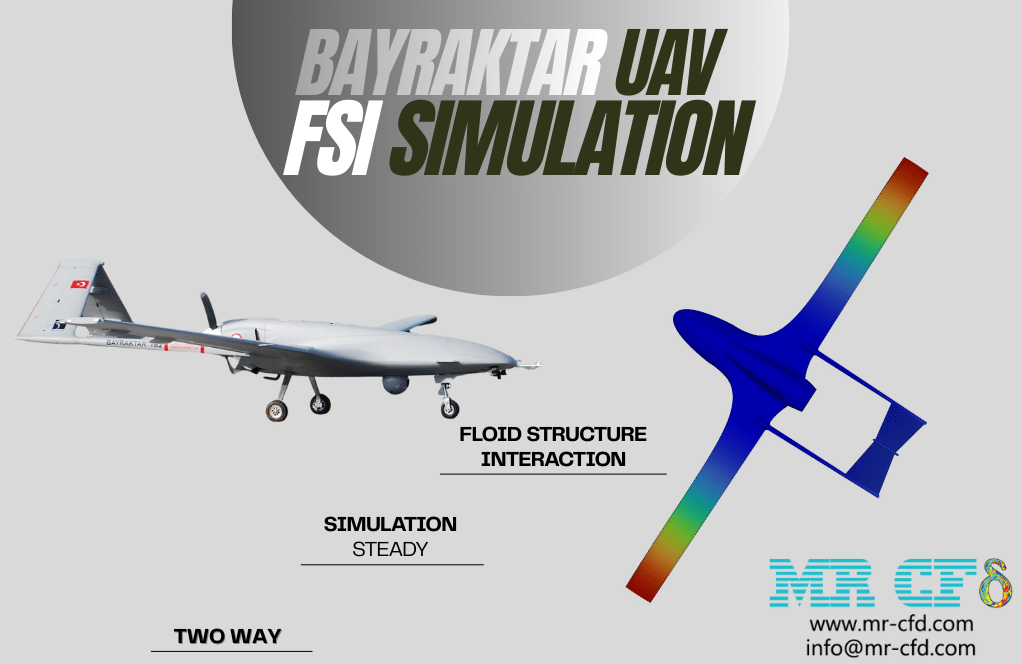
- FSI analysis gives drone designers a high-fidelity window into stress concentrations, joint fatigue, and resonance risks that rigid-body assumptions simply cannot capture.
To Order Your Project or benefit from a CFD consultation, contact our experts via email (info@mr-cfd.com), online support tab, or WhatsApp at +44 7443 197273.
There are some Free Products to check our service quality.
If you want the training video in another language instead of English, ask it via info@mr-cfd.com after you buy the product.
Description
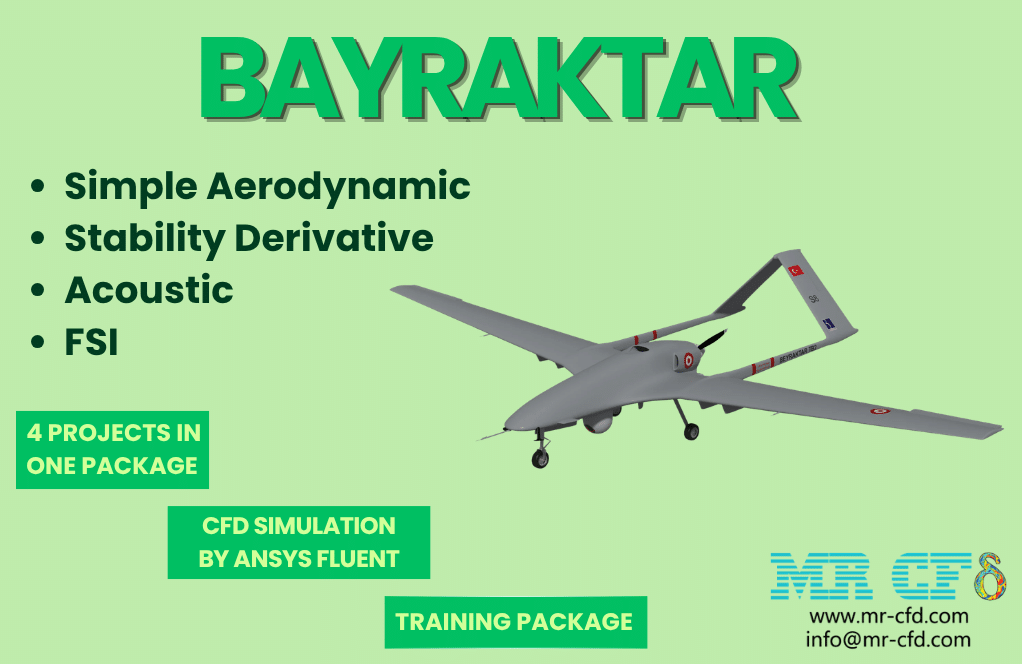
Bayraktar CFD Simulation: 4 Projects In One Package
Develop Real-World UAV Aerodynamic
Unmanned combat aerial vehicles like the Bayraktar series have redefined modern defense aviation, and simulation engineers sit at the center of that evolution. This training package bundles four complete ANSYS Fluent projects each targeting a distinct discipline required to analyze and optimize high-performance UAV platforms. From wing-level flow physics to far-field noise prediction, you will build an end-to-end skill set that mirrors the workflow used by leading drone manufacturers and defense research organizations worldwide.
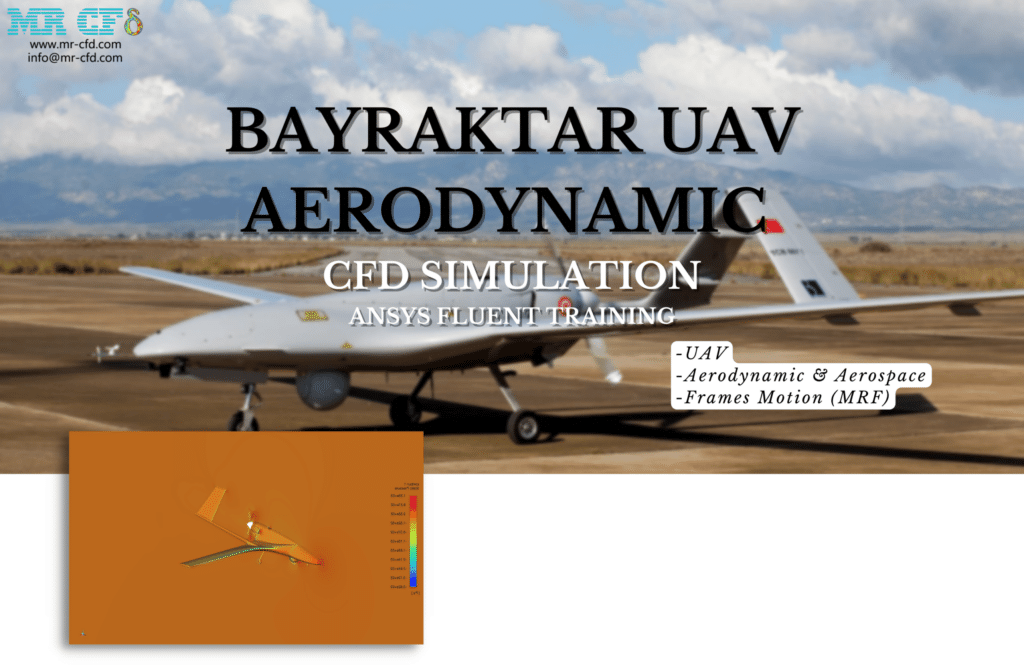
Foundational Flow Physics and Force Prediction Bayraktar Aerodynamic Analysis
Before any stability study or structural check can begin, the aerodynamic baseline must be trustworthy. In this first project you will set up the complete vehicle geometry inside ANSYS Fluent, assign rotating reference frames to each propeller disk, and sweep through multiple flight attitudes to compile lift, drag, and moment tables. You will also learn how to specify freestream inflow, pressure-based exit planes, and no-slip surfaces so the solution converges reliably. The result is a validated force-and-moment database that every subsequent project in the package builds upon.
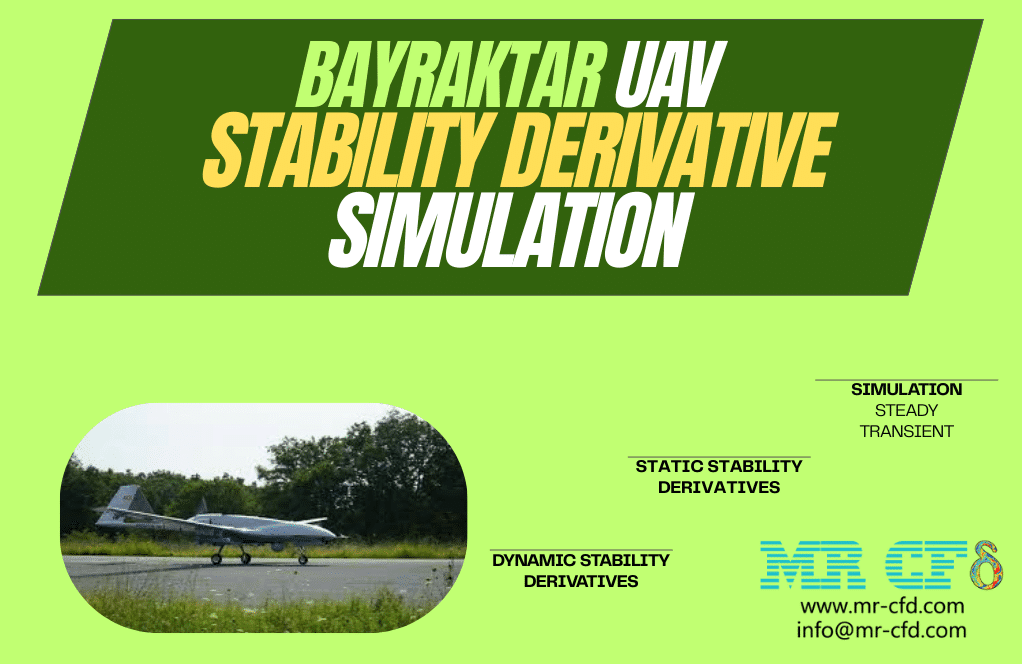
Stability Characterization and Bayraktar Stability Derivatives
A tactical UAV operating in contested airspace must meet demanding handling-quality standards across a wide flight envelope. This project teaches you to perturb the baseline solution systematically small changes in angle of attack, sideslip, and angular rate so you can extract the pitch, roll, and yaw moment derivatives that flight control engineers depend on. You will refine the computational grid around propulsion components and high-gradient zones, then organize the output into a derivative matrix ready for six-degree-of-freedom flight simulators or autopilot gain-tuning loops.
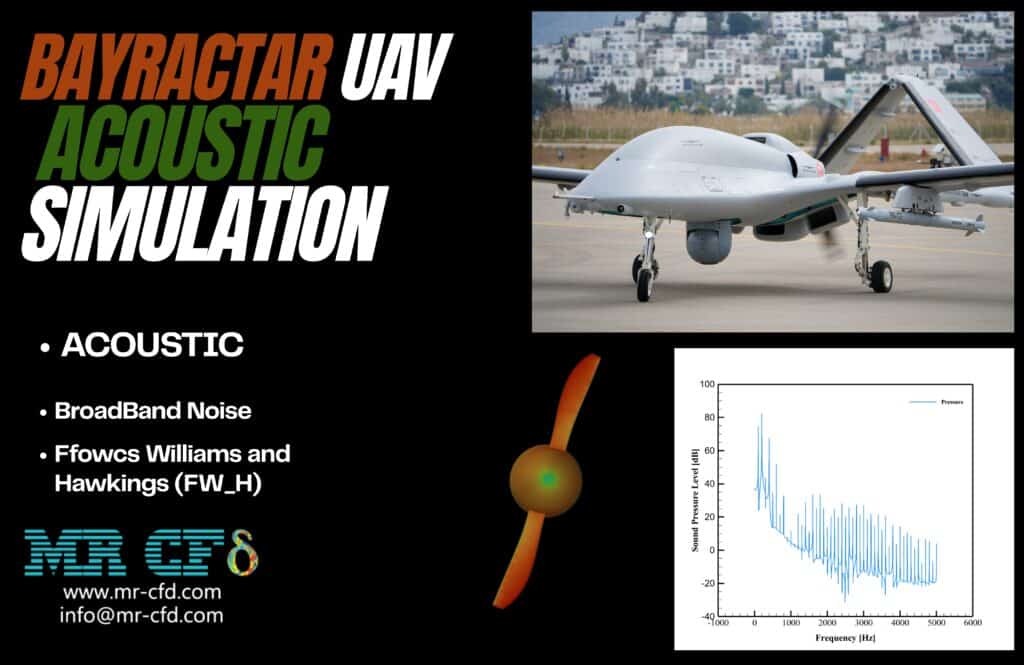
Acoustic Signature Assessment for Bayraktar Operational Scenarios
Noise signature management is a growing consideration in UAV mission planning, affecting both detectability and regulatory compliance. This closing project walks you through the acoustic tool chain available in ANSYS Fluent, from capturing unsteady pressure fluctuations on propeller and airframe surfaces to propagating sound to far-field observer locations. You will compare noise signatures across loiter, cruise, and climb segments and examine the influence of atmospheric absorption on perceived sound levels at ground level.
Coupled Aeroelastic Response Under Operational Loads Bayraktar Fluid-Structure Interaction (FSI)
Treating the airframe as perfectly rigid overlooks deflections that can alter control-surface effectiveness, shift vibration frequencies, and degrade aerodynamic efficiency. This project addresses that gap with a two-way coupling strategy: aerodynamic pressures deform the structure, and the deformed shape updates the flow field in return. The methodology gives you a computational path to flag resonance hazards and structural weak points long before a physical prototype takes to the sky.
You must be logged in to post a review.
Related products
-
Sale

Marine Engineering CFD Training Package for Beginners, 10 Learning Products
Original price was: $1,580.00.$399.00Current price is: $399.00. Internship -
Sale

Electrical and Power Training Package for Beginners, 10 Practical Exercises
Original price was: $1,080.00.$299.00Current price is: $299.00. Internship -
Sale
Architectural Training Package, ANSYS Fluent, 10 Practical Exercises
Original price was: $720.00.$299.00Current price is: $299.00. Internship


 Talk On WhatsApp
Reviews
There are no reviews yet.