
CFD Consulting Services for Industries: When Should Industrial Teams Hire Experts?
A CFD model can influence a pump redesign, an HVAC layout, a combustion chamber, a heat exchanger, a medical device, or a full product development decision. When the simulation is correct, it can shorten design cycles and expose problems before physical testing. When it is wrong, it can quietly push an engineering team toward the wrong geometry, wrong operating condition, or wrong investment decision.
ANSYS Fluent Beginner Course for Less Than the Cost of a Lunch!
No prior experience needed. Start Learning ANSYS Fluent step-by-step with 16 hands-on, real-world projects across multiple engineering fields.
That is why CFD consulting services for industries are not simply a way to “run a simulation.” In serious industrial projects, CFD consulting is a technical decision-support service. It helps teams define the physics correctly, build a defensible model, validate the results where possible, and translate flow, heat transfer, pressure, or multiphase behavior into practical engineering recommendations.
This article explains when industrial teams should continue in-house, when they should bring in CFD consultants, what a professional CFD engagement should deliver, and how MR CFD can support projects that require ANSYS Fluent expertise, validation-focused workflows, and practical simulation guidance.
Beginner CFD Course for Starting ANSYS Fluent Simulation
Start your CFD journey with MR CFD’s beginner CFD course, a practical introduction to ANSYS Fluent workflows, meshing, boundary conditions, and real engineering simulations. Perfect for beginners before moving into advanced CFD Courses.

Premier CFD Consulting Services Using ANSYS Fluent
ANSYS Fluent simulations, validation, and defensible engineering reports across 30+ fields. Registered in 🇺🇸 USA (Delaware), 🇬🇧 UK & 🇴🇲 Oman
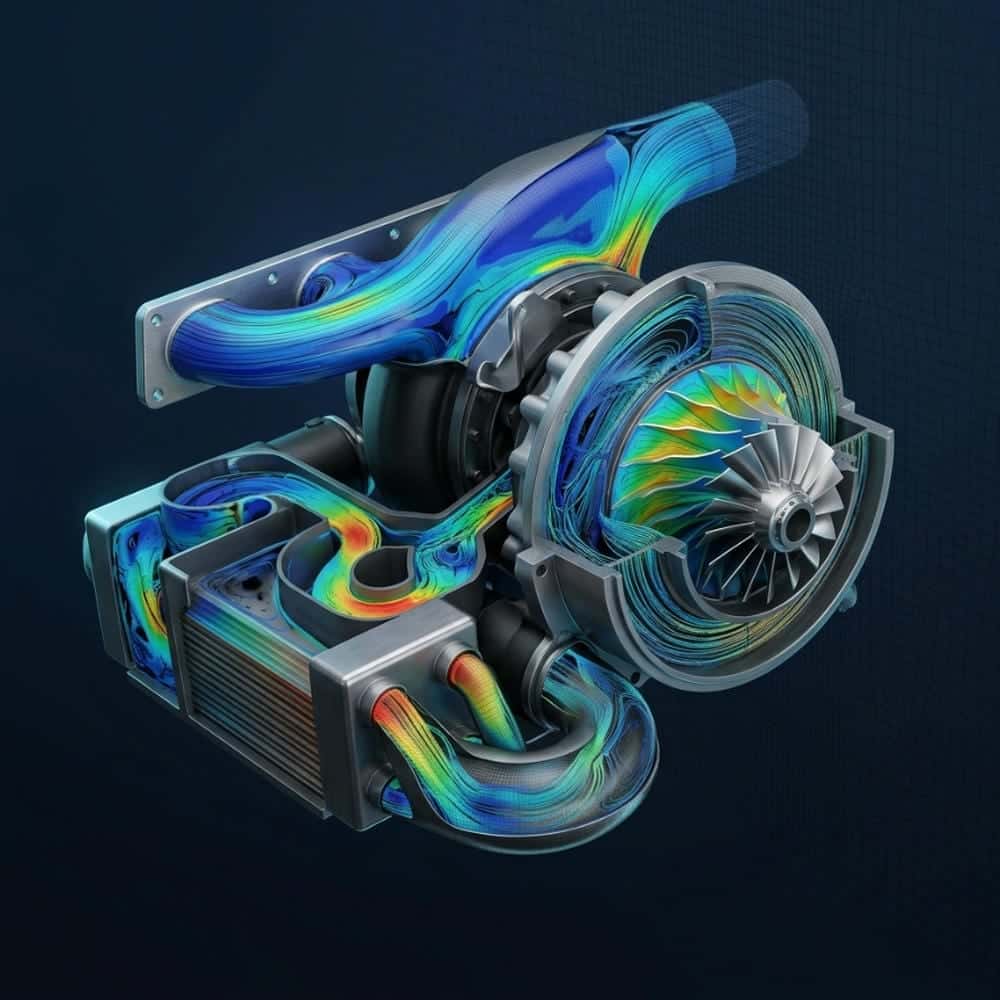
For teams already evaluating a complex project, MR CFD offers CFD consulting services for industrial projects to help assess feasibility, scope the simulation workflow, and define the next engineering step.
What are CFD consulting services for industrial projects?
CFD consulting services help engineering teams use Computational Fluid Dynamics to answer practical questions about flow, heat transfer, pressure loss, mixing, turbulence, multiphase behavior, combustion, ventilation, and related physics.
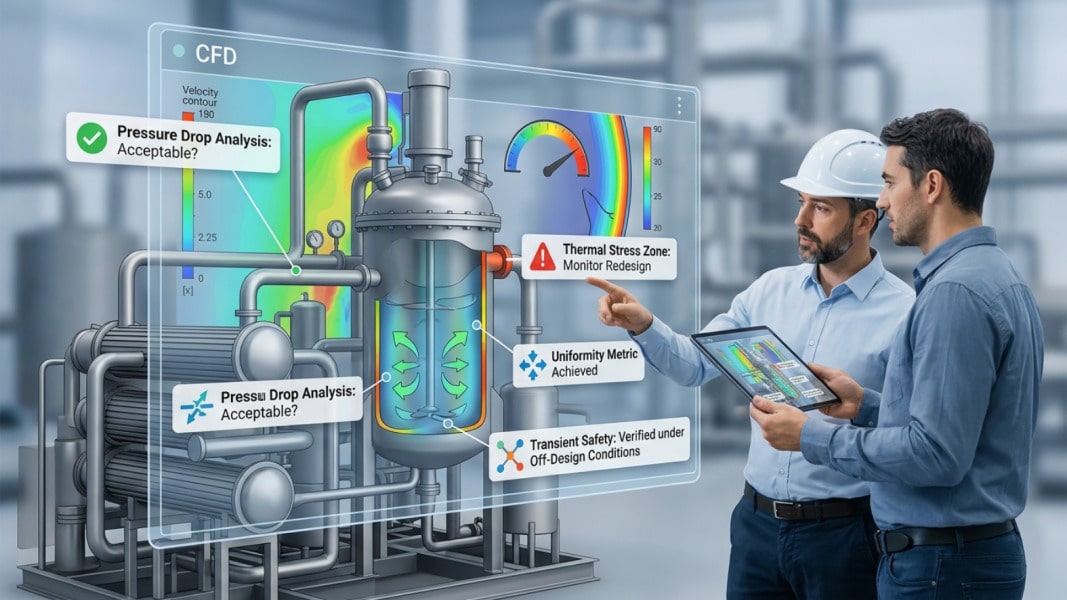
In an industrial context, the goal is rarely just to create attractive velocity contours. The real goal is to support a decision. Should the geometry be changed? Is the pressure drop acceptable? Will the component overheat? Is the flow distribution uniform enough? Is the design safe under transient or off-design conditions?
A professional CFD consultant helps connect the simulation model to the decision that the client needs to make.
Typical industrial CFD consulting may include:
| Project Area | Typical CFD Question | Business or Engineering Value |
|---|---|---|
| Pump and rotating machinery | Where does cavitation, recirculation, or efficiency loss occur? | Improve performance and reduce failure risk |
| Heat exchangers and thermal systems | Are heat transfer rates and temperature fields acceptable? | Improve thermal efficiency and reliability |
| HVAC and ventilation | Does the airflow meet comfort, safety, or cooling requirements? | Improve system layout and reduce rework |
| Chemical reactors and mixers | Is the mixing pattern uniform enough? | Improve yield, residence time, or process quality |
| External aerodynamics | How do drag, lift, and pressure distribution change with geometry? | Support design optimization |
| Biomedical flow | Are flow patterns, wall shear stress, or pressure drops acceptable? | Support research and device evaluation |
The strongest consulting work starts before the solver runs. It begins with the engineering question, available data, limitations, and success criteria.
What does a CFD consultant actually do during an engineering project?
A CFD consultant translates an industrial problem into a simulation workflow that can be trusted enough for engineering use.
That work usually includes:
- Reviewing the engineering objective
- Preparing or simplifying CAD geometry
- Choosing the physical models
- Defining boundary and initial conditions
- Building a mesh suitable for the flow physics
- Selecting solver settings and numerical schemes
- Monitoring residuals and engineering quantities
- Checking mass, momentum, and energy balance
- Running mesh independence or sensitivity checks when needed
- Post-processing results into engineering conclusions
- Preparing a report with assumptions, limitations, and recommendations
For example, in a pressure drop study, the consultant should not only show a pressure contour. They should clarify where the pressure loss occurs, whether the mesh near critical regions is adequate, whether turbulence modeling assumptions are reasonable, and how the result should be interpreted against design requirements.
This is where the value of consulting becomes clear: the client receives not only a simulation result, but also an engineering explanation.
Which industrial decisions can CFD consulting support?
CFD consulting can support decisions across design, troubleshooting, optimization, safety, and R&D. The specific value depends on the quality of the inputs and how well the simulation is aligned with the real engineering question.
Common decisions include:
| Engineering Decision | CFD Output | Practical Impact |
|---|---|---|
| Redesigning a component | Velocity, pressure, turbulence, separation zones | Reduce losses or improve performance |
| Choosing an operating condition | Flow rate, temperature, pressure, residence time | Avoid inefficient or unsafe regimes |
| Comparing design alternatives | Parametric CFD results | Select a stronger design before prototyping |
| Diagnosing a failure | Recirculation, hotspots, cavitation, stagnation | Identify root causes |
| Planning a physical test | Critical locations and measurable outputs | Make testing more focused |
| Supporting customer or management review | Engineering report and visual evidence | Improve decision confidence |
A good CFD consultant should always ask: “What decision will this simulation support?” Without that question, the project can drift into analysis without impact.
Why do industrial CFD projects become expensive or risky when handled by trial and error?
Industrial CFD becomes expensive when teams repeatedly run models without knowing whether the model is physically meaningful.

Trial and error may look fast at first. A team imports geometry, creates a mesh, applies boundary conditions, and runs ANSYS Fluent or another solver. But if the assumptions are weak, the model can converge toward a result that looks polished while still being wrong.
The most common risks include:
- Boundary conditions that do not represent the real system
- Turbulence models chosen without considering the flow regime
- Meshes that miss separation, wall gradients, jets, wakes, or recirculation
- Poor treatment of transient effects
- Under-resolved multiphase or thermal physics
- Misinterpretation of residual convergence
- No comparison against test data, benchmark data, or engineering expectations
- Results presented without uncertainty, limitations, or assumptions
In CFD, the expensive part is often not the simulation run. It is the wrong decision made after trusting a weak model.
What are the hidden costs of inaccurate CFD simulation?
The hidden cost of inaccurate CFD is decision risk.
A weak simulation can lead to unnecessary prototypes, design rework, delayed product launches, overbuilt equipment, undersized components, or false confidence in a design that later fails under real operating conditions.
| Hidden Cost | How It Happens | Why It Matters |
|---|---|---|
| Prototype rework | Simulation misses the real flow problem | Increases development time |
| Wrong component sizing | Pressure drop or heat transfer is mispredicted | Affects performance and cost |
| Delayed engineering decisions | Team keeps troubleshooting convergence | Slows R&D progress |
| Overdesign | Engineers add excessive safety margins due to uncertainty | Increases material or operating cost |
| Failed validation | Test data does not match simulation | Damages confidence in the workflow |
| Poor communication | Results are shown without clear assumptions | Creates confusion between teams |
This is one reason industrial teams hire CFD consultants: not because they cannot press “run,” but because they need confidence in what the result means.
Why are convergence and colorful contours not enough to prove CFD accuracy?
A converged CFD result is not automatically a correct CFD result.
Residuals may decrease, and contours may look smooth, while the model still has unrealistic boundary conditions, insufficient mesh resolution, inappropriate turbulence modeling, or missing physics. Experienced CFD engineers usually check more than residuals. They review engineering monitors, mass and energy balance, mesh sensitivity, wall treatment, and whether the results are consistent with known physics.
Verification and validation are central to simulation credibility. ASME V&V 20 focuses on quantifying accuracy through comparison between solution and data for specified variables at validation points, while the AIAA guide describes verification and validation as key principles for assessing CFD credibility.
For industrial projects, this means a consultant should not only ask, “Did the solver converge?” They should also ask:
- Does the setup represent the real system?
- Are the important gradients resolved?
- Are the engineering outputs stable with mesh refinement?
- Are monitor points physically reasonable?
- Are the assumptions documented?
- Is there test, benchmark, or operational data for comparison?
This mindset separates engineering simulation from visual post-processing.
When should you hire a CFD consulting team instead of relying only on in-house simulation?
You should consider hiring a CFD consulting team when the simulation affects a high-value decision, requires specialized physics, exceeds internal experience, or needs a defensible validation strategy.
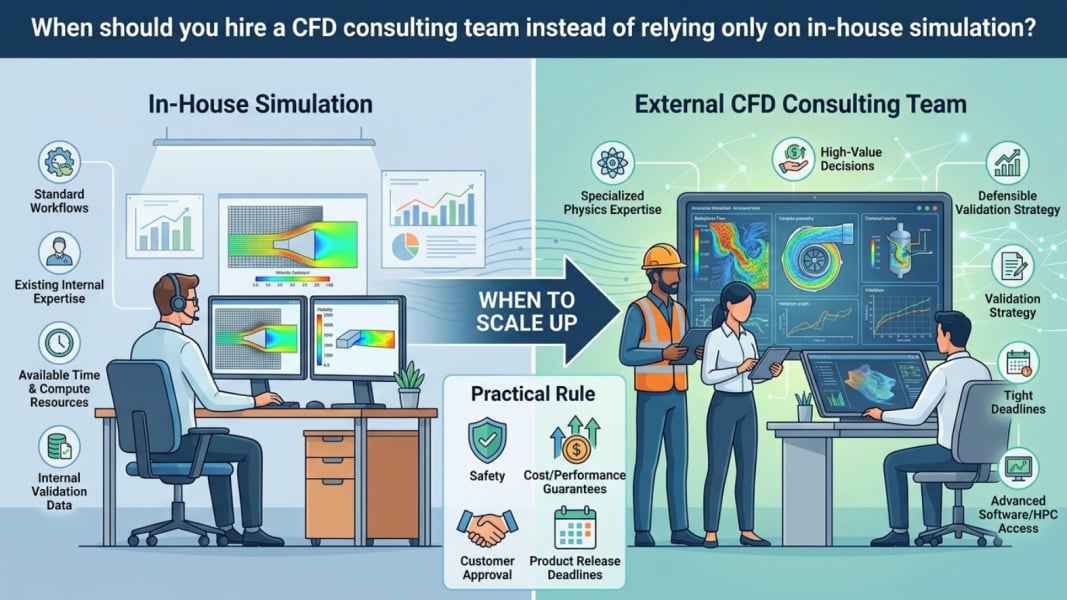
In-house CFD is valuable when your team has the time, expertise, compute resources, and validation data to build reliable workflows. But many industrial projects involve deadlines, unusual physics, or decision pressure that make trial and error risky.
A practical rule: if the CFD result will influence cost, safety, performance guarantees, customer approval, product release, or major design direction, expert review is worth considering.
Use this checklist:
| Hire CFD Experts If… | Why It Matters |
|---|---|
| The project has high financial or safety impact | Weak assumptions can create expensive consequences |
| Your Fluent model does not converge reliably | Instability may indicate setup, mesh, or physics issues |
| Results change significantly with mesh or time step | The model may not be numerically stable enough |
| You need multiphase, combustion, CHT, FSI, or UDFs | Advanced physics requires specialist judgment |
| You lack experimental data but need defensible results | A structured validation or benchmarking plan becomes essential |
| Local hardware limits model size or iteration speed | HPC may be needed for practical turnaround |
| Management or customers need a clear engineering report | Documentation quality matters |
| Your team needs a second opinion | External review can identify blind spots |
If several of these conditions apply, MR CFD can review the project scope through a CFD consulting feasibility assessment.
Should you hire consultants when the simulation affects safety, certification, or investment decisions?
Yes, expert support is especially valuable when CFD influences safety margins, regulatory discussions, capital equipment decisions, product release, or external reporting.
In these cases, the simulation must be traceable. A decision-maker should be able to see what assumptions were used, why the models were selected, how convergence was evaluated, what data was used for validation, and what limitations remain.
For example, a smoke extraction simulation in a transportation facility, a high-temperature thermal system, or a pressure loss study for expensive industrial equipment should not depend on undocumented setup choices. The cost of ambiguity is too high.
A consultant can help structure the work so the final report is not just a collection of images, but a defensible engineering document.
Should you outsource CFD when your team has Fluent access but limited specialist experience?
Software access is not the same as simulation expertise.
Many engineering teams have ANSYS Fluent available, but not every team has deep experience with turbulence modeling, wall functions, multiphase models, dynamic meshes, UDFs, transient stability, or validation workflows. This gap becomes visible when results are unstable, unrealistic, or difficult to explain.
A Fluent operator can set up a model. A simulation engineer must understand whether the model is appropriate for the real physics.
For teams that want to build long-term internal capability, MR CFD’s CFD Online courses and ANSYS Fluent Course for all levels can complement consulting. For urgent or high-risk projects, consulting is often the faster path.
Should you bring in experts when deadlines are too tight for internal learning?
Yes, when deadlines are tight and the simulation problem is unfamiliar, expert support can reduce costly learning loops.
Industrial CFD often involves practical barriers that are not obvious at the start:
- CAD cleanup takes longer than expected
- Mesh quality fails near small gaps or complex curvature
- Residuals stall
- Time step selection affects transient results
- Multiphase models become unstable
- Post-processing does not answer the original design question
An experienced consulting team has likely seen similar failure modes before. That experience can shorten the path from uncertain setup to usable engineering output.
Is outsourcing CFD simulation better than building an in-house CFD team?
Outsourcing CFD is not always better. The right choice depends on project frequency, risk, timeline, physics complexity, confidentiality needs, and internal capability.
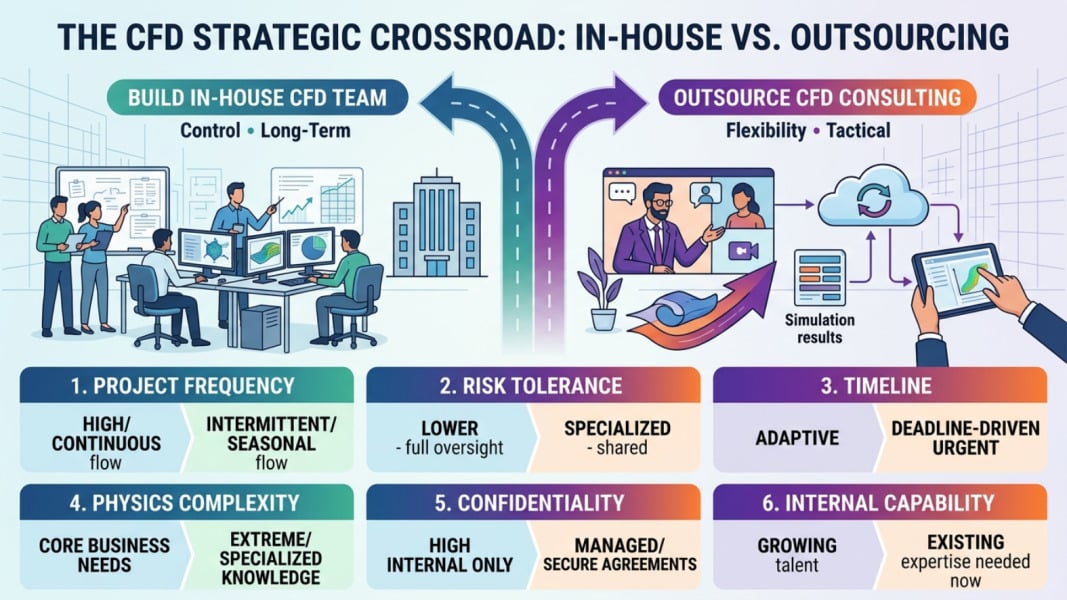
For some companies, building an internal CFD team is the right long-term strategy. For others, external consulting is more practical because simulation demand is intermittent, specialized, or deadline-driven.
| Criteria | In-House CFD Team | External CFD Consulting |
|---|---|---|
| Best for | Continuous simulation demand | Specialized, urgent, or occasional projects |
| Cost profile | Salaries, software, training, hardware | Project-based or scoped engagement |
| Speed at start | Slower if team must learn | Faster if consultant has relevant experience |
| Knowledge retention | Strong internal learning | Depends on documentation and collaboration |
| Advanced physics | Requires specialist hiring or training | Available when consultant has experience |
| Validation workflow | Must be developed internally | Can be built into project scope |
| HPC access | Requires infrastructure or rental | Can be combined with managed HPC |
| Independent review | Limited if only internal | Stronger external second opinion |
The strongest approach is often hybrid: internal engineers own the product knowledge, while CFD consultants support advanced setup, validation, troubleshooting, or peak workload.
When does an in-house CFD team make more sense?
An in-house CFD team makes sense when simulation is a recurring part of product development.
For example, an automotive supplier running weekly design iterations, a turbomachinery company developing multiple product families, or an electronics manufacturer frequently testing thermal layouts may benefit from internal CFD capability.
In-house teams are especially valuable when:
- Product knowledge is highly proprietary
- Design cycles are continuous
- Simulation methods can be standardized
- Engineers need rapid internal iteration
- The company can invest in training and QA processes
Even then, consultants can still help by auditing workflows, creating templates, validating methods, training engineers, or supporting complex cases.
When is external CFD consulting the faster and lower-risk option?
External consulting is usually faster and lower-risk when the project is specialized, urgent, or outside the team’s normal experience.
Examples include:
- A one-time multiphase simulation
- A critical heat transfer problem before prototype release
- A turbulent flow issue that has resisted internal troubleshooting
- A customer-facing engineering report
- A large model requiring ANSYS HPC resources
- A simulation involving UDFs, moving parts, combustion, or transient behavior
In these cases, outsourcing can prevent internal teams from spending weeks solving setup problems that an expert may identify quickly.
Which industrial CFD problems are best suited for expert consultants?
The best candidates for CFD consulting are problems where fluid behavior is complex, decisions are high-value, or the simulation must be documented carefully.
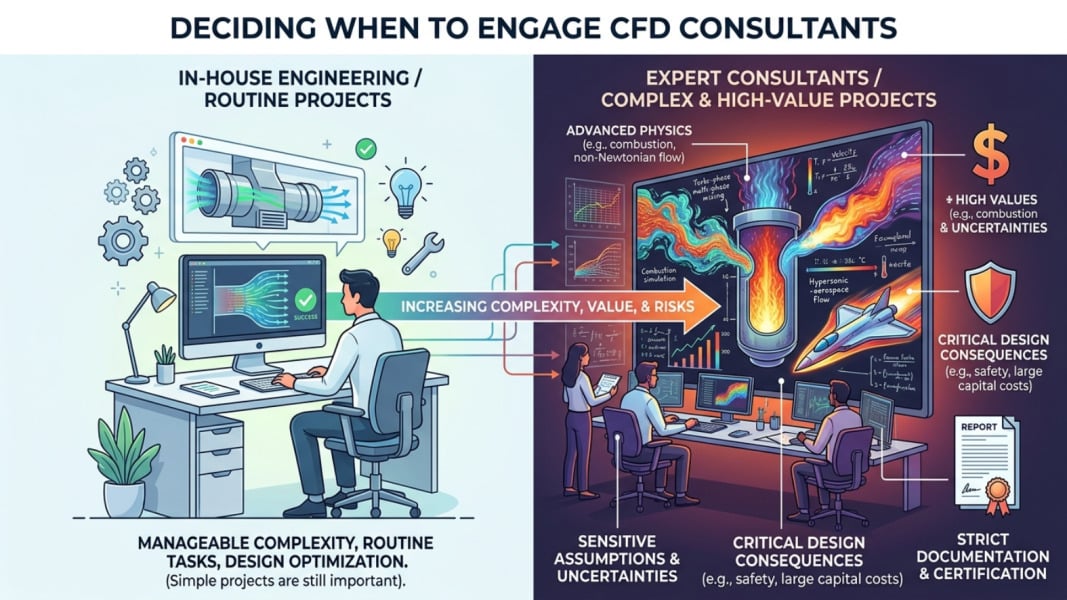
This does not mean simple simulations are unimportant. It means expert involvement becomes more valuable when the model contains advanced physics, sensitive assumptions, or design consequences.
| Industrial Problem Type | Typical CFD Question | Why Expert Support Helps |
|---|---|---|
| Thermal management | Will the system overheat? | Requires correct heat transfer and boundary conditions |
| Multiphase flow | How do bubbles, droplets, particles, or phase change behave? | Model selection and stability are difficult |
| Cavitation | Where does vapor formation occur? | Needs careful pressure, turbulence, and mesh treatment |
| HVAC and ventilation | Is airflow distribution effective? | Geometry, buoyancy, comfort, and contaminants may interact |
| Chemical reactors | Is mixing or residence time adequate? | Requires turbulence, species, and reaction insight |
| Rotating machinery | How do blades, impellers, or fans perform? | Rotation, wakes, and transient effects can dominate |
| Aerodynamics | How do drag, lift, and separation change? | Mesh and turbulence modeling strongly affect results |
| Fire and smoke | How does smoke or heat propagate? | Safety-related results need careful assumptions |
Thermal management and conjugate heat transfer projects
Thermal CFD consulting is valuable when temperature distribution affects reliability, safety, comfort, or performance.
Examples include electronics cooling, heat exchangers, furnaces, battery systems, energy equipment, industrial ovens, and high-temperature components. These problems often require correct treatment of conduction, convection, radiation, fluid properties, contact assumptions, and boundary conditions.
In conjugate heat transfer projects, the fluid and solid domains interact. A weak setup can misrepresent heat paths, surface temperatures, or cooling effectiveness. Consultants help ensure the model captures the right physics and that outputs such as heat transfer coefficient, hotspot location, and thermal margins are interpreted correctly.
Multiphase flow, cavitation, and chemical process simulations
Multiphase CFD is one of the most common reasons teams seek expert help.
Flows involving bubbles, droplets, particles, vapor, liquid-gas interfaces, slurry, sprays, or cavitation are sensitive to model selection and numerical stability. A setup that appears acceptable for single-phase flow may fail when phase interaction, turbulence, time step size, or interface behavior becomes important.
For pumps, cavitation modeling can help identify vapor regions and potential performance loss. For reactors, CFD can help evaluate mixing, residence time, dead zones, and species distribution. For separators or process equipment, it can reveal flow patterns that are difficult to observe directly.
These models should be handled carefully because they often contain assumptions that must be clearly documented.
HVAC, cleanroom, fire, and smoke simulations
HVAC and ventilation projects benefit from CFD when airflow patterns, temperature distribution, contaminants, smoke movement, or comfort conditions matter.
In a data center, CFD can help evaluate hot aisles, recirculation, and cooling effectiveness. In a cleanroom, it can support airflow uniformity and contamination control. In fire and smoke studies, CFD may help understand smoke propagation, extraction strategy, and thermal conditions.
These simulations are highly dependent on boundary conditions. Supply diffusers, exhaust locations, heat loads, openings, leakage paths, and transient events must be modeled with care. Expert consultants can help prevent oversimplified assumptions from producing misleading airflow maps.
Aerospace, automotive, marine, and rotating machinery projects
Aerospace, automotive, marine, and rotating machinery simulations often involve separation, wakes, pressure gradients, moving reference frames, transient effects, and turbulence-dominated flow.
Examples include:
- Drag reduction around vehicles
- Lift and pressure distribution on aerodynamic surfaces
- Hull resistance in marine design
- Fan and pump performance
- Blade flutter or transient loading
- Cooling airflow through compact systems
In these cases, mesh quality, near-wall treatment, turbulence model selection, and post-processing choices can significantly affect engineering conclusions. CFD consultants can help select the right level of model complexity for the project stage.
What should a professional CFD consulting project deliver?
A professional CFD consulting project should deliver more than images. It should deliver a clear engineering package that explains the model, assumptions, numerical method, results, limitations, and recommendations.
Useful deliverables may include:
| Deliverable | What It Should Include |
|---|---|
| Project scope | Objective, geometry, operating conditions, outputs, acceptance criteria |
| Simulation setup summary | Models, materials, boundary conditions, solver settings |
| Mesh report | Mesh strategy, quality metrics, refinement zones, independence checks if needed |
| Convergence evidence | Residuals, monitor points, mass/energy balance, stability observations |
| Validation or benchmarking | Comparison with experimental, analytical, benchmark, or operational data where available |
| Post-processing package | Contours, vectors, streamlines, plots, animations, extracted engineering values |
| Engineering report | Interpretation, limitations, recommendations, and next steps |
| Simulation files | Fluent case/data files or agreed deliverables depending on scope |
The client should understand not only what the simulation showed, but why the result can be used for the intended decision.
What should be included in the CFD project scope?
A strong project scope prevents confusion and scope creep.
Before simulation begins, the team should define:
- The engineering objective
- The geometry version
- The operating conditions
- The fluid and material properties
- The physics to be modeled
- The key outputs
- The required accuracy or confidence level
- The available validation data
- The project timeline
- The final deliverables
For example, “simulate airflow in this room” is too vague. A stronger scope would define supply airflow rate, heat loads, temperature targets, comfort criteria, contaminant concern, output planes, and design alternatives to compare.
The clearer the scope, the more useful the CFD result.
What should be included in the final engineering report?
The final report should be understandable to both engineers and technical managers.
It should typically include:
- Project objective
- Geometry and simplifications
- Mesh strategy
- Boundary and initial conditions
- Solver models and assumptions
- Convergence behavior
- Validation or comparison approach
- Main results
- Engineering interpretation
- Limitations
- Recommendations
A strong report does not hide uncertainty. It explains what is known, what was assumed, and where additional testing or refinement may be useful.
That transparency is one of the most important trust signals in industrial simulation.
What simulation files and documentation should the client receive?
Deliverables depend on the project agreement, confidentiality requirements, software licensing, and scope. In many consulting projects, clients may receive a combination of:
- Engineering report
- Result images and plots
- Animations or videos
- Fluent case/data files where agreed
- CAD-prepared geometry
- Mesh files
- Assumptions log
- Post-processing data
- Recommendations for next design iteration
For sensitive industrial projects, NDA and confidentiality terms should be clear before data is shared. This is especially important when geometry, operating conditions, or product performance information are proprietary.
How should CFD validation and quality assurance be handled?
CFD validation and quality assurance should be planned from the beginning, not added at the end.
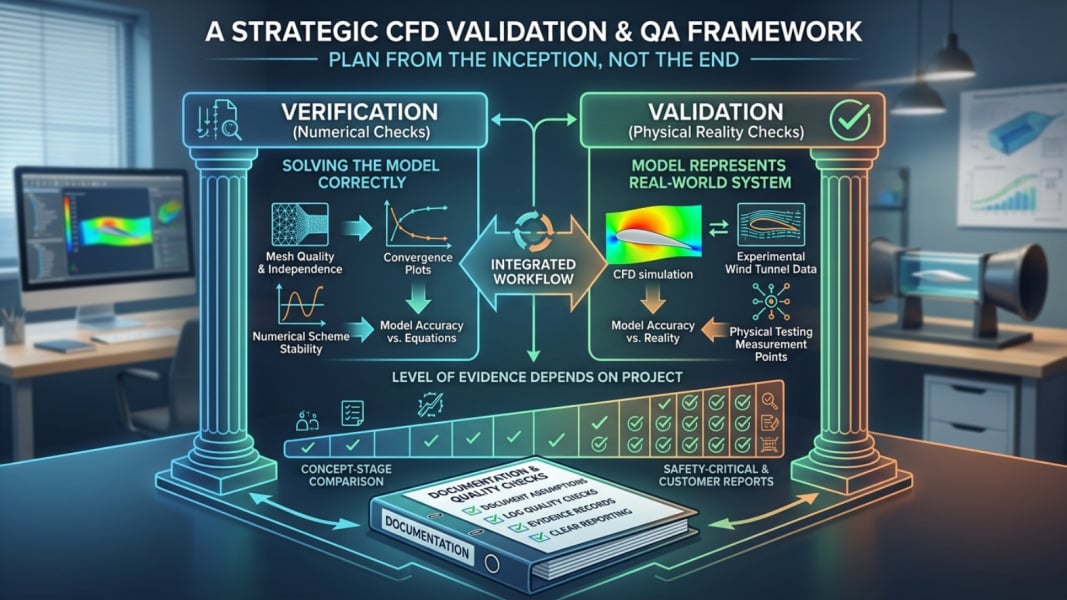
A reliable CFD workflow should include both numerical checks and physical reality checks. Verification asks whether the numerical model is being solved correctly. Validation asks whether the model represents the real-world system accurately enough for the intended use.
The specific level of validation depends on the project. A concept-stage comparison may need less evidence than a safety-critical or customer-facing engineering report. However, every serious project should document assumptions and quality checks.
| QA Element | What It Checks | Why It Matters |
|---|---|---|
| Geometry review | Are simplifications acceptable? | Prevents modeling the wrong system |
| Mesh quality | Are critical regions resolved? | Reduces numerical error |
| Residual convergence | Are equations stabilizing? | Basic solver health check |
| Monitor convergence | Are engineering quantities stable? | More useful than residuals alone |
| Conservation checks | Are mass and energy balanced? | Detects setup or numerical issues |
| Mesh independence | Do key outputs change with mesh? | Supports numerical reliability |
| Sensitivity analysis | Do assumptions strongly affect results? | Reveals risk in uncertain inputs |
| Validation comparison | Does CFD match test or benchmark data? | Builds decision confidence |
ASME and AIAA both treat verification and validation as central to simulation credibility, which is why industrial CFD reports should show more than final contours.
What is the difference between CFD verification and validation?
Verification and validation are related, but they are not the same.
Verification asks: Are we solving the equations correctly?
Validation asks: Are we solving the right equations for the real physical system?
| Concept | Practical Meaning | Example |
|---|---|---|
| Verification | Checks numerical implementation and solution quality | Mesh independence, residuals, conservation checks |
| Validation | Checks physical accuracy against reality | Comparing pressure drop with experimental data |
A model can be verified but not validated. For example, the solver may converge and the mesh may be refined, but if the inlet boundary condition does not represent the real system, the result may still be physically misleading.
Why does mesh independence matter in industrial CFD consulting?
Mesh independence matters because CFD results can change when the mesh changes.
If pressure drop, wall shear stress, heat transfer, separation location, or velocity distribution changes significantly with mesh refinement, the model may not be reliable enough for decision-making.
A useful mesh independence study focuses on engineering outputs, not just cell count. For example:
- Pressure drop across a valve
- Maximum surface temperature on a heat sink
- Lift or drag coefficient
- Outlet flow uniformity
- Wall shear stress in a biomedical device
- Cavitation region size in a pump
The goal is not to create the largest possible mesh. The goal is to create a mesh that resolves the important physics efficiently.
What evidence makes CFD results defensible?
Defensible CFD results usually include a combination of numerical stability, physical consistency, documented assumptions, and comparison with available evidence.
Useful evidence includes:
- Mesh independence study
- Residual and monitor convergence
- Mass and energy balance
- Sensitivity analysis
- Comparison with experimental data
- Comparison with benchmark cases
- Clear boundary condition documentation
- Explanation of turbulence or multiphase model selection
- Transparent limitations
- Engineering interpretation tied to project objectives
Not every industrial project has perfect test data. But every project can still be made more defensible by documenting what was checked and where uncertainty remains.
How does HPC change the value of CFD consulting for industrial projects?
HPC changes CFD consulting by making larger, more detailed, or more iterative simulations practical.
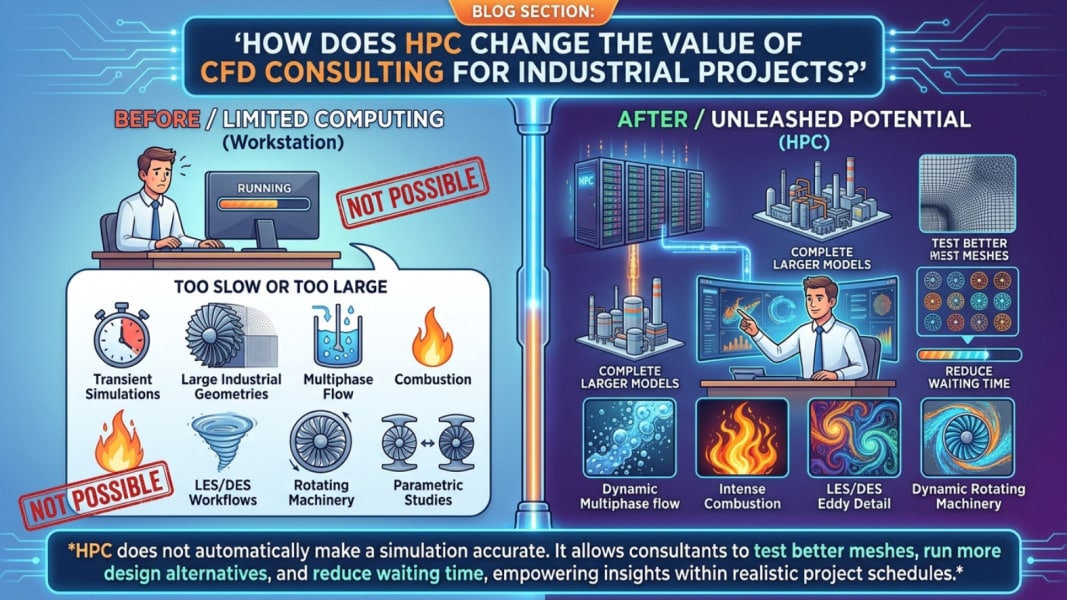
Some models are too slow or too large for a local workstation. This is common in transient simulations, large industrial geometries, multiphase flow, combustion, LES/DES workflows, rotating machinery, and parametric studies.
HPC does not automatically make a simulation accurate. It does, however, allow the consulting team to test better meshes, run more design alternatives, reduce waiting time, or complete larger models within a realistic project schedule.
Which CFD simulations usually need HPC resources?
HPC is most useful when model size, physics complexity, or project deadlines exceed local hardware capacity.
| Simulation Type | Why HPC Helps |
|---|---|
| Large industrial geometry | Handles higher cell counts and complex domains |
| Transient simulation | Reduces time required for many time steps |
| Multiphase flow | Supports expensive phase interaction models |
| Combustion | Handles coupled species, turbulence, and heat release |
| LES/DES | Requires fine spatial and temporal resolution |
| Parametric studies | Runs multiple design cases more efficiently |
| Rotating machinery | Supports transient rotor-stator or sliding mesh cases |
| Conjugate heat transfer | Handles coupled solid-fluid domains |
The decision to use HPC should be based on mesh size, solver settings, physics, turnaround expectations, and budget.
Can managed HPC reduce CFD consulting project time?
Managed HPC can reduce project time when the bottleneck is computational capacity.
For example, if a workstation takes too long to complete each design iteration, HPC can allow the team to test more alternatives or refine the model without delaying the project. This is especially useful when consultants need to compare boundary conditions, mesh refinements, or geometry variants.
However, HPC should be used strategically. A poorly scoped or physically weak model will not become reliable just because it runs on more cores. The best results come from combining expert modeling decisions with the right computational resources.
For larger Fluent projects, MR CFD’s HPC service can be relevant when local hardware limits simulation scale or turnaround time.
What information should you prepare before requesting a CFD feasibility assessment?
Before requesting a CFD feasibility assessment, prepare enough information for the consultant to understand the engineering question, geometry, operating conditions, and expected outputs.
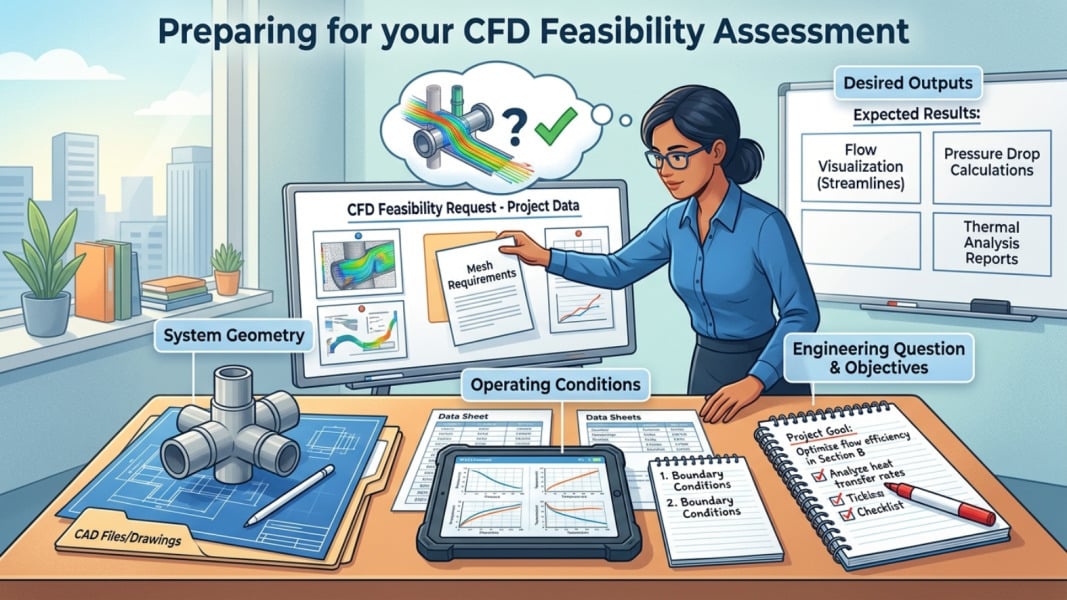
You do not need to have every detail ready before the first conversation. But the more clearly you define the problem, the more accurately the consulting team can estimate scope, feasibility, timeline, and required data.
Useful inputs include:
| Input | Examples |
|---|---|
| Geometry | CAD files, drawings, dimensions, domain boundaries |
| Objective | Reduce pressure drop, improve cooling, predict mixing, compare designs |
| Operating conditions | Flow rate, temperature, pressure, rotation speed, heat load |
| Materials and fluids | Density, viscosity, thermal properties, phase information |
| Boundary conditions | Inlets, outlets, walls, heat sources, moving parts |
| Available data | Test results, sensor data, manufacturer curves, benchmark cases |
| Required outputs | Pressure drop, temperature, forces, flow uniformity, residence time |
| Timeline | Deadline, review milestones, prototype schedule |
| Confidentiality needs | NDA, data handling, file sharing limitations |
What project files and engineering inputs should you collect first?
Start with the files and inputs that define the physical system.
These usually include:
- CAD geometry or drawings
- Operating conditions
- Fluid and material properties
- Known constraints
- Performance targets
- Photos or diagrams if CAD is incomplete
- Existing test or field data
- Previous simulation files if available
- Required output quantities
- Deadline and decision context
Incomplete inputs do not always prevent a feasibility review. But they may affect the accuracy of the project estimate. A good consultant should identify what is missing and explain how it affects the simulation workflow.
What questions should you ask before hiring a CFD consultant?
Before hiring a CFD consultant, ask questions that reveal technical process, not just price.
Useful questions include:
- Have you handled similar physics or industrial applications?
- How will you validate or check the simulation results?
- What deliverables will we receive?
- How will assumptions and limitations be documented?
- What data do you need from our team?
- How will confidentiality be handled?
- Will the final report include engineering recommendations?
These questions help you separate a simulation vendor from a consulting partner. A strong consultant should be comfortable discussing uncertainty, validation, limitations, and decision use.
How does MR CFD approach CFD consulting for industrial projects?
MR CFD approaches CFD consulting as an engineering workflow, not just a software task.
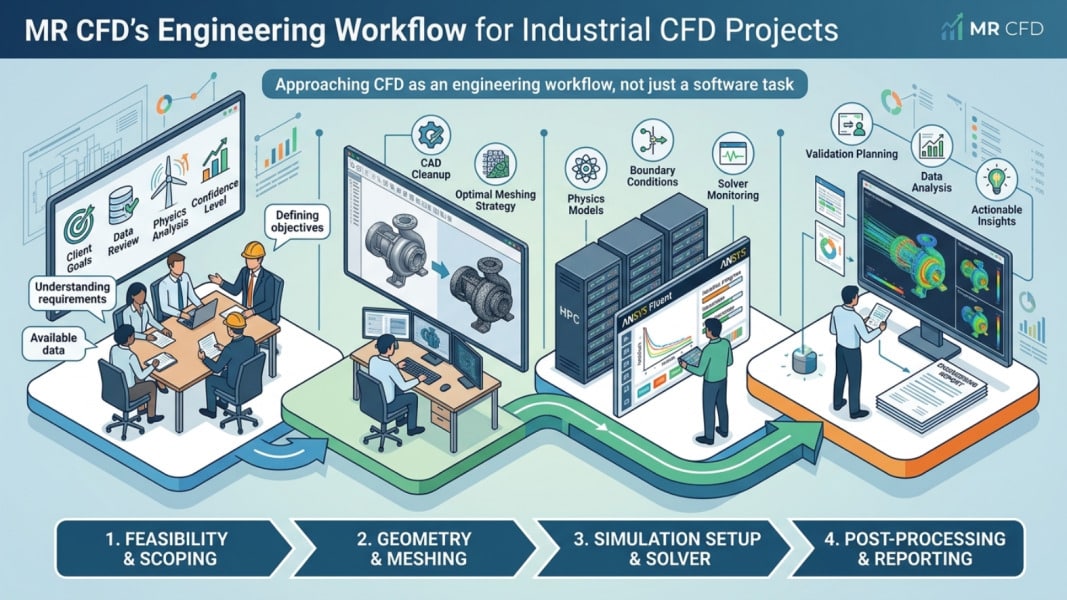
The process typically starts with feasibility and scoping: what the client wants to know, what data is available, what physics are involved, and what level of confidence is required. From there, MR CFD can support geometry preparation, meshing strategy, ANSYS Fluent setup, solver monitoring, validation planning, post-processing, and engineering reporting.
A typical workflow may look like this:
| Step | Purpose |
|---|---|
| Feasibility review | Understand the engineering question and available data |
| Project scoping | Define objectives, assumptions, outputs, and deliverables |
| Model strategy | Choose physics models, boundary conditions, and validation approach |
| Simulation setup | Prepare geometry, mesh, and Fluent settings |
| QA and review | Check convergence, mesh sensitivity, conservation, and physical consistency |
| Post-processing | Extract useful engineering outputs |
| Reporting | Explain results, limitations, and recommendations |
| Next-step support | Support redesign, additional simulations, HPC, or training if needed |
For teams facing uncertain industrial simulation challenges, MR CFD’s CFD consulting services can help clarify the right workflow before project costs escalate.
How does MR CFD combine consulting, ANSYS Fluent expertise, HPC, and training?
Different clients need different levels of support.
Some teams need full CFD outsourcing. Others need expert review of an existing Fluent model. Some need HPC resources because local workstations are slowing down large cases. Others need training so their internal engineers can build stronger long-term CFD capability.
| Client Situation | Best-Fit Support |
|---|---|
| No internal CFD team | CFD consulting and full simulation delivery |
| Internal team needs review | Simulation audit or expert troubleshooting |
| Large model runs too slowly | HPC support for ANSYS Fluent |
| Engineers need skill development | CFD courses and Fluent training |
| Complex project with deadline pressure | Consulting + managed HPC |
| Long-term simulation capability goal | Training + workflow templates + expert review |
This flexible approach allows industrial teams to choose the right level of support instead of forcing every project into the same service model.
What happens after you submit the feasibility assessment form?
After submitting a feasibility assessment request, MR CFD can review the project context and identify the next practical step.
The form can include:
- Full Name
- Your Company Name
- Email, preferably a work email
- Job role
- Project description or technical challenge
The next step is usually to clarify the objective, required outputs, available geometry and data, expected timeline, and whether the project is best suited for consulting, HPC, training, or a hybrid workflow.
The goal is not to sell unnecessary simulation work. The goal is to determine whether CFD can answer the engineering question and what level of modeling effort is appropriate.
What is the next step if your industrial CFD project needs expert review?
If your CFD project affects cost, safety, product performance, customer confidence, or development timing, expert review is worth considering.
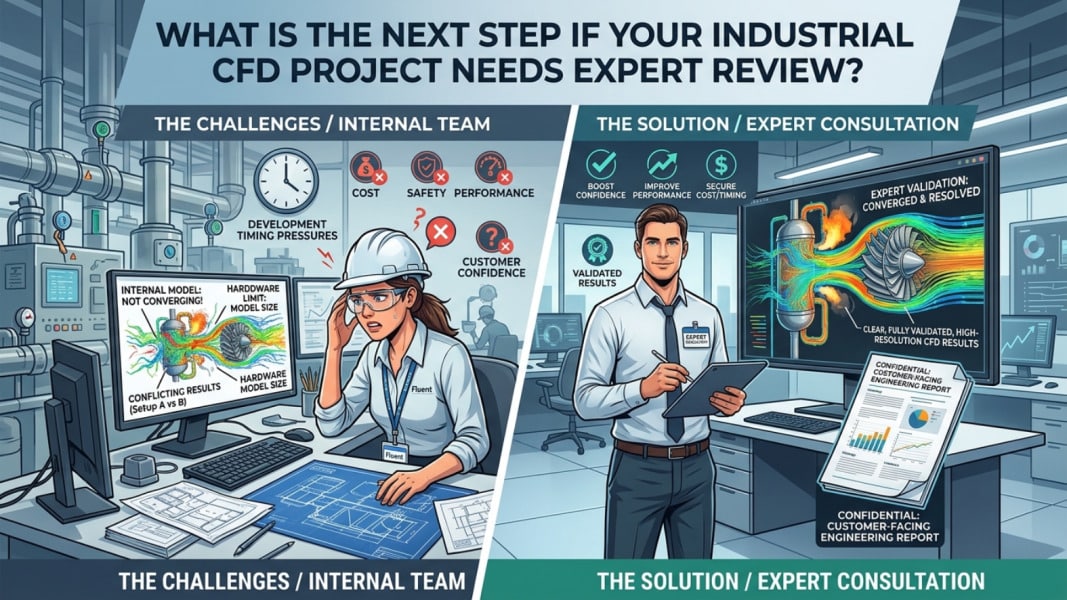
You may need CFD consulting if:
- Your internal model is not converging
- Different setups give conflicting results
- The design decision is high-value
- You need a customer-facing engineering report
- The physics involve multiphase flow, CHT, combustion, or transient behavior
- Your workstation limits model size or iteration speed
- You need validation or a second opinion
- Your team has Fluent access but limited specialist experience
In these situations, CFD consulting can reduce uncertainty and help your team move from trial and error to a structured simulation workflow.
Request a free CFD feasibility assessment from MR CFD
If your team is evaluating an industrial CFD project, MR CFD can help review the technical scope and recommend a practical simulation path.
You can start by requesting a free feasibility assessment through MR CFD’s CFD Consulting. Share your role, company, project objective, and available engineering data. MR CFD can then help determine whether the project requires full consulting, expert review, HPC support, training, or a hybrid approach.
Conclusion
Industrial CFD becomes valuable when it supports better engineering decisions. But that value depends on more than software access. It depends on the quality of the model, the realism of the assumptions, the suitability of the physics, the strength of the validation plan, and the clarity of the final engineering interpretation.
For simple, recurring simulations, an in-house team may be the right choice. For complex, high-risk, urgent, or unfamiliar industrial projects, CFD consulting can provide a faster and more defensible route.
MR CFD supports industrial teams with CFD consulting, ANSYS Fluent expertise, managed HPC options, and CFD training pathways. If your current simulation challenge is affecting a design decision, prototype plan, safety review, or product development timeline, the next step is to request a feasibility assessment and define the right CFD workflow before more time is lost in trial and error.
Frequently Asked Questions about CFD Consulting Services for Industrial Projects
How do I know if my industrial CFD project is too complex for in-house simulation?
Your project may be too complex for in-house simulation if it involves unstable convergence, multiphase flow, combustion, conjugate heat transfer, moving parts, transient behavior, advanced turbulence modeling, or uncertain boundary conditions. Complexity also increases when the simulation affects safety, product release, customer approval, or large investment decisions. If your team cannot explain why the model is behaving a certain way, or if results change significantly with mesh, time step, or solver settings, expert CFD review is usually a good idea.
Are CFD consulting services only useful for companies without an internal simulation team?
No. CFD consulting services are also useful for companies that already have internal simulation capability. Consultants can support advanced physics, independent verification, model troubleshooting, validation planning, peak workload, or customer-facing documentation. Many industrial teams use consultants as a second opinion when the decision is important or when internal engineers need support with unfamiliar models. A hybrid approach can work well: the internal team provides product knowledge, while the consultant supports simulation strategy and quality assurance.
What data does a CFD consultant need to estimate project feasibility?
A CFD consultant usually needs the project objective, CAD geometry or drawings, operating conditions, fluid and material properties, known boundary conditions, required outputs, available test data, and the project timeline. For example, useful information may include flow rate, temperature, pressure, heat load, rotation speed, inlet and outlet conditions, and the performance metric you want to evaluate. If some data is missing, the consultant can still review feasibility, but they should explain how missing inputs affect accuracy, assumptions, and project scope.
Can CFD consulting reduce physical prototyping costs?
CFD consulting can reduce unnecessary prototype iterations when the simulation is properly scoped and validated for the intended decision. It can help identify design weaknesses earlier, compare alternatives, and guide physical testing more efficiently. However, CFD should not be presented as a complete replacement for testing in every case. For high-stakes projects, the strongest workflow often combines simulation with experimental data, benchmark cases, or field measurements. The goal is better engineering confidence, not blind replacement of physical validation.
How important is ANSYS Fluent expertise in industrial CFD consulting?
ANSYS Fluent expertise is important when the project depends on correct solver setup, model selection, meshing strategy, convergence control, UDFs, post-processing, or advanced physics. Fluent is a powerful tool, but industrial accuracy depends on how the model is built and interpreted. A consultant with Fluent experience can help choose suitable turbulence, multiphase, heat transfer, or transient models and document the assumptions behind those choices. This is especially important when results will guide engineering or business decisions.
Does MR CFD offer both CFD consulting and HPC support for Fluent simulations?
MR CFD can support industrial teams through CFD consulting, ANSYS Fluent simulation expertise, and HPC-related workflows when larger or faster simulations are needed. Consulting is useful for defining the model, physics, validation plan, and engineering interpretation. HPC support becomes relevant when local workstations limit mesh size, transient simulation time, or parametric studies. Depending on the project, MR CFD may recommend consulting, HPC support, training, or a combined workflow that fits the technical and business requirements.
Related Posts
Operating Pressure in ANSYS Fluent: Gauge, Absolute & Stagnation Pressure Explained
Operating pressure in ANSYS Fluent is the reference pressure (default 101325 Pa) to which all…
What is Conjugate Heat Transfer Simulation? Complete CHT Guide
Conjugate Heat Transfer (CHT) simulation is a CFD method that solves fluid flow and solid…
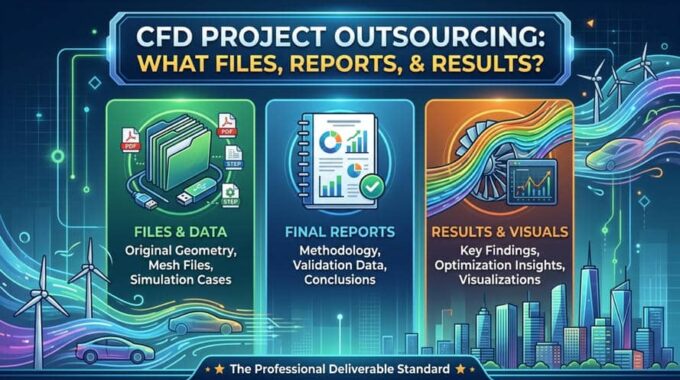
CFD Project Outsourcing: What Files, Reports, and Results Should You Expect?
When engineering teams decide to outsource CFD simulation, the conversation almost always starts with capability and…
 Talk On WhatsApp
Comments (0)