
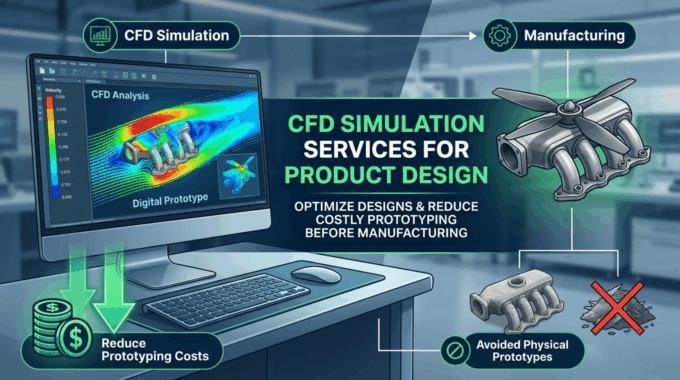
CFD Simulation Services for Product Design: Reduce Prototyping Cost Before Manufacturing
In modern product development, the most expensive mistakes are often discovered after money has already been spent on tooling, testing, and prototype fabrication. For engineering teams, CFD for product design is no longer just a technical analysis method; it is a practical way to reduce uncertainty before manufacturing. At MR CFD, engineering simulation services help product teams evaluate airflow, cooling, pressure drop, thermal behavior, and fluid performance before physical prototypes consume the budget.
ANSYS Fluent Beginner Course for Less Than the Cost of a Lunch!
No prior experience needed. Start Learning ANSYS Fluent step-by-step with 16 hands-on, real-world projects across multiple engineering fields.
Instead of waiting for a prototype to fail, Computational Fluid Dynamics allows engineers to test design assumptions digitally. This gives R&D teams a clearer view of product behavior under real-world operating conditions, helping them reduce prototyping cost, shorten redesign cycles, and make better pre-manufacturing decisions.
Why Traditional Product Development Is Becoming Too Expensive
Physical prototyping is still essential, but relying on it too early or too heavily can slow down the entire product development workflow. Modern products are more compact, more energy-sensitive, and more thermally constrained than ever. A single airflow issue, overheating problem, or unexpected pressure drop analysis result can force a costly redesign.
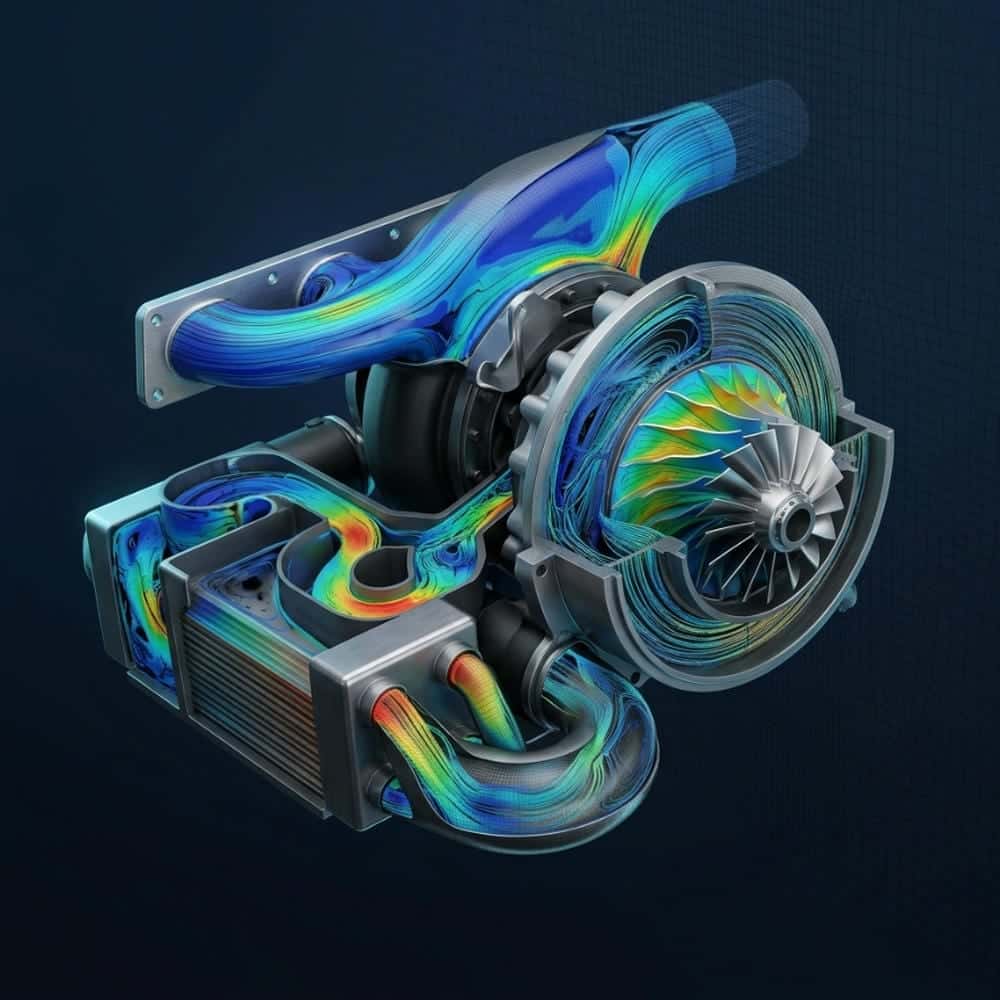
Premier CFD Consulting Services Using ANSYS Fluent
ANSYS Fluent simulations, validation, and defensible engineering reports across 30+ fields. Registered in 🇺🇸 USA (Delaware), 🇬🇧 UK & 🇴🇲 Oman
Beginner CFD Course for Starting ANSYS Fluent Simulation
Start your CFD journey with MR CFD’s beginner CFD course, a practical introduction to ANSYS Fluent workflows, meshing, boundary conditions, and real engineering simulations. Perfect for beginners before moving into advanced CFD Courses.
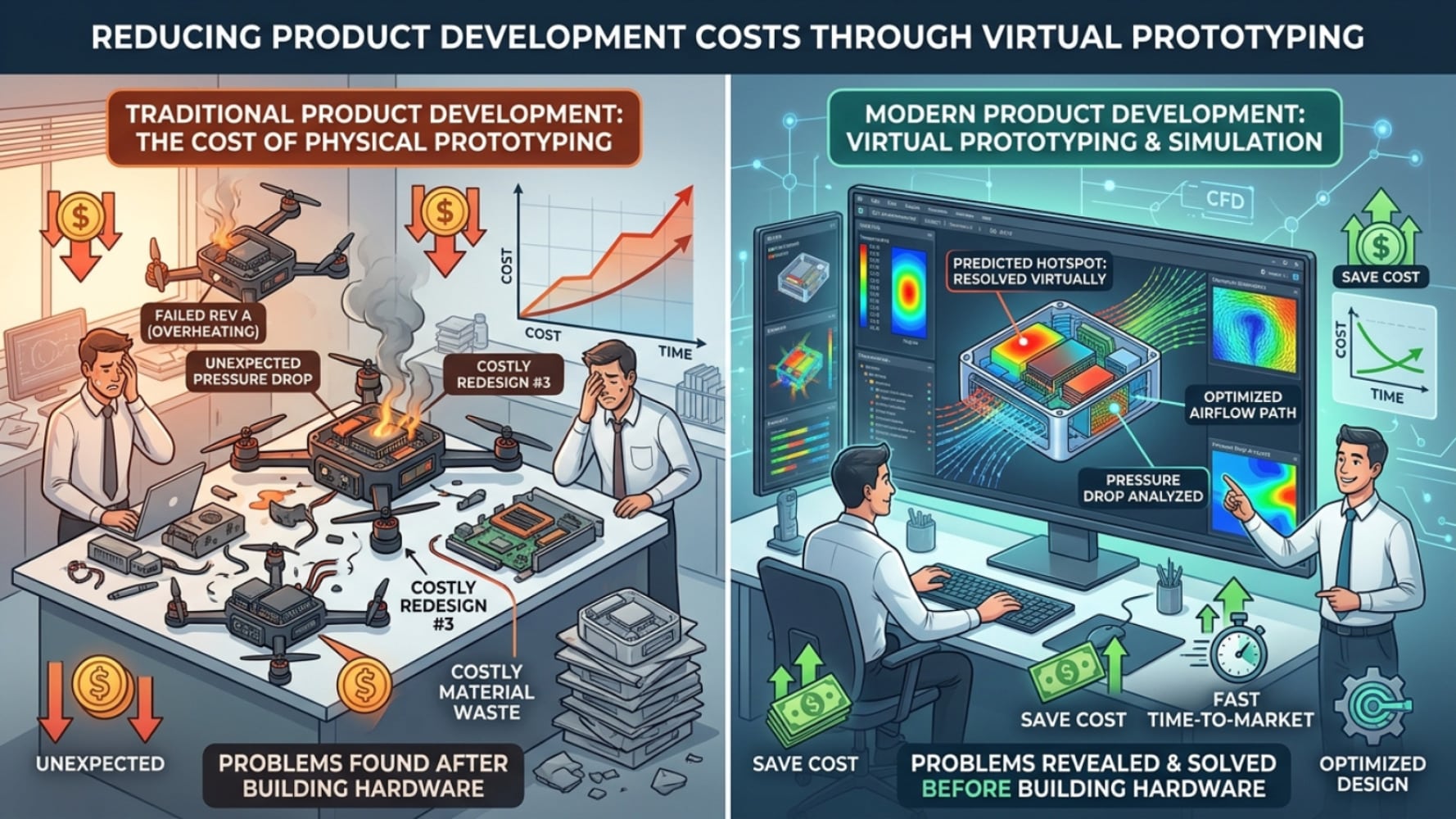
The challenge is simple: physical prototypes show problems after they exist. Virtual prototyping helps reveal many of those problems before hardware is built.
The Hidden Costs of Multiple Prototype Iterations
Prototype cost is not limited to materials. Every failed iteration usually creates extra cost across engineering, purchasing, testing, and management review.
| Cost Area | How It Affects Product Development |
|---|---|
| CAD redesign | Engineers must revise geometry and update assemblies |
| Fabrication | New prototype parts must be manufactured |
| Testing | Lab time, equipment, and technicians are required again |
| Delay | Launch timelines move forward |
| Decision friction | Teams lose confidence in the design direction |
| Supplier impact | Tooling or production partners may need changes |
For example, if an electronics enclosure overheats during testing, the solution may require new vents, fan relocation, internal layout changes, or heat sink redesign. Without thermal analysis during the design phase, the team may go through several expensive physical iterations before finding the right solution.
Manufacturing Risks Discovered Too Late
Late-stage design problems are dangerous because many decisions may already be locked. Tooling, supplier contracts, packaging, certification planning, and production scheduling may all depend on a design that has not been fully validated.
Common late-stage risks include:
- Thermal Management failure under peak load
- Poor airflow simulation results inside compact enclosures
- Excessive pressure drop analysis values in ducts, valves, or manifolds
- Weak fluid flow optimization
- Unstable mixing or uneven distribution
- Aerodynamic drag or flow separation
- Reduced product reliability after manufacturing
When these issues appear late, the cost curve goes uphill fast. Simulation-based engineering helps bring these risks to the surface while the design is still flexible.
How CFD Simulation Transforms Product Design Decisions
Computational Fluid Dynamics turns hidden product behavior into measurable engineering data. Instead of guessing how air, liquid, heat, or pressure will behave, engineers can evaluate performance through CFD Modeling before physical testing begins.

This makes CFD analysis services especially valuable for teams that need technical confidence before approving manufacturing investment.
Testing Product Performance Before Building Anything
With product performance simulation, teams can answer practical questions before the first prototype is built:
- Will the product overheat?
- Is the airflow path restricted?
- Where does pressure loss occur?
- Which design option performs better?
- Are there recirculation zones?
- Does the geometry create unwanted turbulence?
- Can the product meet performance targets under worst-case conditions?
This is where digital prototyping becomes powerful. Instead of building one option, testing it, failing, and redesigning, engineers can compare multiple concepts virtually.
That changes the design conversation from:
“We hope this works.”
to:
“We have simulation evidence showing why this option is stronger.”
Simulating Real Operating Conditions
A useful CFD model must represent real use conditions, not an idealized version of the product. This requires careful boundary condition selection, correct material properties, realistic heat loads, and appropriate solver settings.
Depending on the product, the simulation may include:
- Internal or external airflow
- Liquid flow
- Heat transfer
- Fan or pump behavior
- Rotating components
- Pressure loss
- Mixing
- Multiphase flow
- Transient operating conditions
- Worst-case temperature or load scenarios
For example, an electronics cooling project should not only show velocity contours. It should connect airflow behavior with component heat generation, enclosure geometry, vent placement, and maximum allowable temperature.
That is why expert engineering judgment matters. Software can calculate results, but a skilled consultant defines the right problem.
Where CFD Simulation Delivers the Highest ROI in Product Development
The highest ROI from CFD for product design usually appears when performance depends on flow, pressure, cooling, or heat transfer. These are the areas where physical trial-and-error can become painfully expensive.

For engineering managers, the value of Engineering simulation services is not just technical accuracy. It is better decision-making before major cost commitments.
Thermal Management and Cooling Design
Thermal Management is one of the strongest applications of CFD in product development. Products often fail not because the concept is wrong, but because heat cannot escape efficiently.
Common use cases include:
- Electronics enclosures
- Battery packs
- LED systems
- Power electronics
- Medical devices
- HVAC products
- Industrial control units
- Compact mechanical systems
A CFD-based thermal analysis can identify hot spots, evaluate cooling paths, test fan placement, compare vent designs, and improve internal airflow.
For example, two enclosure designs may look similar from the outside. But one may create internal recirculation and trap heat near sensitive components, while the other guides airflow across the highest heat-load zones. CFD reveals that difference before manufacturing.
Aerodynamic and Flow Optimization
For products affected by air or liquid movement, Aerodynamics CFD Simulations and Fluid Flow Optimization can directly influence performance, energy use, noise, and reliability.
CFD can support:
- Drag reduction
- Flow separation control
- Ventilation improvement
- Fan and duct optimization
- Product shape refinement
- External airflow performance
- Internal channel optimization
In real product design, the goal is not always perfect aerodynamic performance. The goal is often the best balance between performance, manufacturing feasibility, cost, and design constraints.
This is where engineering design optimization becomes practical. CFD allows teams to compare alternatives and select the option that delivers the strongest business and technical outcome.
Pressure Drop and Fluid Distribution Analysis
Excessive pressure drop can quietly damage product performance. A system may function, but require a larger pump, stronger fan, more energy, or higher operating cost.
CFD is highly useful for:
- Valves
- Filters
- Manifolds
- Ducts
- Nozzles
- Pipes
- Heat exchangers
- Process equipment
- Cooling channels
A proper pressure drop analysis does not only calculate total pressure loss. It shows where the loss occurs and why. The cause may be sharp bends, sudden expansions, narrow passages, poor flow distribution, or local turbulence.
For industrial products, this insight can support manufacturing cost reduction, energy efficiency, and better customer performance.
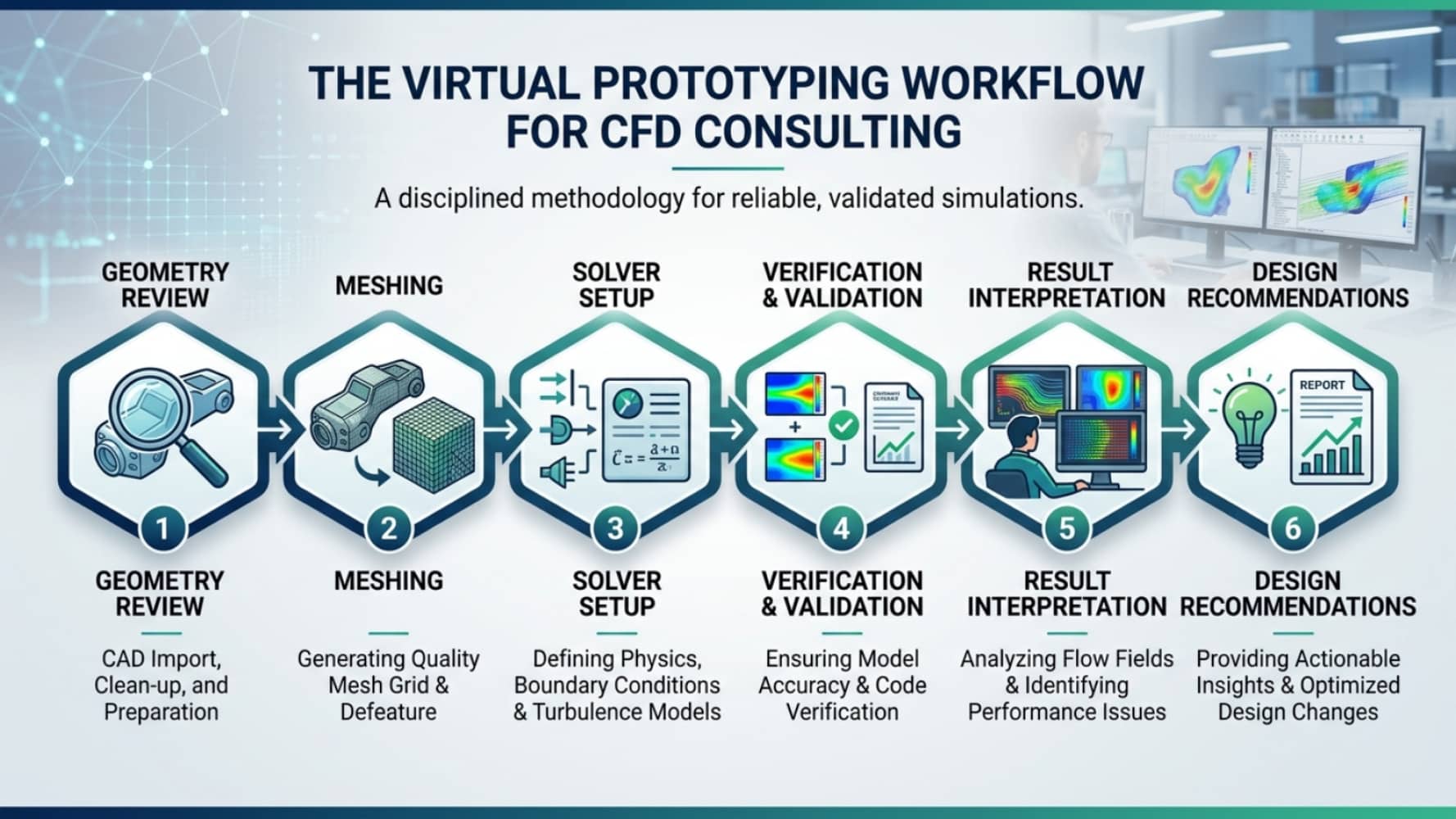
The Virtual Prototyping Workflow Used by CFD Consultants
Professional CFD consulting services follow a structured workflow. A reliable simulation is not created by simply importing CAD into software and pressing run. It requires a disciplined process, strong assumptions, and technical validation.

A serious validated simulation methodology usually includes geometry review, meshing, solver setup, verification, result interpretation, and design recommendations.
Geometry Preparation and Design Review
The process starts with CAD and design review. The consultant studies the product geometry and identifies what must be included, simplified, removed, or modified for simulation.
This stage may involve:
- Cleaning CAD geometry
- Defining the fluid domain
- Removing non-critical tiny features
- Closing gaps or leaks
- Preparing internal flow volumes
- Creating design variants
- Reviewing operating assumptions
- Identifying performance targets
This step is crucial because poor geometry preparation leads to poor simulation quality. Over-simplifying can hide important physics. Over-detailing can waste computation time without improving decision quality.
A skilled CFD consultant knows the difference.
Simulation Setup and Validation
After geometry preparation, the consultant defines the simulation setup. This includes mesh strategy, solver settings, material properties, turbulence models, and boundary condition selection.
A strong setup may include:
- Mesh quality checks
- Mesh independence study
- Solver convergence monitoring
- Residual tracking
- Mass and energy balance checks
- Comparison with benchmarks or test data
- Simulation verification
- Simulation validation where data is available
The goal is not to create attractive contour images. The goal is to create reliable engineering evidence.
Tools such as ANSYS Fluent are powerful for Engineering Simulation, but the final result depends heavily on setup quality and interpretation. In CFD, the tool matters—but the engineering method matters more.
Design Optimization and Performance Benchmarking
Once the baseline simulation is complete, the next step is optimization. This may include comparing several design alternatives against clear engineering benchmarks.
| Performance Metric | Why It Matters |
|---|---|
| Maximum temperature | Measures overheating risk |
| Average pressure drop | Indicates energy and system efficiency |
| Flow uniformity | Shows distribution quality |
| Velocity field | Reveals stagnation or excessive speed |
| Drag coefficient | Supports aerodynamic decisions |
| Heat transfer rate | Shows cooling effectiveness |
| Safety margin | Supports manufacturing confidence |
This is where performance optimization turns CFD results into practical design action. The final output should explain what is happening, why it is happening, and what the engineering team should change.
CFD Simulation vs Physical Prototyping: Cost, Speed, and Risk Comparison
CFD does not remove the need for physical testing in every project. Instead, it makes physical testing smarter, more focused, and less wasteful.
The strongest workflow combines virtual prototyping with targeted physical validation. CFD narrows the design space. Physical testing confirms the final direction.
Development Cost Comparison
Physical prototypes are expensive because every change requires fabrication, assembly, testing, and review. CFD moves many early decisions into the digital phase.
| Factor | Physical Prototyping | CFD Virtual Prototyping |
|---|---|---|
| Cost per iteration | High | Lower during early design |
| Design flexibility | Limited after fabrication | High before manufacturing |
| Testing speed | Slower | Faster for comparison studies |
| Visibility | Limited to sensors and measurements | Full-field flow and thermal insight |
| Risk discovery | Often late | Earlier in the design process |
| Best use | Final validation | Early screening and optimization |
The point is not that CFD is always cheaper in isolation. The point is that CFD can prevent the most expensive kind of mistake: discovering a major flaw after manufacturing decisions are already made.
Time-to-Market Impact
Speed matters when product launch depends on customer deadlines, certification windows, investor milestones, or competitive pressure.
CFD can improve time-to-market by helping teams:
- Compare concepts faster
- Reduce unnecessary prototype rounds
- Detect failure risks earlier
- Focus physical testing on stronger designs
- Make decisions using engineering evidence
- Shorten redesign loops
When simulation is used early, physical prototypes become confirmation tools rather than discovery tools. That is a major shift in product development simulation strategy.
Risk Reduction Before Manufacturing
The closer a product gets to manufacturing, the more expensive design changes become. CFD reduces risk by identifying hidden problems while the design can still be changed.
Key risks CFD can reduce include:
- Overheating
- Poor cooling airflow
- Excessive pressure drop
- Flow separation
- Poor mixing
- Uneven distribution
- Component-level thermal stress
- Inefficient geometry
- Performance failure under worst-case conditions
For decision-makers, this creates stronger confidence before approving tooling, supplier work, and production planning.
How to Determine Whether Your Product Needs CFD Analysis
Not every product needs CFD. But if product performance depends on fluid flow, heat transfer, pressure, or airflow, CFD can provide major value.
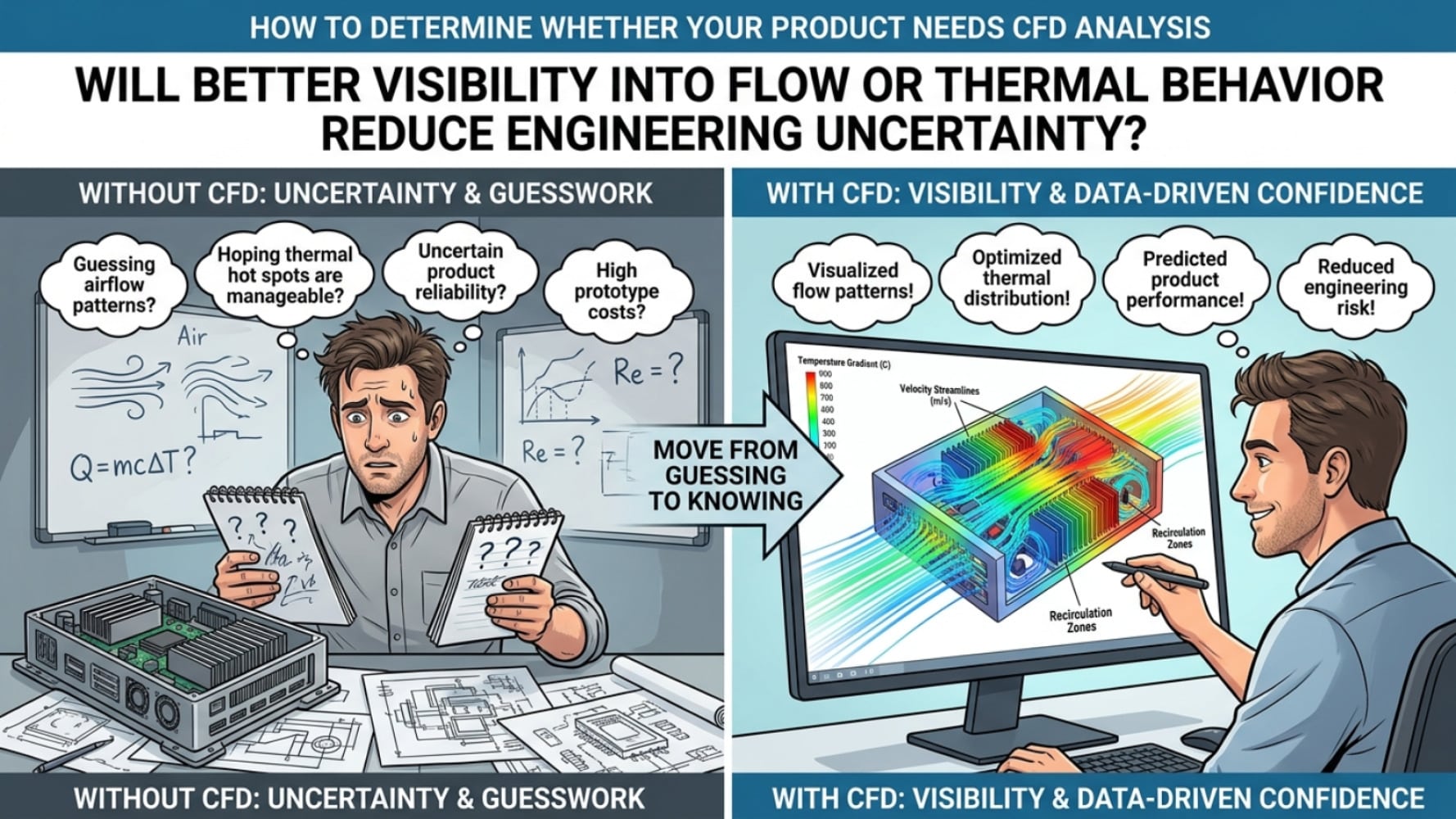
The core question is:
Will better visibility into flow or thermal behavior reduce engineering uncertainty?
If the answer is yes, CFD for product design deserves serious consideration.
Products with Complex Flow or Thermal Behavior
CFD is especially valuable for products involving:
- Airflow
- Liquid flow
- Cooling
- Heating
- Ventilation
- Pressure drop
- Mixing
- Aerodynamic performance
- Rotating flow
- Heat exchangers
- Enclosures with heat-generating components
Product categories that often benefit include electronics, medical devices, HVAC components, industrial equipment, fluid machinery, energy systems, consumer products, and thermal devices.
If the most important physics are hidden inside the product, CFD can reveal what physical inspection cannot.
Signs Your Design Process Could Benefit from CFD
Your team may benefit from CFD if:
- Prototype testing keeps revealing thermal or flow problems.
- You need to compare multiple design options.
- You are unsure where pressure loss occurs.
- Cooling performance is critical.
- The product must operate under several conditions.
- Manufacturing changes would be expensive.
- Internal behavior is hard to measure physically.
- You need technical evidence before approving production.
- Product failure would create warranty or safety risk.
A useful rule of thumb: if one failed prototype cycle costs more than a CFD feasibility assessment, simulation is worth evaluating.
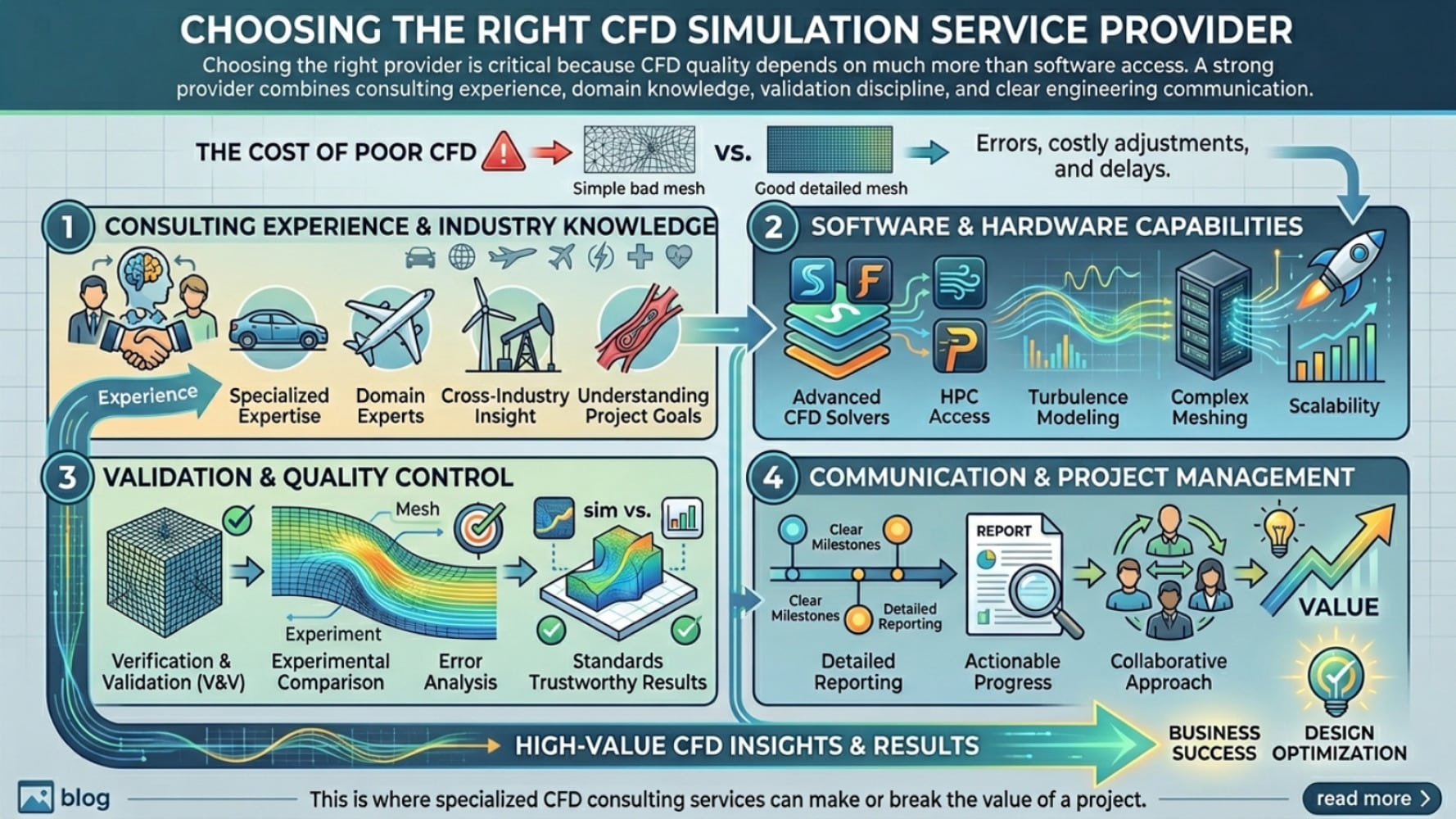
Choosing the Right CFD Simulation Service Provider
Choosing the right provider is critical because CFD quality depends on much more than software access. A strong provider combines consulting experience, domain knowledge, validation discipline, and clear engineering communication.

This is where specialized CFD consulting services can make or break the value of a project.
Technical Expertise and Validation Experience
Before choosing a provider, engineering managers should verify whether the team can explain:
- Why the selected model is appropriate
- How boundary conditions are defined
- How mesh quality is controlled
- Whether a mesh independence study is needed
- How convergence is evaluated
- What assumptions are included
- How uncertainty is handled
- Whether validation data is available
- How results support design decisions
Reliable consultants do not overpromise. They clarify assumptions, limitations, and confidence levels. That transparency is essential for serious design validation services.
For related support, MR CFD’s CFD consulting services can help teams define, run, and interpret simulation projects with a practical engineering focus.
Industry-Specific Engineering Knowledge
A CFD provider should understand the product context, not only the software. Cooling electronics is different from optimizing a valve. External aerodynamics is different from internal manifold flow. Medical device flow is different from HVAC ducting.
Industry-specific knowledge helps with:
- More realistic assumptions
- Better model setup
- Faster diagnosis
- Stronger recommendations
- More practical design changes
- Better communication with R&D teams
When reviewing CFD project case studies, look for similarity in physics and decision context, not just similar industry names.
HPC Infrastructure and Simulation Capability
Some simulations are computationally heavy. Large meshes, transient models, rotating machinery, multiphase flow, optimization loops, and detailed turbulence models may require serious HPC Computing resources.
That is why access to HPC resources for large CFD projects matters. Without enough computing power, project timelines can become a bottleneck.
MR CFD supports advanced simulation work through HPC Rental for ANSYS Fluent, helping teams run larger and faster simulations when local hardware is limited.
For teams that want to develop internal skills, MR CFD also provides ANSYS Fluent training courses and professional CFD Courses to support long-term simulation capability.
Get a Free Feasibility Assessment for Your Product Design Project
Before investing in a full simulation project, many teams need to know whether CFD is technically and commercially suitable for their product. A feasibility assessment helps define the scope, complexity, required inputs, and potential business value.
For engineering managers, this is the lowest-friction way to evaluate whether engineering simulation services can reduce prototype risk.
What Information to Prepare Before Contacting a CFD Consultant
To make the first consultation productive, prepare:
- Product description
- CAD file or geometry screenshots
- Main engineering challenge
- Operating conditions
- Fluid type
- Flow rate, velocity, or pressure data
- Heat load or temperature limits
- Material information
- Design alternatives
- Existing test data
- Performance targets
- Timeline and decision deadline
A vague request such as “We need CFD” is less useful than a decision-focused request such as:
“We need to compare three cooling vent designs and determine whether the maximum component temperature stays below the allowable limit under peak load.”
That level of clarity helps turn CFD into an engineering decision tool.
What Happens During the Assessment Process
A typical MR CFD feasibility assessment may include:
- Reviewing the product and technical challenge
- Identifying whether CFD is suitable
- Defining the likely simulation scope
- Reviewing inputs, assumptions, and missing data
- Estimating model complexity and computational needs
- Recommending the next engineering step
- Helping your team decide whether to proceed with full CFD analysis
This process keeps the project focused, practical, and aligned with business value.
Conclusion
CFD for product design helps engineering teams make better decisions before expensive physical prototypes and manufacturing commitments. By using engineering simulation services, R&D teams can evaluate airflow, cooling, pressure drop, heat transfer, and product performance earlier in the design cycle.
The real value is not just fewer prototypes. It is better engineering confidence, faster design iteration, stronger validation, and reduced manufacturing risk.
If your product involves Thermal Management, Aerodynamics, pressure drop analysis, or complex fluid behavior, MR CFD can help you evaluate the next step.
Frequently Asked Questions About CFD for Product Design
How much can CFD simulation reduce product prototyping costs?
The savings depend on product complexity, prototype cost, and how early CFD is used. The strongest savings usually come from avoiding repeated physical prototype iterations, late-stage redesign, and manufacturing changes. If CFD prevents even one failed prototype cycle, the return can be significant.
When should CFD analysis be performed during product development?
CFD should ideally be used before physical prototyping and before manufacturing decisions are locked. It is most valuable during concept comparison, design optimization, and pre-manufacturing validation. Late-stage CFD can still diagnose problems, but early simulation gives teams more design freedom.
Is CFD simulation accurate enough to replace physical testing?
CFD can reduce the need for repeated physical testing, but it does not always replace final validation. Accuracy depends on geometry quality, boundary condition selection, mesh strategy, solver settings, and simulation validation. The best workflow often combines CFD for virtual testing with targeted physical testing for confirmation.
What types of products benefit most from CFD consulting services?
Products involving airflow, liquid flow, cooling, heating, pressure drop, mixing, or aerodynamic performance benefit most. Examples include electronics enclosures, HVAC products, valves, manifolds, filters, medical devices, heat exchangers, industrial equipment, and energy systems.
How long does a typical CFD product design project take?
Project duration depends on geometry complexity, physics, number of design alternatives, available data, and validation requirements. A focused baseline simulation may be relatively fast, while transient simulations, optimization studies, or complex multiphysics projects require more time and computing power.
What information is required to start a CFD simulation project?
A CFD consultant usually needs CAD geometry, product objectives, operating conditions, fluid properties, flow rates, pressure values, heat loads, material data, temperature limits, design alternatives, and performance targets. Existing test data is especially useful for validation.
How does CFD help reduce manufacturing risk?
CFD helps reveal hidden design problems before tooling and production. It can identify overheating, poor airflow, excessive pressure drop, uneven distribution, drag issues, and weak cooling performance. This allows teams to improve the design before manufacturing changes become expensive.
What software is commonly used for product design CFD simulations?
ANSYS Fluent is widely used for product development simulation because it supports advanced fluid flow, heat transfer, turbulence, and multiphysics modeling. Professional CFD teams may also use CAD tools, meshing platforms, post-processing tools, and HPC Computing resources.
Related Posts
Operating Pressure in ANSYS Fluent: Gauge, Absolute & Stagnation Pressure Explained
Operating pressure in ANSYS Fluent is the reference pressure (default 101325 Pa) to which all…
What is Conjugate Heat Transfer Simulation? Complete CHT Guide
Conjugate Heat Transfer (CHT) simulation is a CFD method that solves fluid flow and solid…
CFD Project Outsourcing: What Files, Reports, and Results Should You Expect?
When engineering teams decide to outsource CFD simulation, the conversation almost always starts with capability and…
 Talk On WhatsApp
Comments (0)