
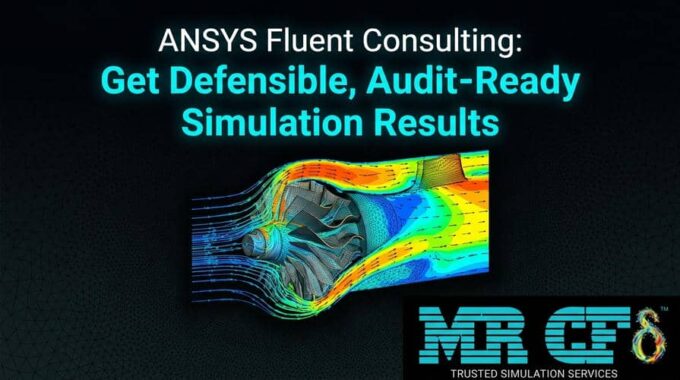
ANSYS Fluent Consulting: Get Defensible, Audit-Ready Simulation Results
You need ANSYS Fluent results that can survive scrutiny — a design review, a client presentation, a regulatory submission, or a go/no-go decision that carries real financial weight. The problem is not that your team lacks intelligence. The problem is that senior ANSYS Fluent expertise is one of the most specialized and scarcest skill sets in engineering, and building that capability in-house costs far more than most project budgets can justify. At MR CFD, we have delivered 500+ validated CFD simulations across industries ranging from aerospace to biomedical — and we have seen, repeatedly, what separates results that hold up from results that collapse under the first technical question. This article is written for engineering managers and R&D leads who are evaluating whether to outsource ANSYS Fluent simulation work — and who need a clear, honest picture of what professional ANSYS Fluent consulting actually delivers, what it costs compared to the alternatives, and how to know if it is the right move for your project.
ANSYS Fluent Beginner Course for Less Than the Cost of a Lunch!
No prior experience needed. Start Learning ANSYS Fluent step-by-step with 16 hands-on, real-world projects across multiple engineering fields.
Ready to get started? Fill in the form below:
Why Engineering Teams Outsource ANSYS Fluent Work in 2026
The decision to outsource ANSYS Fluent simulation is rarely about capability in the abstract. It is almost always about a specific combination of pressure: a project deadline that cannot wait for a six-month hiring process, a physics problem that exceeds the current team’s validated experience, or a licensing and hardware cost that cannot be justified for a single product program.
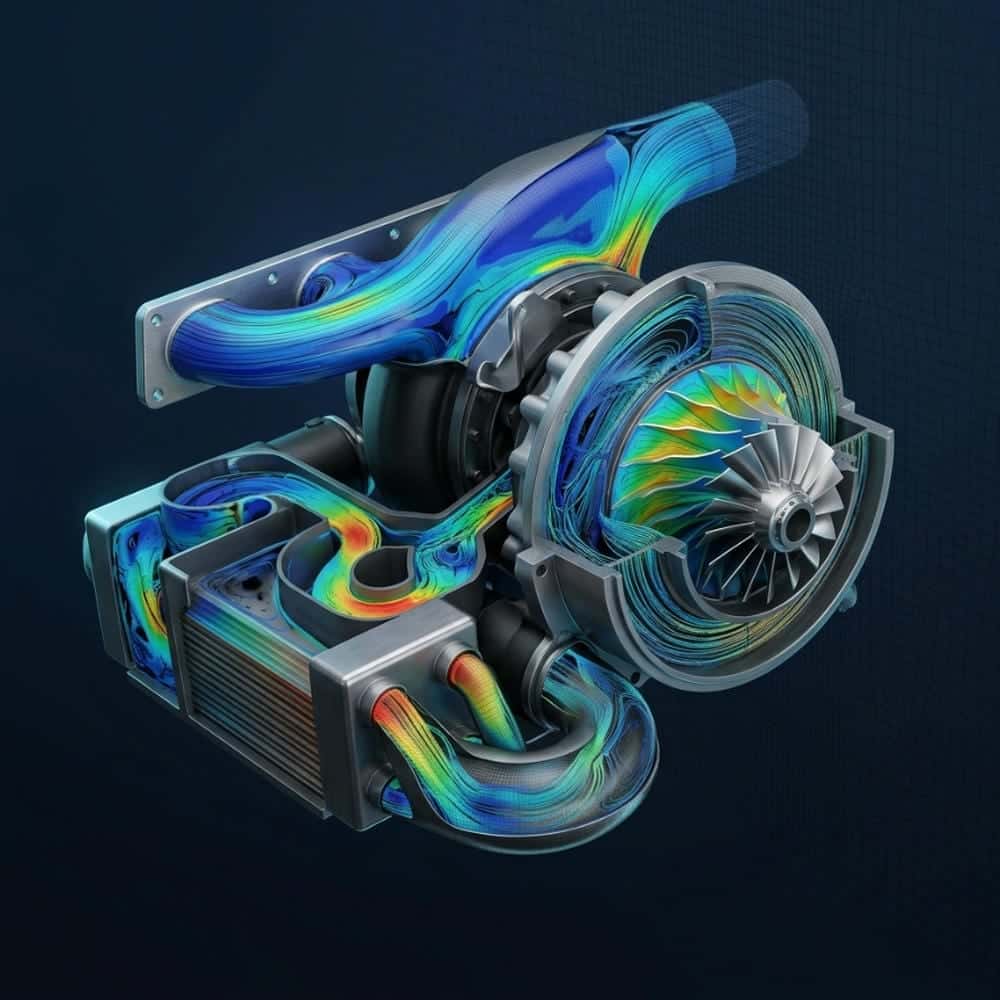
Premier CFD Consulting Services Using ANSYS Fluent
ANSYS Fluent simulations, validation, and defensible engineering reports across 30+ fields. Registered in 🇺🇸 USA (Delaware), 🇬🇧 UK & 🇴🇲 Oman
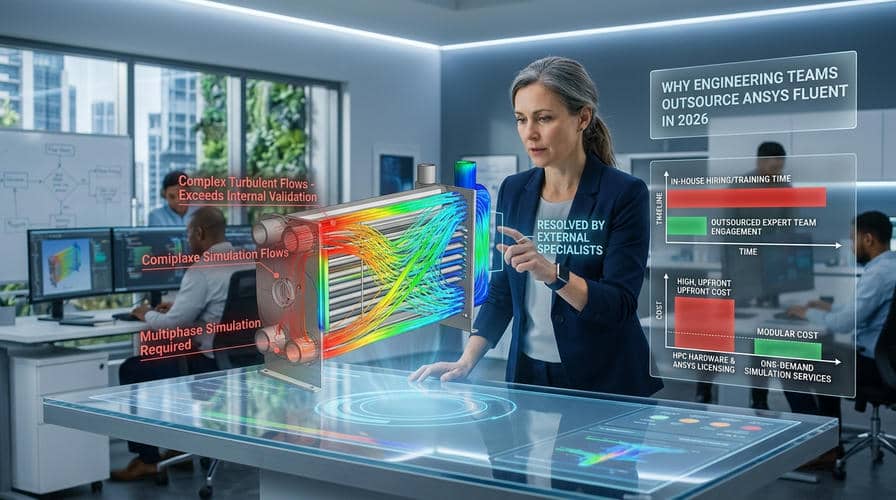
In 2026, the structural drivers for computational fluid dynamics outsourcing have intensified. ANSYS Fluent remains the dominant commercial CFD solver for industrial applications — but the gap between “someone who can open Fluent” and “a senior specialist who can produce defensible results” has never been wider. Universities produce graduates who have run tutorial cases. They rarely produce engineers who can independently select the correct turbulence closure model, execute a rigorous mesh independence study, and deliver a CFD report for regulatory review — without supervision.
At the same time, project demand for simulation is not constant. Most engineering organizations need CFD intensively during design validation phases and barely at all during production. That demand curve makes full-time senior CFD hiring economically irrational for the majority of companies.
The result: ANSYS Fluent consulting services and Fluent simulation service providers like MR CFD have become a standard part of the engineering supply chain — not a workaround, but a deliberate strategic choice.
The Hidden Cost of Running Fluent Simulations Without a Senior Specialist
The most dangerous CFD result is not one that obviously fails. It is one that looks plausible but is wrong in ways that only become visible after a product decision has been made.
Here is what happens when ANSYS Fluent simulations are run without a senior specialist:
| Risk Category | Specific Failure Mode | Downstream Cost |
|---|---|---|
| Turbulence model selection | Using k-ε where k-ω SST is required (e.g., adverse pressure gradient flows) | Non-conservative drag or separation predictions; wrong design point |
| Mesh quality | Insufficient near-wall resolution (y+ non-compliance) | Inaccurate wall shear stress, heat transfer coefficients, and skin friction |
| Mesh independence | No GCI (Grid Convergence Index) study performed | Results cannot be defended; discretization error unknown |
| Solver divergence | Inappropriate under-relaxation factors or time step selection | Wasted compute time; inconclusive results |
| Boundary condition errors | Incorrect turbulence intensity specification at inlets | Systematic error in flow field prediction throughout domain |
| Post-processing errors | Reporting area-averaged values where mass-flow-weighted averages are required | Incorrect performance metrics reported to stakeholders |
Each of these failures is common. Each of them is invisible to someone without deep ANSYS Fluent experience. And each of them has a real downstream cost — in re-simulation time, in delayed decisions, or in products that underperform because the CFD data that informed their design was silently wrong.
The simulation validation methodology required to catch these errors before they propagate is not a checklist item. It is a discipline built over years of project experience across diverse physics domains.
When Outsourcing ANSYS Fluent Work Delivers Better ROI Than Hiring
Let us put concrete numbers on the build-vs-buy decision.
The cost of building in-house ANSYS Fluent capacity:
- ANSYS Fluent license: Commercial licenses range from approximately $25,000 to $80,000+ per year depending on module configuration (HPC, add-on physics packs, etc.)
- HPC infrastructure: A simulation-capable workstation cluster capable of handling industrial-scale meshes (10M–100M cells) requires $30,000–$150,000+ in capital investment, plus ongoing maintenance
- Senior CFD engineer salary: In North America and Western Europe, a senior CFD specialist with validated ANSYS Fluent experience commands $100,000–$160,000+ per year in total compensation
- Recruiting timeline: 3–6 months minimum to identify, assess, and onboard a qualified candidate — during which your project waits
Total year-one cost of in-house capacity: $155,000–$390,000+, before a single simulation deliverable is produced.
The cost of outsourcing to a professional ANSYS Fluent consulting service:
- Per-project engagement scoped to your specific deliverable
- No license, hardware, or recruiting overhead
- Senior expertise available immediately
- Scalable — one project or ten, without headcount implications
For companies with project-based CFD consulting needs — which describes the majority of engineering organizations — the engineering simulation ROI of outsourcing is not marginal. It is decisive.
The strategic question is not “can we afford to outsource?” — it is “can we afford not to?”
What a Professional ANSYS Fluent Consulting Engagement Actually Delivers
There is a significant difference between a vendor who runs your geometry through Fluent and returns contour plots, and a professional ANSYS Fluent consulting engagement that produces results you can actually use. The difference is methodology — and it starts long before the solver is initialized.
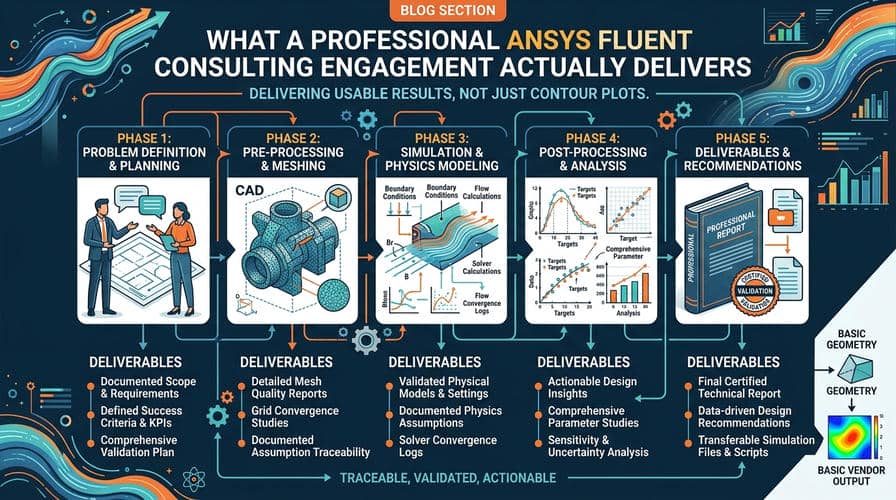
A professional Fluent CFD analysis service delivers a structured, quality-controlled process from problem definition to final deliverable. Every phase is traceable, every assumption is documented, and every result is validated against defined acceptance criteria. Here is what that looks like in practice.
Simulation Scope Definition and Physics Validation — Before a Single Cell Is Meshed
The most consequential decisions in any ANSYS Fluent project are made before meshing begins. A pre-simulation feasibility review is not a formality — it is where the technical success of the project is determined.
At MR CFD, every engagement begins with a structured scope definition phase that includes:
1. Problem Statement Review
- What physical quantity needs to be predicted, and to what accuracy?
- What is the decision that will be made based on this result?
- What are the acceptable margins of uncertainty?
2. Governing Physics Selection
- Are the Navier-Stokes equations solved in steady or transient mode?
- Is the flow turbulent? If so, what is the appropriate turbulence closure — k-ε, k-ω SST, RSM, or LES?
- Are there coupled physics: conjugate heat transfer, species transport, multiphase interaction, structural deformation?
3. Boundary Condition Logic
- What are the inlet and outlet conditions, and what is the uncertainty in those specifications?
- Are wall conditions adiabatic, constant-temperature, or heat-flux driven?
- Iterative boundary condition refinement is applied where initial specifications are incomplete or uncertain
4. Geometry Simplification Strategy
- What geometric features can be safely suppressed without affecting the flow field of interest?
- Where does full geometric fidelity need to be preserved?
This phase is what separates a simulation that answers the right question from one that answers a different question very precisely.
Mesh Independence, Solver Convergence, and Result Validation — The Defensibility Stack
A simulation result is only as credible as the process used to produce it. The defensibility stack — the set of quality assurance steps that make results presentable to clients, regulators, or internal review boards — consists of three mandatory components:
Mesh Independence Verification
- A minimum of three mesh refinement levels is run
- GCI (Grid Convergence Index) is calculated for the key output quantity of interest
- Target: GCI < 1% for the reported metric, confirming that the result is not a function of mesh resolution
- CFD mesh quality metrics (skewness, orthogonal quality, aspect ratio) are verified against ANSYS best-practice thresholds
Solver Convergence Criteria
- Residuals monitored to target levels (typically 10⁻⁴ for most variables, 10⁻⁶ for energy)
- Mass imbalance < 0.1% confirmed for all control volume boundaries
- Monitor point stabilization verified for all reported quantities — residual convergence alone is not sufficient
- Y+ compliance verified across all wall-adjacent cells for the selected turbulence model wall treatment
Result Validation
- Where published experimental data or analytical solutions exist, results are compared against them
- Sensitivity studies are run on key boundary conditions where uncertainty exists
- All assumptions and their potential impact on result accuracy are documented explicitly
This is the standard that makes a CFD report for regulatory review defensible. It is also the standard that most in-house teams running occasional simulations do not have the bandwidth or experience to apply consistently.
Deliverables You Can Use: Reports, Animations, and Decision-Ready Data Outputs
The final deliverable from an MR CFD ANSYS Fluent consulting engagement is not a folder of .cas and .dat files. It is a complete package designed to support engineering decisions at every level of your organization:
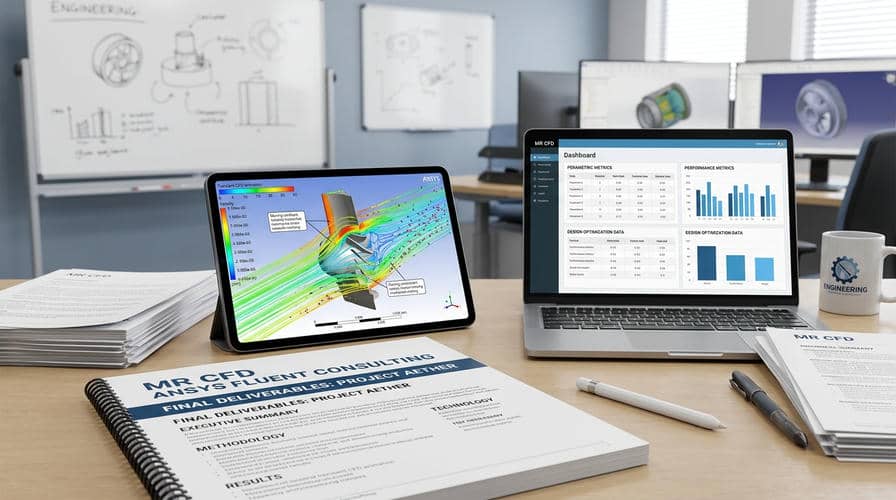
Technical Report
- Executive summary with key findings and engineering recommendations
- Full methodology documentation: geometry, mesh, physics models, boundary conditions, solver settings
- Quantitative results with uncertainty bounds
- Comparison against benchmarks or prior results where applicable
- Clearly stated limitations and confidence levels
CFD Visualizations and Animations
- High-resolution contour plots, vector fields, streamline visualizations
- Transient animations where applicable (flow development, thermal cycling, particle tracking)
- Annotated views designed for presentation to non-CFD audiences
Decision-Ready Data Outputs
- Parametric data tables for design optimization
- Extracted performance metrics (pressure drop, heat transfer coefficient, drag coefficient, flow uniformity index)
- Data formatted for direct input into system-level models or design tools
Every deliverable is structured around the question: “What does the engineering team need to make the next decision?” — not around what is easiest to export from the post-processor.
Industries and Project Types MR CFD Handles with ANSYS Fluent
MR CFD’s ANSYS Fluent consulting services span a broad range of industrial sectors and physics domains. The common thread across all of them is the need for results that are technically rigorous, clearly communicated, and directly applicable to engineering decisions.
Aerospace and Defense External aerodynamics, nacelle inlet flow, thermal management of avionics, store separation, and high-speed compressible flow. Aerospace aerodynamics simulation projects frequently require RANS with compressibility corrections and detailed boundary layer resolution.
Ready to get started? Fill in the form below:
Automotive and Ground Vehicles External aerodynamics (drag, lift, cooling airflow), underhood thermal management, brake cooling, HVAC cabin comfort, and EV battery thermal management. Rotating reference frame (MRF) and sliding mesh methods are routinely applied.
HVAC and Built Environment Indoor air quality, contaminant dispersion, thermal comfort analysis, data center cooling, and clean room validation. HVAC simulation projects often involve buoyancy-driven flows, radiation modeling, and occupant-level velocity/temperature fields.
Oil, Gas, and Process Industries CFD Simulations; Pipe flow, separator design, multiphase transport, valve and fitting pressure drop, and heat exchanger performance. These projects frequently involve the Volume of Fluid (VOF) method for free-surface flows or Eulerian-Eulerian models for dispersed phase systems.
Electronics Cooling Component-level and system-level thermal management, PCB cooling, heat sink optimization, and forced convection in enclosures. Electronics cooling CFD projects require tight coupling between fluid flow and solid conduction (conjugate heat transfer).
Biomedical and Life Sciences Cardiovascular flow analysis, medical device hemodynamics, respiratory airway modeling, and bioreactor mixing. Biomedical fluid dynamics projects require non-Newtonian fluid models and physiologically realistic boundary conditions.
Industrial Process and Energy Combustion, reacting flows, spray drying, fluidized beds, and turbomachinery. These are among the most physics-complex projects in the portfolio, often combining multiple coupled physics domains in a single simulation.
Complex Physics Domains: Turbulence, Multiphase, Heat Transfer, and FSI
The physics models that most commonly drive the decision to seek external ANSYS Fluent consulting are the ones where selection errors have the highest consequence:
Turbulence Modeling
- Reynolds-Averaged Simulation (RANS) covers the majority of industrial cases. The choice between k-ε (two-equation, robust for free-stream flows), k-ω SST (superior near-wall performance, adverse pressure gradients, separated flows), and RSM (Reynolds Stress Model, for highly anisotropic turbulence) is not arbitrary — it is physics-driven and must be justified
- Large Eddy Simulation (LES) and hybrid RANS-LES (DES, SBES) for time-resolved turbulent structures where RANS is insufficient
- Turbulence model selection is one of the most common sources of error in simulations run without specialist oversight
Multiphase Flow
- Volume of Fluid (VOF) for free-surface and stratified flows (filling, sloshing, wave interaction)
- Eulerian-Eulerian for dense dispersed phases (bubble columns, slurry transport)
- Discrete Phase Model (DPM) for dilute particle, droplet, or bubble tracking
- Each model has specific applicability criteria that must be matched to the physical regime
Conjugate Heat Transfer
- Simultaneous solution of fluid flow and solid conduction with interface coupling
- Critical for electronics cooling, heat exchanger design, and any application where thermal resistance at solid-fluid boundaries matters
Fluid-Structure Interaction (FSI)
- One-way and two-way coupling between fluid pressure/shear loads and structural deformation
- Requires careful attention to mesh morphing, coupling frequency, and convergence of the coupled system
Ready to get started? Fill in the form below:
Project-Based vs. Retainer Consulting: Which Model Fits Your Team?
MR CFD offers two primary engagement structures, and the right choice depends on your simulation demand profile:
| Engagement Model | Best Fit | Structure |
|---|---|---|
| Project-Based Consulting | Defined deliverable, specific deadline, one-time or irregular need | Fixed scope, fixed deliverable, per-project pricing |
| Retainer / Ongoing Support | Regular simulation needs, product development programs, R&D teams needing consistent CFD capacity | Monthly or quarterly engagement, priority access, accumulated project knowledge |
Project-based is the right model if you have a specific geometry, a defined question, and a deadline. It is also the right entry point if you have never worked with MR CFD before — the free feasibility assessment starts this process.
Retainer consulting is the right model if your team runs 5–20+ simulations per year across a product program, and you want a consulting partner who accumulates context about your products, materials, and performance targets over time — rather than starting from zero on each engagement.
How MR CFD’s ANSYS Fluent Consulting Process Works — From Brief to Deliverable
Process transparency is one of the most important trust signals in CFD consulting for engineering teams. You are not just buying simulation hours — you are buying a structured methodology that produces a result you can stand behind. Here is exactly how MR CFD’s engagement process works:
Stage 1: Intake and Free Feasibility Assessment You submit your project brief through the form below (or via direct contact). A senior MR CFD consultant reviews the scope, identifies the governing physics, flags any technical risks, and provides an initial estimate of timeline and effort. This is provided at no cost and with no obligation.
Stage 2: Scope Agreement and Project Kickoff Once the feasibility assessment is reviewed and the engagement is confirmed, a formal scope document is issued. This specifies: geometry inputs required, boundary condition data needed from your team, physics models to be applied, deliverable format, timeline milestones, and QA checkpoints.
Stage 3: Geometry Preparation and Meshing CAD geometry is received in your preferred format (STEP, IGES, STL, Parasolid, SpaceClaim). Geometry cleanup and simplification are performed as needed. The computational domain is constructed, and the mesh is generated with CFD mesh quality metrics verified before solver initialization.
Stage 4: Solver Setup and Simulation Execution Boundary condition setup in Fluent is performed according to the scoped physics model. Solver settings — discretization schemes, under-relaxation factors, convergence criteria — are configured to Fluent solver setup best practices. Simulations are executed on MR CFD’s High-Performance Computing (HPC) infrastructure, ensuring turnaround times that in-house workstations typically cannot match.
Stage 5: Quality Assurance and Validation Mesh independence study is completed. Convergence is verified across all monitors. Results are compared against analytical benchmarks or published data where available. Any anomalies are investigated and resolved before the report is drafted.
Stage 6: Deliverable Preparation and Handoff The full deliverable package — technical report, visualizations, data outputs — is prepared and delivered. A technical review call is offered to walk through findings and answer questions. Post-delivery support is available for follow-up questions within the project scope.
Stage 7: Post-Project Support MR CFD provides a defined post-delivery support window for clarification questions, additional post-processing requests, or scope extensions. Returning clients benefit from accumulated project context on follow-on work.
Ready to get started? Fill in the form below:
This is not a black-box service. Every step is visible, every decision is documented, and every result is traceable back to its inputs and methodology.
Get Your Free CFD Simulation Feasibility Assessment
If you have reached this point in the article, you are likely evaluating whether MR CFD is the right partner for a specific project — or trying to understand what an engagement would actually look like before committing to a conversation.

The free CFD feasibility assessment is designed to answer exactly that question.
Here is what it includes:
✅ Technical review of your project scope by a senior ANSYS Fluent specialist
✅ Physics model recommendation — which solver settings, turbulence models, and multiphase approaches are appropriate for your application
✅ Risk identification — any geometric, physical, or data gaps that could affect result quality
✅ Timeline and effort estimate — a realistic picture of what the engagement requires
✅ No obligation — the assessment is provided as a professional service, not a sales pitch
There is no cost. There is no commitment. There is no requirement to have a perfectly defined scope before reaching out — that is part of what the assessment clarifies.
Fill in the form below to request your free feasibility assessment:
Frequently Asked Questions About ANSYS Fluent Consulting
What does an ANSYS Fluent consulting engagement typically include from scope to final deliverable?
A professional ANSYS Fluent consulting engagement covers the full simulation lifecycle: project scoping and CFD feasibility assessment, geometry preparation and cleanup, physics and turbulence model selection, structured meshing with mesh independence study verification, solver setup and convergence monitoring, CFD post-processing results, and a final technical report with visualizations and decision-ready data outputs.
At MR CFD, every engagement also includes documented methodology — governing equations, boundary conditions, solver settings, and QA results — so the deliverable is fully traceable and defensible. The specific scope is confirmed before work begins, so there are no surprises in the final deliverable.
How do I know if my CFD project is complex enough to require an external ANSYS Fluent consultant?
Complexity is not the only trigger for seeking external ANSYS Fluent consulting. The more important question is: what is the consequence of a wrong result?
If your simulation output will inform a product design decision, a capital investment, a client commitment, or a regulatory submission — the cost of a flawed result is high enough to justify professional consultation regardless of nominal complexity.
That said, the following project characteristics are strong indicators that external expertise adds decisive value:
- Turbulent flows with adverse pressure gradients, separation, or reattachment (where turbulence model selection is non-trivial)
- Multiphase flows (VOF, Eulerian, DPM) with complex interface dynamics
- Conjugate heat transfer or Fluid-Structure Interaction (FSI) requiring coupled physics
- Transient simulations where time step selection and temporal accuracy matter
- Results intended for client presentation or regulatory review
If you are unsure, the free feasibility assessment is the right first step — it will give you a clear technical opinion at no cost.
How long does a typical ANSYS Fluent simulation consulting project take from kickoff to delivery?
Timelines depend primarily on physics complexity, geometry scale, and the number of simulation cases required:
| Project Type | Typical Timeline |
|---|---|
| Single-physics steady-state (internal flow, HVAC, electronics cooling) | 5–10 business days |
| Conjugate heat transfer or multiphase (VOF, DPM) | 10–15 business days |
| Transient simulation or FSI | 15–25 business days |
| Multi-case parametric study | Timeline scales with number of cases |
These timelines assume prompt receipt of geometry and boundary condition data from the client. MR CFD provides a specific timeline estimate during the feasibility assessment phase, and milestone checkpoints are built into the project scope agreement.
What is the cost of outsourcing an ANSYS Fluent simulation compared to running it in-house?
The full cost of in-house ANSYS Fluent capacity — licensing, hardware, and senior engineering talent — typically ranges from $155,000 to $390,000+ in year one, before a single deliverable is produced. For companies with irregular or project-based simulation needs, this cost structure is economically unjustifiable.
Outsourcing to MR CFD provides access to licensed software, HPC infrastructure, and senior specialist expertise on a per-project basis. The cost of a scoped consulting engagement is a fraction of the in-house alternative — and it carries no overhead, no recruiting risk, and no bench time between projects.
The engineering simulation ROI of outsourcing is most favorable for companies that need high-quality results on a project basis rather than continuous simulation throughput. The free feasibility assessment includes a transparent effort estimate so you can evaluate cost before committing.
Can MR CFD’s Fluent consultants work with our existing CAD geometry and boundary condition data?
Yes. MR CFD accepts CAD geometry in all standard formats: STEP, IGES, STL, Parasolid, SpaceClaim (.scdoc), and ANSYS DesignModeler files. If your geometry requires cleanup, defeaturing, or simplification for simulation purposes, that work is included in the engagement scope.
For boundary condition setup in Fluent, MR CFD works with whatever data your team can provide — measured flow rates, temperatures, pressures, or system-level specifications. Where boundary condition data is uncertain or incomplete, sensitivity studies are designed to quantify the impact of that uncertainty on the final result.
You do not need a perfectly prepared geometry or a complete data package before reaching out. The feasibility assessment is specifically designed to identify what is needed and flag any gaps.
How does MR CFD ensure simulation results are validated and defensible for engineering decisions or regulatory review?
MR CFD applies a mandatory simulation validation methodology on every project. The core components are:
- Mesh independence study using GCI analysis — target GCI < 1% for the reported output quantity
- Solver convergence verification — residuals, mass imbalance (< 0.1%), and monitor point stabilization all confirmed
- Y+ compliance verified for the selected turbulence model wall treatment
- Benchmark comparison against published experimental data or analytical solutions where available
- Sensitivity analysis on key boundary conditions where input uncertainty exists
- Full documentation of all assumptions, model selections, and their potential impact on result accuracy
This stack is what makes results suitable for presentation to internal review boards, external clients, or regulatory authorities. Every deliverable includes the methodology documentation needed to support independent technical review.
What industries and physics domains does MR CFD’s ANSYS Fluent consulting service cover?
MR CFD’s Fluent simulation service covers the full range of industrial CFD applications:
Industries: Aerospace, automotive, HVAC and built environment, oil and gas, process engineering, electronics and semiconductors, biomedical devices, marine, energy and power generation, and industrial manufacturing.
Physics Domains:
- Turbulent flow: RANS (k-ε, k-ω SST, RSM), LES, hybrid RANS-LES
- Conjugate heat transfer and thermal management
- Multiphase flow: VOF, Eulerian-Eulerian, DPM
- Reacting flows and combustion
- Fluid-Structure Interaction (FSI)
- Rotating machinery: MRF, sliding mesh
- Compressible flow and high-speed aerodynamics
- Biomedical fluid dynamics and non-Newtonian flow
- Acoustics and noise prediction
If your application is not listed here, the feasibility assessment is the right place to ask — the physics scope is broad enough that most industrial CFD problems fall within MR CFD’s delivered experience.
What is a free CFD feasibility assessment, and what can I expect from MR CFD’s initial review?
The free CFD feasibility assessment is a structured technical review of your project by a senior MR CFD ANSYS Fluent specialist. It is not a sales call. It is a professional engineering opinion on your specific simulation problem.
After you submit the form, you can expect:
- Technical scope review: Your problem statement is evaluated against the governing physics, available data, and simulation objectives
- Physics model recommendation: The appropriate turbulence model, multiphase approach, and solver configuration are identified for your application
- Risk and gap identification: Any geometric, physical, or data issues that could affect result quality are flagged upfront
- Timeline and effort estimate: A realistic picture of what the engagement requires — timeline, data inputs needed from your team, and deliverable format
- No obligation: You receive the assessment as a professional service. There is no pressure to proceed, and no cost regardless of your decision
The assessment typically takes 1–3 business days from form submission. It gives you everything you need to make an informed decision about whether and how to proceed.
Ready to get started? Fill in the form below:
Related Posts
Operating Pressure in ANSYS Fluent: Gauge, Absolute & Stagnation Pressure Explained
Operating pressure in ANSYS Fluent is the reference pressure (default 101325 Pa) to which all…
What is Conjugate Heat Transfer Simulation? Complete CHT Guide
Conjugate Heat Transfer (CHT) simulation is a CFD method that solves fluid flow and solid…
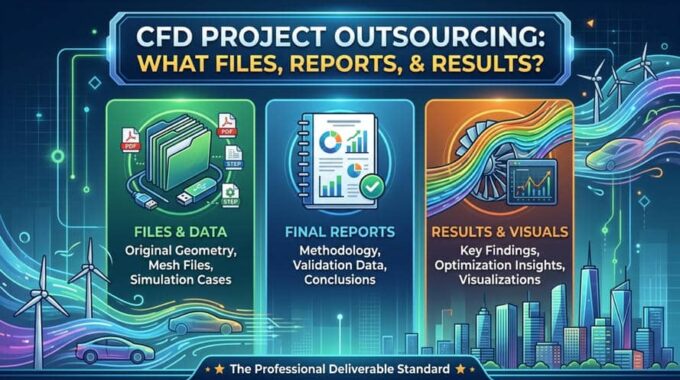
CFD Project Outsourcing: What Files, Reports, and Results Should You Expect?
When engineering teams decide to outsource CFD simulation, the conversation almost always starts with capability and…
 Talk On WhatsApp
Comments (0)