
Battery Module, Cooling Plate, ANSYS Fluent CFD Simulation
$630.00 Internship
- This product numerically simulates a Battery Module using ANSYS Fluent software.
- We design the 3-D models with the Design Modeler software.
- We mesh the models with ANSYS Meshing software.
- This product is implemented in Two steps: Battery with or without Cooling Plate.
- We use the CHT coupling model to define the heat sources.
- The run calculation is in an unsteady-state (transient).
To Order Your Project or benefit from a CFD consultation, contact our experts via email (info@mr-cfd.com), online support tab, or WhatsApp at +44 7443 197273.
There are some Free Products to check our service quality.
If you want the training video in another language instead of English, ask it via info@mr-cfd.com after you buy the product.
Description
Description
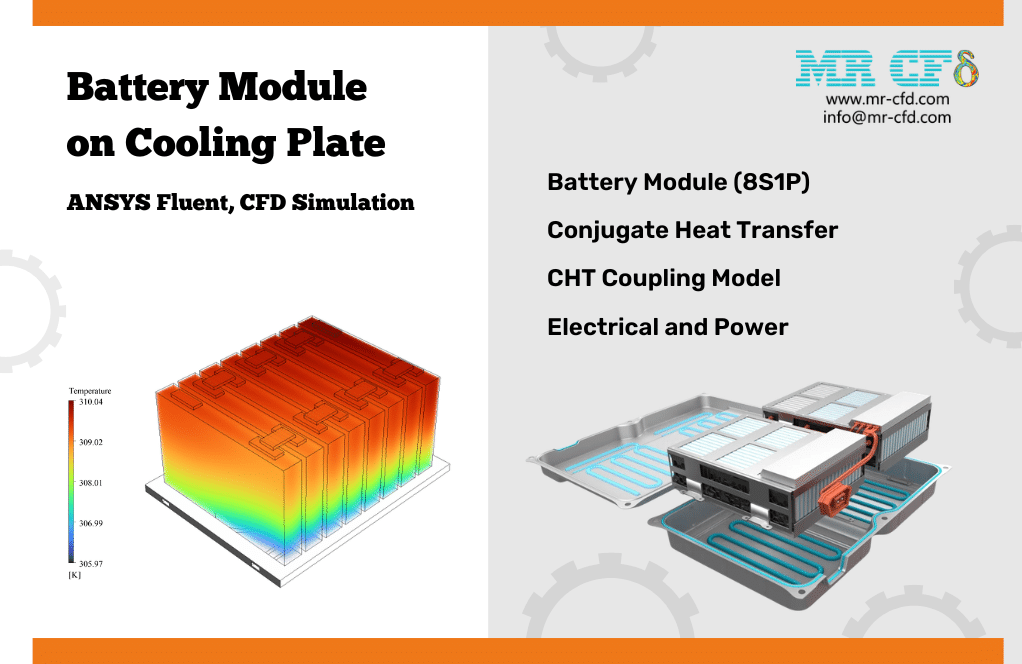
In this project, we present the CFD simulation of a battery module involving a cooling plate in ANSYS Fluent software.
A battery is a device that converts chemical energy into electric energy through chemical reactions. Several single battery cells are connected to create a battery module.
Note that this modeling focus is on conjugate heat transfer (CHT). Therefore, we implemented the present project in two steps:
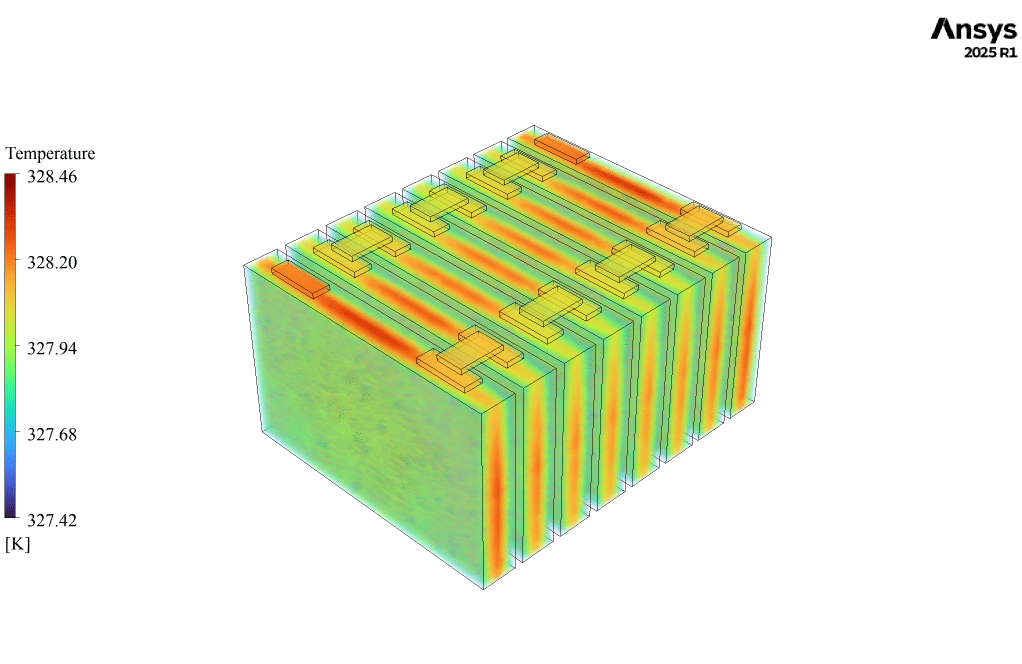
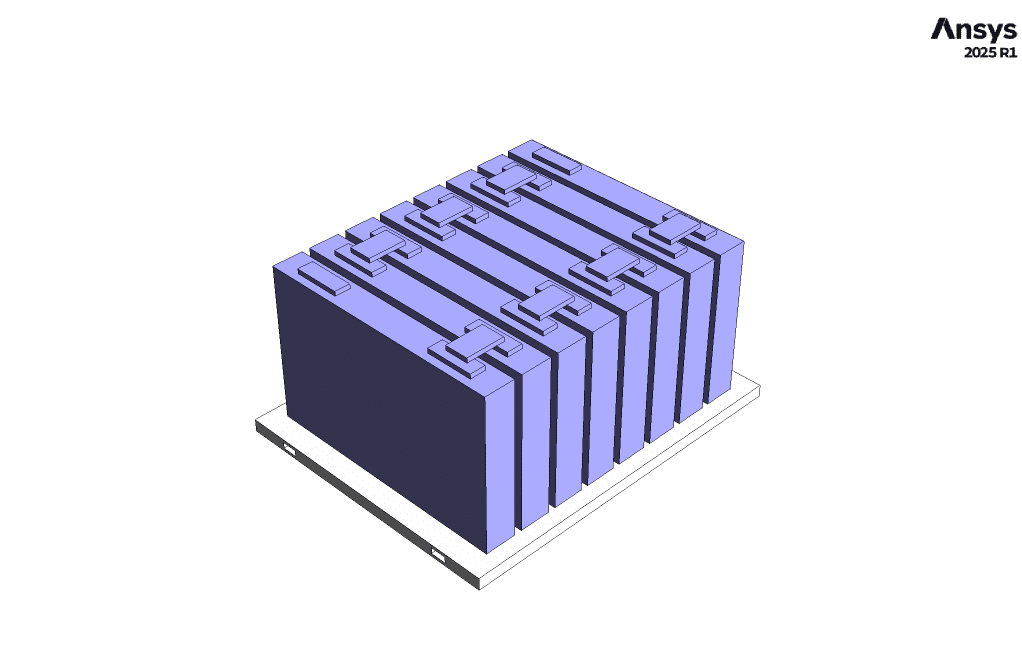
In the first case, we designed only a battery module consisting of 8 battery cells in a serial configuration. So, it is called the 8S1P arrangement.
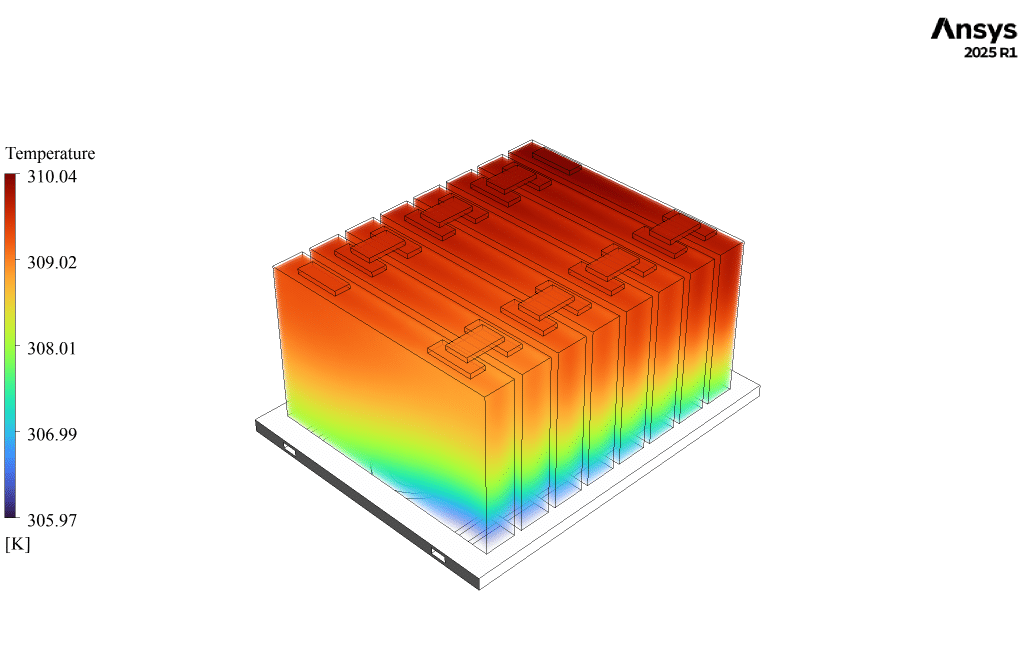
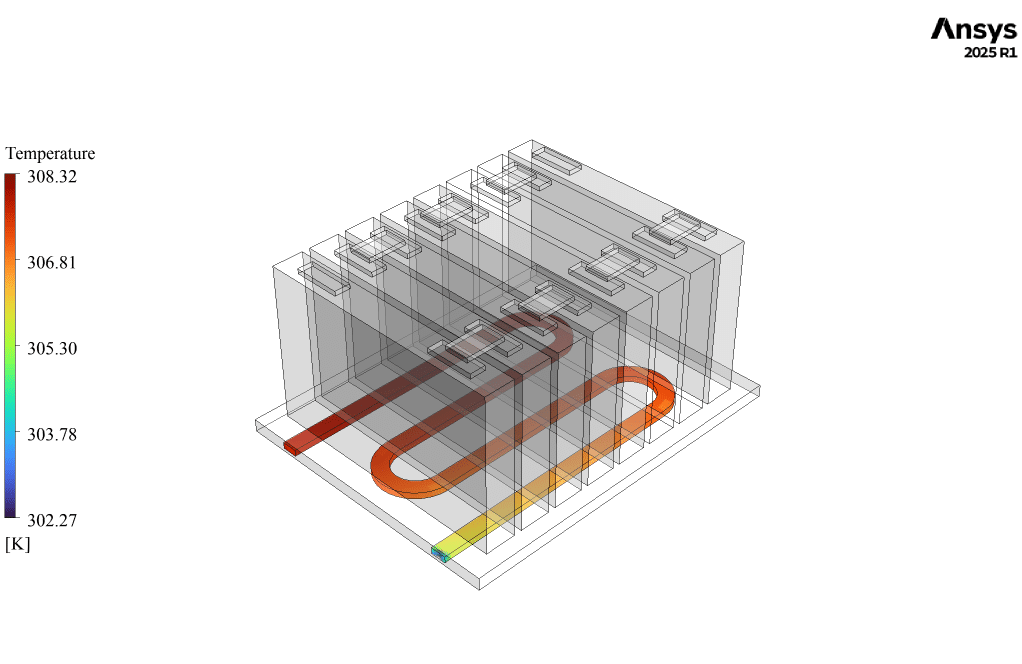
In conventional, operation of battery cells results in significant heat generation. So, for the second case, the battery module is mounted on a cold plate to effectively control the temperature rise.
Methodology
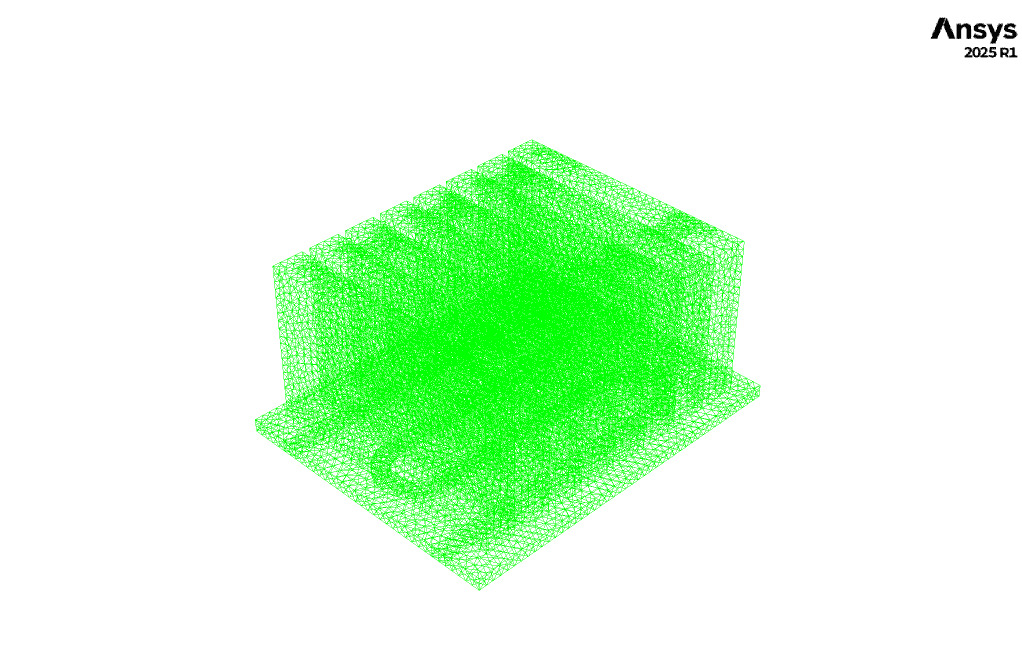
We modeled a battery module geometry (one lonely and the other with a cooling plate) using Design Modeler software. Next, we meshed the models using ANSYS Meshing software, and 155,384 and 183,781 elements were generated, respectively.
Finally, we set up this battery module using the Battery model in ANSYS Fluent software.
We used the CHT coupling model for battery modeling. It is a simple method that allows the user to directly define the heat sources for each battery cell without the need to solve potential equations for estimating the heat generation.
Conclusion
We intend to analyze the thermal behavior of the battery module by comparing cases with and without cooling systems. Therefore, we obtained the contours of temperature for both cases.
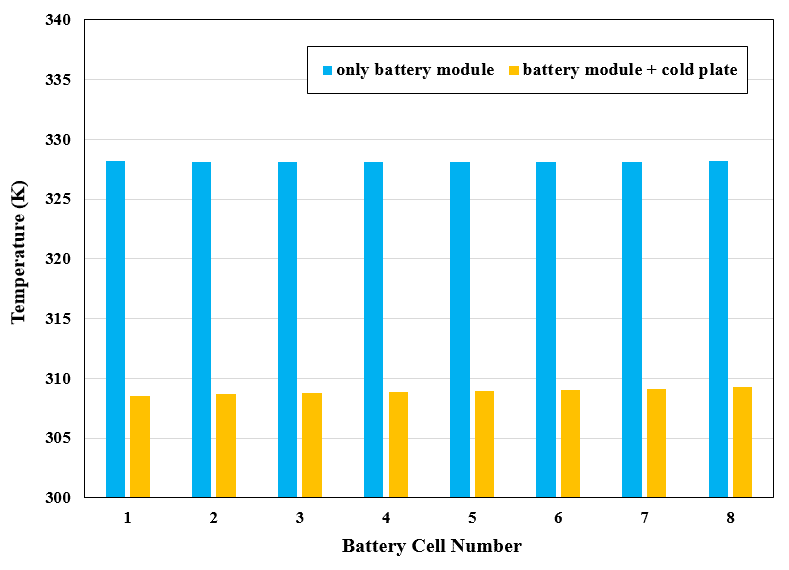
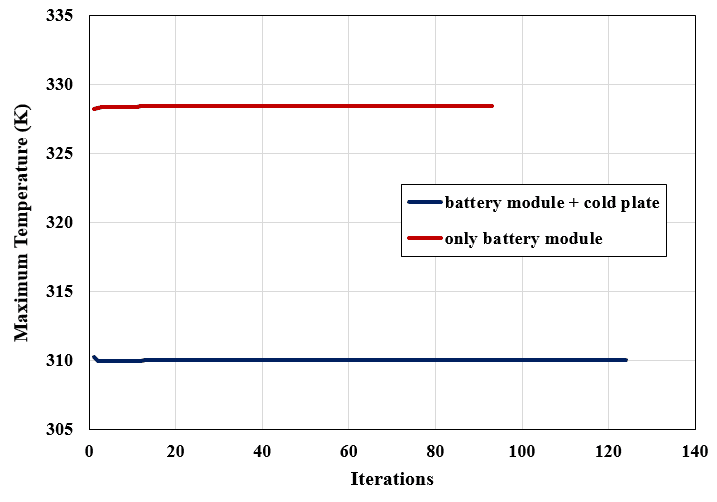
Then, we presented a convergence graph of the maximum temperature of the battery module and a bar plot of the average temperature of all battery cells in two cases.
The results show that the utilizing a cooling plate significantly reduces the temperature of the battery module. Therefore, it is concluded that the cooling plate is a suitable method for thermal management of batteries.
You must be logged in to post a review.



 Talk On WhatsApp
Reviews
There are no reviews yet.