
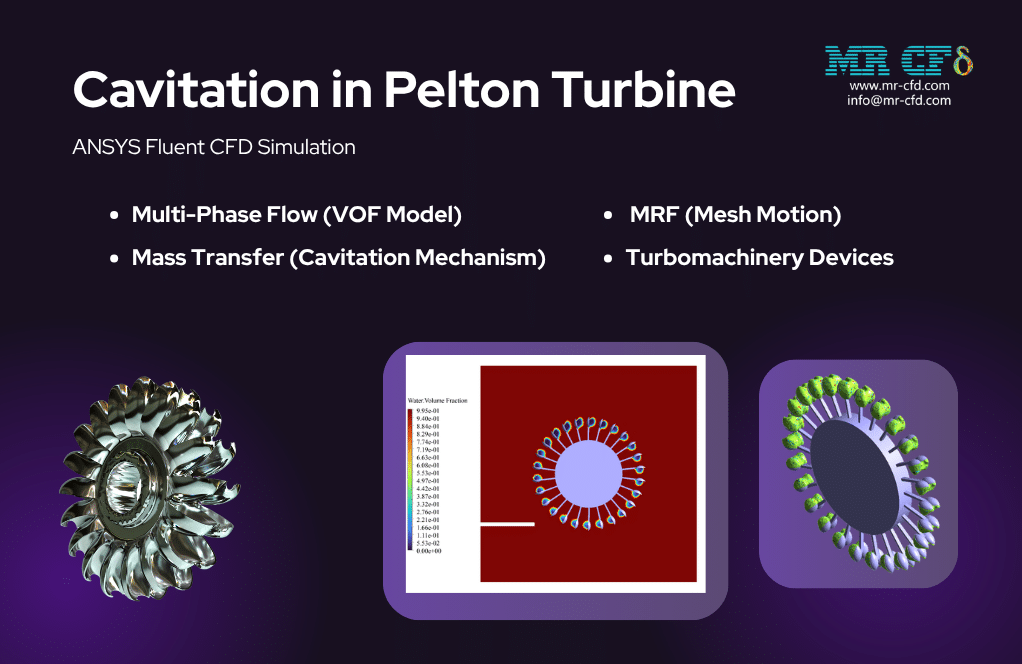
Cavitation in Pelton Turbine, ANSYS Fluent CFD Simulation
$220.00 Internship
- This product numerically simulates the Cavitation in a Pelton Turbine using ANSYS Fluent software.
- We design the 3D model with Design Modeler software.
- We mesh the model with ANSYS Meshing software.
- We use the Volume of Fluid (VOF) Multi-Phase Model to define a two-phase flow.
- We use the Mass Transfer mechanism to define Cavitation.
- We use the Mesh Motion to define a rotational flow.
To Order Your Project or benefit from a CFD consultation, contact our experts via email (info@mr-cfd.com), online support tab, or WhatsApp at +44 7443 197273.
There are some Free Products to check our service quality.
If you want the training video in another language instead of English, ask it via info@mr-cfd.com after you buy the product.
Description
Description
In this project, we perform the numerical simulation of the Cavitation phenomena in a Pelton Turbine in ANSYS Fluent software.
A Pelton turbine is a type of hydraulic turbine that uses the energy of water pressure to rotate a wheel with cup-shaped blades and subsequently produce the required mechanical energy.
Cavitation is a destructive phenomenon that can occur in hydraulic turbomachinery and reduce system efficiency. Whenever the fluid pressure drops below the vaporization pressure, vapor bubbles form. These bubbles then collapse due to circulation and pressure rise, creating strong shock waves to the body and blades of the turbine.
Methodology
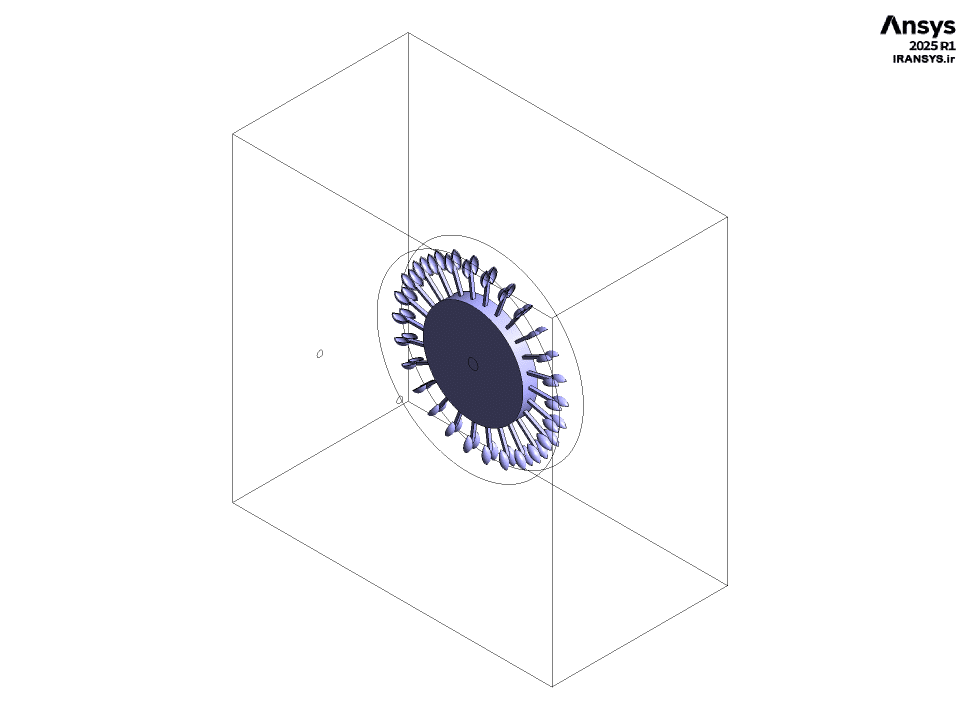
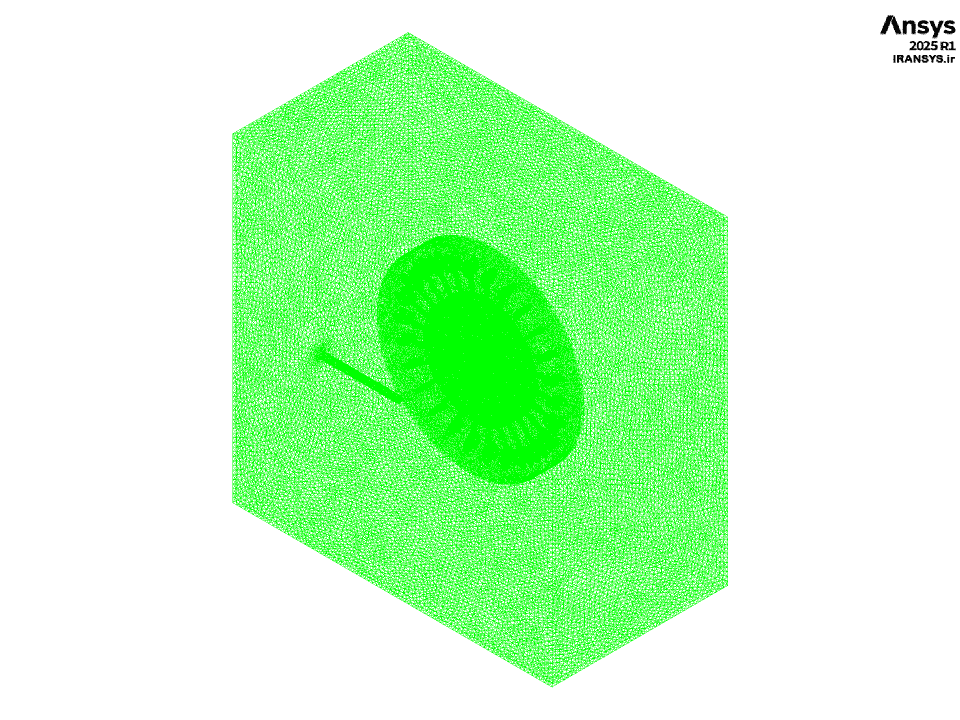
First, we model the geometry in 3D using Design Modeler software. The computational domain is the interior of a closed chamber in which a Pelton turbine is mounted. Then, we mesh the model using ANSYS Meshing software, and about 4,136,000 cells are generated. Finally, we simulate the flow around the Pelton turbine in ANSYS Fluent software.
We use the Multi-Phase Model to define a two-phase flow, including water-liquid and water-vapor. For multiphase flow, we define the Volume of Fluid (VOF) model. Then, we define a mass transfer mechanism between the two phases in the form of the cavitation model based on the vaporization pressure. Thus, phase exchange occurs from the primary phase (water) to the secondary phase (vapor).
We utilize the Moving Reference Frame (MRF) to define a rotation flow zone. In other words, we apply rotation to the fluid region adjacent to the turbine body. Since the run calculation is in an unsteady state, we use the Mesh Motion tool with a specified rotational speed.
Conclusion
After calculations, we analyze the behavior of multiphase flow and the cavitation phenomenon.
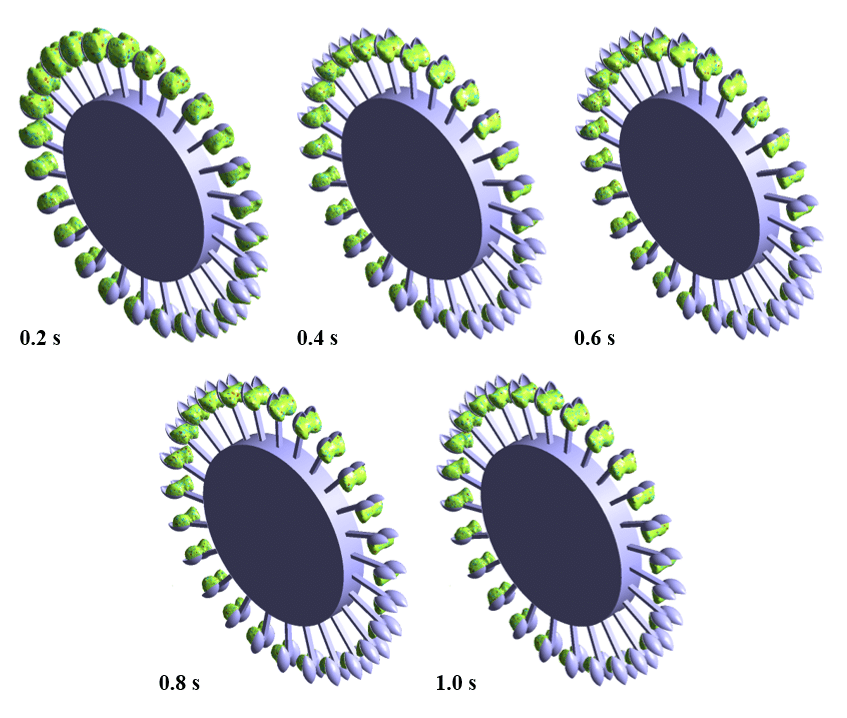
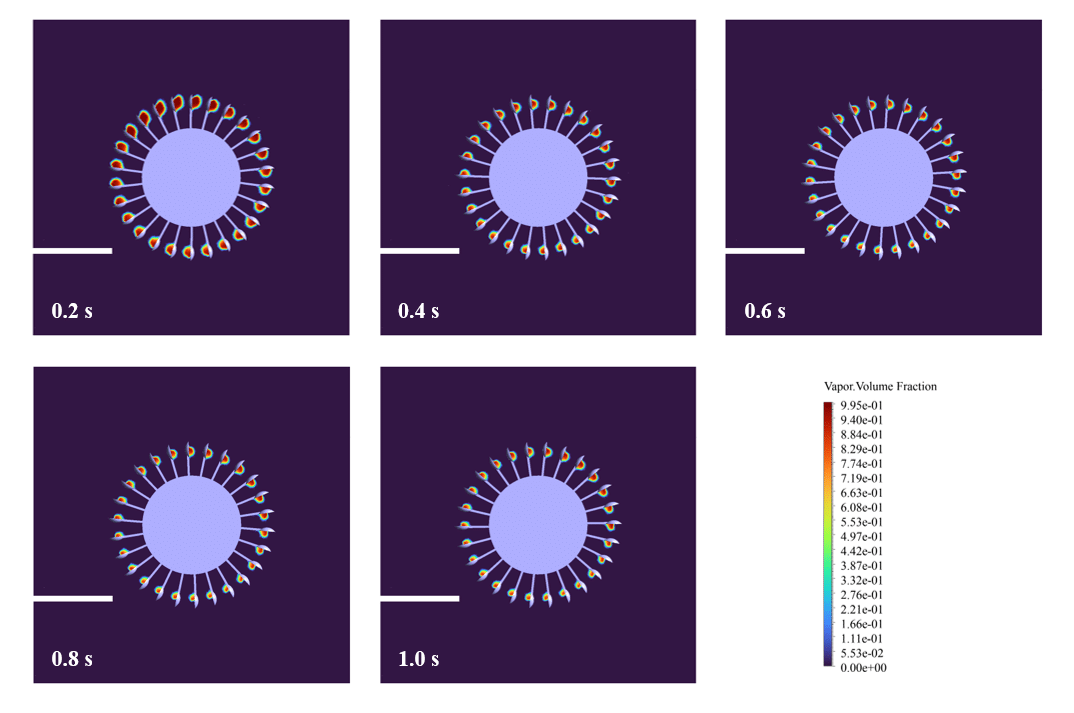
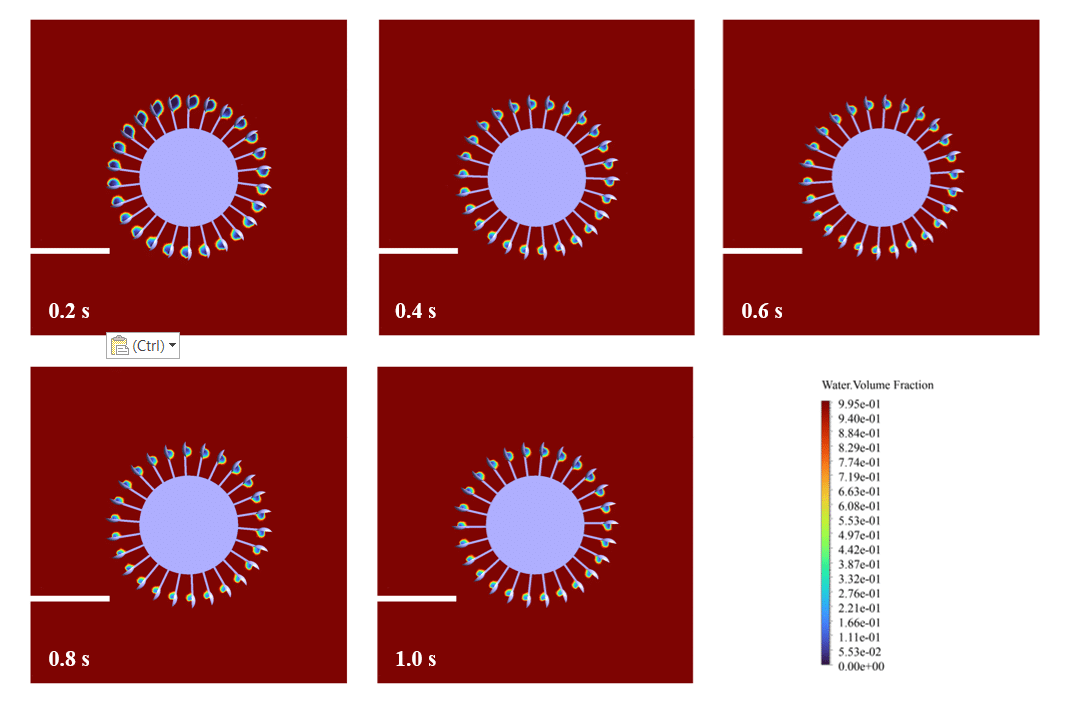
For this purpose, we obtain the distribution of water-liquid and water-vapor phases in the vicinity of the turbine body at different times. Therefore, we obtain the contours corresponding to the volume fraction of water and vapor.
The distribution of water and vapor confirms that phase exchange occurs in zones where pressure variations are significant. Therefore, in the vicinity of the turbine blades, vapor bubbles are generated over time.
So, we can conclude that our simulation has been performed correctly.
You must be logged in to post a review.
 Talk On WhatsApp
Reviews
There are no reviews yet.