
Thermal FSI (1-way External FSI): T-Junction CFD Simulation by ANSYS Fluent
$210.00 Internship
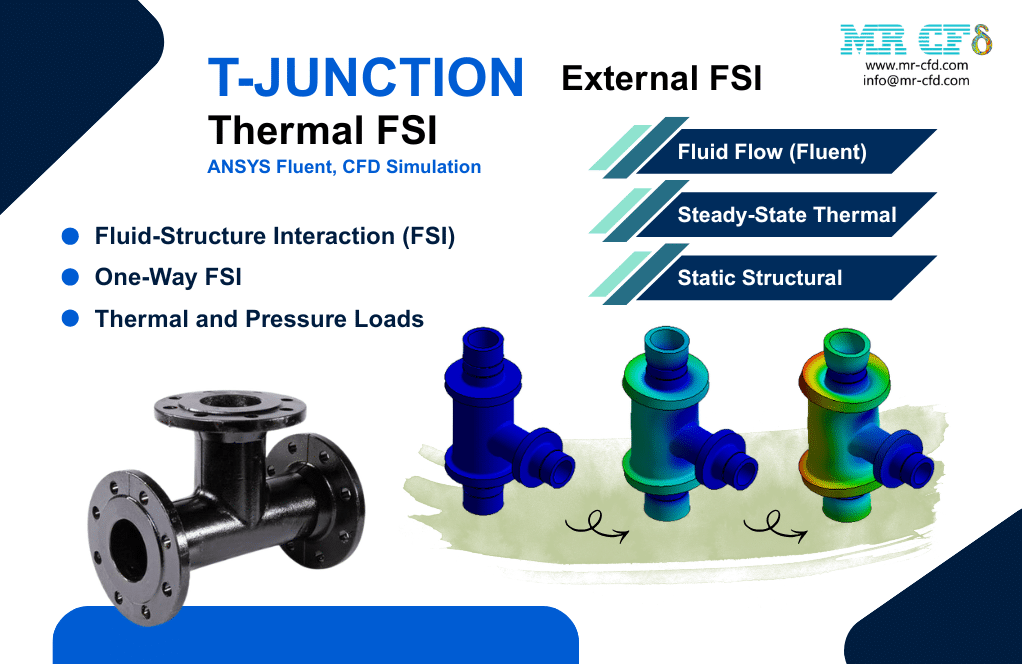
- This product numerically simulates a T-Junction using ANSYS software.
- This project is implemented as a Fluid-Structure Interaction (FSI) in thermal and mechanical approaches.
- We perform the Fluid simulation in ANSYS Fluent and the Thermal simulation in ANSYS Steady-State Thermal.
- We perform the Solid simulation in ANSYS Static Structural.
- We use a One-Way FSI for data transfer from Fluent and Steady-State Thermal to Static Structural.
- We design the 3-D model in the Design Modeler software and mesh it in the ANSYS Meshing software.
To Order Your Project or benefit from a CFD consultation, contact our experts via email (info@mr-cfd.com), online support tab, or WhatsApp at +44 7443 197273.
There are some Free Products to check our service quality.
If you want the training video in another language instead of English, ask it via info@mr-cfd.com after you buy the product.
Description
Description
In this project, we present the CFD simulation of a T-Junction under Fluid-Structure Interaction (FSI) in ANSYS software.
We consider a simple T-junction, which is designed to mix two fluid streams with different temperatures. One stream with a higher temperature flows through the straight path, and the other stream with a lower temperature flows through the branch.
Due to the mixing of two fluid streams with different temperatures, Thermal Loads appear on the T-junction structure. On the other hand, fluid motion throughout the pipes can expose the Pressure Loads on the T-Junction body.
As a result, we intend to analyze the Stresses due to thermal and pressure loads on the T-junction body.
In such a condition, we need to implement the simulations of the fluid and structure in thermal and mechanical approaches. So, we model a computational domain consisting of the fluid zone for the water flow and the solid zone for the T-junction body. For this, it is known as fluid-structure interaction (FSI).
We intend to evaluate the hydrodynamic motion of the fluid inside the pipes and the thermal variation of the fluid and the structure, and transfer only into the T-junction structure, in the form of stress. Therefore, we utilize a One-Way FSI.
Methodology
For this project, we want to solve the fluid pressure from Fluent and obtain the thermal solution from Steady-State Thermal, then connect to Static Structural in the form of loads.
In the first step, we model the computational domain in the Design Modeler software. We design a T-junction as if it were a straight pipe with a branch (including two inlets and one outlet). It consists of a fluid domain inside an outer solid domain.
We use the solid body for simulation in ANSYS Static Structural and ANSYS Steady-State Thermal, and the fluid zone inside it for simulation in ANSYS Fluent software.
In the second step, we describe the simulation in Fluent software. Before that, we mesh the fluid domain in ANSYS Meshing software, so that about 946,000 elements are generated. Then, for boundary conditions, we define two water streams with different temperatures from two inlets.
In the third step, we describe the thermal simulation of the structure in Steady-State Thermal software.
We define the Convection thermal condition for the external walls of the T-junction body. Besides, we import the fluid temperature to the inner wall of the T-junction body.
In the final step, we describe the simulation of the structure in the Static Structural software.
We define three components of each pipe by a Fixed Support. However, except for these supports, the T-junction body is capable of deformation under thermal and pressure stresses. Therefore, we define an Imported Body Temperature for the thermal load and an Imported Pressure for the mechanical load.
Conclusion
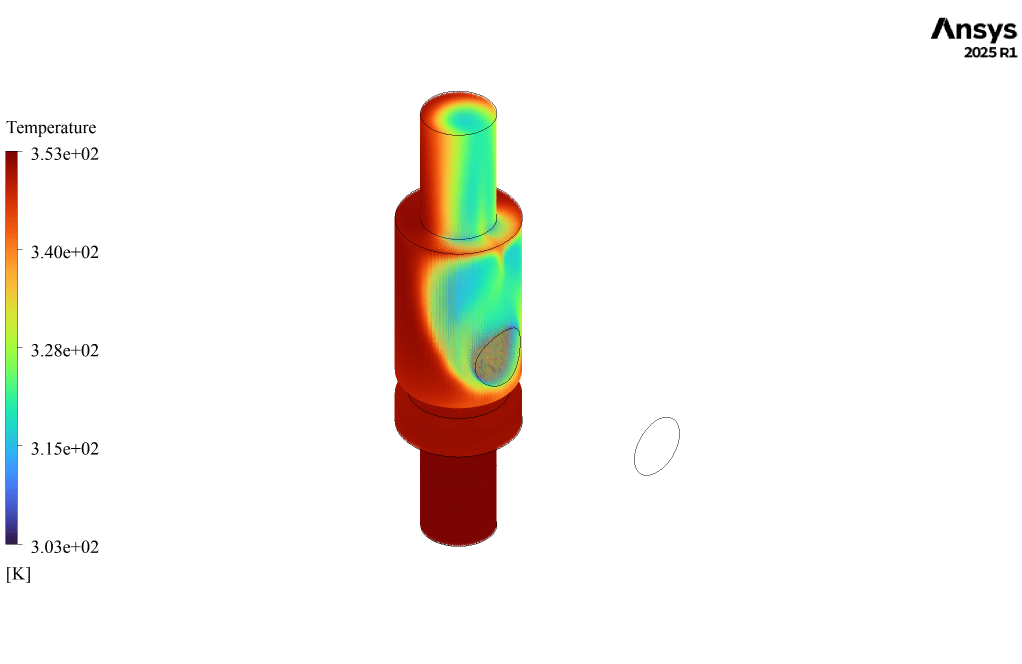
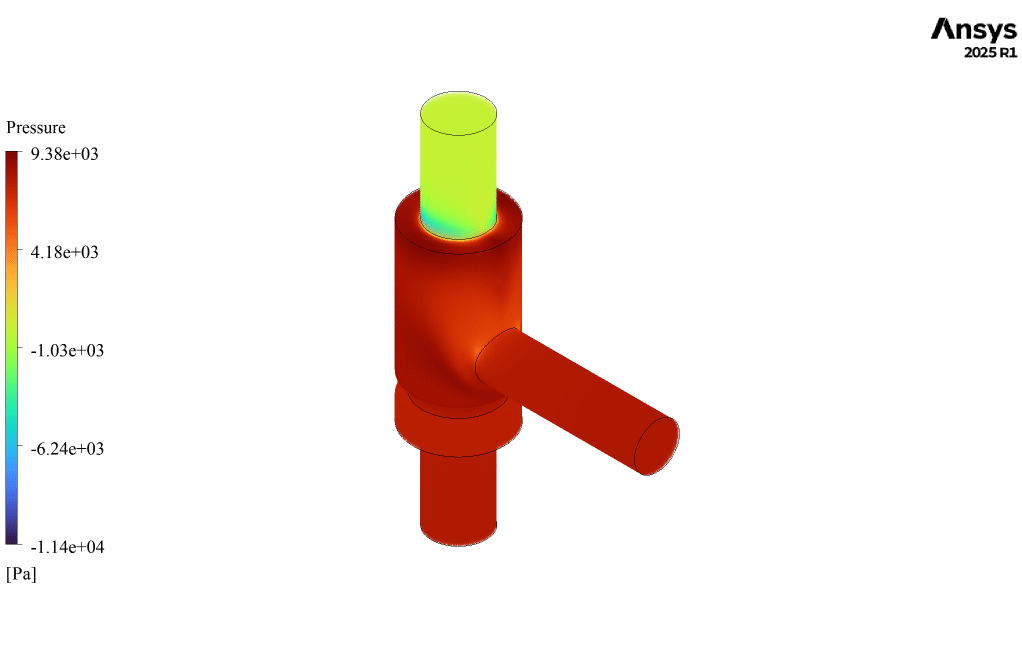
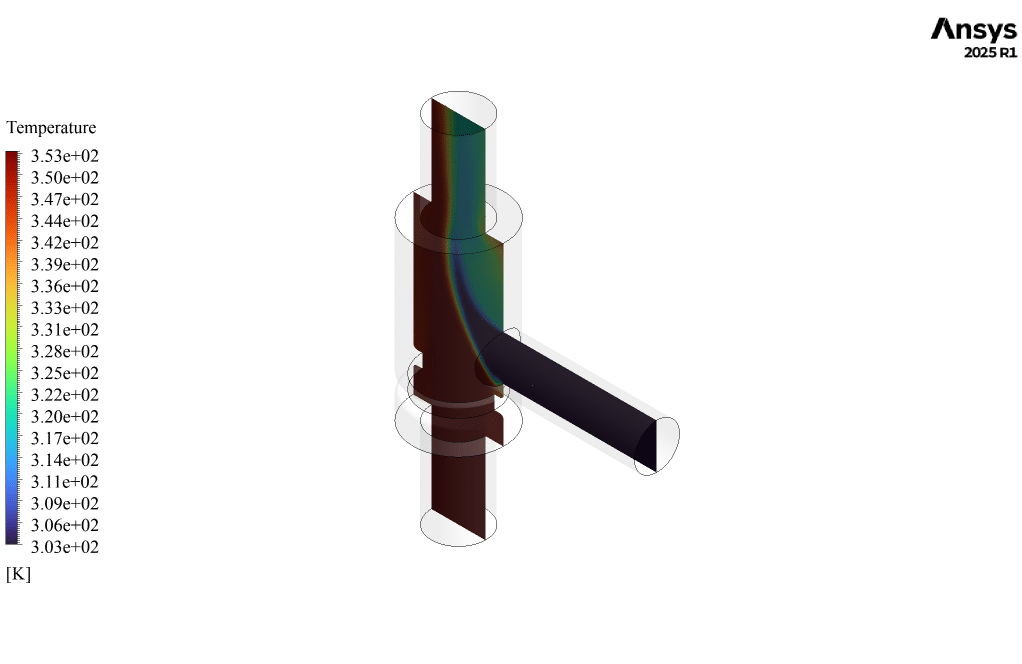
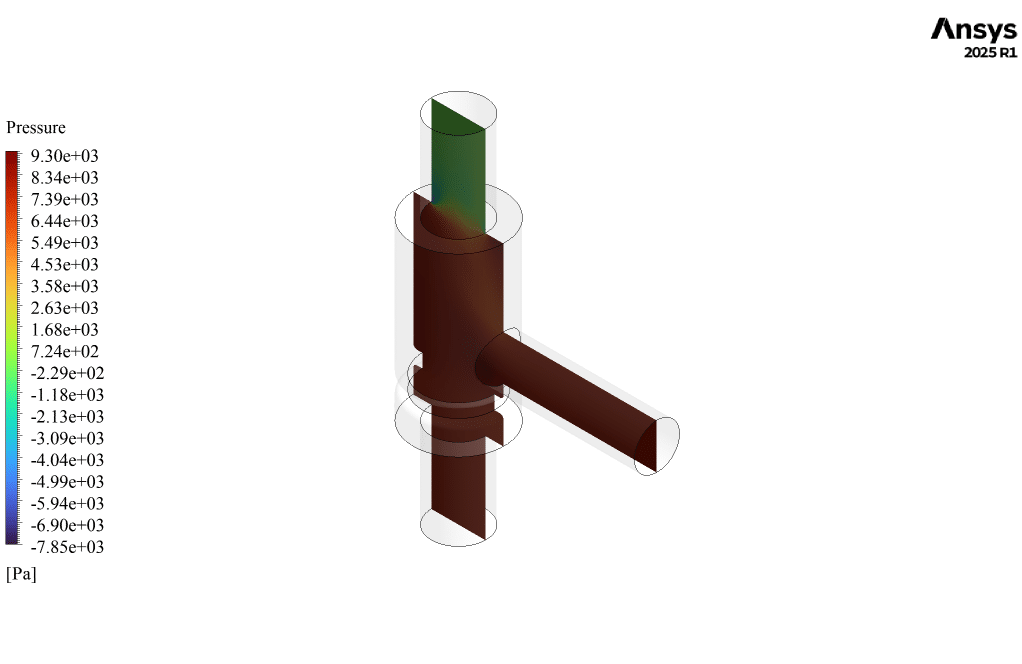
After the calculation process, we represent the analysis in three approaches: Fluid, Thermal, and Structural.
In Fluent, we obtain the Temperature and Pressure distribution of the water flowing inside the T-junction, as well as the surface temperature and pressure on the internal wall of the T-junction.
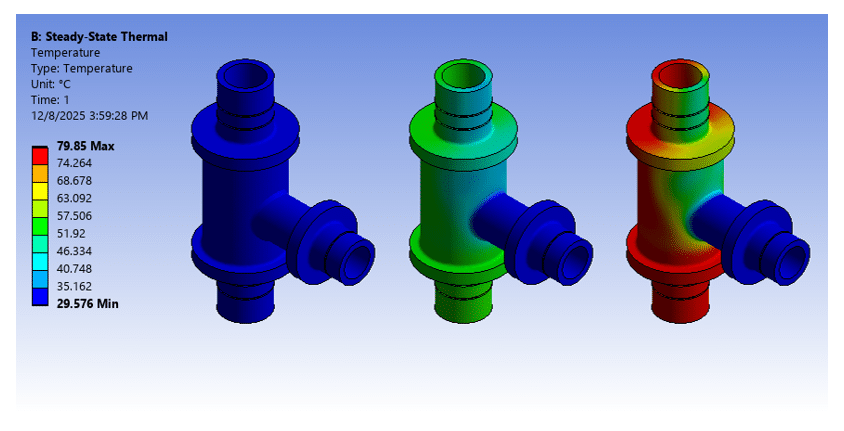
In Steady-State Thermal, we obtain the contours of the Temperature distribution on the T-junction structure body. The results show that heat transfer occurs properly between the fluid and the structure.
On the one hand, fluid calculations are transferred to the structure as pressure loads; on the other hand, thermal calculations are transferred as thermal loads.
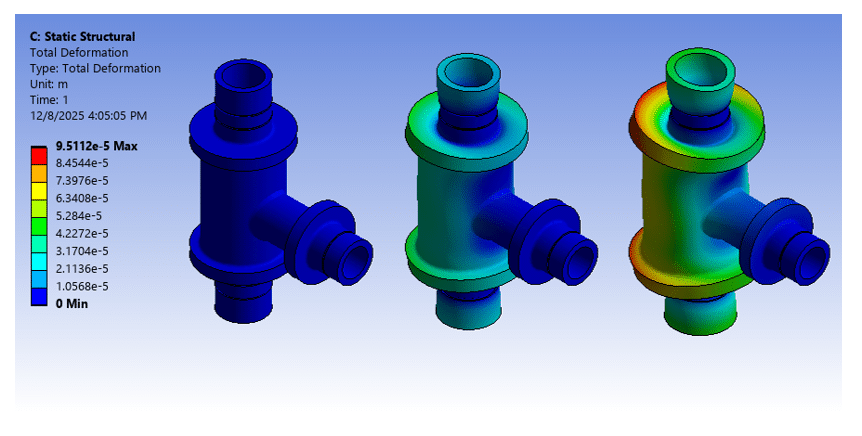
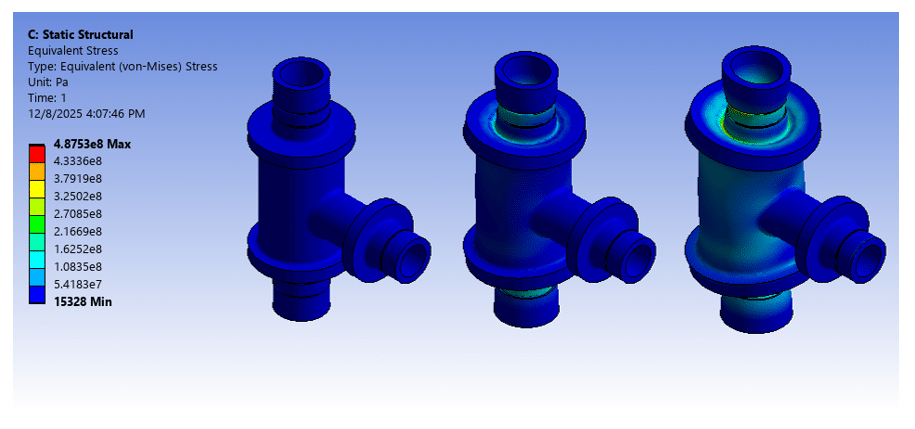
As a result, in Static Structural, we obtain the contours of Total Deformation and Von Mises Stress on the T-junction structure body. The results show that the T-junction body undergoes significant deformation under pressure and thermal stresses.
Note that we provide the contours of temperature, deformation, and stress on the T-junction structure in a way that shows the procedure for reaching from the initial to the stable distribution.
You must be logged in to post a review.

 Talk On WhatsApp
Reviews
There are no reviews yet.