
UDF GOLDEN Training Package: +115 CFD Simulations by ANSYS Fluent
$2,499.00 HPC
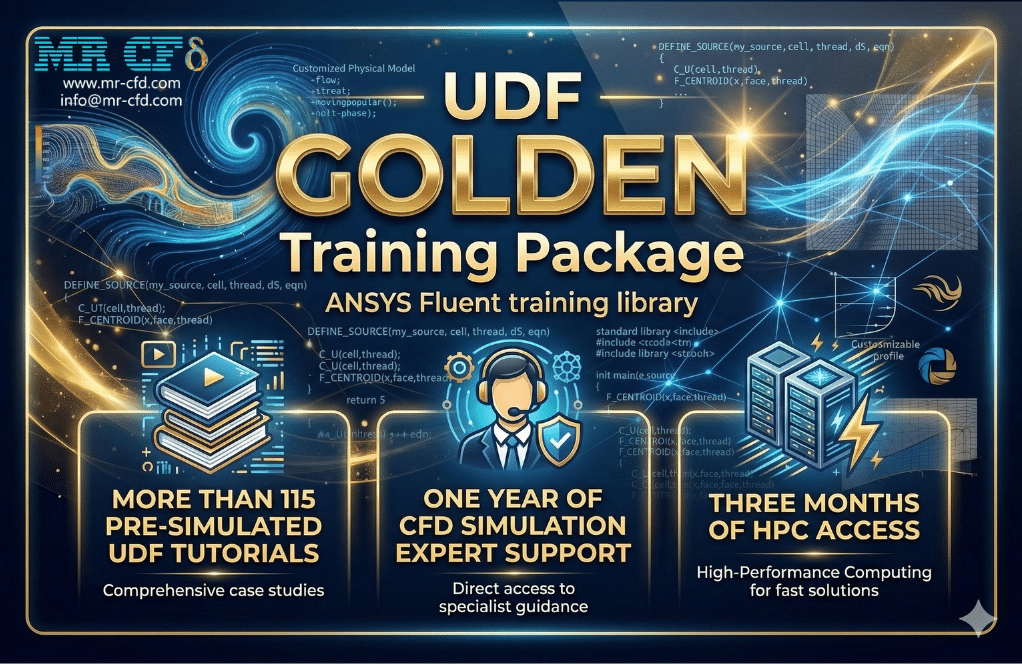
MR CFD’s “UDF GOLDEN Training Package” is a comprehensive ANSYS Fluent training library that turns engineers, students, and technical teams into expert users of User-Defined Functions across real industrial CFD projects. It bundles more than 115 pre-simulated UDF tutorials, one year of expert support, and three months of HPC access to fast‑track onboarding, reduce training costs, and standardize advanced UDF practices across organizations.
To Order Your Project or benefit from a CFD consultation, contact our experts via email (info@mr-cfd.com), online support tab, or WhatsApp at +44 7443 197273.
There are some Free Products to check our service quality.
If you want the training video in another language instead of English, ask it via info@mr-cfd.com after you buy the product.
Description
User Defined Function Golden Training Package, CFD Simulation by ANSYS Fluent
Empower your engineering team with MR CFD’s extensive “User Defined Function (UDF) GOLDEN Training Package.” Designed for university professors, CEOs, managers, institutes, and major companies, this collection of more than 115 ANSYS Fluent tutorials turns beginners into proficient users, ready to tackle projects in the advanced UDF applications in the related engineering fields and industries.
Key Benefits
New employees quickly master intricate projects like the Brething UDF, meeting tight deadlines with comprehensive real-world simulations. Professors access pre-built course materials for training student engineers and interns efficiently. Institutions cut redundant training expenses, as scenarios from basic Time Step Size Control UDF to Magnetic Field (MHD) UDF, come fully pre-simulated.
Employee Benefits
Teams handle advanced Systems tasks of UDF without delays, covering Bubble Dynamics in a Boiling Chamber: UDF is employed to establish a thin sinusoidal layer of air at the bottom of the chamber, Evaporation UDF, etc, for immediate project success. This eliminates onboarding hurdles and ensures full operational readiness.
Academic Value
Professors deploy ready simulations as teaching tools, enriching curricula with practical ANSYS Fluent examples for the Grid Motion UDF, Heat Source UDF, and beyond. Interns gain hands-on expertise through structured, deployable content.
Cost Savings
Organizations bypass custom training by leveraging over 115 pre-simulated cases, from Piston Motion UDF to Advanced PBM UDF, optimizing budgets. Continuous updates maintain relevance across all UDF challenges.
Ideal Applications
Teams gain immediate capabilities for deploying simulations in Pressure UDF, and Pulsatile Blood Flow UDF, boosting productivity across industries. This comprehensive resource supports seamless project execution without extensive prior experience.
Why Choose This Package?
Complete Expertise for Your Team: Whether you have students, new employees, or an experienced team, our package ensures every individual becomes an expert in CFD simulation projects applying UDF. No need for additional training, saving you valuable time and reducing stress.
End-to-End Coverage: From initial design concepts to final report generation, all stages of your UDF–Based projects are covered comprehensively.
Stay Ahead of Industry Trends: Gain access to the latest advances and best practices in UDF application for CFD simulation to keep your organization competitive and innovative.
Fast-Track Onboarding: Minimize onboarding time for new hires and reduce project risks by having ready-to-apply skills from day one.
Stress-Free Knowledge Management: Eliminate inconsistencies in training and knowledge across your teams, streamlining project workflows for faster, more reliable outcomes.
Tailored for Diverse Professionals: Designed not just for engineers, but also accessible and valuable for decision-makers, managers, and technical educators who seek to empower their teams with cutting-edge CFD simulation skills.
Leverage 15 Years of Expertise: By purchasing this package, you gain not only the courses but also the benefit of MR CFD’s 15 years of deep, practical experience and consulting in CFD simulations and training, ensuring you learn proven, industry-leading methods and workflows.
What You Get
- Practical exercises and case studies rooted in real-world, +115 pre-simulated projects applying UDF.
- Step-by-step tutorials from geometry creation, meshing, solving, and advanced post-processing.
- While you obtain the Golden Package, you will receive non-limited 1-year technical support from MR CFD experts.
- By purchasing this Golden package, you can benefit from our 3-month HPC.
- Full course selection available under the UDF category here:
https://www.mr-cfd.com/product-category/for-professionals/udf/
Added Value for Decision-Makers and Educators
Maximize ROI on Training: Investing in this package reduces lost productivity caused by lengthy and inconsistent training sessions.
Empower Future Engineers: University professors can equip students with in-demand industry skills.
Support Strategic Growth: CEOs and managers gain confidence in their teams’ readiness for critical UDF-based projects.
Streamline Talent Development: Save costs on external training and speed up team readiness and project delivery.
Experience-Backed Learning: Benefit from MR CFD’s 15 years of consulting and training expertise, ensuring practical, reliable, and industry-approved learning pathways.
Updates
Packages receive regular enhancements for new project fields like Reciprocating, Rotational, and Oscillating Motion UDF, ensuring perpetual relevance without extra investment. Invest in MR CFD’s “UDF Golden Training Package” and transform your team into User Defined Function experts ready to meet today’s and tomorrow’s engineering challenges. This turnkey solution empowers your organization to innovate faster, reduce risk, and secure a competitive edge with confidence.
Project Topics
This package encompasses all +115 Training products from the UDF category, spanning from Beginner to Advanced levels.
Some highlights include diverse UDF applications are as follows:
Breathing UDF
- COVID-19 Transient Breathing in the Operating Room
- Hospital Airflow Dynamics: A CFD Study on Ventilation Efficiency and Pathogen Dispersion
Bubble Dynamics in a Boiling Chamber
- UDF is employed to establish a thin sinusoidal layer of air at the bottom of the chamber.
Evaporation UDF
Drying
- Meat Drying: User-Defined Function (UDF) governs the mass transfer process, ensuring that phase change (evaporation) only occurs at the outer surface of the meat.
- Heat Pump Dryer For Wood Drying: User-Defined Function (UDF) was developed to represent the evaporation process accurately.
Surface Evaporation
- Surface Evaporation of a Falling Water Droplet: UDF to define surface evaporation as the Mass Transfer rate between water and air.
- Single Slope Solar Still, Paper Numerical Validation: UDF to define a mass transfer between water and vapor, based on surface evaporation.
- Solar Desalination: A UDF function defines the rate of evaporation
- Two-stage Water Desalination Equipment: UDF was hooked to the Fluent source code to model the mass transfer through surface evaporation, as this mechanism is not included in the Fluent base code.
- Solar Water Desalination, Species Transport: UDF to define mass transfer rate in the form of evaporation-condensation.
- 2-D and 3-D Solar Still, Species Transport Model: The solar heat passes through the glass to the surface of the water in the enclosure and causes surface evaporation, applying a UDF for surface evaporation.
Grid Motion
- Wall Wavy Motion, Dynamic Mesh: UDF to define the wavy motion. To apply the wave motion to the wall, we must use the Grid Motion
- Balloon Pumping Mechanism Inside an Aorta: The expansion of the balloon and the deflection of the heart valve are defined by incorporating two Grid Motion User-Defined Functions (UDFs).
Heat Source UDF
Arc Welding
- User-Defined Scalar (UDS) is added for calculating the electrical properties, and a User-Defined Function (UDF) is used for the computation of heat release from the electric field, which is added to the energy equation as a source term.
Brake Disk System
- Conduction Heat Transfer: UDF is implemented to account for the radial heat flux.
Hyperthermia Therapy
- Hyperthermia Therapy of a Cancer Tissue: UDF code defines the amount of heat applied per volume unit.
Laser
- Laser Cladding: A User-Defined Function (UDF) implemented the moving Gaussian laser heat source, enabling realistic simulation of droplet injection, spreading, and weld layer formation.
- Laser Processing: The simulation employs a User-Defined Function (UDF) to implement a moving Gaussian heat source representing the laser beam characteristics.
Magnetic Feild (MHD)
- Magnetic Field Effect on Nanofluid Heat Transfer: UDF as the energy source
Paper Validation
- Water-Cooled Photovoltaic Thermal (PVT) System using nanofluid: UDF in SOURCE Macro is used for the heat generation.
- Trombe Wall: UDF is used for the heat source in the absorber.
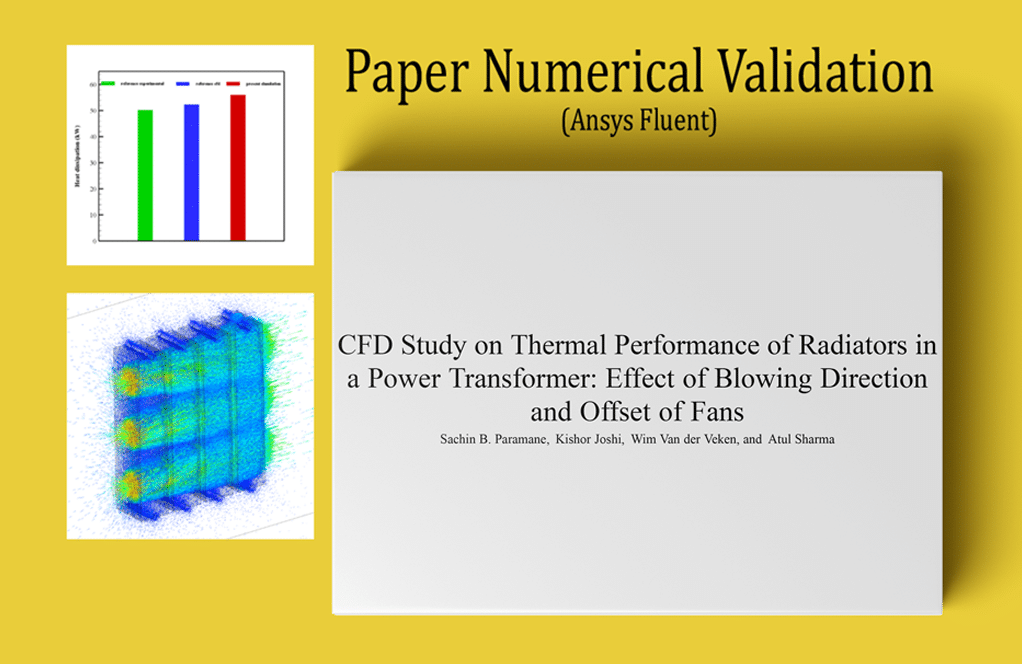
- Radiator Thermal Performance with Fans: The temperature profile depends on the height of the radiator plates. The “TEMPERATURE” boundary condition applying a UDF is used to define this temperature profile.
Temperature-Dependent Properties
- Shell and Tube Heat Exchanger by PCM, Paper Validation: UDF to define the temperature-dependent viscosity.
Magnetic Field (MHD) UDF
- Spiral Magnetic Separator: The Magnetic Induction MHD Method is enabled to model the applied magnetic field, with User-Defined Functions (UDFs) implemented for magnetic field components.
PBM (Polpulation Balanced Model) UDF
Crystallization
- Crystallization of Loratadine: UDF to define the nucleation and growth kinetics of the crystals, allowing the rates to depend on local supersaturation and flow conditions.
Nucleation
- UDF function to define the nucleation and growth rates in PBM analysis.
Synthesis
- FeNi Nanoparticle Synthesis: User-Defined Functions (UDFs) implement nucleation, growth, and agglomeration phenomena for nanoparticle prediction.
Piston Motion UDF
- Cylinder Piston Motion, Dynamic Mesh: In-Cylinder option to define the reciprocating motion of the piston inside a cylinder. in-build function called full-piston to define the movement of the piston surface. Profile to define the intake and exhaust valve lift.
- Piston Chamber with Air and Water: Six DOF Dynamic Mesh technique employed to accommodate piston movement.
Pressure Profile
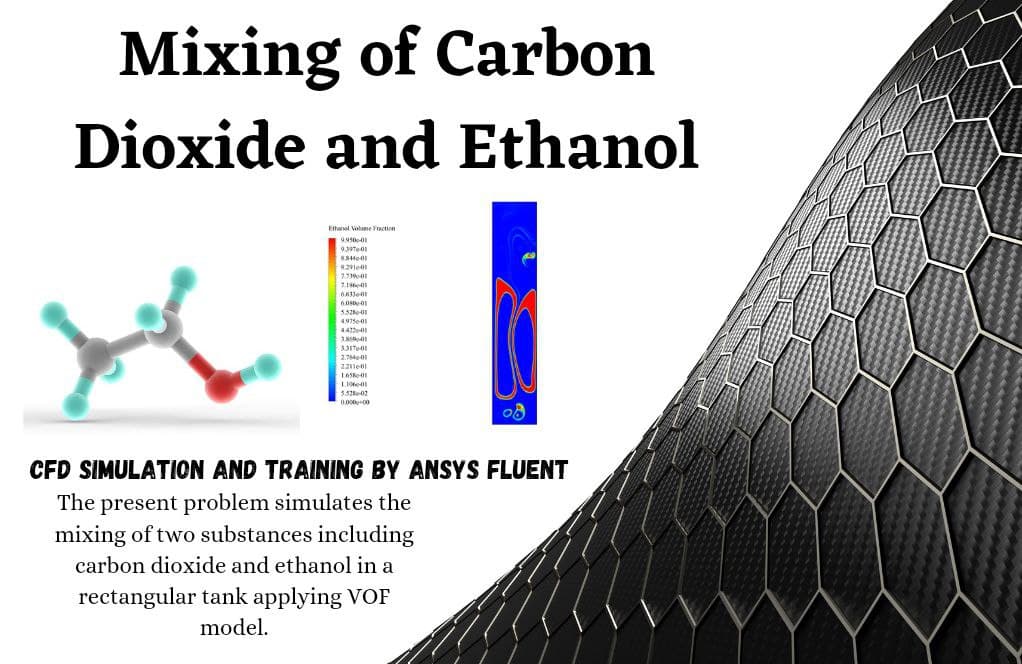
- Mixing of Carbon Dioxide and Ethanol: UDF to define time-dependent pressure at the model’s inlet.
Pulsatile Blood Flow UDF
- Blood Vessel
- Lumen Blood Vessel: Non-Newtonian Flow and FSI
- Artery Flow
- Arterial Bifurcation
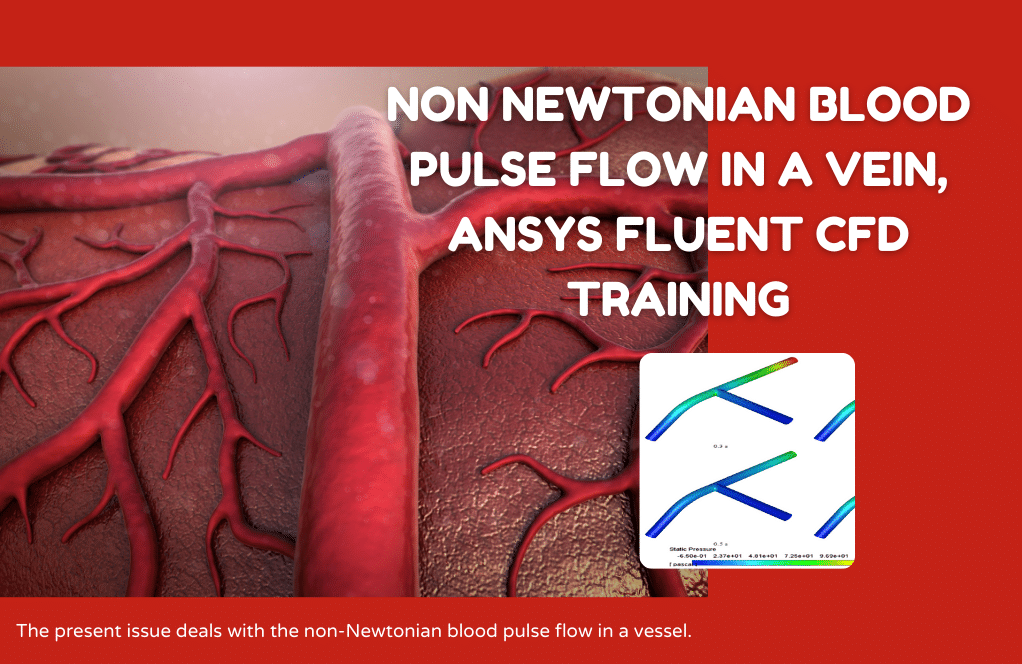
- Non Newtonian Blood Flow in a Vein
- Aorta: Non-Newtonian flow
- Arterial Stent
- Blood Vessel: FSI
- Blood Flow in a Coronary Bifurcation: Paper Numerical Validation
Reciprocating, Rotational, and Oscillating Motion UDF
- Oscillating Multiphase Flow with Dynamic Mesh: UDF to define the Moving Wall
- Diaphragm Pump: (UDF) to define the reciprocating motion.
- Submarine Movement in Water by Dynamic Mesh (1-DOF): UDF to define the rotational movement.
- Non-Return Valve by Dynamic Mesh (1-DOF): Input speed is defined using UDF.
Rotary Equipment
Pump
- Lobe Pump
Gerotor Pump
- Gerotor Pump
- Cavitation Phenomena in a Gerotor Pump: UDFs controlled the rotation of both rotors.
Gear Pump
- Internal Gear Pump
- External Gear Pump
Separation Delay
- Separation Delay on Airfoil Using DBD plasma actuator: Three User-Defined Scalars (UDS) are added for calculating the electrical and magnetic properties, and five User-Defined Functions (UDF) are used for the computation of the magnetic equations’ source terms, heat release from the electric field, and momentum body forces.
Sloshing and Aerodynamics Forces UDF
- Sloshing of a Tanker Truck
- Rotation of a Cube Considering Sloshing: UDF to define the variable angular velocity of the cube’s rotation.
- Sloshing Tank: Frame Motion (MRF) method applying a UDF for the sloshing movement is used.
- Javelin Rocket Motion Simulation with Dynamic Mesh Method (Six DOF): The simulation incorporates external forces and moments acting on the Javelin Rocket, including propulsion and aerodynamic forces, defined using a user-defined function (UDF).
Solid Object Movement UDF
- Submarine Robot motion in a Water Channel, Dynamic Mesh: Since the robot only moves horizontally at a certain speed, a Profile is used to define this type of movement.
- Falling Objects into Water, Dynamic Mesh: Furthermore, a UDF is used to impose cubes’ motion toward the water surface based on gravitational acceleration.
- Earthquake Effect on a Dam: The Frame Motion technique defines the earthquake process, in which a UDF is used to determine the type of movement and displacement of the computational area.
- Floating Vessel Motion in Water by Dynamic Mesh: UDF is used to define this type of motion with two degrees of freedom (2-DOF).
- Self-Propelled Submarine Motion, Dynamic Mesh (6-DOF): The properties of six degrees of freedom, including the mass and the moment in different directions for this model, are defined as a UDF to define the movement as a Rigid Body.
UDF for Static and Dynamic Stability Derivative
- RQ_7 UAV: The key method involved the oscillatory region technique, in which an inner fluid region, containing the UAV, was forced into a simple harmonic oscillation via a UDF.
- RQ_11 Drone
- ScanEagle UAV
- Skywalker_X5 Drone
- Skywalker_X8 UAV:
- Bayraktar Drone
- Quadcopter: UDF files to define the rotational and oscillation motion of the Quadcopter and blades.
- Dynamic Stability Derivatives for Javelin Rocket: UDF files to define the rotational and oscillation motion of the Rocket.
- Dynamic Stability Derivatives for a Flying Wing, Aircraft: The key methodology involved a Sliding Mesh technique where an inner fluid zone, containing the aircraft, was forced into a simple harmonic oscillation via a UDF.
Time Step Size Control UDF
- Water Tank Filling Process
User-Defined Function (UDF) CFD Simulation Training Course
- UDF Concepts for CFD Simulation by ANSYS Fluent
Macro
CG-Motion Macro
- User-Defined Function (UDF) to define a transitional reciprocating motion.
Delta T macro
· User-Defined Function (UDF) to control time step size
DPM-Drag Macro
- User-Defined Function (UDF) to define a drag between particles and fluid.
Init Macro
- User-Defined Function (UDF) to define an initial temperature.
Mass Transfer Macro
- User-Defined Function (UDF) to define a mass transfer: Evaporation and Condensation rate.
Prandtl-K Macro
- User-Defined Function (UDF) to define the Prandtl number.
Profile Macro
- User-Defined Function (UDF) to define a pressure profile.
Property Macro
- User-Defined Function (UDF) to define a viscosity relation.
Source Macro
- Momentum Source Term: User-Defined Function (UDF) to define a source term.
Velocity and Mass Flow Rate UDF
- Speaker Sound Generation and Propagation Inside a Pipe: This velocity formula is defined for the diaphragm boundary by writing a UDF (User-Defined Function) file and hooking it into the dynamic mesh.
- Air Pollution within a Street Canyon: The value of input velocity is defined as a function of the input section’s location, and hence, a profile in UDF format is used.
- Nanofluid Flow Heat Transfer in a Wave Sine Channel: The horizontal flow velocity function is defined as a UDF.
- FSI and Vibration Analysis of Airflow around an Airfoil: UDF to determine variable velocity and attack angle.
- Shuffle Parking Ventilation: UDF is used to define the mass flow rate of the emitted gas.
- Car Park (Stacker) Ventilation: UDF to define the mass flow rate of pollutant gas from car exhaust.
Wavy Motion UDF
- Oscillatory Wave and its Effect on Fin Motion: UDF to define the reciprocating motion of the wall that causes the wavy flow.
- Offshore Pipeline Considering Hydrodynamic Force: UDF to define wavy flow velocity and relative pressure due to wave motion.
You must be logged in to post a review.
 Talk On WhatsApp
 Talk On WeChat

Reviews
There are no reviews yet.