
UDF GOLDEN Training Course: +100 Simulations (All in One Course)
$1,499.00 Internship
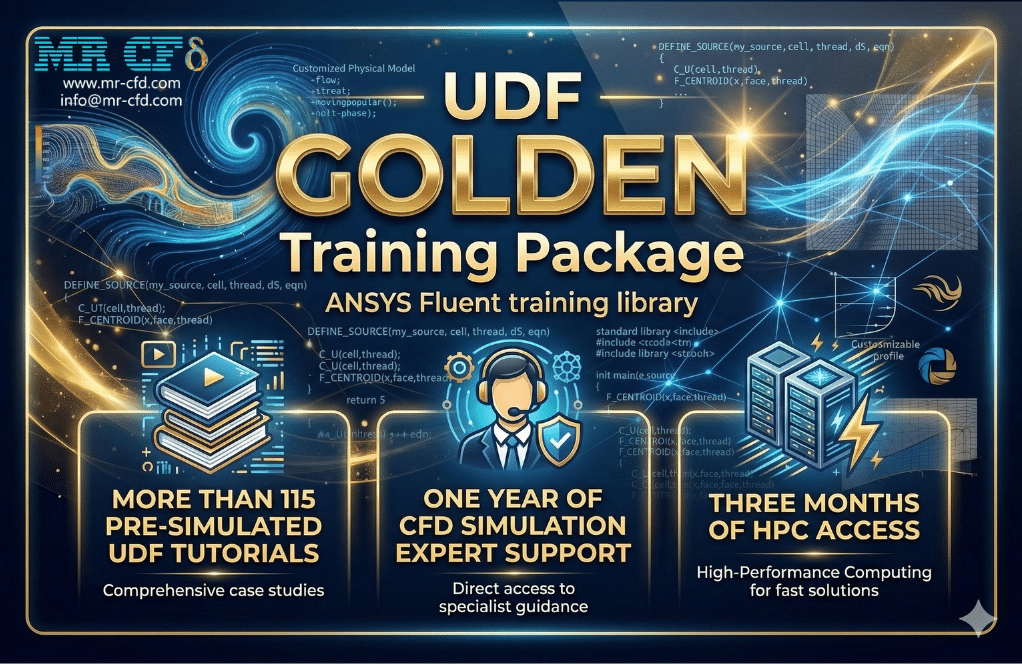
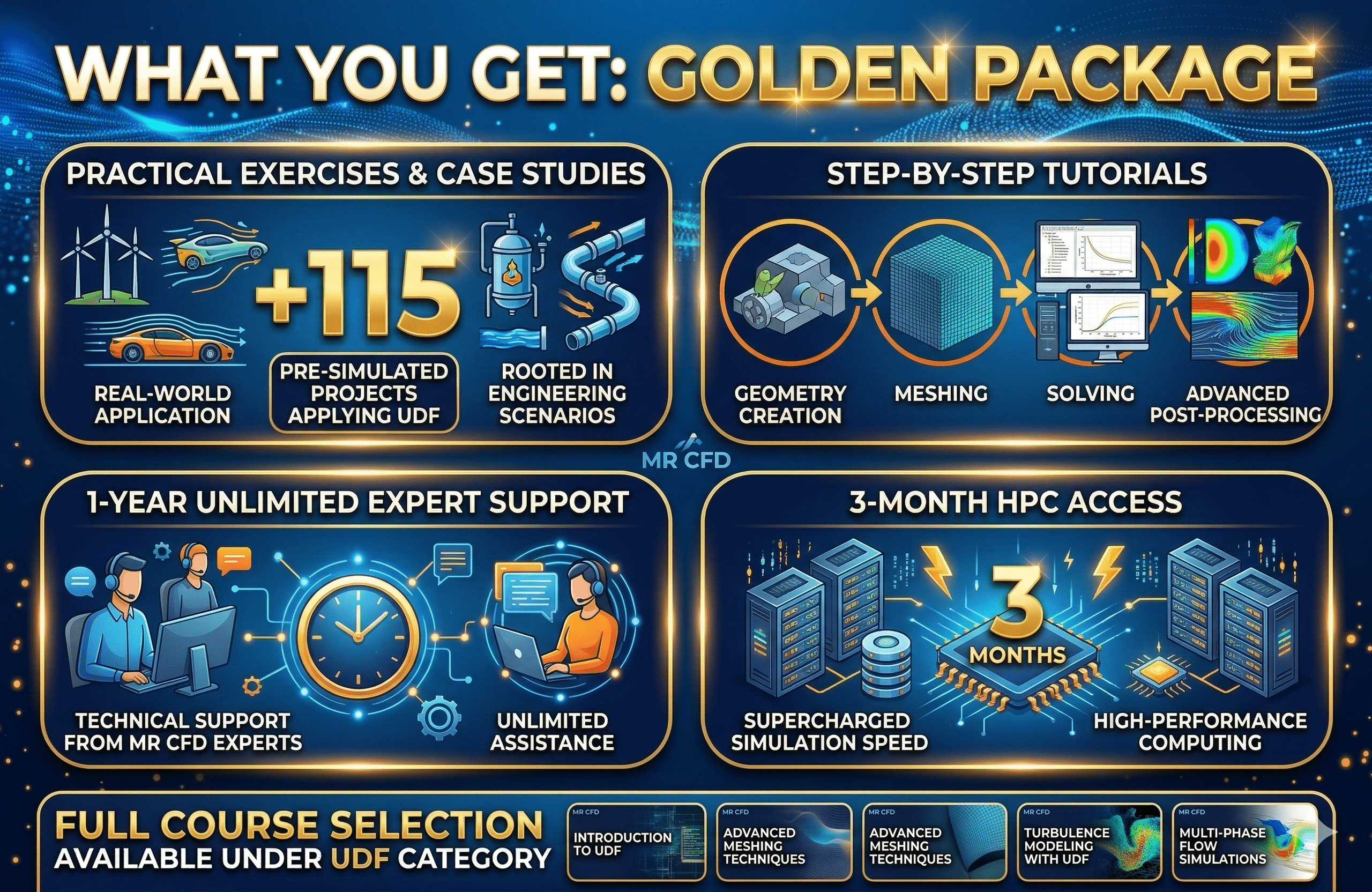
MR CFD’s “UDF GOLDEN Training Package” is a comprehensive ANSYS Fluent training library that turns engineers, students, and technical teams into expert users of User-Defined Functions across real industrial CFD projects. It bundles more than 115 pre-simulated UDF tutorials, one year of expert support, and three months of HPC access to fast‑track onboarding, reduce training costs, and standardize advanced UDF practices across organizations.
To Order Your Project or benefit from a CFD consultation, contact our experts via email (info@mr-cfd.com), online support tab, or WhatsApp at +44 7443 197273.
There are some Free Products to check our service quality.
If you want the training video in another language instead of English, ask it via info@mr-cfd.com after you buy the product.
Description
ANSYS Fluent UDF Complete CFD Course: 115+ Real-World Simulations
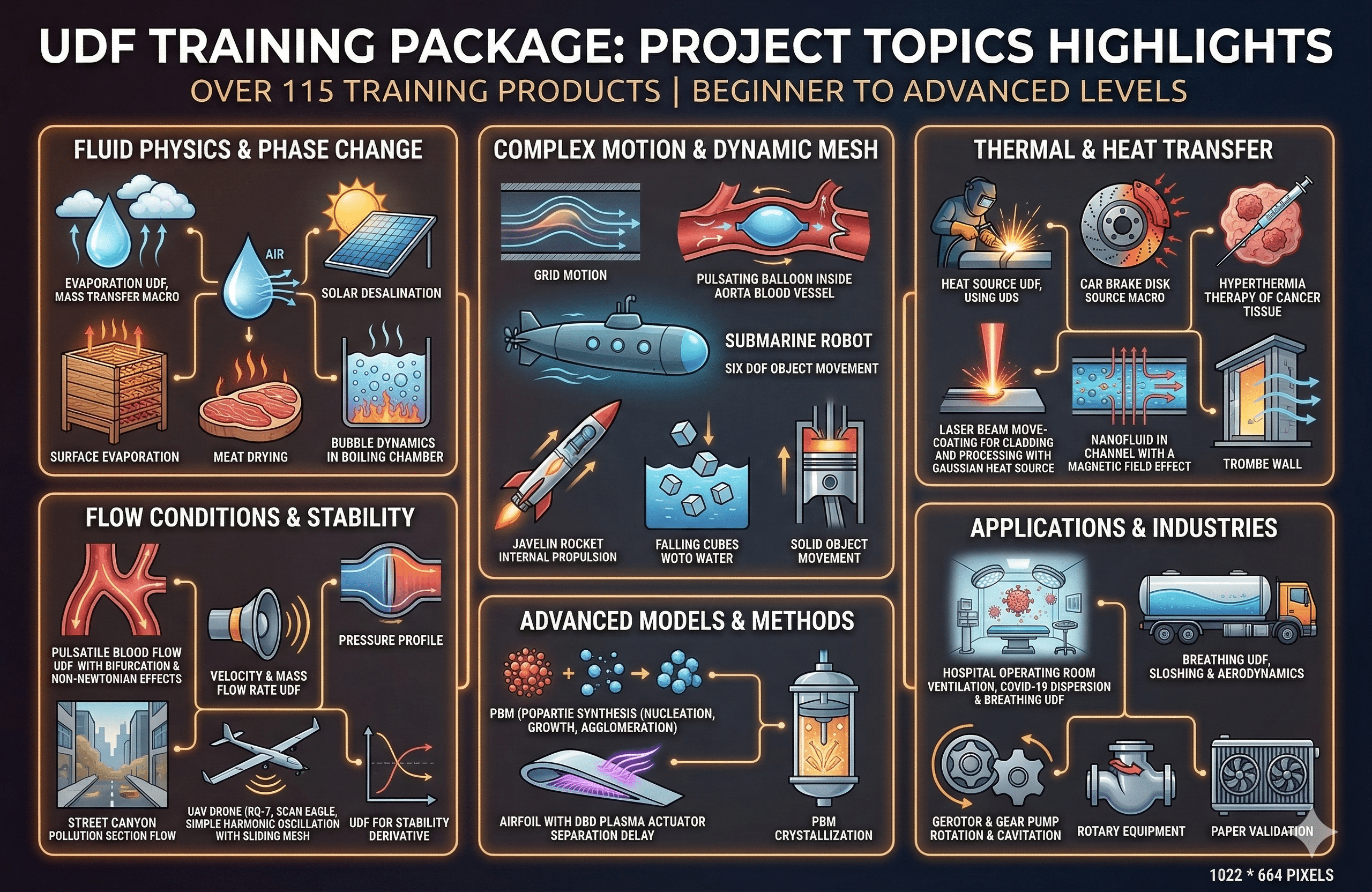
Engineering simulation has crossed a threshold where standard solver settings are no longer sufficient for cutting-edge research and industrial project delivery. The physical phenomena that define modern engineering challenges — from pulsatile blood flow in cardiovascular devices to six-DOF dynamic mesh motion in autonomous underwater vehicles — demand a level of solver customization that only ANSYS Fluent UDF programming can provide. This UDF Complete CFD Course, developed by MR CFD, is the most comprehensive User Defined Function simulation training available, encompassing over 115 production-grade ANSYS Fluent projects structured from beginner fundamentals to expert-level multi-physics implementations.
Whether you are an engineering student encountering UDF macros for the first time or a simulation specialist seeking to master DEFINE_CG_MOTION, DEFINE_MASS_TRANSFER, and Population Balance Model UDF workflows, this course delivers structured, industry-validated learning. Explore the full catalog of CFD training courses at MR CFD to understand how this UDF training integrates into a complete simulation mastery pathway. Every project in this course is pre-simulated, step-by-step documented, and directly mapped to real engineering applications, ensuring immediate professional applicability from the first tutorial.
Why ANSYS Fluent UDF Full Course Is a Non-Negotiable Engineering Competency
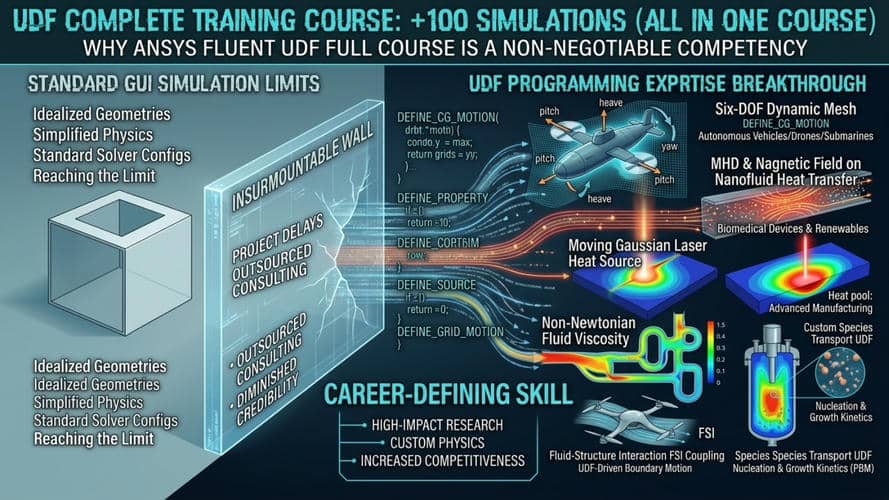
The gap between what ANSYS Fluent’s native GUI can model and what real engineering systems actually demand is precisely where UDF programming expertise becomes a career-defining skill. Standard solver configurations handle idealized geometries and simplified physics adequately. However, the moment a project involves non-Newtonian fluid viscosity, a moving Gaussian laser heat source, MHD magnetic field effects on nanofluid heat transfer, or time-dependent pressure boundary conditions, the engineer without UDF knowledge reaches an insurmountable wall.
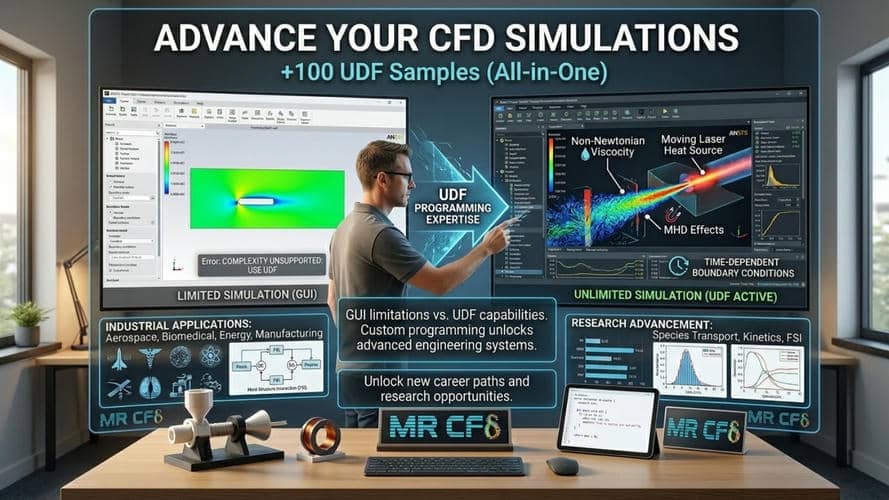
Industrial demand for ANSYS Fluent UDF simulation specialists has grown substantially across sectors including biomedical device development, aerospace stability analysis, renewable energy systems, and advanced manufacturing. Research institutions publishing in high-impact journals routinely require custom species transport UDF implementations, nucleation and growth kinetics definitions in PBM frameworks, and fluid-structure interaction FSI coupling through UDF-driven boundary motion. The inability to write, compile, and hook a UDF into the Fluent solver directly translates to project delays, outsourced consulting costs, and diminished research credibility.
Furthermore, the rise of six-DOF dynamic mesh CFD for autonomous vehicle simulation, drone aerodynamics, and submarine robotics has made DEFINE_CG_MOTION and DEFINE_GRID_MOTION macro proficiency a baseline expectation in advanced simulation roles. This course addresses every one of these competency gaps systematically.
Core Technical Competencies Delivered in This UDF Comprehensive Training Course
This UDF CFD comprehensive training is engineered to build layered competency across four critical skill domains:
Technical & Solver Customization Skills:
- Writing, compiling, and hooking C-language UDF routines into the ANSYS Fluent solver
- Implementing DEFINE_SOURCE for momentum, energy, and species source term customization
- Applying DEFINE_PROFILE for spatially and temporally variable boundary conditions
- Controlling solver time advancement using DEFINE_DELTA_T time step control
- Defining DEFINE_PROPERTY for temperature-dependent viscosity and non-Newtonian fluid behavior
- Programming DEFINE_DPM_DRAG for discrete phase model particle-fluid interaction
Modeling & Physics Customization Skills:
- Configuring dynamic mesh UDF for reciprocating, oscillating, and six-DOF rigid body motion
- Implementing DEFINE_MASS_TRANSFER for evaporation, condensation, and phase-change modeling
- Defining custom nucleation and growth rate functions within the Population Balance Model PBM
- Coupling User Defined Scalars UDS with UDFs for electromagnetic and thermal field computation
Solver Settings & Workflow Skills:
- Integrating UDFs with multiphase VOF, Mixture, and Eulerian models
- Applying MHD magnetohydrodynamics UDF for magnetic induction and body force computation
- Configuring FSI fluid-structure interaction boundary motion through UDF-driven mesh deformation
- Managing six-DOF dynamic mesh mass and moment definitions for autonomous body simulations
Validation & Verification Skills:
- Reproducing published paper numerical results using UDF-enhanced Fluent setups
- Verifying non-Newtonian blood flow models against clinical reference data
- Validating solar desalination evaporation UDF outputs against experimental benchmarks
- Cross-checking PBM nanoparticle synthesis UDF predictions with laboratory measurements
Comprehensive Course Modules & Simulated Engineering Projects
Breathing Dynamics & Biomedical Airflow UDF Simulations
This module addresses transient breathing UDF simulation in clinical and public health contexts. Projects include COVID-19 transient breathing in operating room environments and hospital ventilation efficiency studies modeling pathogen dispersion. The UDF defines the cyclic, time-dependent velocity profile of human respiration, enabling accurate prediction of airborne contaminant transport. These simulations are directly applicable to biomedical CFD, hospital infrastructure design, and infection control engineering, where standard inlet boundary conditions cannot replicate the physiological complexity of breathing cycles.
Evaporation, Drying & Solar Desalination UDF Applications
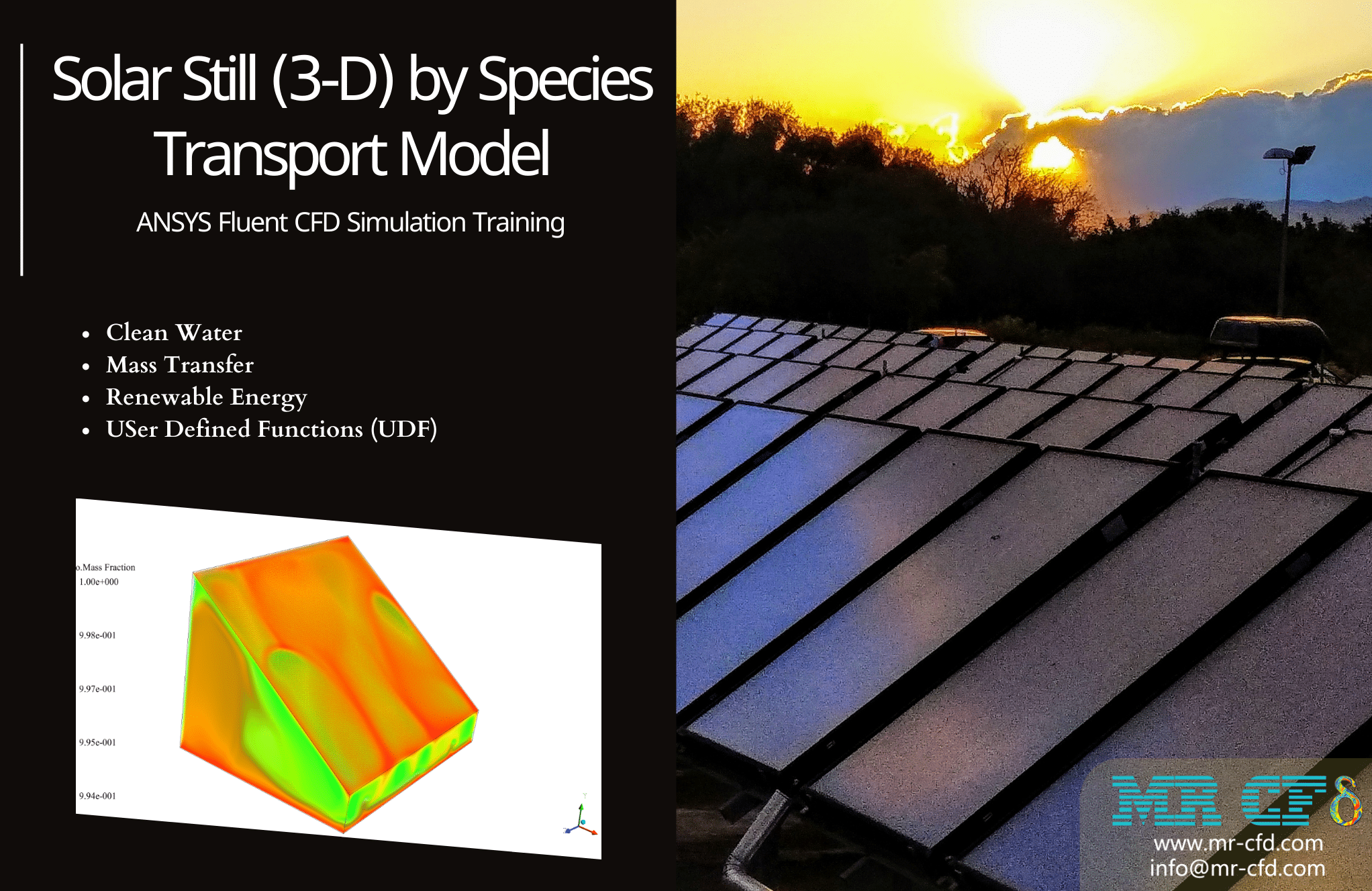
The mass transfer UDF module covers one of the most industrially critical yet solver-challenging physics domains: phase-change evaporation. Projects span meat drying with surface-limited evaporation UDF, heat pump wood dryers, falling water droplet surface evaporation, and an extensive suite of solar desalination UDF simulations including single-slope solar stills, two-stage desalination equipment, and species transport evaporation-condensation models. Since ANSYS Fluent’s base code does not natively support surface evaporation as a mass transfer mechanism, the DEFINE_MASS_TRANSFER macro is essential, and this module provides complete implementation training across 2D and 3D geometries with paper numerical validation.
Dynamic Mesh & Grid Motion UDF Engineering Projects
Dynamic mesh UDF simulation represents one of the most technically demanding areas of ANSYS Fluent customization. This module covers wavy wall motion, balloon pumping inside an aorta with simultaneous heart valve deflection using dual DEFINE_GRID_MOTION UDFs, and oscillating multiphase flow with moving wall boundaries. Engineers learn to apply DEFINE_CG_MOTION for translational and rotational rigid body dynamics, configure mesh smoothing and remeshing parameters, and manage computational stability in highly deforming domains. Applications span cardiovascular device simulation, wave energy converters, and industrial diaphragm pump design.
Heat Source UDF: Welding, Laser Processing & Thermal Therapy
The heat source UDF module addresses scenarios where thermal energy input is spatially non-uniform, time-varying, or physically localized in ways the standard Fluent energy model cannot represent. Projects include arc welding with User Defined Scalar UDS for electrical property computation and UDF-driven heat release from electric field sources, laser cladding with a moving Gaussian laser heat source UDF, laser processing simulations, brake disk radial heat flux modeling, and hyperthermia therapy of cancerous tissue with volumetric heat dose definition. Each project demonstrates how the DEFINE_SOURCE macro injects custom thermal energy into the energy equation with spatial and temporal precision.
MHD Magnetic Field UDF & Nanofluid Heat Transfer Simulations
Magnetohydrodynamics UDF simulation requires the simultaneous coupling of electromagnetic field equations with fluid flow and heat transfer, a capability that demands both UDS scalar transport and multi-component UDF source term implementation. This module covers magnetic field effects on nanofluid heat transfer, spiral magnetic separator modeling using the Magnetic Induction MHD Method, and water-cooled photovoltaic thermal PVT systems with nanofluid. Engineers learn to define magnetic field components, compute Lorentz body forces, and inject electromagnetic energy sources into the momentum and energy equations through coordinated UDF-UDS frameworks.
Population Balance Model (PBM) UDF: Crystallization & Nanoparticle Synthesis
The PBM UDF module addresses particle size distribution evolution in reactive and crystallizing flow systems. Projects include Loratadine crystallization with supersaturation-dependent nucleation and growth kinetics UDF, general PBM nucleation and growth rate definition tutorials, and FeNi nanoparticle synthesis modeling incorporating nucleation, growth, and agglomeration UDFs. This module is particularly valuable for pharmaceutical process engineering, advanced materials manufacturing, and chemical reactor design, where accurate prediction of particle size distribution directly impacts product quality and process efficiency.
Piston Motion & Reciprocating Machinery UDF Projects
Piston motion UDF simulation using ANSYS Fluent’s in-cylinder dynamic mesh framework is covered comprehensively in this module. Projects include cylinder piston reciprocating motion with intake and exhaust valve lift profiles, and piston chamber simulations with combined air-water multiphase dynamics using six-DOF dynamic mesh techniques. Engineers learn to apply the built-in full-piston function, define valve lift profiles, and manage the complex mesh topology changes associated with internal combustion engine and compressor simulations. These skills are directly transferable to automotive CFD and industrial compressor design workflows.
Pulsatile Blood Flow UDF: Cardiovascular & Biomedical CFD
The pulsatile blood flow UDF module is one of the most clinically significant sections of this course, covering arterial bifurcations, coronary bifurcation with paper numerical validation, lumen blood vessel FSI, aortic non-Newtonian flow, arterial stent hemodynamics, and non-Newtonian blood flow in veins. The UDF defines the physiologically accurate, time-dependent inlet velocity waveform of the cardiac cycle. Combined with non-Newtonian viscosity UDF implementations using the Carreau or Power Law models, these simulations achieve the accuracy required for medical device regulatory submissions and cardiovascular research publications.
Rotary Equipment UDF: Gear Pumps, Lobe Pumps & Gerotor Systems
This module addresses rotary pump UDF simulation for positive displacement machinery. Projects cover lobe pumps, internal and external gear pumps, and gerotor pump systems including cavitation phenomena modeling where UDFs control the synchronized counter-rotation of both rotors. Engineers learn to implement DEFINE_CG_MOTION for multi-body rotational dynamics, manage sliding mesh interfaces, and capture cavitation inception in high-speed pump geometries. These capabilities are essential for hydraulic system design, lubrication engineering, and industrial fluid power applications.
Sloshing, Aerodynamic Forces & Rocket Dynamics UDF Projects
The sloshing and aerodynamic forces UDF module covers tanker truck sloshing analysis, rotating cube sloshing with variable angular velocity UDF, Frame Motion MRF sloshing tank simulation, and the Javelin Rocket six-DOF flight simulation incorporating propulsion and aerodynamic force UDFs. Engineers learn to define time-varying angular velocity profiles, implement external force and moment vectors for free-flight body dynamics, and couple aerodynamic loading with rigid body motion. These skills are directly applicable to aerospace CFD, naval architecture, and autonomous vehicle dynamics.
Solid Object Motion UDF: Submarines, Falling Objects & Earthquake Simulation
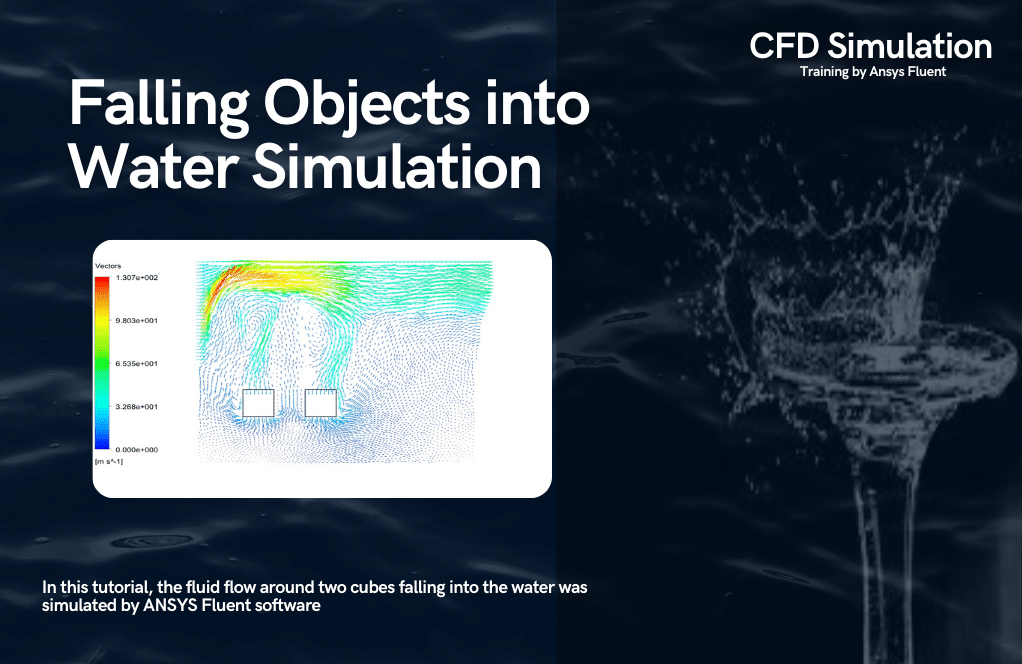
This module covers a diverse range of solid object motion UDF applications including submarine robot horizontal translation, falling cubes into water with gravitational acceleration-driven UDF motion, earthquake-induced dam deformation using Frame Motion with displacement UDF, floating vessel two-DOF motion, and self-propelled submarine six-DOF simulation with full rigid body property definition. Each project demonstrates a different approach to prescribing body motion in ANSYS Fluent, from simple profile-based translation to fully autonomous six-DOF dynamics governed by fluid-body force coupling.
UAV, Drone & Aircraft Dynamic Stability Derivative UDF Simulations
The dynamic stability derivative UDF module is among the most advanced sections of this course, covering the RQ-7 UAV, RQ-11 drone, ScanEagle UAV, Skywalker X5 and X8 platforms, Bayraktar drone, quadcopter blade oscillation, Javelin Rocket stability analysis, and flying wing aircraft. The oscillatory region technique forces the aircraft or UAV into simple harmonic oscillation via UDF, enabling extraction of pitch, roll, and yaw stability derivatives. This methodology is used in aerospace defense CFD for flight envelope prediction and control system design validation.
UDF Macro Fundamentals: Complete Programming Reference Module
The UDF macro programming module provides the foundational C-language and Fluent API knowledge underpinning all other course sections. Tutorials cover DEFINE_CG_MOTION for transitional reciprocating motion, DEFINE_DELTA_T for adaptive time step control, DEFINE_DPM_DRAG for particle drag customization, DEFINE_INIT for initial condition fields, DEFINE_MASS_TRANSFER for evaporation-condensation rates, Prandtl-K turbulence property definition, DEFINE_PROFILE for pressure boundary profiles, DEFINE_PROPERTY for viscosity relations, and DEFINE_SOURCE for momentum source terms. This module ensures every learner possesses the complete macro vocabulary required for independent UDF development.
Velocity Profile, Mass Flow Rate & Wavy Motion UDF Applications
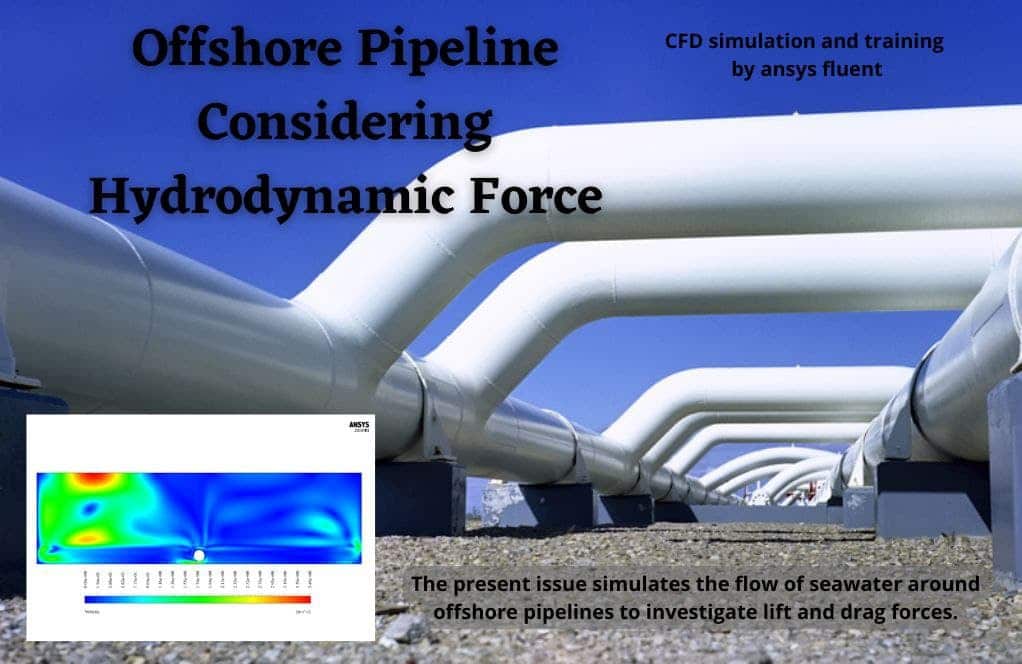
The velocity and mass flow rate UDF module covers speaker diaphragm velocity UDF for acoustic propagation simulation, atmospheric boundary layer velocity profiles for urban air pollution in street canyons, sinusoidal velocity UDF for nanofluid heat transfer in wave-sine channels, variable attack angle UDF for airfoil FSI and vibration analysis, and mass flow rate UDFs for car park and shuffle parking ventilation systems. The wavy motion UDF sub-module addresses oscillatory wave effects on fin motion and offshore pipeline hydrodynamic loading with wave-induced pressure and velocity boundary definitions.
Professional Engineering Skills Developed Through This UDF CFD Training
| Skill Domain | Competencies Acquired |
|---|---|
| CFD Solver Customization | UDF compilation, hooking, and debugging in ANSYS Fluent; multi-macro coordination; UDS-UDF coupling |
| Dynamic Mesh Engineering | Six-DOF rigid body motion; reciprocating and oscillating mesh; FSI boundary deformation |
| Multiphase & Mass Transfer | Evaporation-condensation UDF; VOF with custom source terms; PBM nucleation and growth kinetics |
| Biomedical CFD | Pulsatile inlet profiles; non-Newtonian viscosity models; cardiovascular FSI simulation |
| Electromagnetic CFD | MHD Lorentz force UDF; UDS for electrical and magnetic field transport; nanofluid thermal coupling |
| Aerospace & Defense CFD | Dynamic stability derivative extraction; six-DOF flight simulation; UAV oscillatory UDF methodology |
| Thermal Engineering | Moving heat source UDF; volumetric heat generation; temperature-dependent property definition |
| Industrial Machinery | Rotary pump counter-rotation UDF; piston in-cylinder dynamics; cavitation in positive displacement pumps |
Real-World Industrial Applications of ANSYS Fluent UDF Simulation Expertise
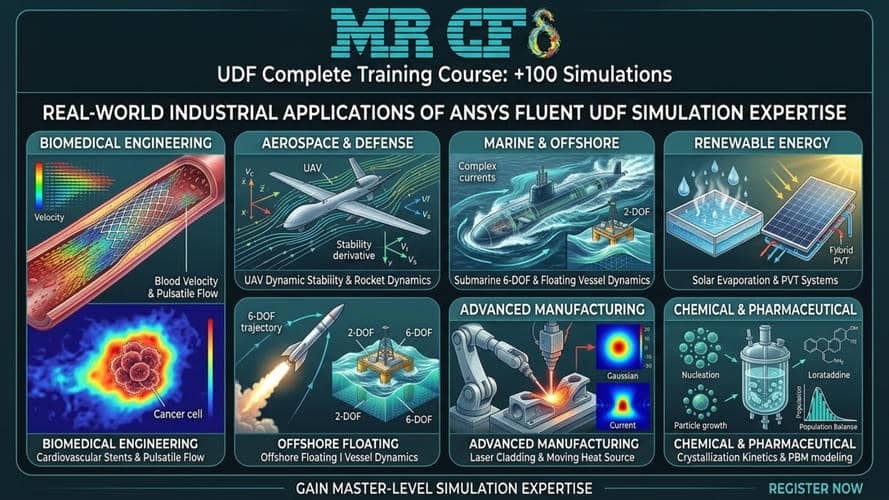
Biomedical & Healthcare Engineering: Cardiovascular device hemodynamic validation, arterial stent flow analysis, hyperthermia cancer therapy dosimetry, and hospital ventilation pathogen dispersion modeling all rely on pulsatile blood flow UDF and heat source UDF capabilities developed in this course.
Aerospace & Defense: UAV and drone dynamic stability derivative extraction, Javelin Rocket six-DOF flight simulation, and flying wing aircraft oscillatory analysis directly apply the UDF oscillatory region technique covered in the stability derivatives module.
Marine & Offshore Engineering: Submarine six-DOF autonomous motion, floating vessel two-DOF dynamics, sloshing tanker truck analysis, and offshore pipeline hydrodynamic loading utilize solid object motion UDF and wavy motion UDF skills from this course.
Renewable Energy & Desalination: Solar still evaporation modeling, PVT nanofluid system optimization, and Trombe wall thermal analysis apply evaporation UDF and heat source UDF workflows directly to clean energy system design.
Advanced Manufacturing: Laser cladding, arc welding, and laser processing simulations using moving Gaussian heat source UDF and UDS electrical property computation are directly applicable to precision manufacturing process optimization.
Chemical & Pharmaceutical Engineering: Loratadine crystallization, FeNi nanoparticle synthesis, and PBM nucleation kinetics UDF implementations address core population balance model challenges in pharmaceutical and advanced materials production.
Who Should Enroll in This User Defined Function Complete CFD Course
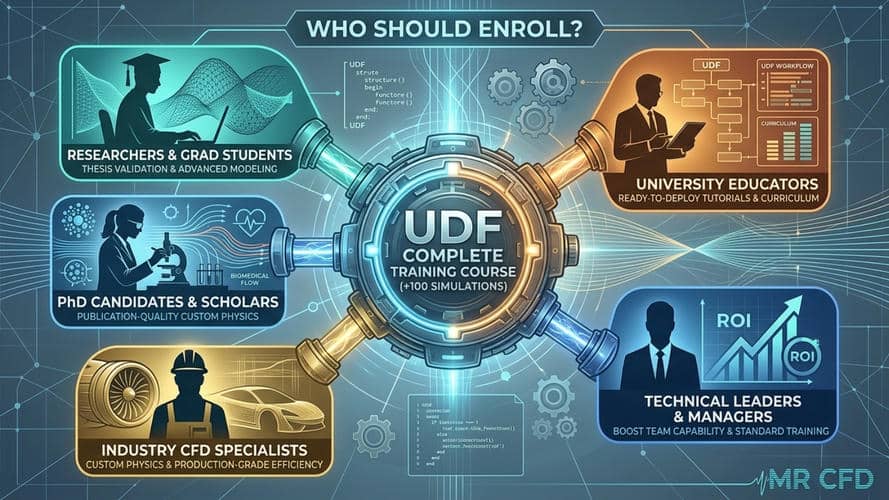
Engineering Students & Graduate Researchers: Students pursuing CFD-intensive thesis projects requiring custom physics definitions, paper numerical validation, or advanced multiphase modeling will find this course provides the exact UDF programming competencies their research demands.
PhD Candidates & Academic Researchers: Researchers working on biomedical flow, MHD systems, nanoparticle synthesis, or aerospace stability analysis will gain the ability to implement and validate publication-quality UDF-enhanced simulations independently.
Industry CFD Engineers & Simulation Specialists: Practicing engineers in automotive, aerospace, marine, energy, and manufacturing sectors who need to extend ANSYS Fluent’s native capabilities for production-grade project delivery will find immediate ROI in this training. Those interested in structured professional development may also explore the CFD internship program at MR CFD.
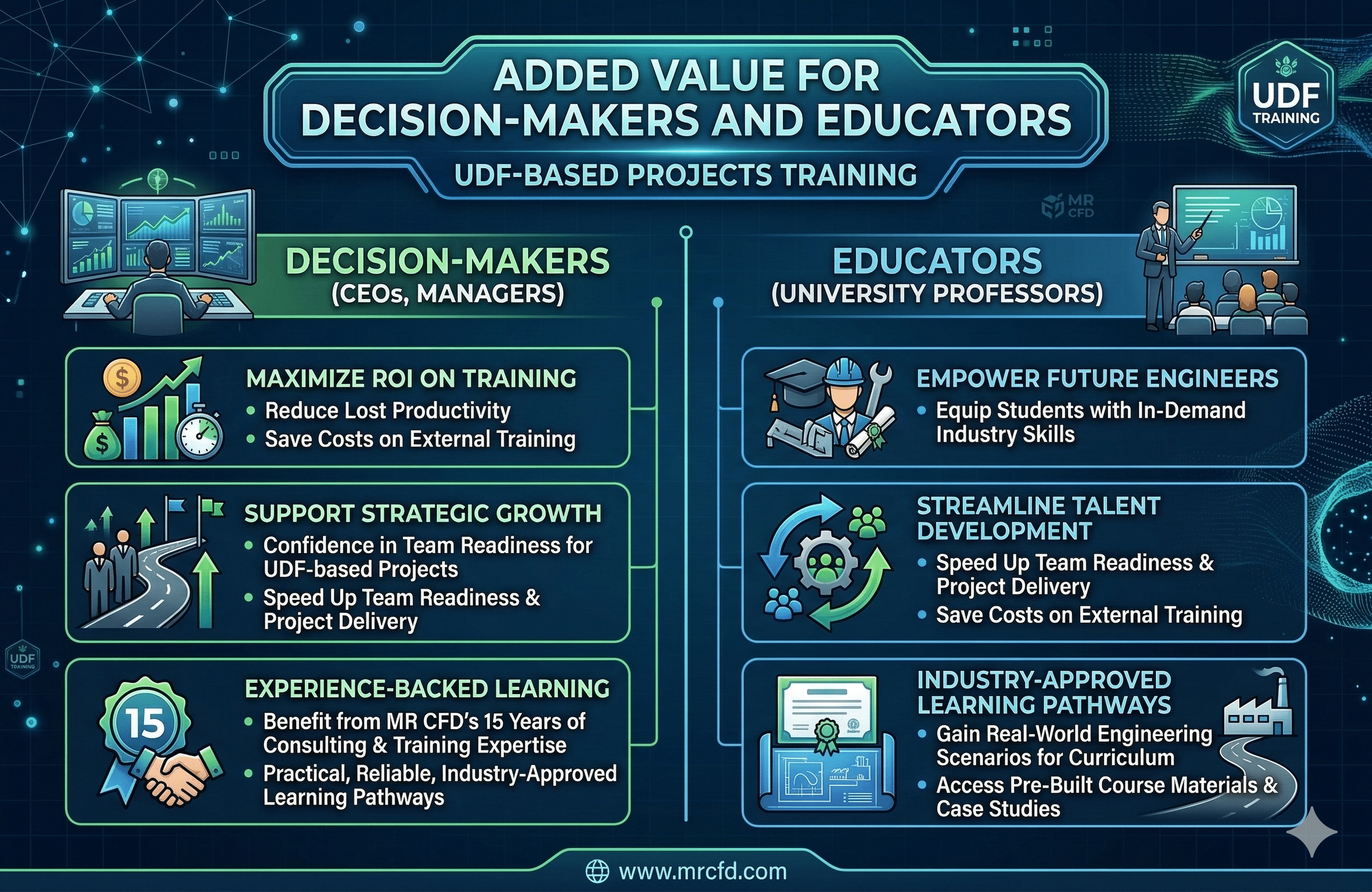
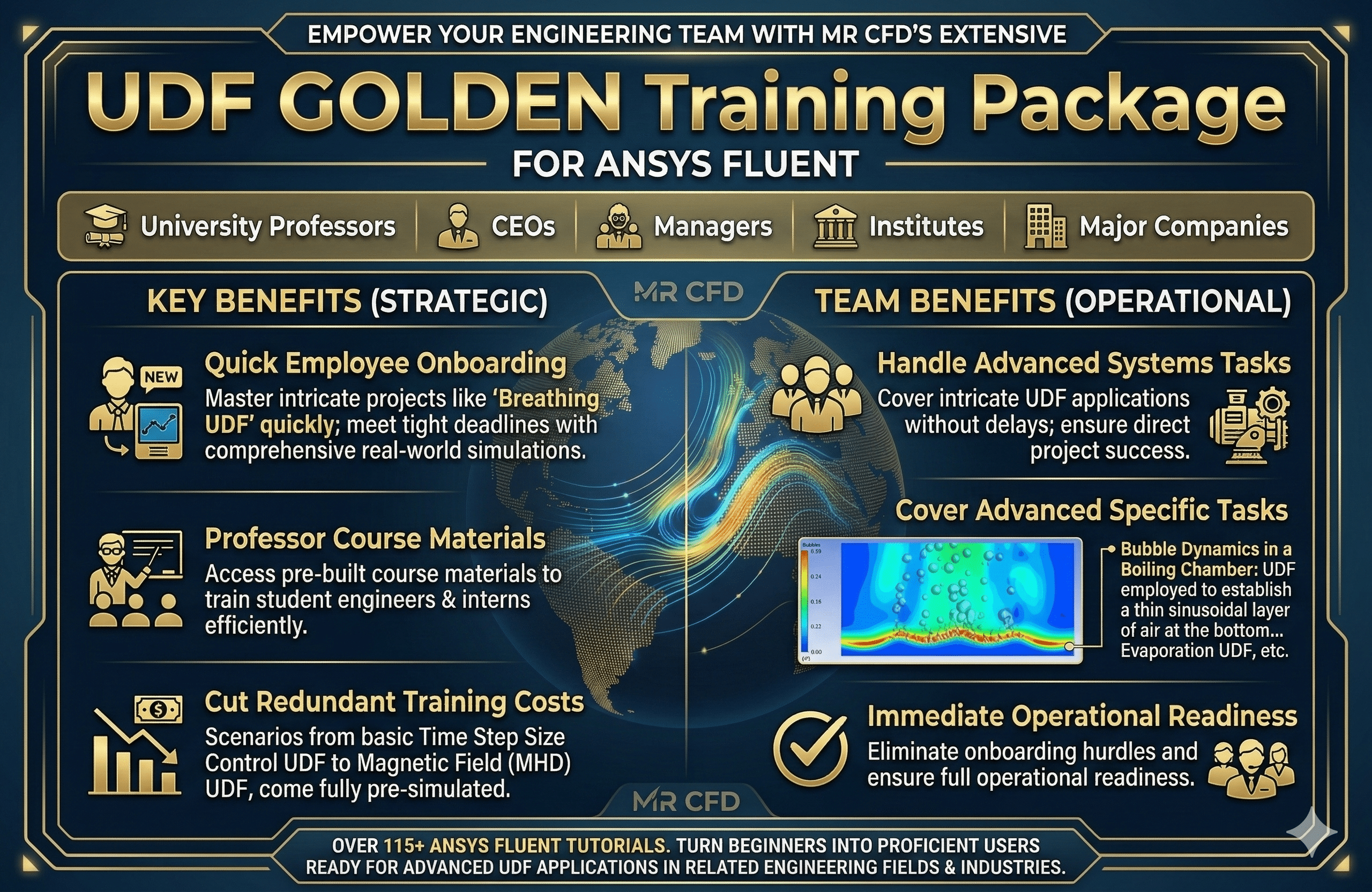
University Professors & Technical Educators: Faculty seeking ready-to-deploy, pre-simulated ANSYS Fluent UDF tutorials for curriculum enrichment will find over 115 structured projects covering every major UDF application category, eliminating the need to develop teaching materials from scratch.
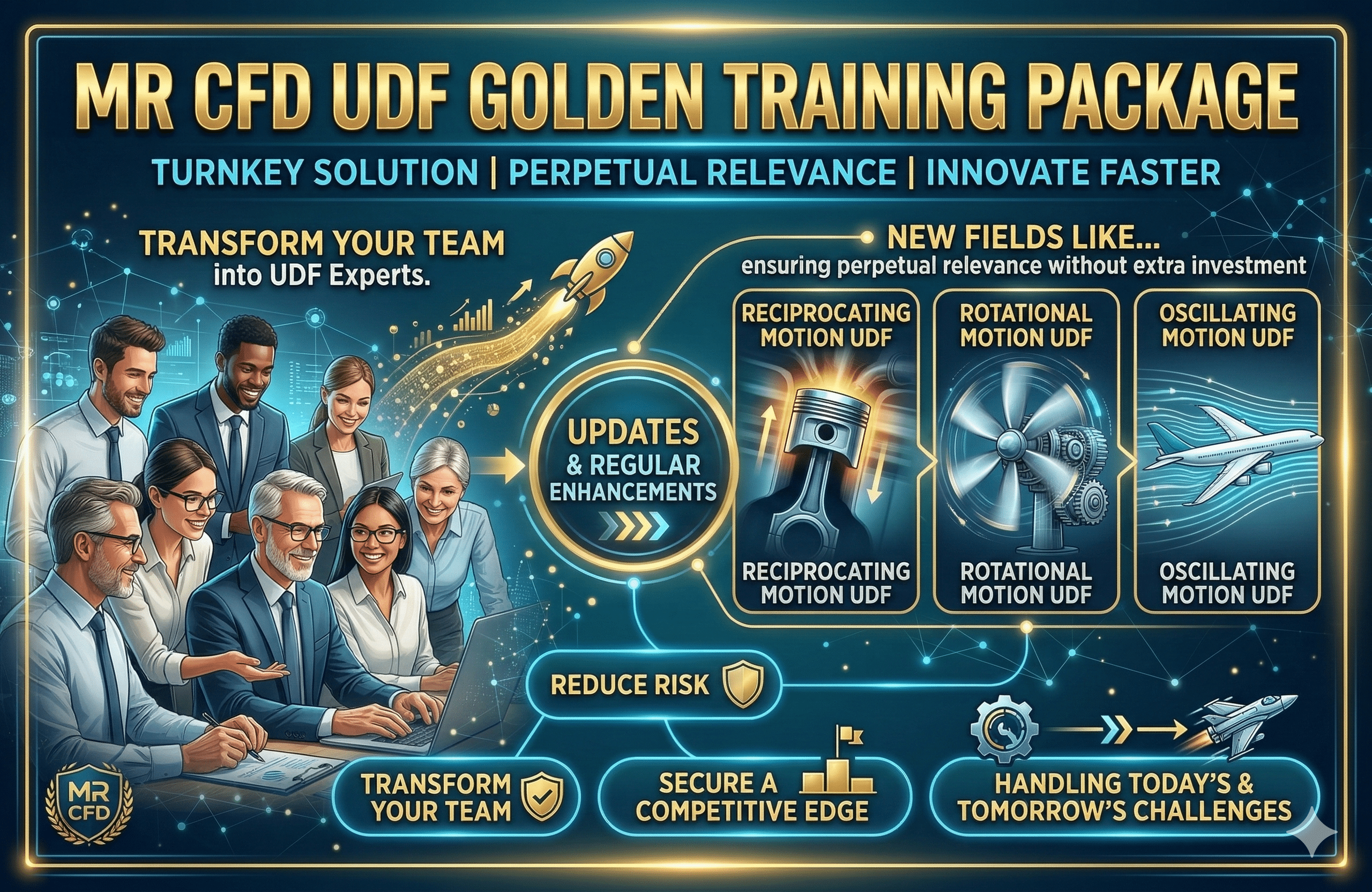
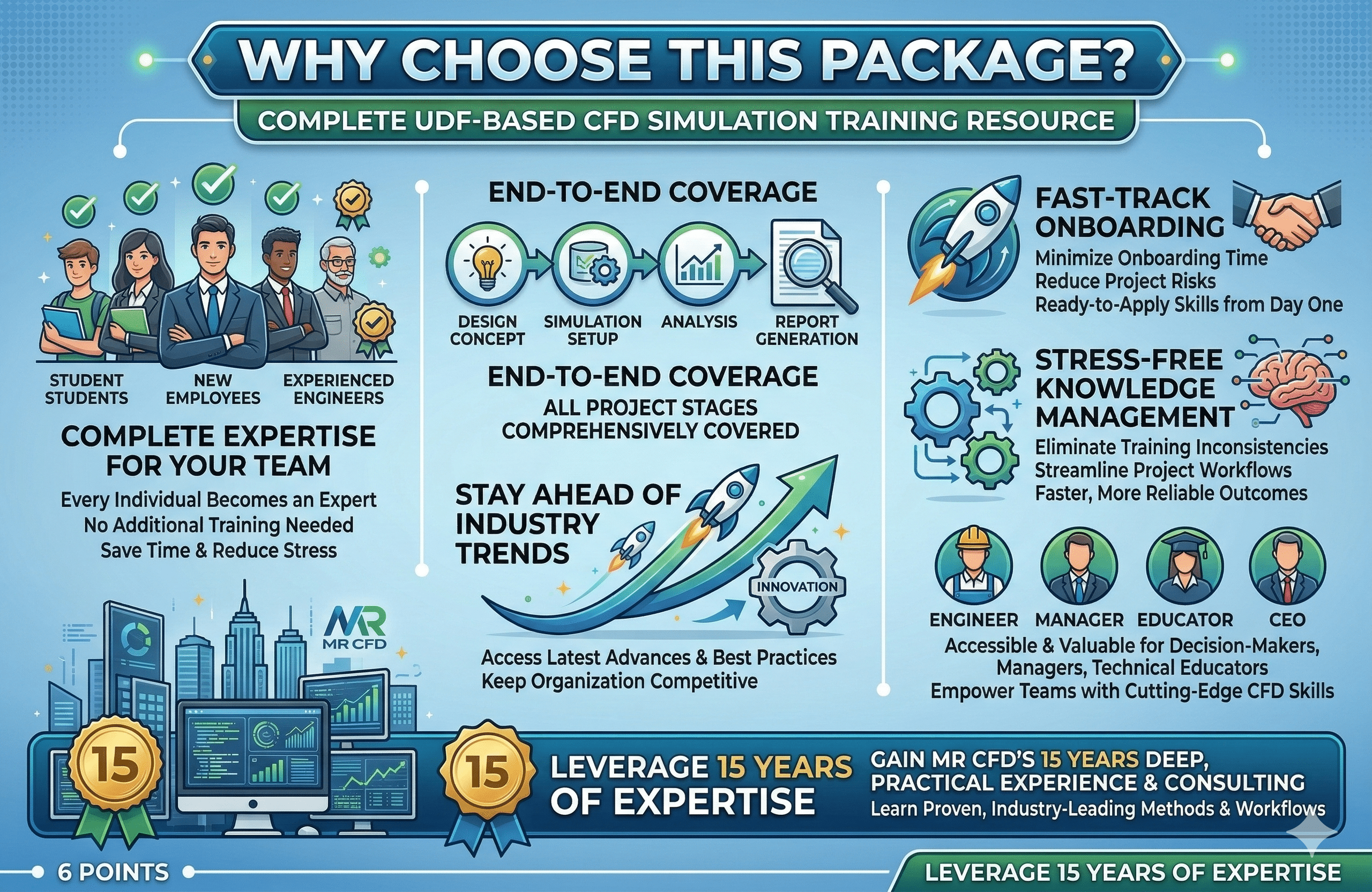
Engineering Managers & Technical Decision-Makers: Organizations evaluating team simulation capability gaps will find this course provides a complete, standardized UDF training pathway that eliminates inconsistent knowledge levels and accelerates project onboarding timelines. For teams requiring bespoke simulation support, CFD consulting services from MR CFD are also available.
Why MR CFD Delivers Unmatched Authority in UDF Simulation Training
MR CFD brings over 15 years of deep, applied CFD consulting and engineering education expertise to every course in its catalog. This UDF comprehensive training course is not assembled from textbook theory — every one of the 115+ projects is derived from real consulting engagements, published research collaborations, and industry-standard simulation workflows validated against experimental and numerical benchmarks.
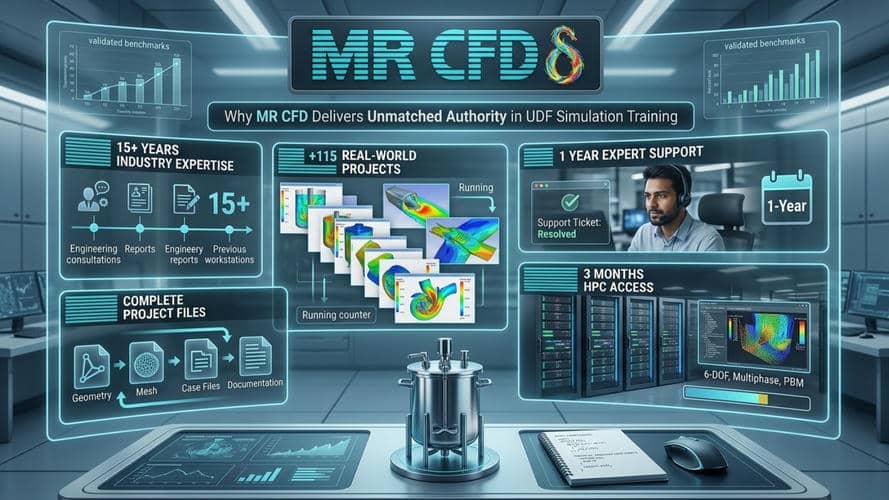
The course provides one year of unlimited technical support from MR CFD’s expert engineering team, ensuring that learners encountering compilation errors, mesh instability, or convergence challenges in their own UDF projects receive direct, expert-level resolution. Additionally, enrollment includes access to three months of HPC (High-Performance Computing) resources, enabling learners to run computationally intensive six-DOF, multiphase, and PBM simulations at production-grade speeds. Learn more about MR CFD’s ANSYS HPC optimization capabilities to understand how computational resource access accelerates simulation throughput.
Every project in this course is accompanied by complete geometry, mesh, case files, and post-processing documentation, ensuring that learners can immediately reproduce, modify, and extend each simulation for their own engineering applications.
Engineering Progression Pathway & Advanced Training Roadmap
This UDF complete CFD course is structured to accommodate learners across the full competency spectrum:
- Beginner Level: UDF macro fundamentals, DEFINE_INIT, DEFINE_PROFILE, DEFINE_PROPERTY, and simple velocity boundary condition UDFs provide the programming foundation and Fluent API familiarity required for all advanced work.
- Intermediate Level: Heat source UDF, evaporation mass transfer UDF, piston motion dynamic mesh, and pulsatile blood flow UDF projects build multi-physics modeling confidence and introduce UDS coupling.
- Advanced Level: Six-DOF dynamic mesh for submarines and rockets, PBM nucleation kinetics UDF, MHD electromagnetic field UDF, and UAV dynamic stability derivative extraction represent expert-tier simulation capabilities with direct research and industrial applicability.
Upon completing this course, learners are equipped to pursue advanced ANSYS Fluent specializations including turbulence model customization, adjoint optimization with UDF-defined objectives, and reacting flow UDF implementations. The complete library of progression-mapped CFD simulation courses is available through the MR CFD learning portal.
Begin Your ANSYS Fluent UDF Mastery — Enroll in the Complete CFD Course Today
The ability to write, implement, and validate ANSYS Fluent UDF code is one of the most technically differentiated and professionally valuable competencies in computational engineering today. This UDF comprehensive CFD training course from MR CFD provides the most complete, project-rich, and industrially validated pathway to achieving that mastery — covering over 115 real-world simulations across biomedical, aerospace, marine, energy, manufacturing, and chemical engineering domains.
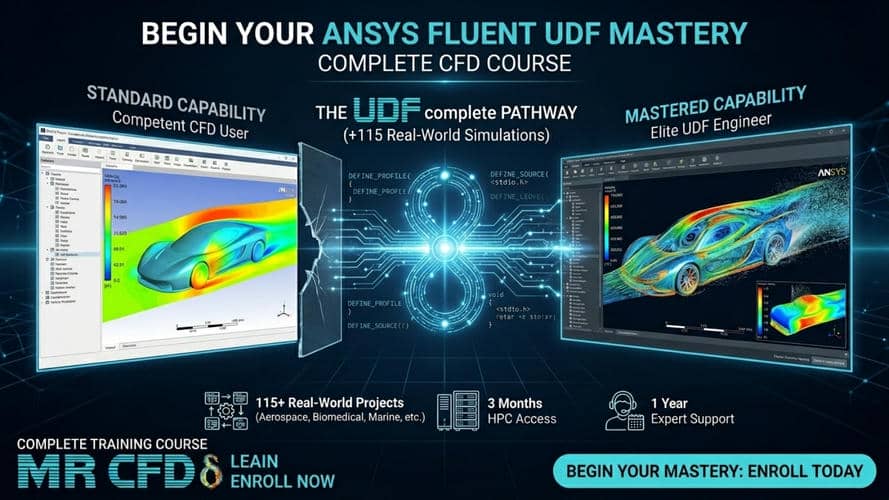
Every project is pre-simulated, every macro is explained from first principles, and every simulation is mapped to a real engineering application. With one year of expert technical support, three months of HPC access, and a structured progression from beginner macros to advanced six-DOF and PBM implementations, this course represents the definitive investment in CFD UDF simulation expertise.
Engineers, researchers, and educators who complete this course do not simply learn UDF syntax — they acquire the solver customization mastery that separates competent CFD users from elite simulation engineers capable of tackling any physics challenge ANSYS Fluent can model.
Enroll now and transform your ANSYS Fluent capability from standard to exceptional.
You must be logged in to post a review.
 Talk On WhatsApp
Reviews
There are no reviews yet.