
What is CFD Simulation? Process, Modeling & Calculations Guide
Computational Fluid Dynamics (CFD) is one of the most powerful engineering technologies for predicting how fluids-air, water, gases, liquids, and multiphase mixtures-behave inside or around a product, system, or environment. In simple terms, CFD simulation is the process of using numerical methods, physics models, and computer algorithms to virtually analyze fluid flow, heat transfer, pressure distribution, turbulence, and related phenomena before building a physical prototype.
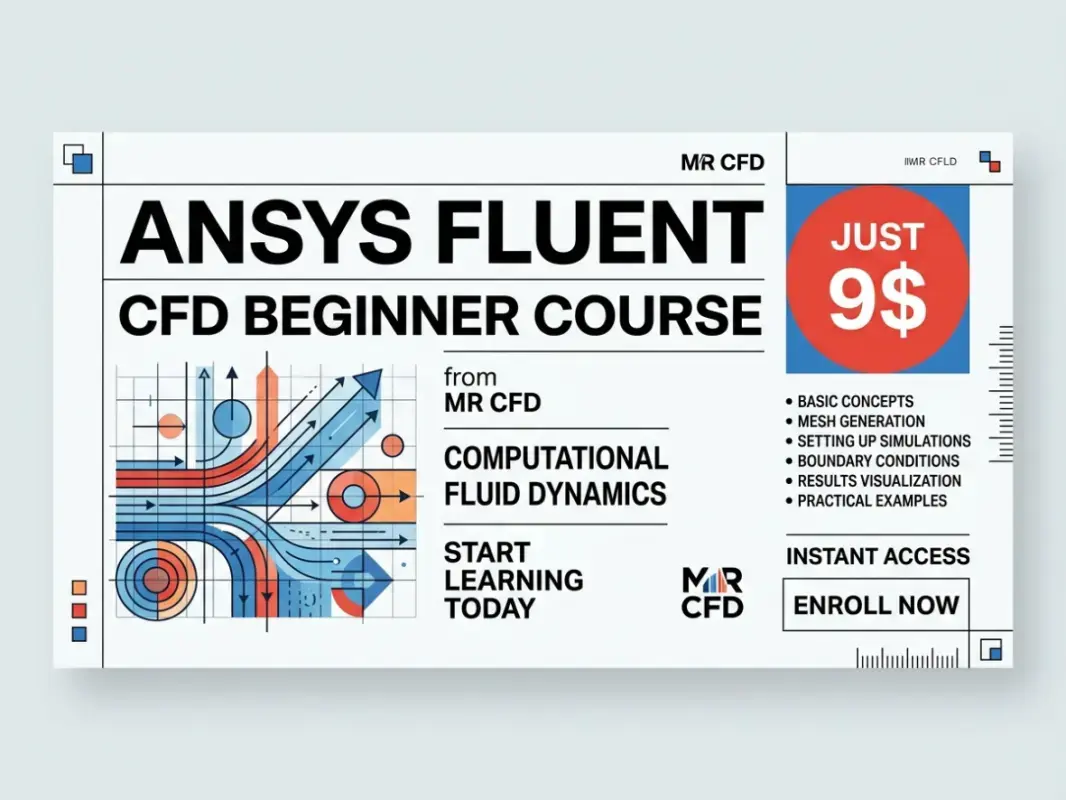
ANSYS Fluent Beginner Course for Less Than the Cost of a Lunch!
No prior experience needed. Start Learning ANSYS Fluent step-by-step with 16 hands-on, real-world projects across multiple engineering fields.
For engineering teams, CFD modeling is not just a mathematical exercise. It is a cost-saving and risk-reducing design tool. By replacing repeated physical prototyping with advanced computational fluid dynamics modeling, companies can reduce development costs, accelerate time-to-market, and improve product performance before manufacturing begins. Whether you are optimizing a heat exchanger, reducing aerodynamic drag on a vehicle, improving HVAC airflow, or studying blood flow through a biomedical device, CFD simulation provides actionable engineering insight.
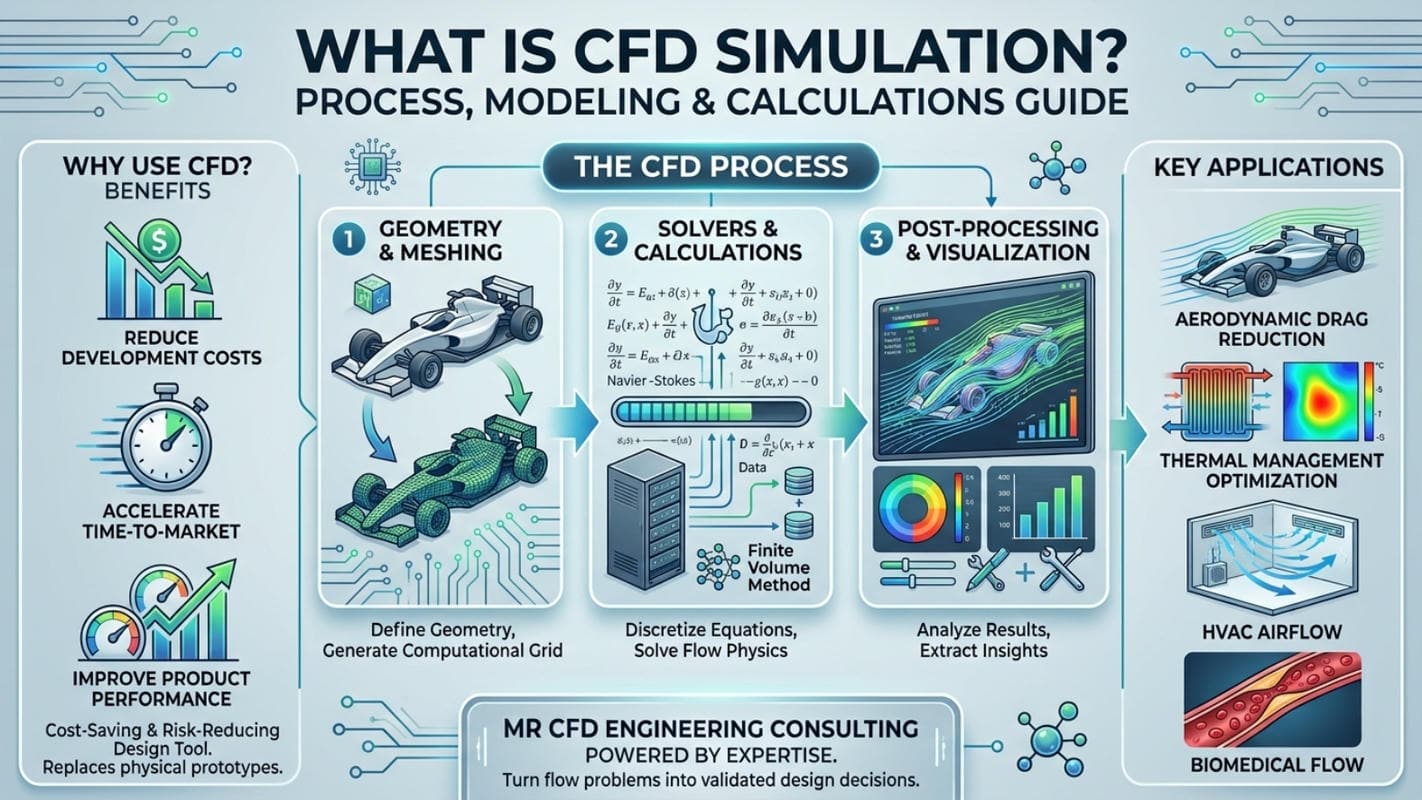
At MR CFD, we use CFD engineering consulting to help companies turn complex flow problems into validated design decisions. From thermal management optimization and aerodynamic drag reduction to pressure drop calculation, multiphase flow, and performance validation, CFD allows engineers to identify problems early, compare design alternatives, and reduce costly trial-and-error testing.
What is CFD Analysis?
CFD analysis is the digital investigation of fluid flow behavior using mathematical equations, numerical methods, and specialized simulation software. Instead of relying only on experiments or hand calculations, engineers build a virtual model of the real system and solve the governing flow equations across a defined computational domain.
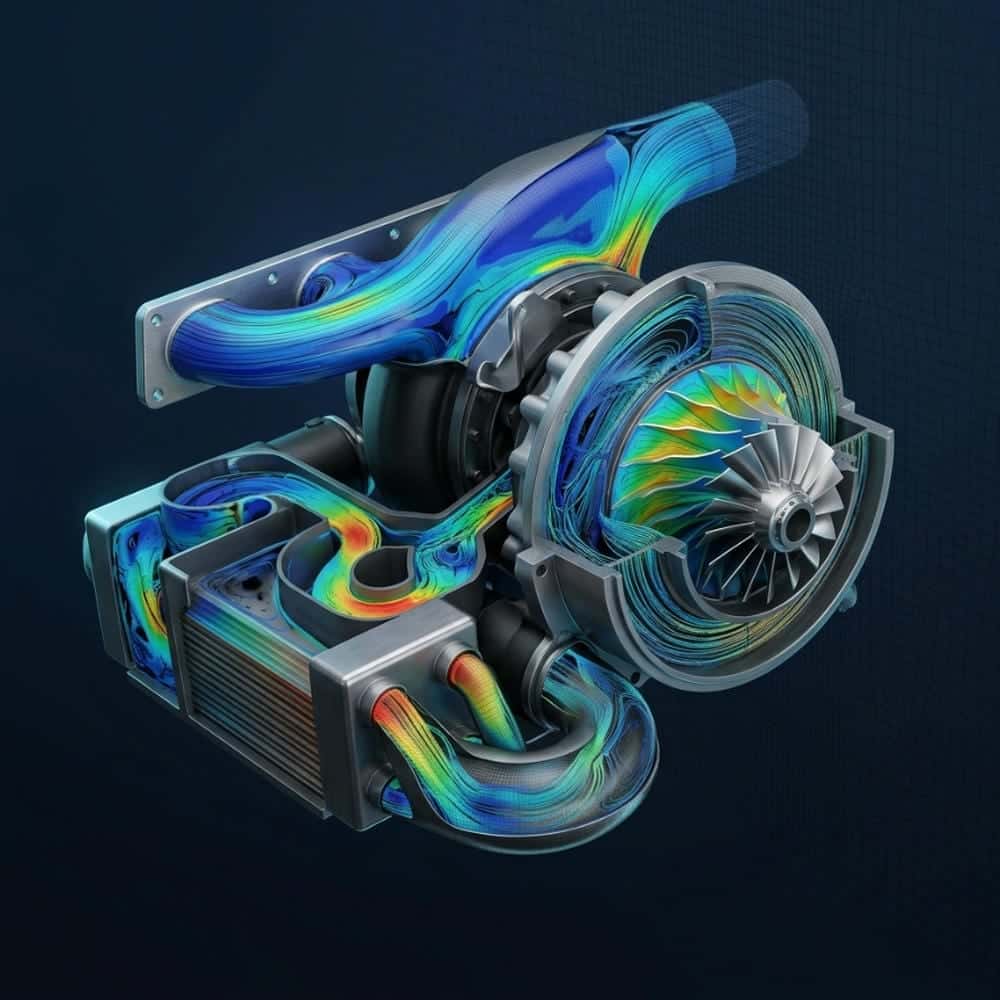
Premier CFD Consulting Services Using ANSYS Fluent
ANSYS Fluent simulations, validation, and defensible engineering reports across 30+ fields. Registered in 🇺🇸 USA (Delaware), 🇬🇧 UK & 🇴🇲 Oman
In practical terms, what is CFD analysis? It is a virtual wind tunnel, water channel, thermal chamber, or process test bench. It allows engineers to study velocity fields, pressure zones, temperature gradients, vortices, recirculation regions, flow separation, and heat transfer performance before producing a physical prototype.
A professional CFD simulation can answer questions such as:
- Where does the highest pressure drop occur?
- Is the cooling system sufficient for thermal management optimization?
- Does the design create unwanted flow separation?
- Is there a risk of cavitation in a pump or valve?
- How can geometry changes improve design optimization?
- Which boundary condition has the greatest effect on performance?
- Is a fine mesh necessary, or has a mesh independence study confirmed accuracy?
This is why computational fluid dynamics (CFD) is widely used in aerospace, automotive, energy, HVAC, biomedical, marine, chemical, and environmental engineering.
Stop Guessing. Start CFD Simulating NOW.
See how our engineers can validate your fluid dynamics design before you build a single physical prototype.
Why CFD Simulation Matters for Engineering ROI
The value of CFD simulation comes from its ability to reduce uncertainty early in the design cycle. Physical testing is still important, but it can be expensive, slow, and difficult to repeat across many design variations. With CFD modeling, engineers can rapidly test multiple operating conditions and geometry changes in a controlled digital environment.
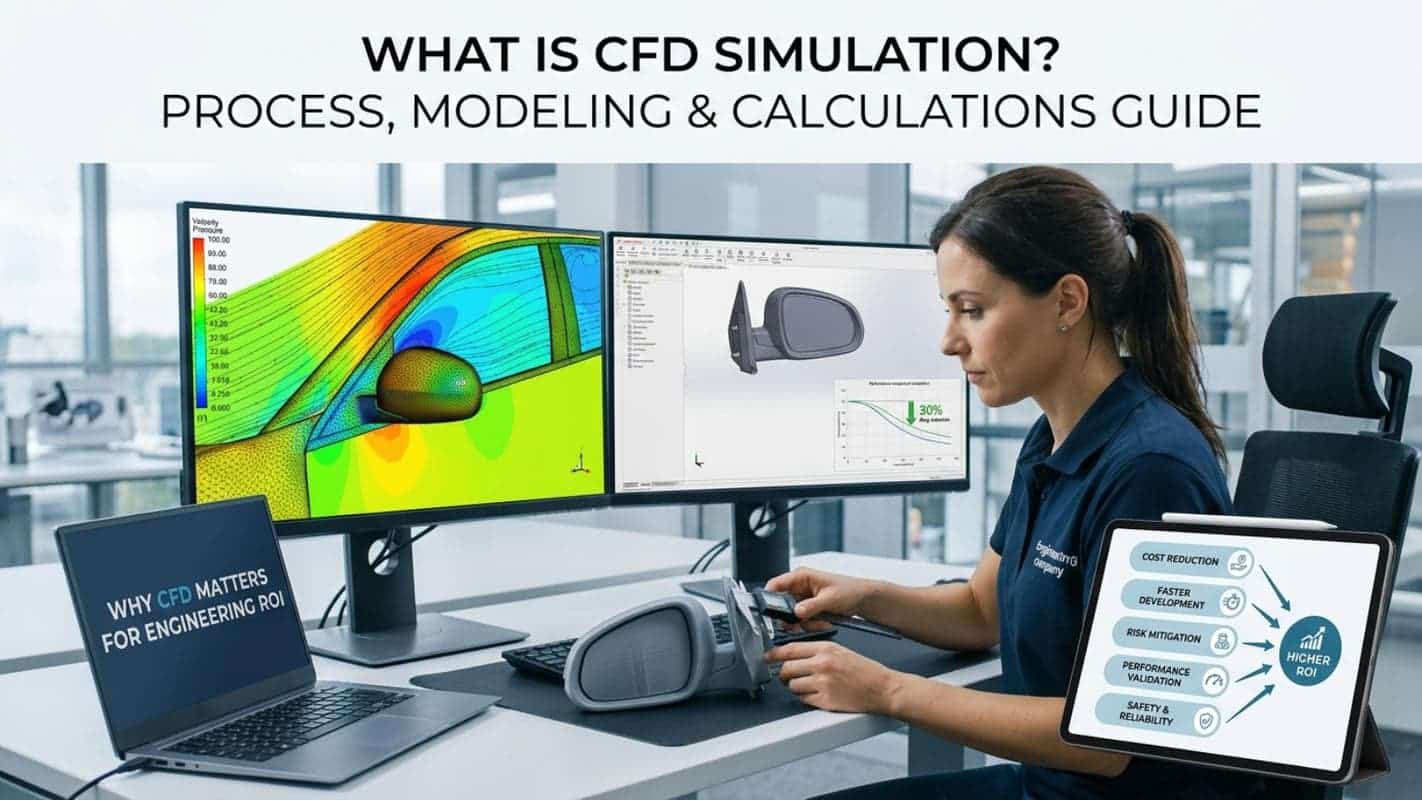
Key business benefits include:
- Prototype cost reduction
- Faster product development
- Lower risk of late-stage design failure
- Better performance validation
- Improved safety and reliability
- More efficient design optimization
- Reduced dependence on expensive physical test campaigns
For example, an automotive team can use CFD simulation for aerodynamic drag reduction before wind-tunnel testing. A pump manufacturer can predict cavitation risk before machining impellers. An electronics company can perform thermal management optimization before selecting fans, heat sinks, or enclosure geometry.
This makes CFD analysis especially valuable for B2B engineering teams that need reliable decisions, not just colorful flow images.
Core Principles of Computational Fluid Dynamics in Simple Terms
The foundation of computational fluid dynamics (CFD) is converting a real fluid-flow problem into a numerical model that a computer can solve. This involves dividing the physical space into many small cells, applying fluid mechanics equations to each cell, and calculating flow variables such as velocity, pressure, temperature, density, and turbulence quantities.
The main ideas behind CFD calculations include:
- Computational domain: The region where the fluid problem is solved.
- Mesh generation: Dividing the domain into cells or elements.
- Spatial discretization: Converting continuous equations into algebraic equations.
- Boundary conditions: Defining inlets, outlets, walls, symmetry planes, heat fluxes, pressures, and velocities.
- Solver setup: Choosing models, algorithms, convergence criteria, and numerical schemes.
- Post-processing: Visualizing results using contours, streamlines, vectors, graphs, and animations.
Most industrial CFD simulation tools solve the governing equations using methods such as the Finite Volume Method (FVM), Finite Element Method (FEM), or Finite Difference Method (FDM). In many commercial CFD solvers, especially ANSYS Fluent, the Finite Volume Method (FVM) is widely used because it conserves mass, momentum, and energy across each control volume.
How CFD Calculations are Performed
CFD calculations are performed by solving fluid-flow equations numerically across a mesh. The computer does not solve the entire physical domain as one continuous object. Instead, it breaks the domain into thousands, millions, or even billions of small cells and calculates the flow behavior inside each cell.
A typical CFD calculation includes the following stages:
- Geometry preparation
The physical model is created or imported from CAD software. - Computational domain definition
Engineers define the fluid region where the simulation will be performed. - Mesh generation
The domain is divided into cells. Mesh quality strongly affects accuracy. - Physics selection
The analyst selects laminar, turbulent, compressible, incompressible, steady, transient, single-phase, or multiphase flow models. - Boundary conditions
Inlets, outlets, walls, pressure zones, heat sources, and moving surfaces are defined. - Numerical solution
The solver performs iterative CFD calculations until residuals and monitored quantities converge. - Result validation
The solution is checked through convergence plots, engineering judgment, experimental comparison, or a mesh independence study.
In real engineering work, CFD calculations are not just about pressing “run.” Correct assumptions, proper boundary conditions, suitable turbulence models, and high-quality meshing are essential. Poor setup can produce visually impressive but physically incorrect results.
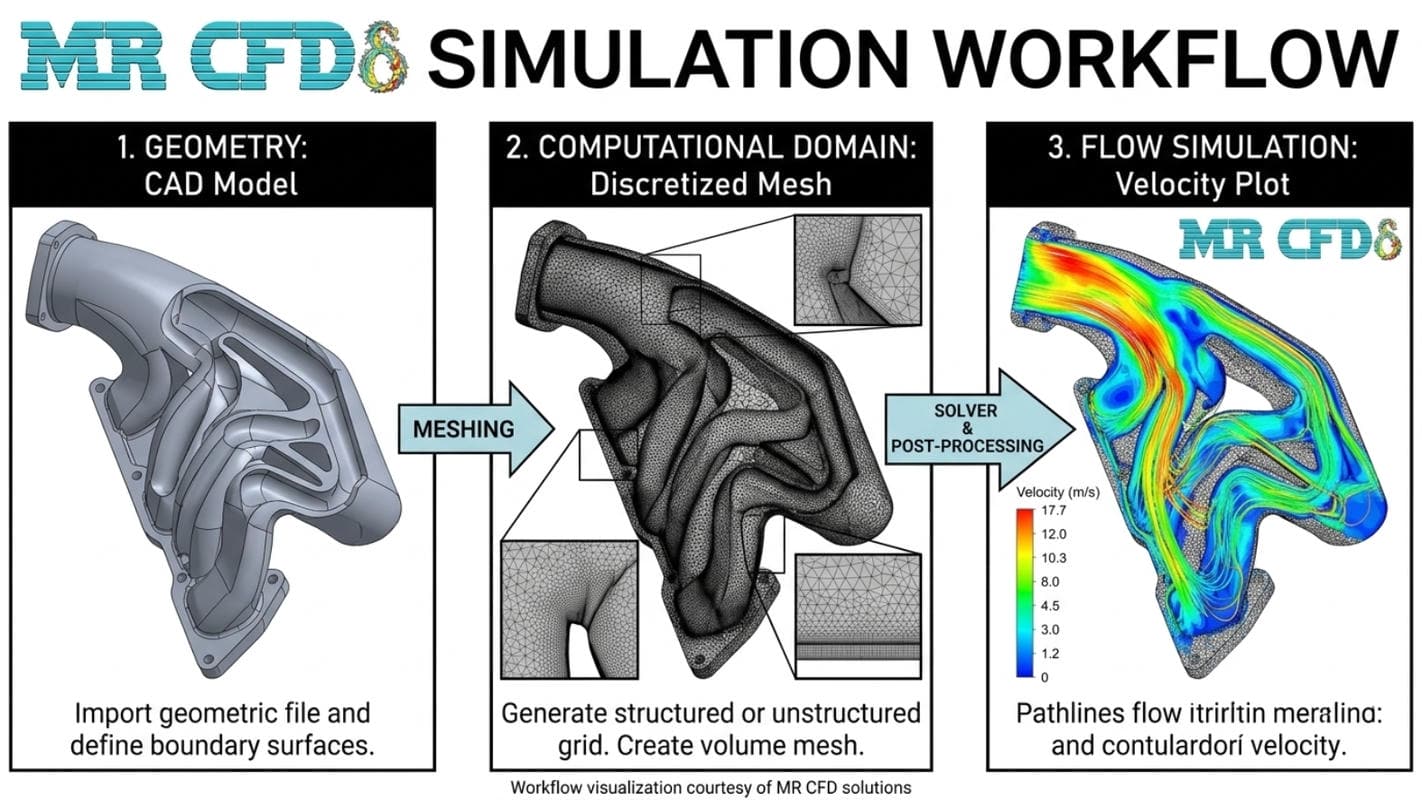
The CFD Process: Step-by-Step Engineering Workflow
The CFD process generally follows three major stages: pre-processing, solving, and post-processing. A professional simulation workflow is iterative, meaning engineers often refine the mesh, update boundary conditions, adjust solver settings, and repeat the analysis until reliable results are achieved.
1. Pre-Processing
Pre-processing is the first and most important stage of the CFD process. It includes everything required before the solver begins numerical calculations.
Key pre-processing tasks include:
- Creating or importing geometry
- Cleaning CAD files
- Defining the computational domain
- Generating the mesh
- Checking mesh quality
- Selecting physics models
- Defining fluid or solid materials
- Applying boundary conditions
- Choosing solver type
- Selecting turbulence, heat transfer, or multiphase flow models
At this stage, the analyst decides whether the model should include laminar flow, turbulence modeling, compressibility, radiation, combustion, rotating machinery, conjugate heat transfer, or phase interaction.
Poor pre-processing is one of the most common causes of inaccurate CFD simulation results.
2. Processing / Solving
The solving stage is where the software performs the actual CFD calculations. The solver applies numerical methods to the mesh and iteratively solves the governing equations.
This stage includes:
- Selecting the computing algorithm
- Choosing pressure-velocity coupling methods
- Defining spatial discretization schemes
- Setting relaxation factors
- Monitoring convergence
- Checking mass and energy imbalance
- Tracking engineering outputs such as lift, drag, heat transfer, or pressure drop calculation
For transient simulations, time-step sensitivity is also important. For turbulent flows, the analyst may choose models such as k-epsilon, k-omega SST, LES, or, in research-level cases, DNS.
3. Post-Processing
Post-processing converts numerical data into engineering insight. This is where the analyst visualizes and interprets the results.
Common post-processing outputs include:
- Velocity contours
- Pressure contours
- Temperature distributions
- Streamlines
- Vector plots
- Particle traces
- Wall shear stress maps
- Lift and drag graphs
- Heat transfer coefficients
- Pressure drop calculation reports
Post-processing should not be treated as decoration. It is the stage where engineers identify design weaknesses, confirm performance, and make decisions.
Recommended visual: Use MR CFD portfolio images such as velocity contours, particle traces, pressure maps, and thermal fields.
What is CFD Modeling?
CFD modeling is the process of creating a digital representation of a real fluid-flow problem. It includes geometry simplification, domain definition, meshing, physics model selection, solver setup, and result interpretation.
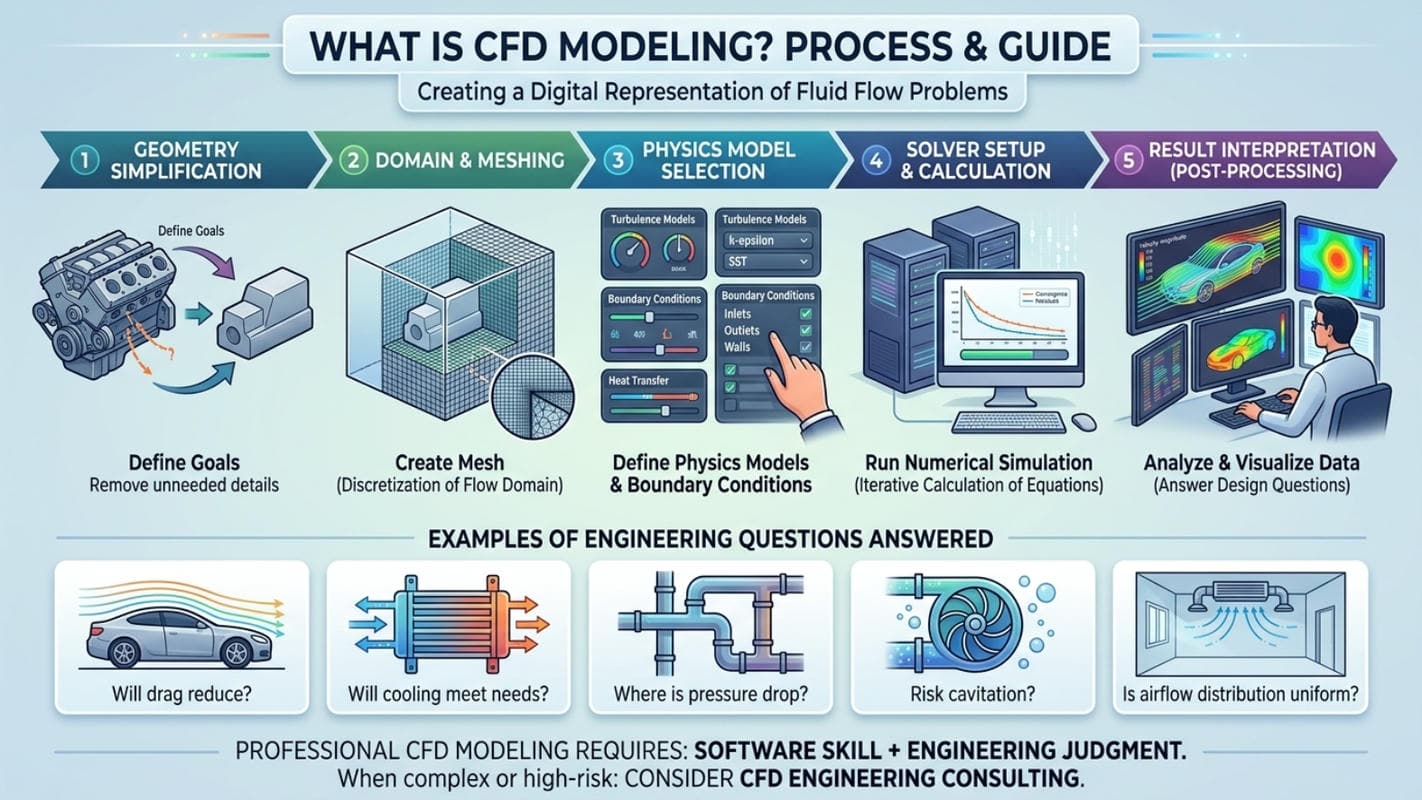
In engineering practice, CFD modeling is used to answer design questions such as:
- How will air flow around this vehicle?
- Will this heat exchanger meet cooling requirements?
- Where does the system experience excessive pressure drop?
- Does the pump design risk cavitation?
- Is the airflow distribution uniform?
- Will the new geometry reduce drag?
- Which design version provides better performance?
Professional CFD modeling requires both software skill and engineering judgment. The model must represent the real-world physics closely enough to support reliable decisions. This is why companies often use outsourced simulation services or CFD engineering consulting when the problem is complex, high-risk, or outside their internal expertise.
CFD Software Comparison: OpenFOAM vs ANSYS Fluent vs COMSOL
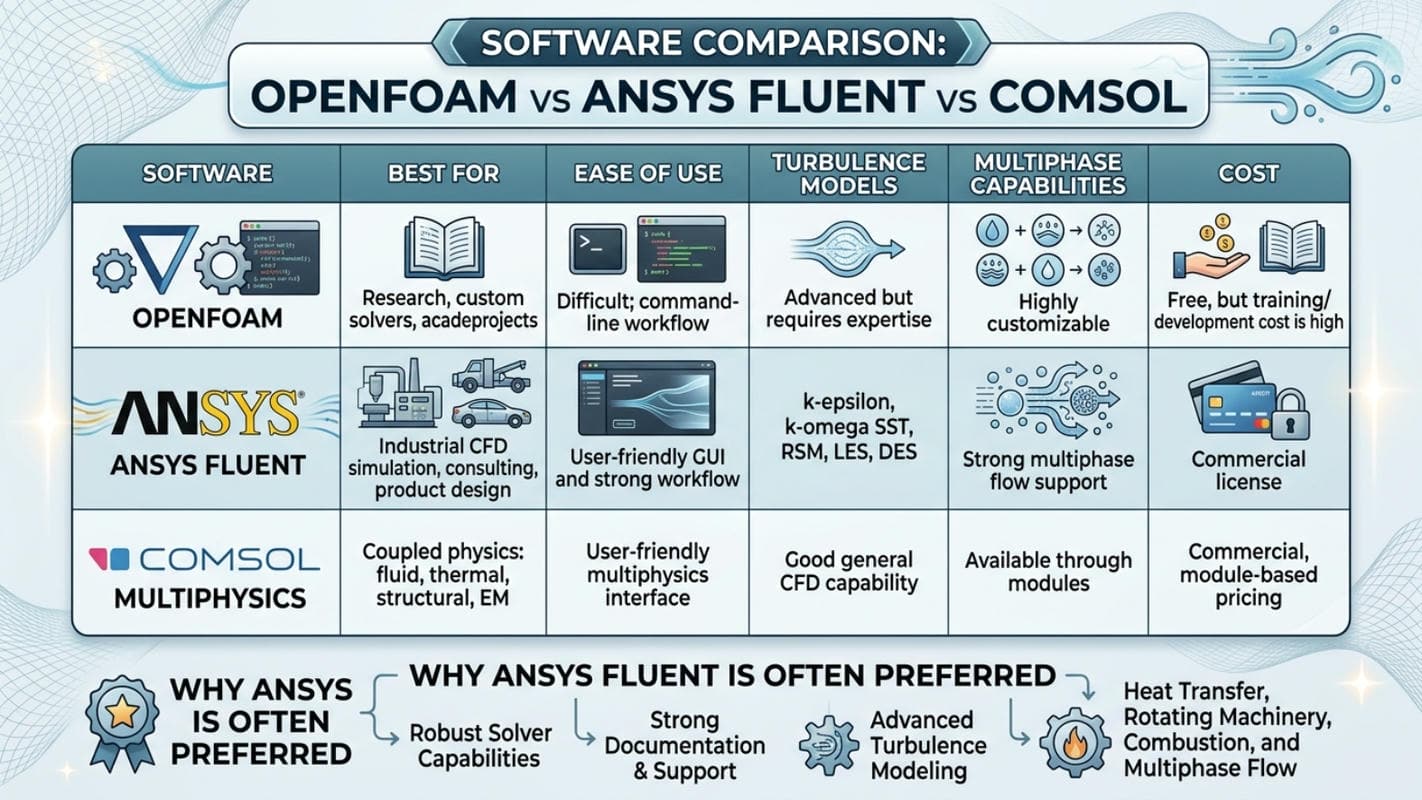
Choosing the right software is an important part of the CFD process. Different tools offer different strengths depending on budget, complexity, customization needs, and industry requirements.
| Software | Best For | Ease of Use | Turbulence Models | Multiphase Capabilities | Cost |
|---|---|---|---|---|---|
| OpenFOAM | Research, custom solvers, academic projects | Difficult; command-line workflow | Advanced but requires expertise | Highly customizable | Free, but training/development cost is high |
| ANSYS Fluent | Industrial CFD simulation, consulting, product design | User-friendly GUI and strong workflow | k-epsilon, k-omega SST, RSM, LES, DES | Strong multiphase flow support | Commercial license |
| COMSOL Multiphysics | Coupled physics: fluid, thermal, structural, EM | User-friendly multiphysics interface | Good general CFD capability | Available through modules | Commercial, module-based pricing |
ANSYS Fluent is often preferred for industrial CFD engineering consulting because it provides robust solver capabilities, strong documentation, advanced turbulence modeling, and reliable support for heat transfer, rotating machinery, combustion, and multiphase flow.
OpenFOAM is powerful for users who need code-level customization, but it requires strong knowledge of computational fluid dynamics, Linux workflows, and solver development.
COMSOL Multiphysics is valuable when fluid flow must be tightly coupled with other physics such as structural mechanics, electromagnetics, or chemical transport.
Need Help Setting Up Your Fluent Simulation?
Skip the learning curve. Our ANSYS experts can build your computational domain, mesh, and solver setup today.
View Our CFD Consulting Services
Navier-Stokes Equations in CFD: From Math to Engineering Results
The Navier-Stokes equations are the scientific foundation of computational fluid dynamics (CFD). They describe how fluids move by enforcing conservation of mass, momentum, and energy.
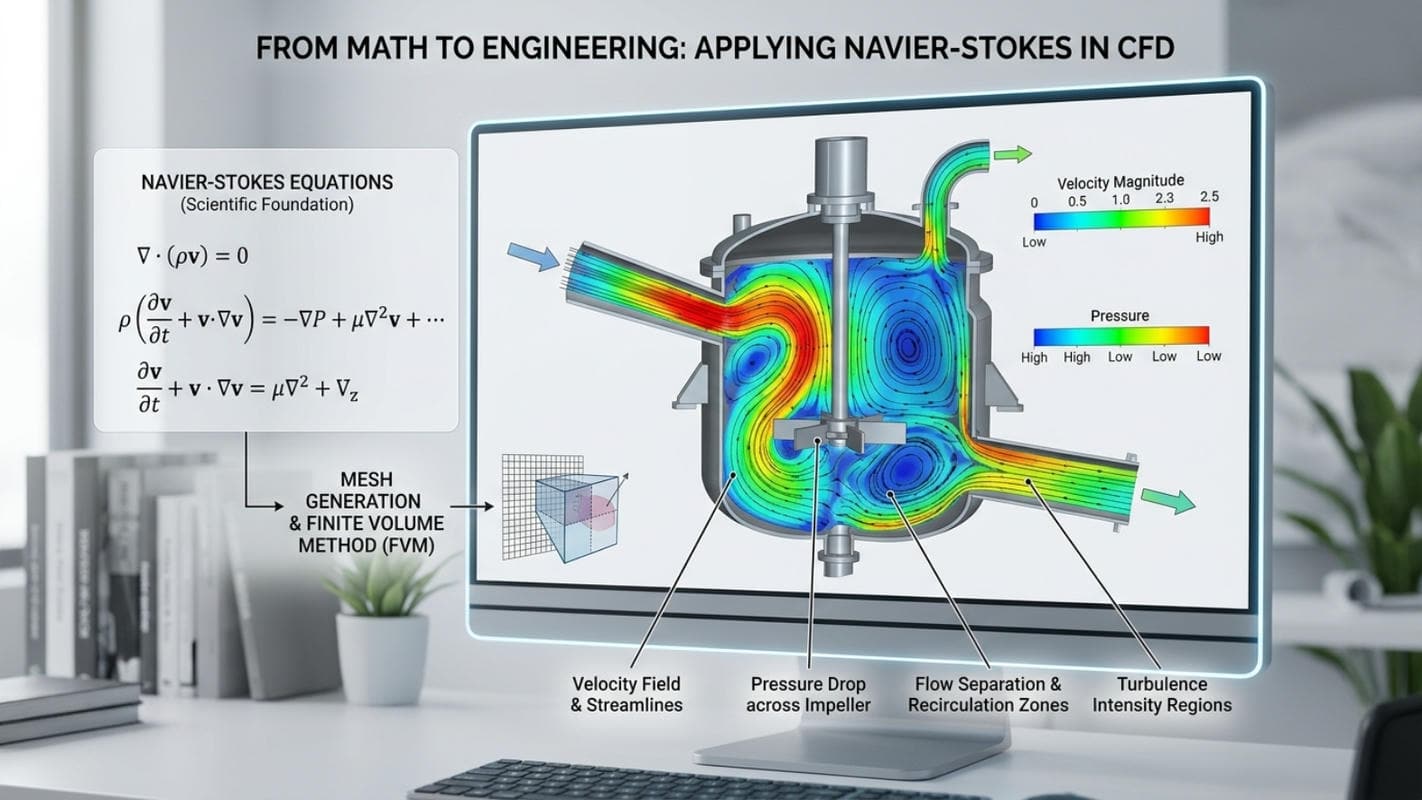
However, in applied CFD simulation, the objective is not simply to display equations. The real engineering value comes from solving these equations numerically for a practical system.
Modern CFD solvers use numerical methods such as the Finite Volume Method (FVM) to convert the Navier-Stokes equations into algebraic equations across the mesh. These equations are then solved iteratively to predict:
- Velocity
- Pressure
- Temperature
- Turbulence intensity
- Wall shear stress
- Flow separation
- Heat transfer
- Pressure drop
- Phase distribution in multiphase flow
For most industrial problems, the Navier-Stokes equations cannot be solved analytically because of nonlinear terms, complex geometry, turbulent behavior, and real-world boundary conditions. This is why CFD calculations rely on numerical approximation, mesh quality, suitable physics models, and validation.
Meshing: The Foundation of Accurate CFD Simulation
Mesh quality can make or break a CFD simulation. Meshing is the process of dividing the computational domain into smaller cells where the governing equations are solved.
The main mesh types include:
- Structured mesh
Regular grid-like structure; efficient but less flexible for complex geometry. - Unstructured mesh
Uses triangles, tetrahedra, or polyhedral cells; flexible for complex industrial models. - Hybrid mesh
Combines structured boundary-layer elements with unstructured core elements.
For accurate CFD modeling, engineers must refine the mesh in areas with high gradients, such as:
- Boundary layers
- Sharp corners
- Wake regions
- Shock waves
- Heat transfer surfaces
- Rotating zones
- Regions of flow separation
- Areas with high pressure drop
A mesh independence study is often required to confirm that the solution is not overly dependent on mesh size. In this process, engineers run the simulation with progressively finer meshes and check whether key results remain stable.
CFD Applications Across Industries
The value of CFD simulation is most visible in real engineering applications. It helps teams evaluate performance, reduce risk, and optimize designs across many industries.
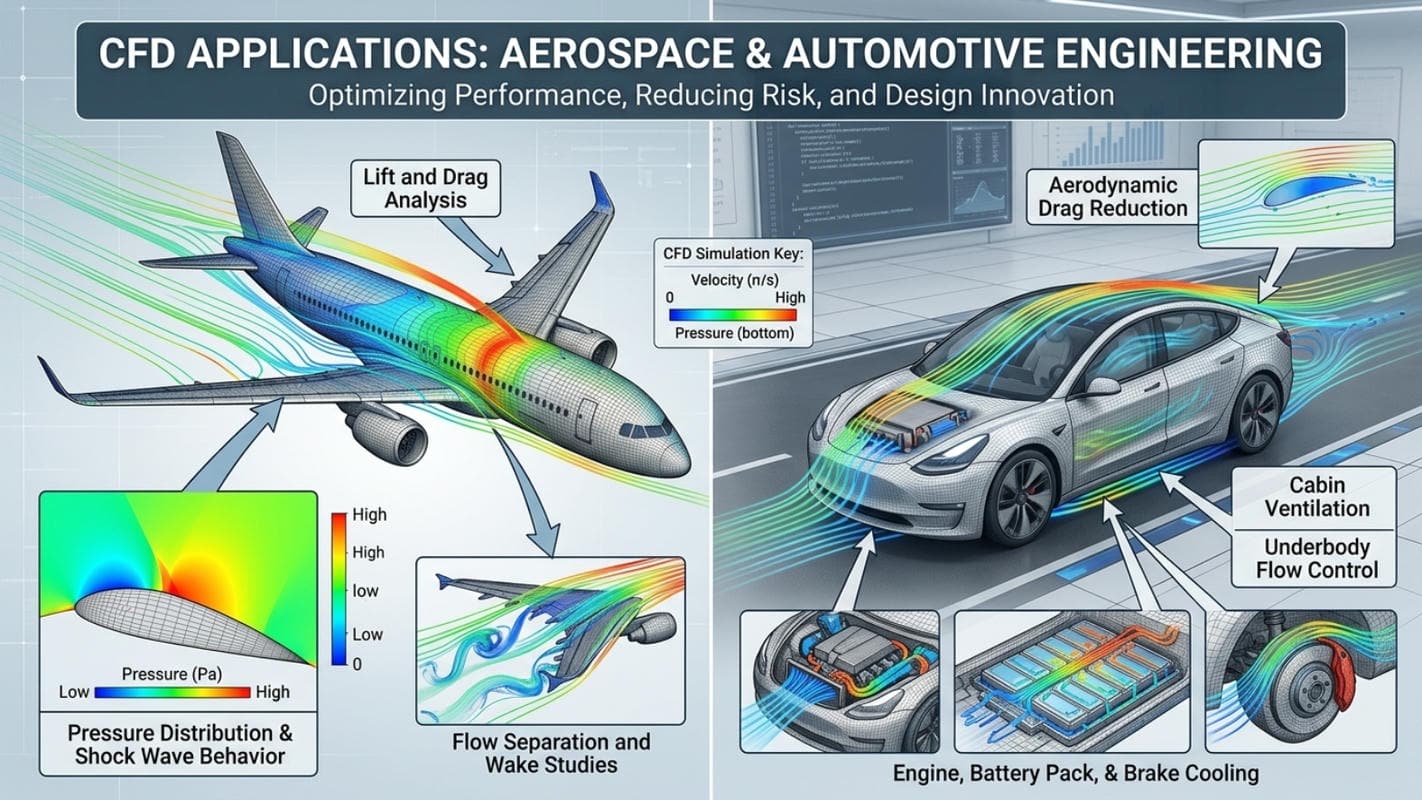
Aerospace and Automotive Engineering
In aerospace, CFD analysis is used to study airflow over wings, fuselages, turbine blades, drones, and propulsion systems. It helps predict lift, drag, pressure distribution, shock behavior, and flow separation.
In automotive engineering, CFD simulation supports:
- Aerodynamic drag reduction
- Engine cooling
- Cabin ventilation
- Battery pack cooling
- Brake cooling
- Exhaust system optimization
- Underbody flow control
A small improvement in aerodynamic efficiency can translate into major fuel savings or extended electric vehicle range.
Thermal and Energy Systems
Thermal management optimization is one of the strongest commercial use cases for CFD modeling. Engineers use CFD to analyze:
- Heat exchangers
- Electronics cooling
- Data center airflow
- Battery thermal systems
- Solar collectors
- Turbine cooling
- Industrial furnaces
- HVAC systems
By visualizing temperature gradients and airflow distribution, engineers can detect hot spots, improve cooling paths, and reduce energy consumption.
Pumps, Valves, and Multiphase Systems
For pumps, valves, compressors, and pipelines, CFD simulation helps with:
- Pressure drop calculation
- Mitigating cavitation
- Predicting recirculation
- Evaluating valve coefficients
- Studying slurry transport
- Modeling gas-liquid or liquid-solid multiphase flow
- Optimizing impeller and blade geometry
These simulations are especially important when physical testing is difficult, expensive, or unsafe.
Biomedical and Environmental Engineering
In biomedical engineering, CFD modeling is used to study blood flow, respiratory airflow, stents, heart valves, and medical devices.
In environmental engineering, CFD supports:
- Pollutant dispersion
- Urban wind flow
- Natural ventilation
- River flood modeling
- Smoke spread
- Air quality analysis
These examples show how computational fluid dynamics extends far beyond textbook equations and directly supports safety, sustainability, and engineering innovation.
Ready to Optimize Your Next Engineering Project?
Speak directly with a senior CFD engineer about your specific flow, thermal, or multiphase flow challenges.
CFD Engineering Services: When to Outsource Simulation
Many companies have talented engineers but lack dedicated CFD specialists, software licenses, HPC resources, or validation experience. In these cases, outsourced simulation services can be more cost-effective than building a full internal CFD department.
Professional CFD engineering services are useful when:
- The flow physics are complex
- The geometry requires advanced meshing
- The project involves multiphase flow
- The simulation requires LES or advanced turbulence modeling
- Experimental testing is expensive
- A design decision must be validated quickly
- The company needs an independent design optimization audit
- Internal teams need support with ANSYS Fluent
At MR CFD, our CFD engineering consulting process can include geometry preparation, meshing, solver setup, model selection, convergence monitoring, post-processing, validation, and technical reporting.
CFD Analysis Cost and ROI

The cost of CFD analysis depends on several factors:
- Geometry complexity
- Mesh size
- Required accuracy
- Physics models
- Steady vs transient simulation
- Single-phase vs multiphase flow
- Heat transfer or radiation requirements
- Turbulence model selection
- Number of design iterations
- Validation requirements
- Computing resources
A simple internal flow simulation may require relatively limited setup and computing time. A transient rotating machinery simulation with cavitation, heat transfer, and multiphase flow may require far more expertise and computational power.
The ROI of CFD simulation usually comes from:
- Avoiding failed prototypes
- Reducing physical testing cycles
- Improving product efficiency
- Preventing overheating or pressure losses
- Shortening design timelines
- Supporting confident engineering decisions
For many B2B projects, the cost of one failed prototype or delayed launch can exceed the cost of a professional CFD simulation study.
Validation and Verification: Ensuring Reliable CFD Results
A converged simulation is not automatically a correct simulation. Reliable CFD analysis requires verification and validation.
Verification asks: Are we solving the equations correctly?
Common verification methods include:
- Residual monitoring
- Mass and energy balance checks
- Mesh independence study
- Time-step sensitivity analysis
- Comparison with benchmark cases
Validation asks: Are we solving the right physical problem?
Common validation methods include:
- Experimental comparison
- Field data comparison
- Analytical solution comparison
- Checking dimensionless numbers such as Reynolds and Mach number
- Comparing different turbulence models
Professional performance validation is essential for high-stakes engineering decisions. Without validation, CFD simulation can become a visual presentation rather than a reliable design tool.
Learning CFD: Courses, Skills, and Career Paths
To master computational fluid dynamics (CFD) (ANSYS Fluent Learning path), engineers need a combination of fluid mechanics, numerical methods, software training, and practical project experience.
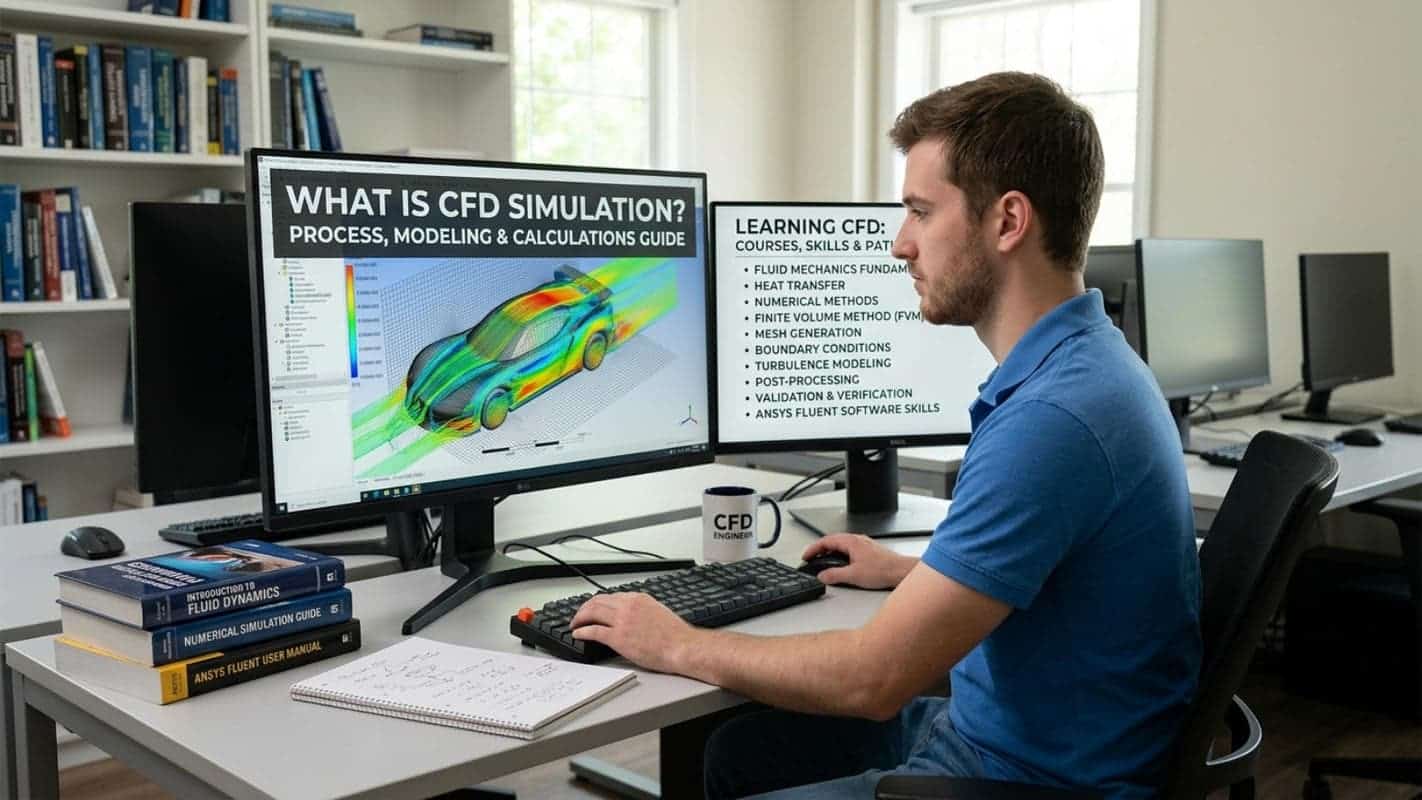
Important skills include (You can join our Zero to Expert CFD with Ansys fluent):
- Fluid mechanics fundamentals
- Heat transfer
- Numerical methods
- Finite Volume Method (FVM)
- Mesh generation
- Boundary conditions
- Turbulence modeling
- Post-processing
- Validation and verification
- Software tools such as ANSYS Fluent
Career paths in CFD include:
- CFD Engineer
- Thermal analyst
- Aerodynamics engineer
- Multiphase flow specialist
- Research scientist
- Simulation consultant
- CFD software developer
A structured ANSYS Fluent course or professional CFD course can help engineers move from basic theory to real simulation capability.
The Future of CFD Simulation
The future of CFD simulation is being shaped by automation, cloud computing, artificial intelligence, and high-performance computing.
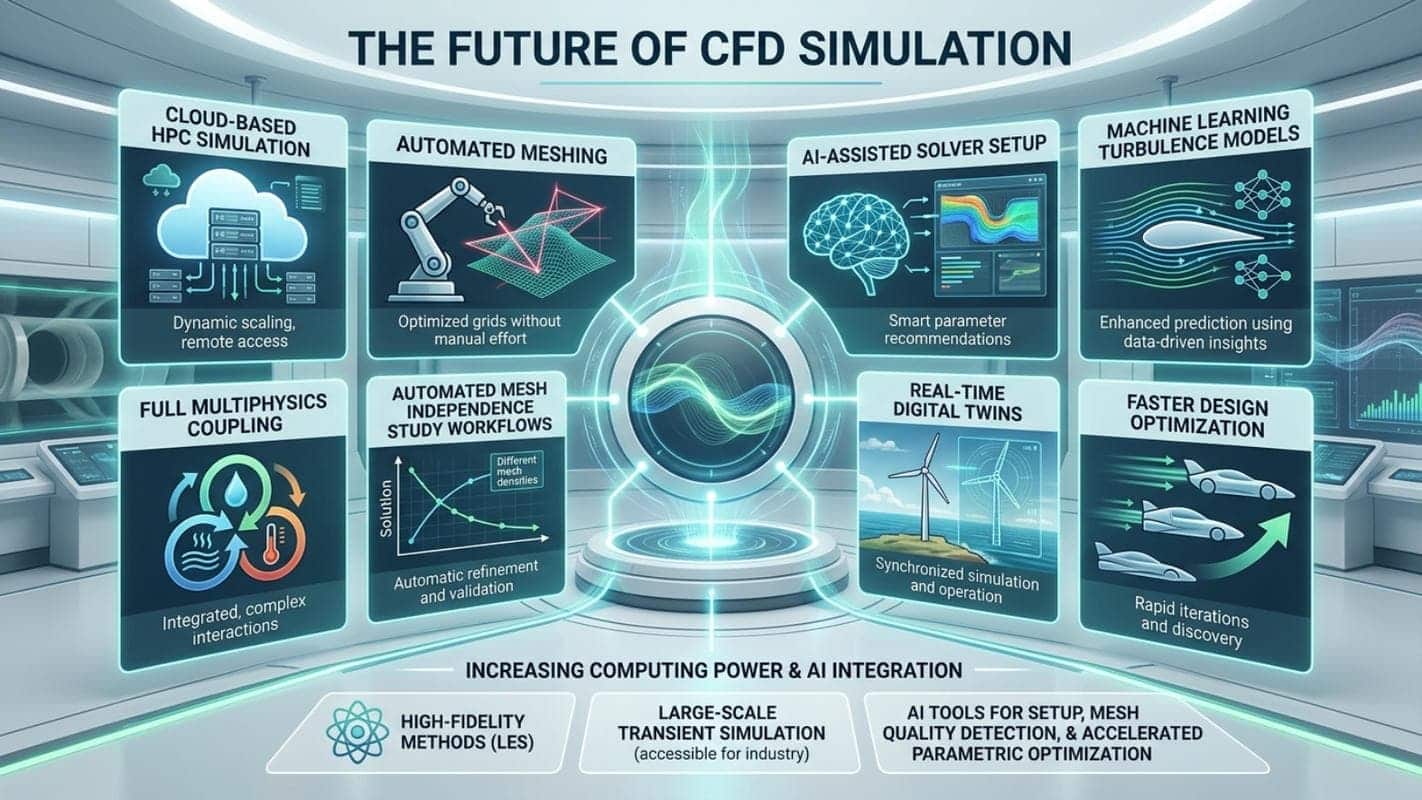
Important trends include:
- Cloud-based HPC simulation
- Automated meshing
- AI-assisted solver setup
- Machine learning turbulence models
- Faster design optimization
- Real-time digital twins
- Automated mesh independence study workflows
- Full multiphysics coupling
As computing power increases, high-fidelity methods such as LES and large-scale transient simulation will become more accessible for industrial applications. At the same time, AI tools may help reduce setup time, detect poor mesh quality, and accelerate parametric optimization.
Conclusion: From CFD Theory to Better Engineering Decisions
CFD simulation is no longer just a research tool or academic concept. It is a practical engineering method for reducing prototype costs, improving performance, validating designs, and solving complex flow and thermal problems.
By understanding the CFD process, performing accurate CFD calculations, applying proper boundary conditions, selecting suitable turbulence modeling, and validating results through a mesh independence study, engineering teams can make faster and more confident decisions.
Whether your challenge involves aerodynamic drag reduction, thermal management optimization, pressure drop calculation, flow separation, cavitation, or multiphase flow, computational fluid dynamics modeling can help turn uncertainty into engineering insight.
Ready to Optimize Your Next Engineering Project?
Speak directly with a senior CFD engineer about your specific flow, thermal, or multiphase flow challenges.
FAQ: Computational Fluid Dynamics and CFD Simulation
What is CFD simulation?
CFD simulation is the use of numerical methods and computer software to predict fluid flow, heat transfer, pressure, turbulence, and related physical behavior inside or around a system.
What is CFD modeling?
CFD modeling is the process of creating a digital representation of a fluid-flow problem, including geometry, mesh, computational domain, physics models, boundary conditions, and solver settings.
How are CFD calculations performed?
CFD calculations are performed by dividing the domain into a mesh and solving conservation equations for mass, momentum, and energy using numerical methods such as the Finite Volume Method (FVM).
What is the CFD process?
The CFD process includes pre-processing, solving, post-processing, and validation. It starts with geometry and meshing, continues with solver setup and numerical calculation, and ends with result analysis and verification.
Which CFD software is best?
The best software depends on the project. ANSYS Fluent is strong for industrial CFD simulation, OpenFOAM is powerful for custom research, and COMSOL is useful for coupled multiphysics problems.
Why is mesh quality important in CFD?
Mesh quality affects numerical accuracy and convergence. A poor mesh can create inaccurate results, while a proper mesh independence study helps confirm that the solution is reliable.
When should a company use CFD engineering consulting?
A company should consider CFD engineering consulting when the simulation involves complex geometry, advanced physics, multiphase flow, turbulence modeling, high risk, or the need for independent performance validation.
Related Posts
Operating Pressure in ANSYS Fluent: Gauge, Absolute & Stagnation Pressure Explained
Operating pressure in ANSYS Fluent is the reference pressure (default 101325 Pa) to which all…
What is Conjugate Heat Transfer Simulation? Complete CHT Guide
Conjugate Heat Transfer (CHT) simulation is a CFD method that solves fluid flow and solid…

CFD Project Outsourcing: What Files, Reports, and Results Should You Expect?
When engineering teams decide to outsource CFD simulation, the conversation almost always starts with capability and…
 Talk On WhatsApp
Comments (0)