
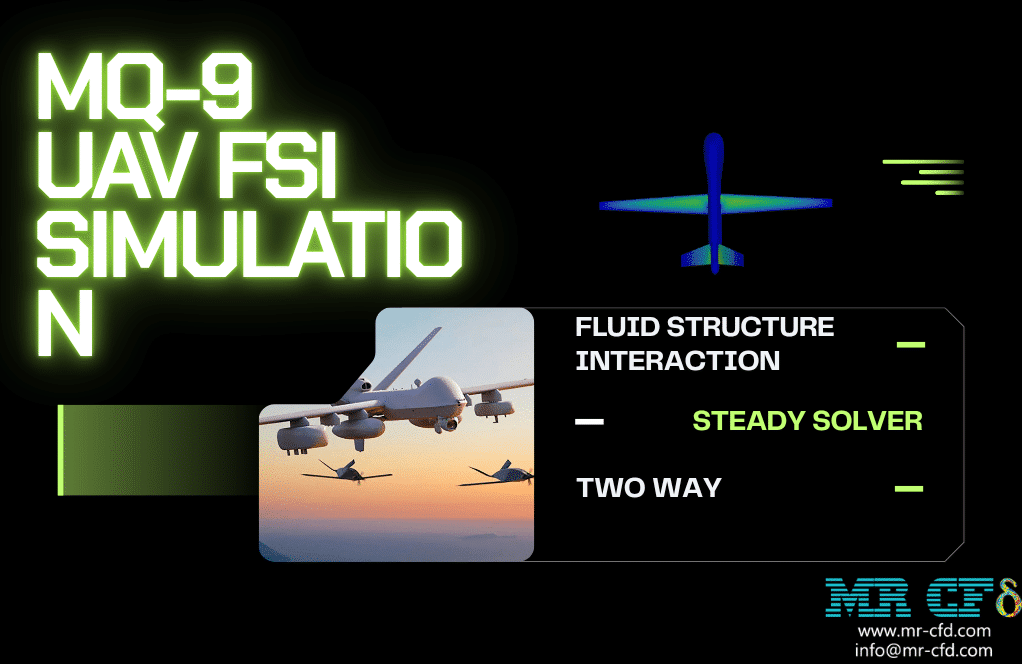
MQ-9 UAV: CFD Simulation Training Package
$3,499.00 Internship
- Aerodynamic data quality determines the ceiling for every other analysis if the force and moment baseline carries errors, stability predictions, structural loads, and acoustic estimates all inherit them.
- Stability derivative analysis quantifies the vehicle’s reaction to atmospheric disturbances and control inputs at every point in its operating envelope, giving autopilot and control engineers the coefficients they actually design against.
- Acoustic modeling traces how noise propagates, reflects, and weakens across the surrounding space, providing the directional insight needed to shape quieter airframe geometries from the concept phase onward.
- FSI couples the aerodynamic and structural solvers into one iterative loop, surfacing deformation patterns and resonance threats that neither discipline can detect when solved independently.
To Order Your Project or benefit from a CFD consultation, contact our experts via email (info@mr-cfd.com), online support tab, or WhatsApp at +44 7443 197273.
There are some Free Products to check our service quality.
If you want the training video in another language instead of English, ask it via info@mr-cfd.com after you buy the product.
Description
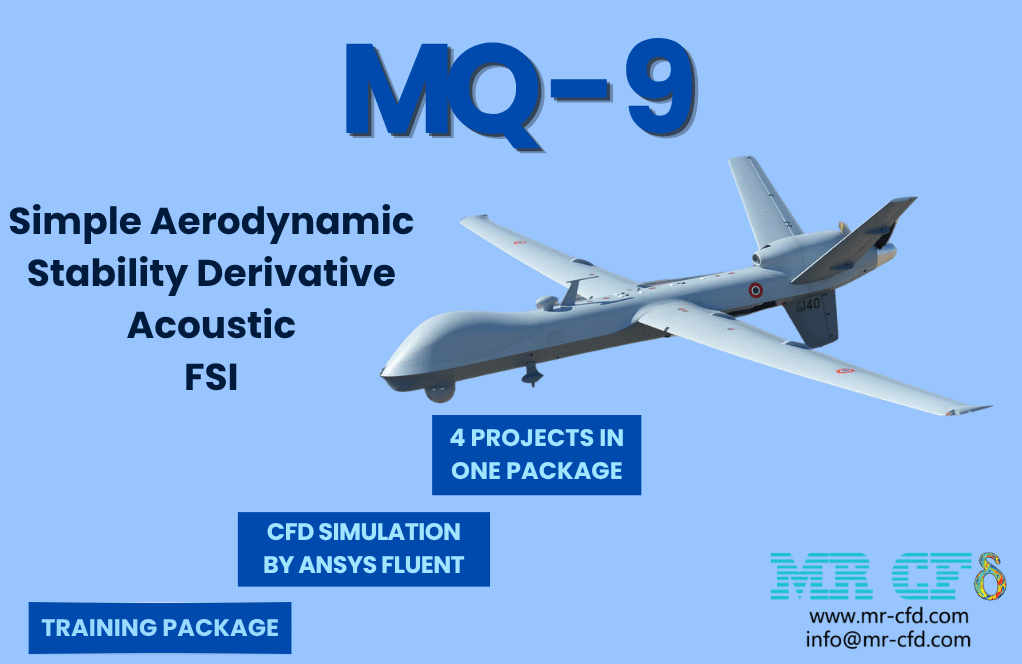
MQ-9 CFD Simulation: 4 Projects In One Package
Comprehensive Aerodynamic Simulation Training for High-Endurance UAV Platforms
Large-scale surveillance and strike platforms like the MQ-9 fly long missions across diverse atmospheric conditions where aerodynamic efficiency, structural durability, and acoustic awareness directly shape operational effectiveness. This package assembles four self-contained ANSYS Fluent projects into a structured learning path spanning aerodynamic data generation, stability derivative calculation, noise field characterization, and fully coupled aeroelastic investigation.
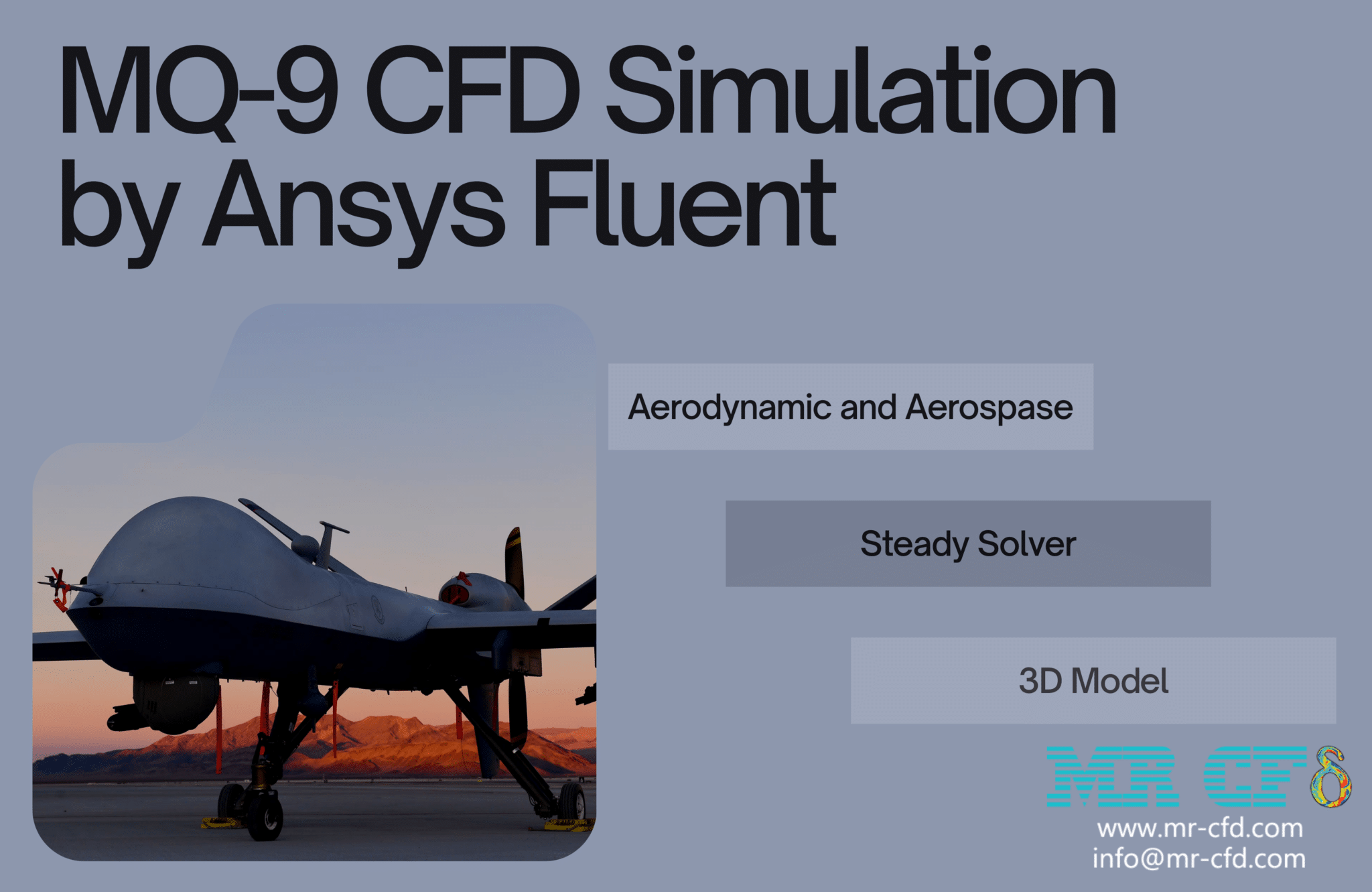
Aerodynamic Data Generation and Performance Mapping for MQ-9
Every load envelope, every control surface schedule, and every acoustic source estimate depends on the fidelity of the aerodynamic baseline. This first project walks you through importing the full MQ-9 geometry into ANSYS Fluent, configuring the computational domain, and executing a disciplined sweep of angle-of-attack and sideslip conditions to build complete lift, drag, and moment polars. You will set freestream velocity boundaries, pressure-regulated outlets, and viscous wall treatments calibrated for robust convergence. The aerodynamic database you assemble here anchors every analysis that follows in the package.
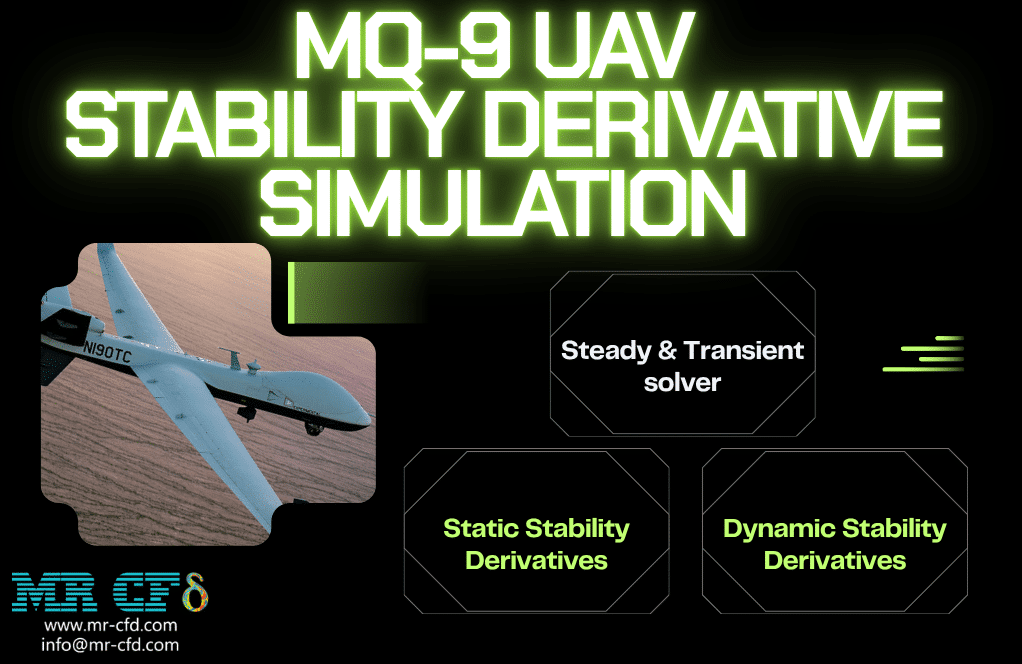
Stability Derivative Calculation for MQ-9 and Autopilot Design
A platform tasked with hours-long loiter and precision tracking cannot afford ambiguous handling qualities. This project has you apply controlled perturbations small deviations in pitch angle, sideslip, and angular rate around the trimmed condition and record how forces and moments shift in response. The results fill a derivative matrix covering short-period, phugoid, Dutch-roll, and spiral modes. Mesh refinement targets the wake region downstream of the wing trailing edge and the junction zones where control surfaces meet the main airframe, ensuring derivative values survive grid-independence checks. The completed matrix integrates seamlessly with six-DOF flight models and gain-scheduling frameworks.
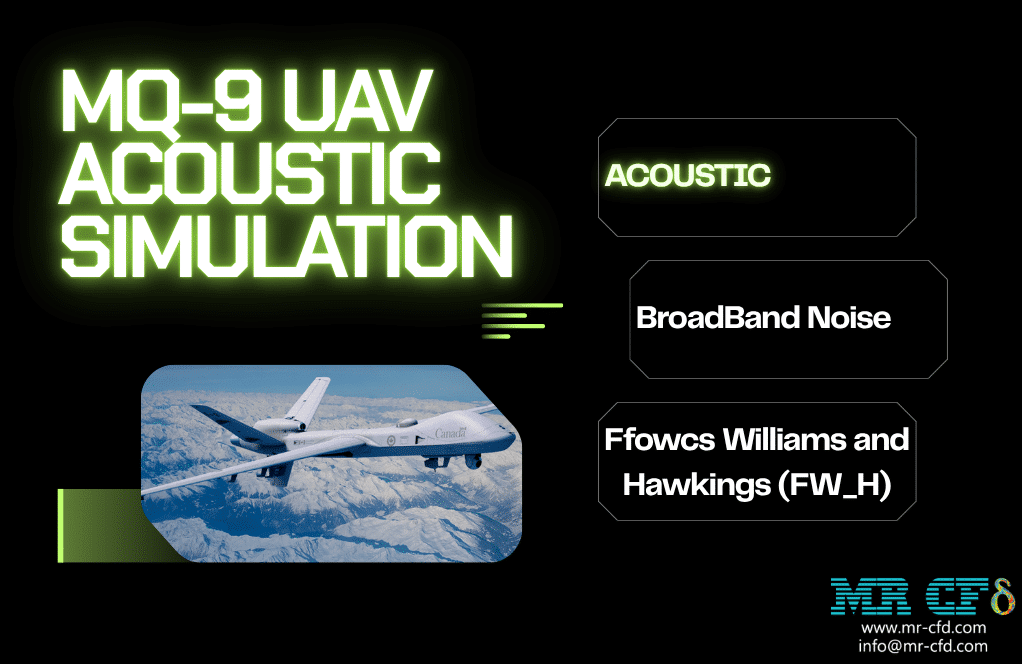
Noise Field Characterization for MQ-9
Whether the priority is reducing detectability during low-altitude passes or meeting noise regulations at a shared operating base, a detailed acoustic picture is essential. This project guides you through ANSYS Fluent’s unsteady acoustic workflow: you will capture transient pressure fluctuations on aerodynamic surfaces and fuselage panels, apply integral propagation methods to calculate far-field sound pressure levels, and separate the spectral content by flight segment climb, cruise, loiter, and descent. The output is a spatially resolved noise map that supports trade-offs on airframe shaping, cruise speed, and mission altitude while respecting the aerodynamic performance verified in the opening project.
Fully Coupled Aeroelastic Investigation and Structural Validation for MQ-9
High-aspect-ratio wings designed for fuel efficiency flex significantly under flight loads behavior that a rigid-geometry CFD model will never capture. This project implements a two-way FSI coupling in ANSYS Fluent: aerodynamic surface pressures deform the wing and empennage structure, and the deformed shape is passed back to the flow domain for an updated aerodynamic calculation. The exchange continues until forces and displacements converge to a stable equilibrium. You will map spanwise bending and twist at representative airspeeds, monitor natural-frequency migration against known excitation sources, and quantify the drag and trim penalty that elastic deformation imposes. The result is a digital structural clearance that can eliminate months of iterative prototype testing.
You must be logged in to post a review.
Related products
-
Sale

Heat Transfer CFD Training Package for Advanced Users, 10 Practical Exercises
Original price was: $2,140.00.$699.00Current price is: $699.00. Internship -
Sale
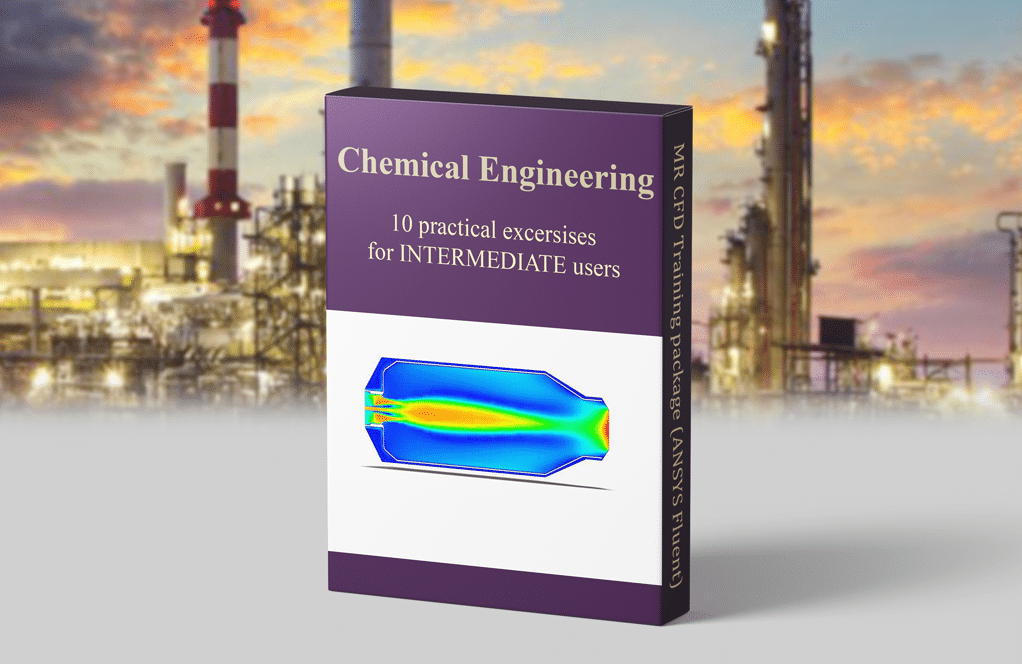
Chemical Engineering Training Package, Intermediates, 10 Practical Exercises
Original price was: $1,300.00.$299.00Current price is: $299.00. Internship -
Sale
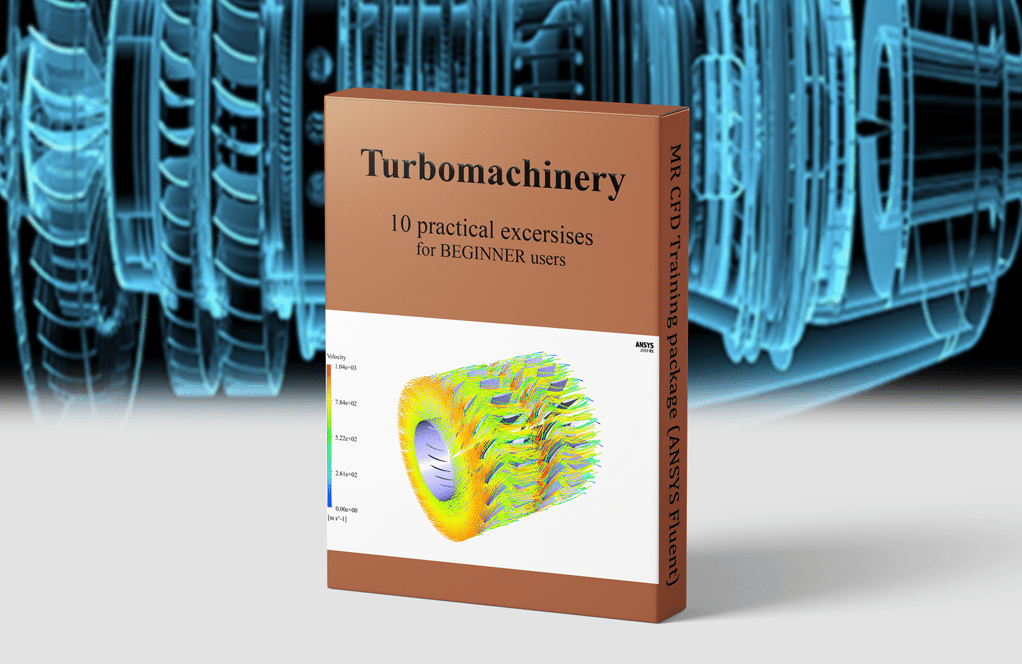
Turbomachinery CFD Training Package for Beginners, 10 Learning Products
Original price was: $1,200.00.$299.00Current price is: $299.00. Internship

 Talk On WhatsApp
Reviews
There are no reviews yet.