
RQ-4 UAV: CFD Simulation Training Package
$3,999.00 Internship
- Without trustworthy aerodynamic force and moment data, stability margins become unreliable, structural load cases lose their anchor, and acoustic source models start from a flawed flow field aerodynamics is the foundation everything else depends on.
- Stability derivatives translate complex flow interactions into a concise set of numbers that describe how the vehicle pitches, rolls, and yaws in response to gusts, maneuvers, and trim changes throughout its speed and altitude range.
- Acoustic analysis goes beyond measuring overall noise levels it reveals the spatial and spectral distribution of sound around the airframe, enabling targeted geometry modifications that reduce the acoustic signature where it matters most.
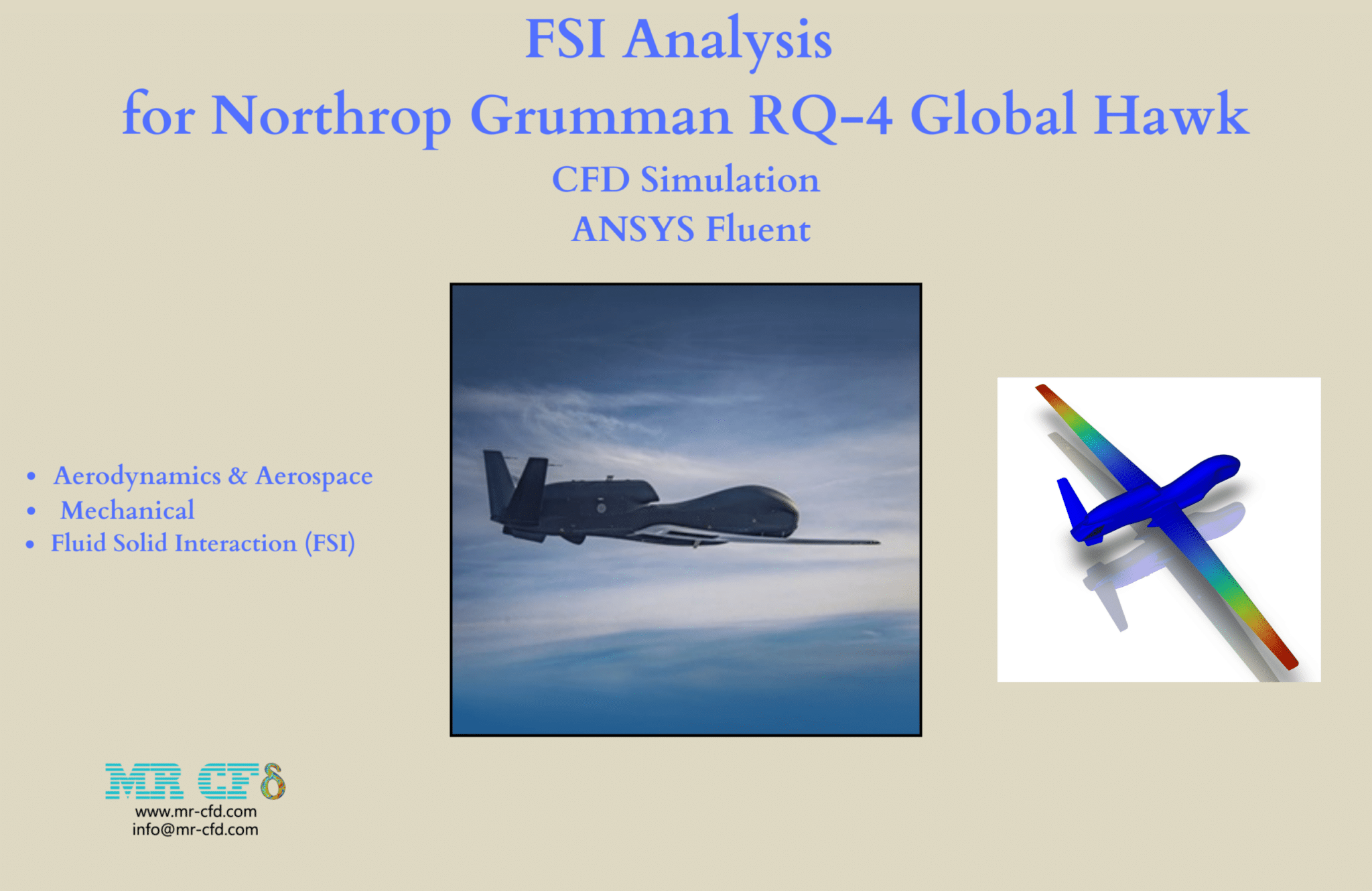
- FSI links flow-induced loading and material response in a continuous feedback cycle, exposing flex-driven load redistribution and modal frequency shifts that standalone aerodynamic or structural analyses would never reveal.
To Order Your Project or benefit from a CFD consultation, contact our experts via email (info@mr-cfd.com), online support tab, or WhatsApp at +44 7443 197273.
There are some Free Products to check our service quality.
If you want the training video in another language instead of English, ask it via info@mr-cfd.com after you buy the product.
Description
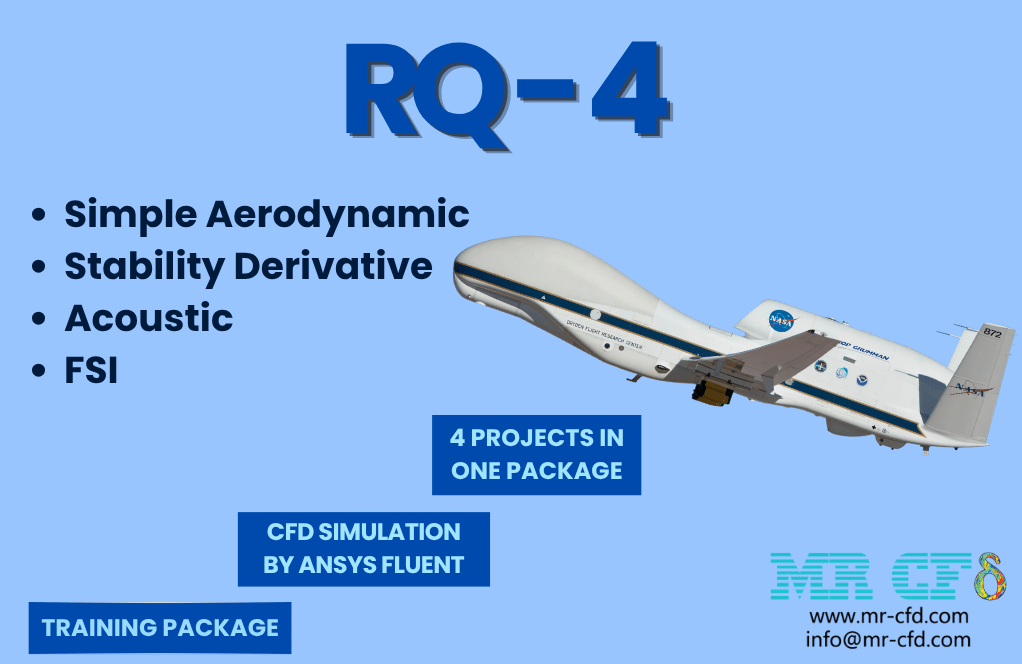
RQ-4 CFD Simulation: 4 Projects In One Package
Four Disciplines, One Workflow Simulation Training Built Around a Strategic Reconnaissance UAV
High-altitude long-endurance platforms such as the RQ-4 operate at the edge of the flight envelope for hours at a time, demanding aerodynamic models that hold up across thin-atmosphere cruise, structural analyses that account for sustained loading, and acoustic predictions relevant to takeoff and recovery environments. This package delivers four discrete ANSYS Fluent projects that collectively cover force extraction, dynamic stability assessment, acoustic signature evaluation, and bidirectional fluid-structure coupling.
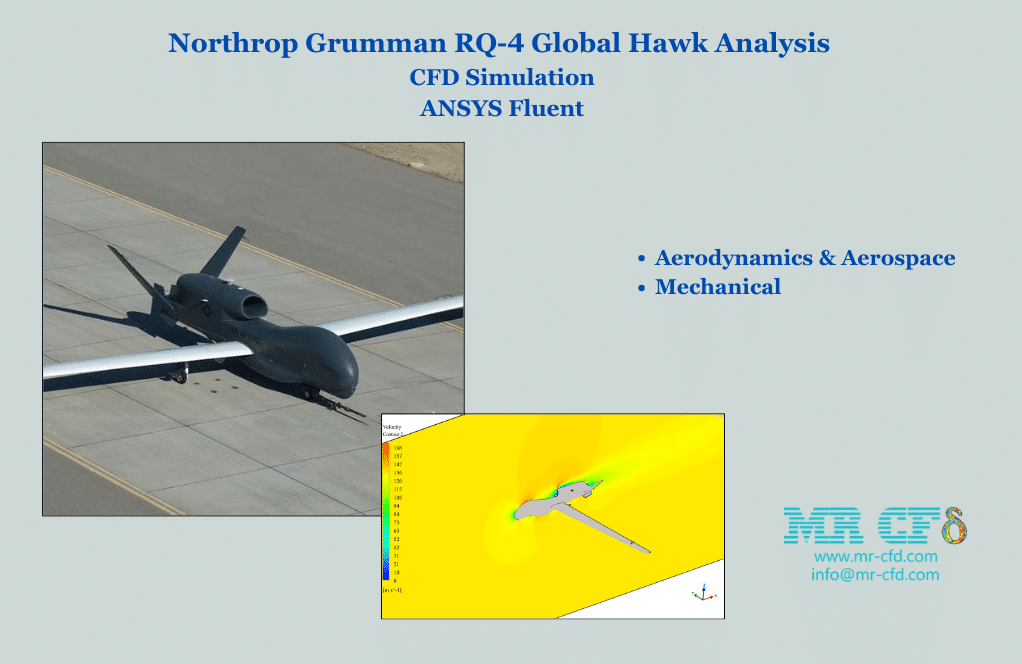
RQ-4 Aerodynamic Analysis and CFD Simulation in ANSYS Fluent
At altitudes where air density drops to a fraction of sea-level values, small errors in lift and drag prediction translate into significant range and endurance miscalculations. This project begins with full airframe preparation in ANSYS Fluent, proceeds through boundary condition setup freestream velocity specification, pressure-based exit planes, and no-slip surface definitions and culminates in a systematic angle-of-attack and sideslip campaign that populates a complete aerodynamic coefficient table. The dataset you produce serves as the single authoritative reference for all stability, acoustic, and structural work downstream.
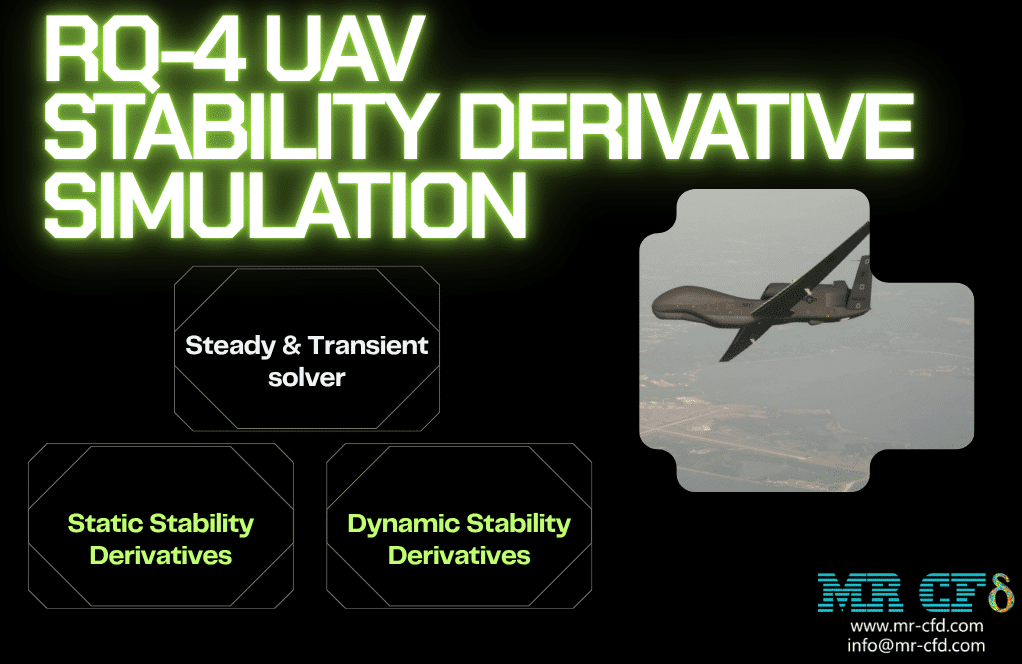
RQ-4 Dynamic Stability Derivatives, ANSYS Fluent CFD Simulation
Holding a precise surveillance orbit for twelve or more hours requires an autopilot tuned against accurate stability derivatives approximations simply will not hold over that duration. In this project you will systematically perturb the converged trim solution in pitch, roll, and yaw, extract the incremental moment responses, and organize the data into a comprehensive derivative set addressing longitudinal and lateral-directional dynamics. Grid density is increased in the wake of the high-aspect-ratio wing and around the V-tail junction to prevent numerical diffusion from contaminating the derivative magnitudes. The finished dataset feeds directly into linear analysis tools, hardware-in-the-loop test benches, and certification documentation.
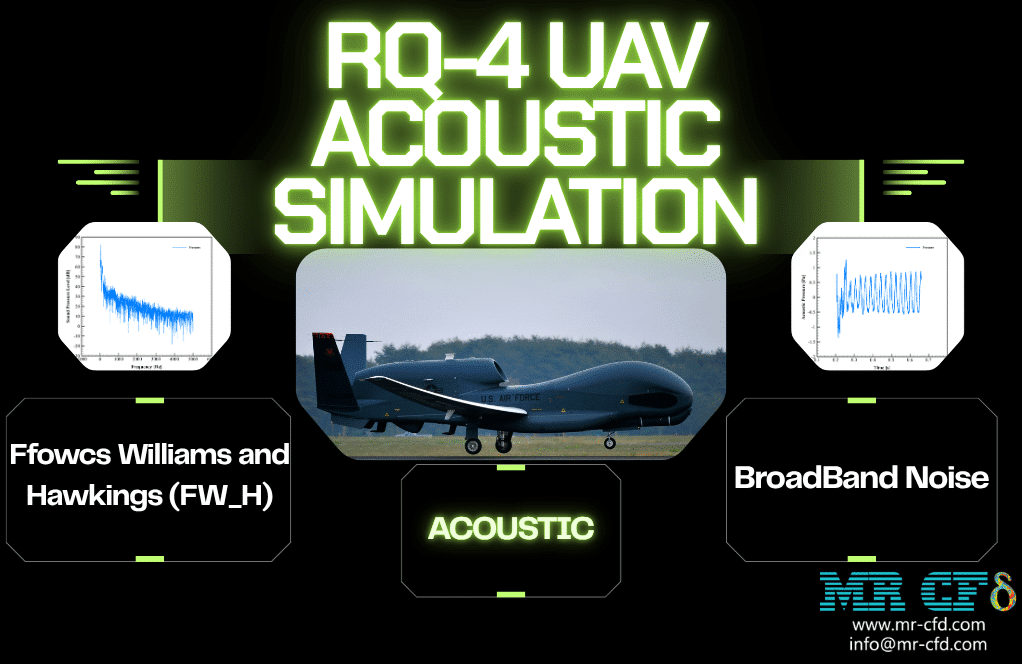
RQ-4 CFD Simulation, Acoustic Analysis, Industrial Application
While high-altitude cruise keeps the vehicle acoustically invisible to ground observers, takeoff and recovery phases generate noise levels that must satisfy airfield regulations and community standards. This project covers ANSYS Fluent’s time-accurate acoustic solver chain: you will resolve fluctuating pressures on the airframe and intake surfaces, propagate the resulting sound field to far-field monitoring stations using surface-integral methods, and analyze frequency spectra across engine power settings corresponding to ground roll, initial climb, and approach. The deliverable is a directional noise atlas that informs operational procedures departure headings, power management schedules, and recovery profiles without compromising the aerodynamic efficiency established in the first project.
RQ-4 Fluid-Structure Interaction (FSI) Simulation using ANSYS Fluent
Wings spanning over thirty meters flex substantially under sustained aerodynamic loading, and that deformation alters the pressure distribution that caused it a feedback loop invisible to any uncoupled solver. This project sets up a synchronized two-way in ANSYS Fluent: aerodynamic surface pressures deform the wing and empennage structure, and the deformed shape is passed back to the flow domain for an updated aerodynamic calculation. You will record spanwise bending-twist distributions at multiple cruise and maneuvering airspeeds, track modal frequency evolution against airframe vibration sources, and measure how elastic effects modify the vehicle’s lift-to-drag ratio and trim condition. The outcome is a computationally validated structural assessment that compresses the timeline between design freeze and flight authorization.
You must be logged in to post a review.
Related products
-
Sale

Mechanical Engineering Training Package for Beginners, Part 1, 10 Practical Exercises
Original price was: $720.00.$199.00Current price is: $199.00. Internship -
Sale
Turbomachinery CFD Training Package for Beginners, 10 Learning Products
Original price was: $1,200.00.$299.00Current price is: $299.00. Internship -
Sale

Coronavirus CFD Simulation Training Package, 10 Practical Exercises
Original price was: $1,440.00.$499.00Current price is: $499.00. Internship

 Talk On WhatsApp
Reviews
There are no reviews yet.