
RQ-170 UAV: CFD Simulation Training Package
$3,499.00 Internship
- Aerodynamics sits at the root of the entire simulation tree force and moment accuracy at this stage dictates whether downstream stability, structural, and acoustic results are meaningful or misleading.
- Stability derivative extraction gives flight dynamics teams a precise, quantitative map of how the airframe behaves when disturbed, replacing qualitative intuition with measurable coefficients tied to every corner of the flight envelope.
- Acoustic simulation reconstructs the full sound field around the vehicle, showing not just intensity but propagation direction and frequency content the kind of detail that turns vague noise concerns into specific, actionable design changes.
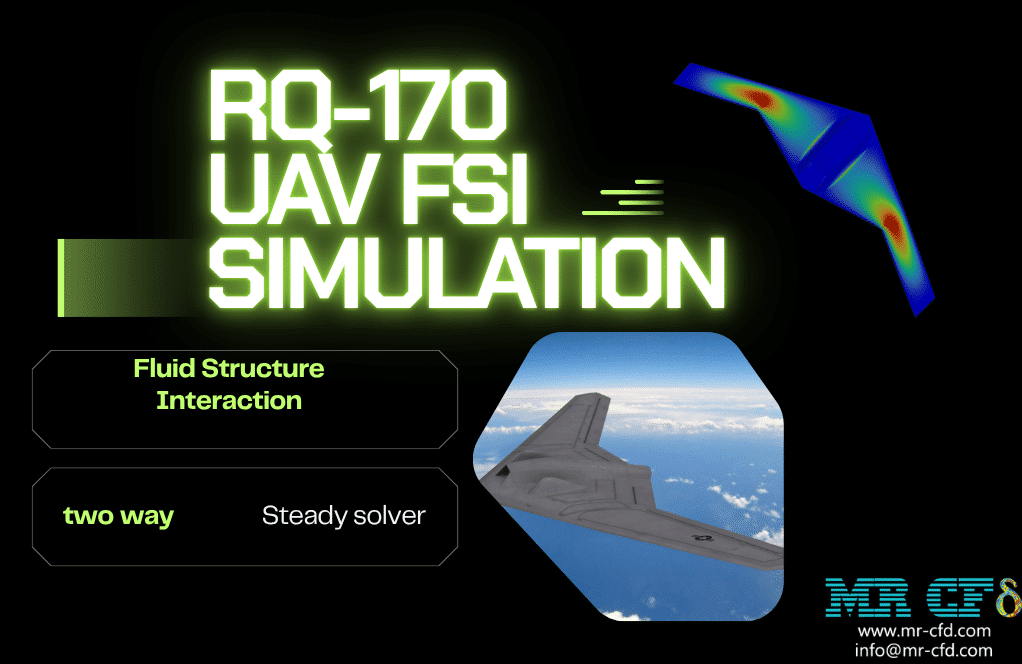
- FSI merges aerodynamic pressure fields and structural deformation into a single converging calculation, catching elastic effects, load path changes, and resonance proximity that two separate solvers running in isolation would miss entirely.
To Order Your Project or benefit from a CFD consultation, contact our experts via email (info@mr-cfd.com), online support tab, or WhatsApp at +44 7443 197273.
There are some Free Products to check our service quality.
If you want the training video in another language instead of English, ask it via info@mr-cfd.com after you buy the product.
Description
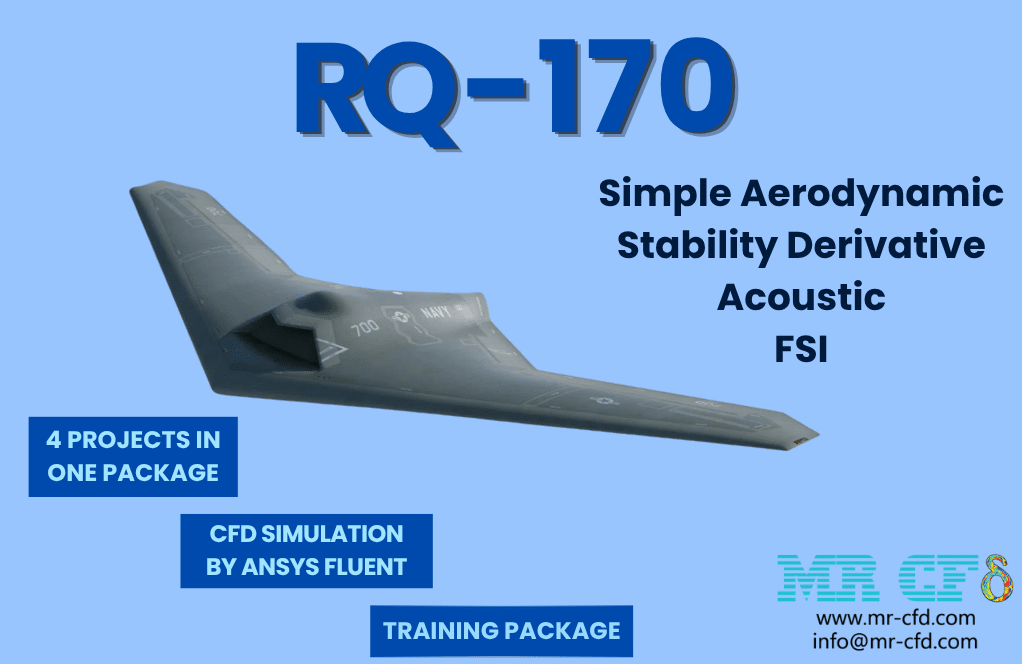
RQ-170 CFD Simulation: 4 Projects In One Package
Stealth UAV Simulation Mastery Aerodynamics, Stability, Acoustics, and Structural Coupling
Flying-wing stealth platforms like the RQ-170 demand an aerodynamic development process where every surface contour serves double duty optimizing lift-to-drag performance while minimizing radar and acoustic signatures. This package organizes four independent ANSYS Fluent projects around that dual mandate: baseline aerodynamic quantification, stability derivative extraction tailored to tailless configurations, acoustic emission mapping, and two-way aeroelastic simulation. Together they deliver the multidisciplinary fluency expected of engineers working on low-observable UAV programs.
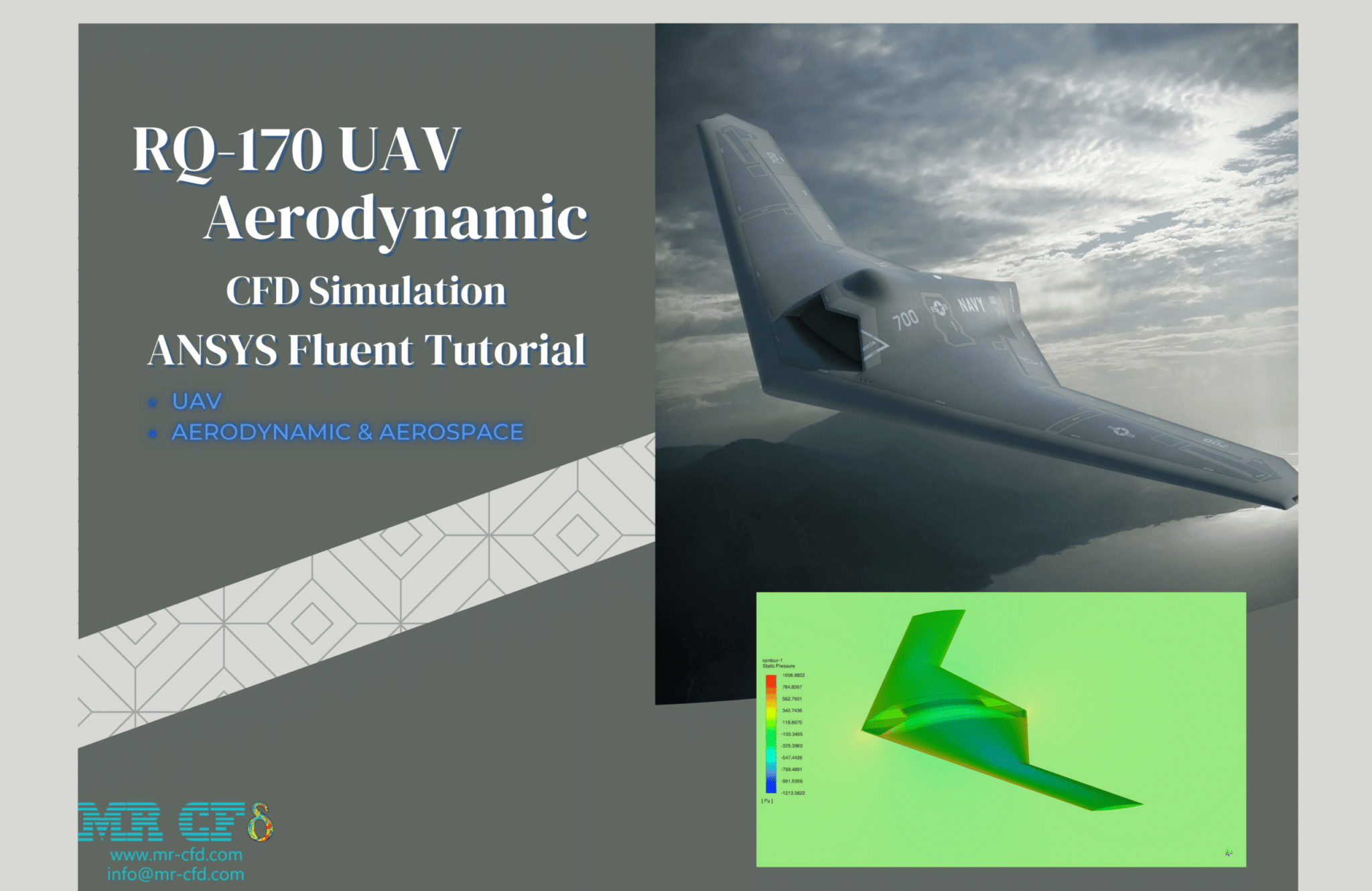
RQ-170 Aerodynamic Analysis
A blended flying wing generates lift, manages pitching moment, and provides directional control through subtle geometry features rather than conventional tail surfaces making the accuracy of the initial CFD dataset even more consequential. This project takes you from geometry import and domain construction through boundary condition definition freestream inflow, back-pressure exits, and smooth-wall viscous models to a complete incidence and sideslip parametric study. The resulting lift, drag, and moment maps give you a verified aerodynamic foundation that the stability, acoustic, and FSI projects each depend on.
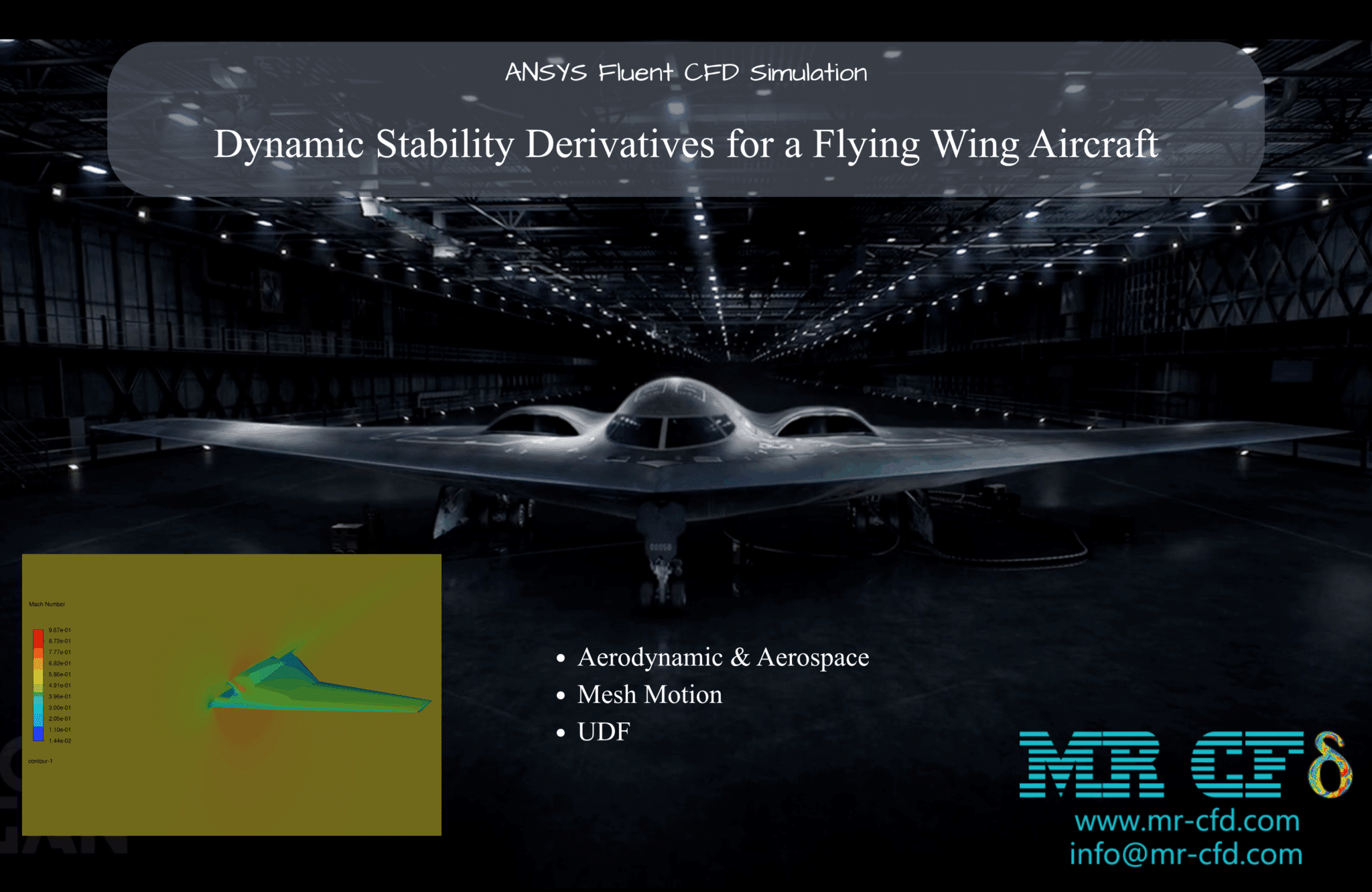
RQ-170 Dynamic Stability Derivatives, ANSYS Fluent CFD Simulation
Without a horizontal or vertical tail, pitch and yaw authority come entirely from elevon scheduling, split surfaces, and planform shaping making stability margins inherently tighter and derivative precision non-negotiable. You will perturb the baseline trim state through measured pitch, roll, and yaw increments, capture the moment response at each condition, and construct a derivative set that spans both longitudinal and lateral-directional axes. Mesh density is concentrated along leading-edge sweep breaks and trailing-edge control surface hinge lines where flow gradients govern derivative magnitude. The completed matrix supports fly-by-wire control law development, linear stability analysis, and formal handling-quality evaluation.
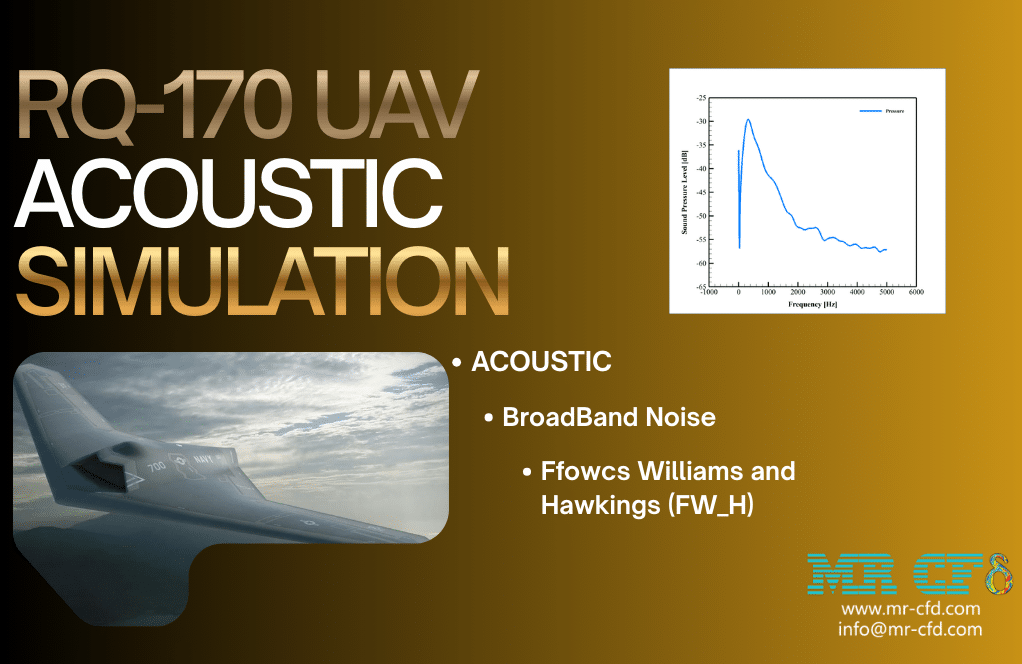
Acoustic Emission Mapping for RQ-170
For a platform designed to avoid detection, acoustic discretion is as strategically important as radar cross-section management. This project walks you through ANSYS Fluent’s transient acoustic framework: you will resolve unsteady pressures across the airframe’s upper and lower surfaces and intake region, propagate the acoustic energy to distant observer grids using analogy-based methods, and decompose the noise spectrum by flight condition ingress, loiter, and egress. The result is a three-dimensional sound-field map that lets you evaluate how changes in cruise altitude, airspeed, and inlet geometry affect the vehicle’s acoustic detectability all while maintaining the aerodynamic benchmarks locked in during the first project.
Two-Way Aeroelastic Simulation of RQ-170 for Structural Confidence
Thin composite wings and slender tail booms are efficient but inherently flexible and that flexibility reshapes the very pressure field that causes it. To capture this behavior accurately, the project implements a two-way fluid-structure interaction methodology in ANSYS Fluent: aerodynamic pressures deflect the structure, the revised shape re-enters the flow domain, and the loop repeats until equilibrium is reached. Key deliverables include spanwise bend-twist distributions at multiple airspeeds and a quantified measure of how elastic effects alter overall vehicle drag and trim. The entire investigation runs computationally, providing structural confidence months ahead of any flight-test schedule.
You must be logged in to post a review.
Related products
-
Sale

Chemical Engineering Training Package for Beginners, 10 Practical Exercises
Original price was: $1,120.00.$299.00Current price is: $299.00. Internship -
Sale
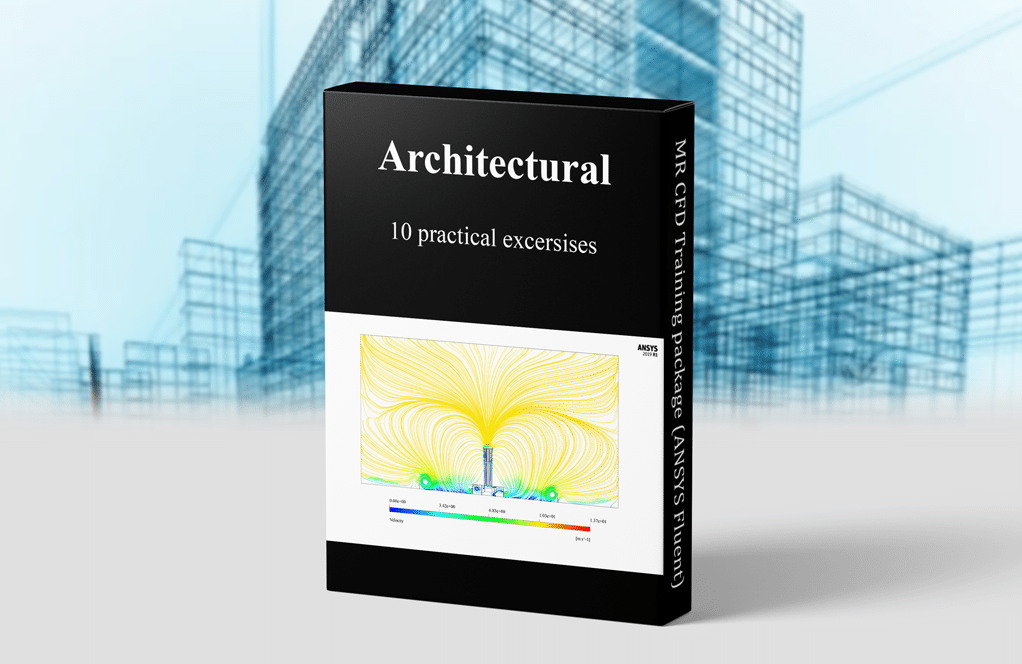
Architectural Training Package, ANSYS Fluent, 10 Practical Exercises
Original price was: $720.00.$299.00Current price is: $299.00. Internship -
Sale
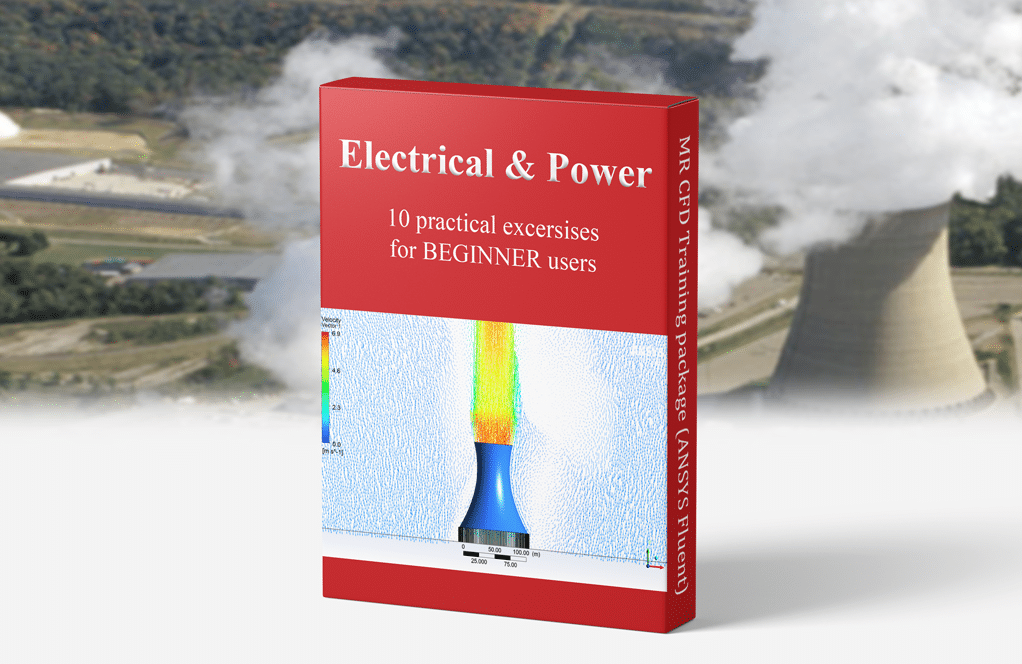
Electrical and Power Training Package for Beginners, 10 Practical Exercises
Original price was: $1,080.00.$299.00Current price is: $299.00. Internship

 Talk On WhatsApp
Reviews
There are no reviews yet.