

What is ANSYS Software Used For? 2026 Simulation Guide
Ansys software is used by engineers, researchers, and product development teams to simulate how real-world products behave before they are manufactured. Instead of relying only on physical testing, companies use Ansys simulation software to analyze fluid flow, heat transfer, structural stress, electromagnetic behavior, combustion, acoustics, and complex multiphysics simulation problems.
ANSYS Fluent Beginner Course for Less Than the Cost of a Lunch!
No prior experience needed. Start Learning ANSYS Fluent step-by-step with 16 hands-on, real-world projects across multiple engineering fields.
For organizations in aerospace, automotive, energy, electronics, HVAC, biomedical engineering, and industrial manufacturing, Ansys helps reduce design risk, improve product performance, and accelerate product development cycles. By using tools such as Ansys Fluent, Ansys Mechanical, and Ansys Workbench, engineering teams can test multiple design scenarios virtually, reduce physical prototyping costs, and make better technical decisions earlier in the product lifecycle.
At MR CFD, we use Ansys simulation software, especially Ansys Fluent and advanced CFD consulting services, to help companies solve challenging fluid, thermal, and multiphase flow problems with engineering-grade accuracy.
Struggling with Complex CFD Setup?

Premier CFD Consulting Services Using ANSYS Fluent
ANSYS Fluent simulations, validation, and defensible engineering reports across 30+ fields. Registered in 🇺🇸 USA (Delaware), 🇬🇧 UK & 🇴🇲 Oman
Let our engineering team handle your simulation bottlenecks and reduce your prototyping costs.
What is Ansys?
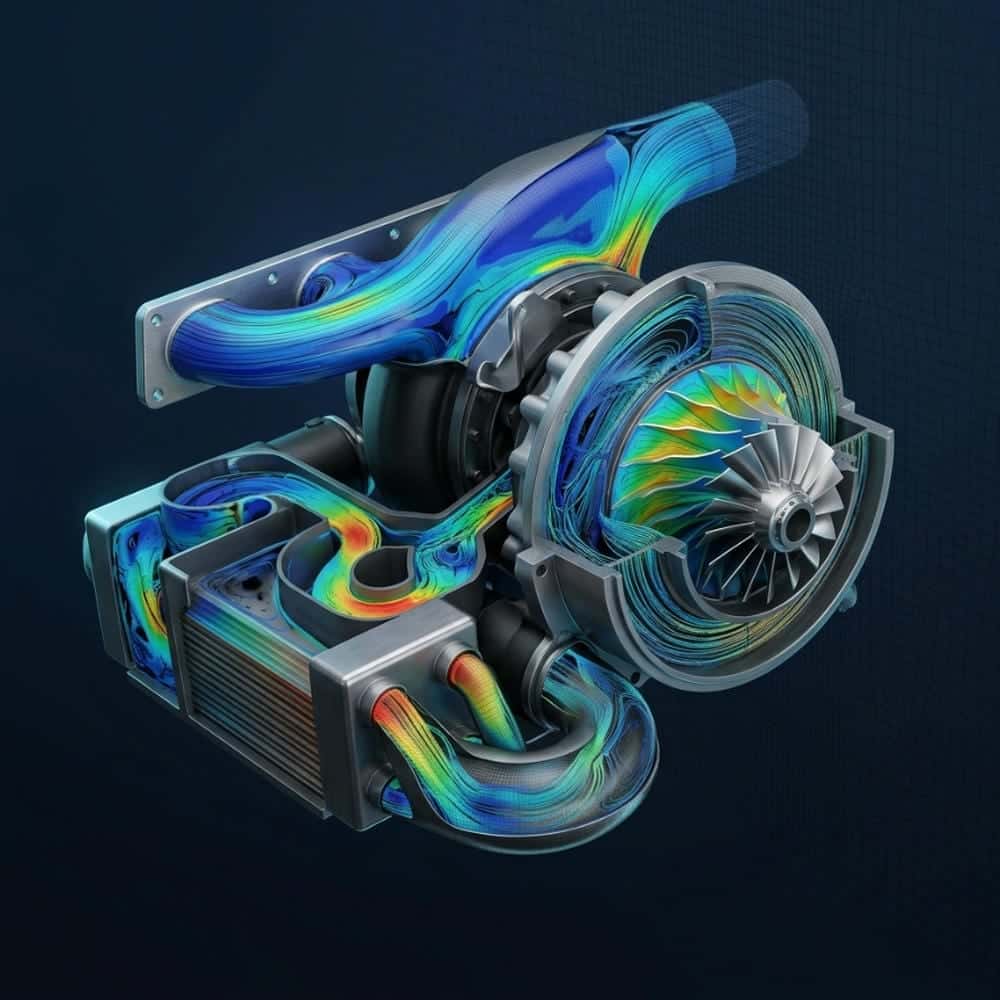
Ansys is a professional engineering simulation platform used to predict how products, systems, and physical processes behave under real operating conditions. It allows engineers to model physics such as computational fluid dynamics, Finite Element Analysis, thermal behavior, electromagnetics, acoustics, and Fluid-Structure Interaction before expensive prototypes are built.
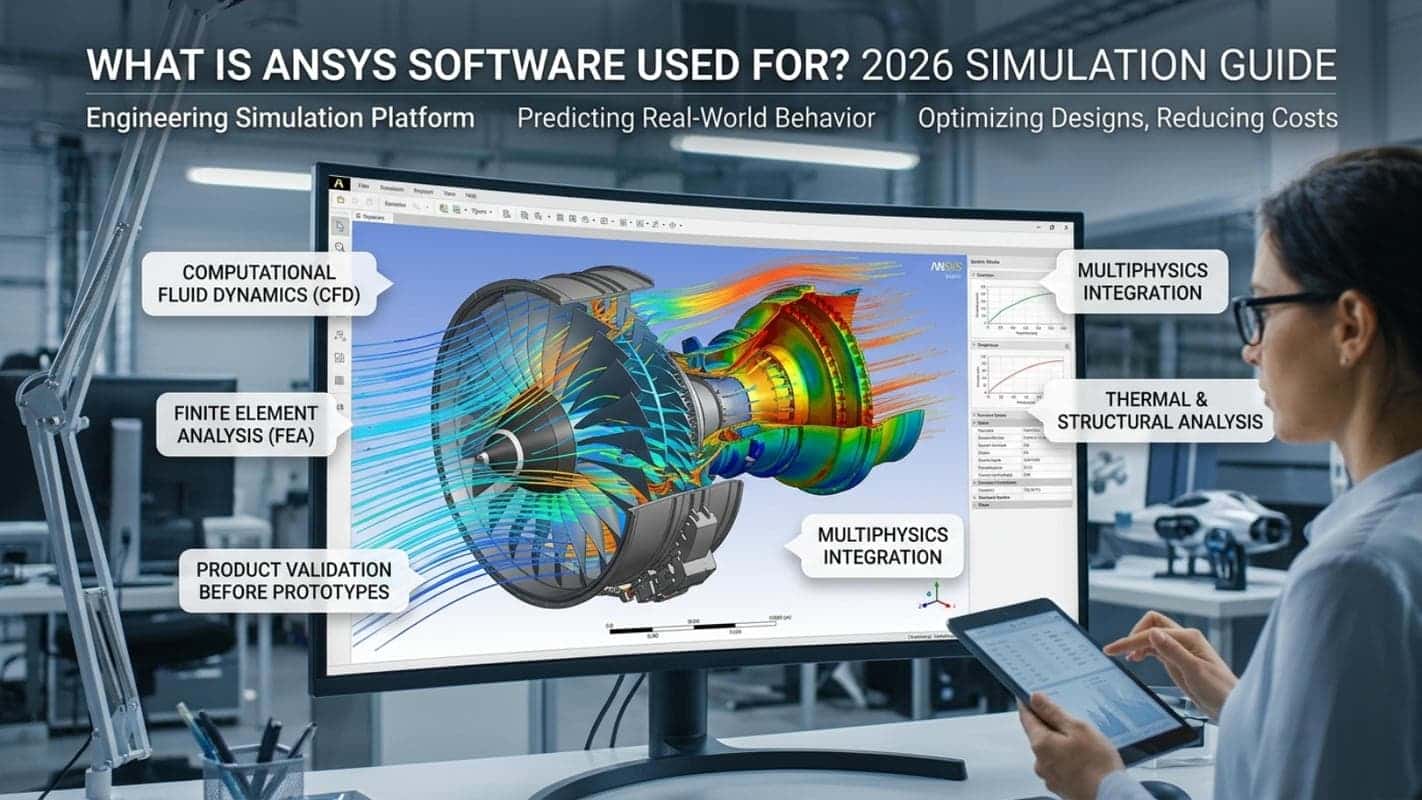
In simple terms, Ansys software helps answer questions such as:
- Will this part fail under mechanical load?
- How will air or liquid move through this system?
- Will overheating occur inside an electronic device?
- How much pressure drop will happen in a pipe, valve, or HVAC duct?
- How does a structure respond to vibration, thermal stress, or fluid forces?
- Can a design be optimized before manufacturing?
This is why Ansys simulation software is widely used for project optimization, performance validation, product safety, and cost reduction.
What is Ansys Software Used For?
Ansys software is used for engineering simulation, including fluid dynamics, structural analysis, thermal analysis, electromagnetic simulation, multiphysics coupling, and design optimization.
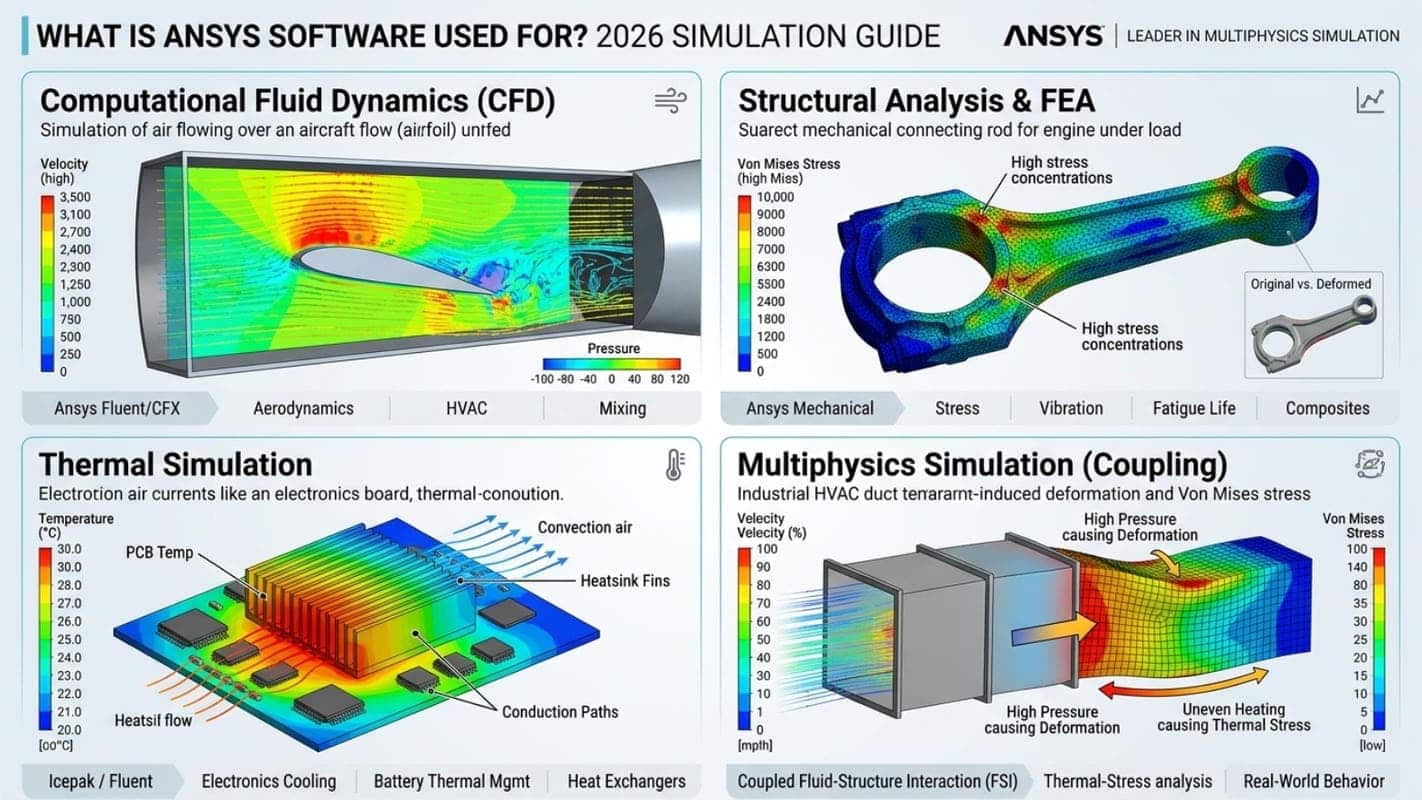
Its main applications include:
1. Computational Fluid Dynamics CFD
One of the most common uses of Ansys is computational fluid dynamics, especially through Ansys Fluent and Ansys CFX. CFD allows engineers to simulate airflow, water flow, gas flow, combustion, heat transfer, turbulence, pressure drop, and multiphase systems.
Typical CFD applications include:
- Aerodynamic analysis of aircraft, drones, and vehicles
- HVAC airflow and thermal comfort simulation
- Pump, fan, turbine, and compressor performance
- Oil and gas flow assurance
- Combustion and emissions analysis
- Electronics cooling and thermal management optimization
- Biomedical flows such as blood flow or respiratory airflow
- Industrial mixing, spraying, and particle transport
With Ansys Fluent, engineers can model advanced flow phenomena such as multiphase flows, Discrete Phase Model DPM, turbulence models like k-ω SST, species transport, chemical reactions, and conjugate heat transfer.
2. Structural Analysis and FEA
Ansys Mechanical is widely used for Finite Element Analysis FEA. FEA helps engineers predict how parts and assemblies respond to stress, vibration, fatigue, pressure, temperature, and mechanical loads.
Structural applications include:
- Stress and deformation analysis
- Fatigue life prediction
- Modal and vibration analysis
- Buckling analysis
- Impact and crash simulation
- Thermal stress evaluation
- Pressure vessel and piping analysis
- Composite material behavior
By using Finite Element Analysis FEA, companies can identify weak points, improve material usage, and reduce the risk of failure before production begins.
3. Thermal Simulation
Ansys simulation software is also used for thermal analysis, including conduction, convection, radiation, and coupled thermal-fluid problems.
Thermal simulation is especially important in:
- Electronics cooling
- Battery thermal management
- Heat exchangers
- Turbomachinery
- HVAC systems
- Automotive engine compartments
- Industrial furnaces
- Renewable energy systems
When thermal behavior is coupled with flow simulation, engineers can solve conjugate heat transfer problems and evaluate how fluids and solids exchange heat in real operating environments.
4. Multiphysics Simulation
Modern engineering problems rarely involve only one type of physics. A design may experience airflow, heat transfer, vibration, pressure loading, and structural deformation at the same time. This is where Ansys multiphysics simulation becomes highly valuable.
For example, in an HVAC system, airflow distribution may create thermal gradients across a metal duct or enclosure. Those temperature differences may then cause thermal expansion, stress, or deformation. By linking fluid, thermal, and structural domains, engineers can understand the complete system behavior.
This type of engineering simulation solution is essential for high-value industries where failure is expensive, safety-critical, or difficult to test physically.
Is Ansys a CAD Software?
No, Ansys is not primarily a CAD software. Ansys is mainly an engineering simulation platform, while CAD software is used to create 3D geometry and product designs.
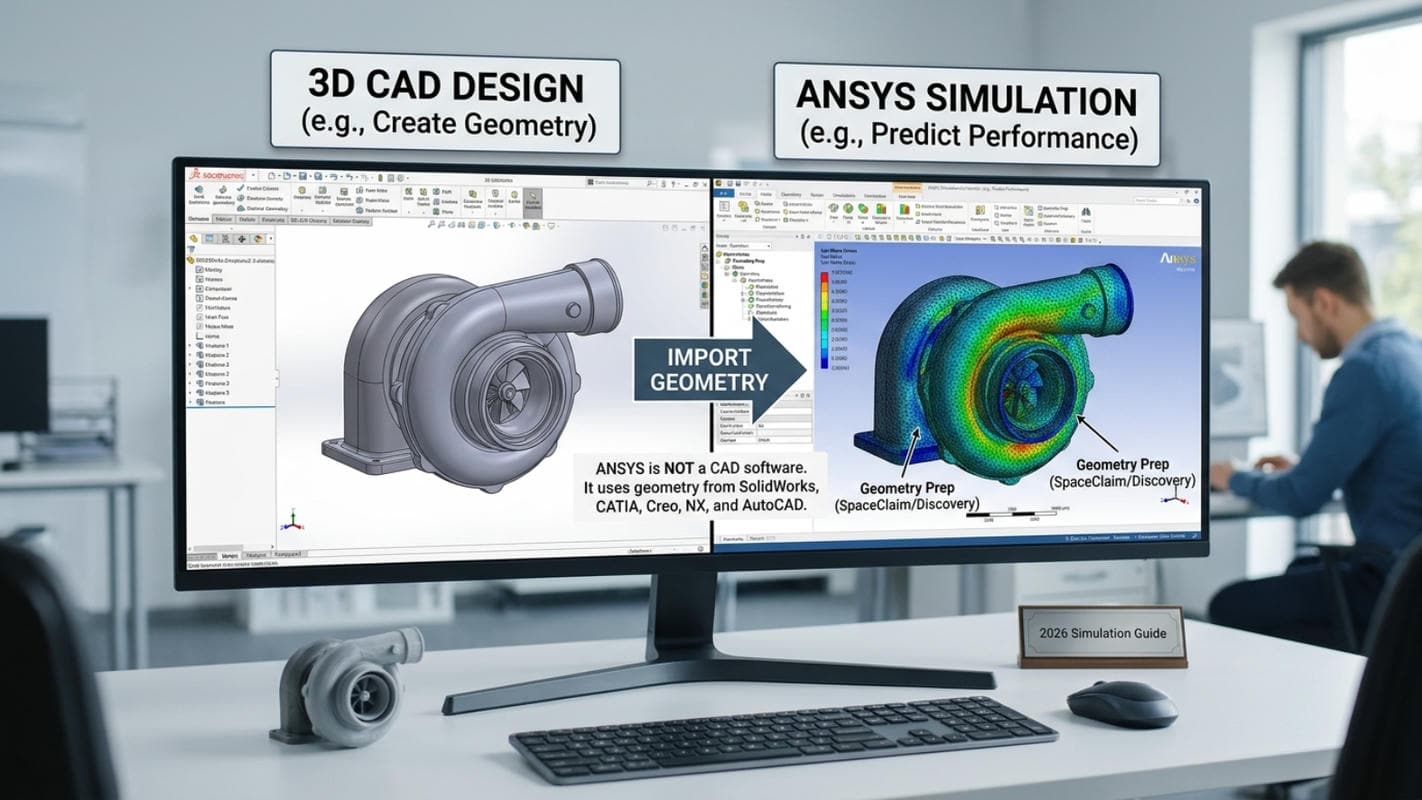
However, Ansys software can import CAD models from tools such as SolidWorks, CATIA, Creo, NX, and AutoCAD. It can also include geometry preparation tools through platforms like Ansys SpaceClaim and Ansys Discovery.
| Feature | CAD Software | Ansys Software |
|---|---|---|
| Main purpose | Create geometry and 3D models | Simulate real-world physics |
| Typical users | Designers, CAD engineers | Simulation engineers, analysts, researchers |
| Main output | 3D model, drawings, assemblies | Stress, flow, heat, pressure, deformation, performance data |
| Examples | SolidWorks, CATIA, Creo, AutoCAD | Ansys Fluent, Ansys Mechanical, Ansys Workbench |
| Role in workflow | Design creation | Design validation and optimization |
So, while CAD tools answer “What does the product look like?”, Ansys simulation software answers “How will the product perform?”
What is Ansys Workbench?
Ansys Workbench is the integrated project environment used to manage simulation workflows inside Ansys software. It allows engineers to connect geometry, meshing, physics setup, solving, and post-processing in one organized interface.
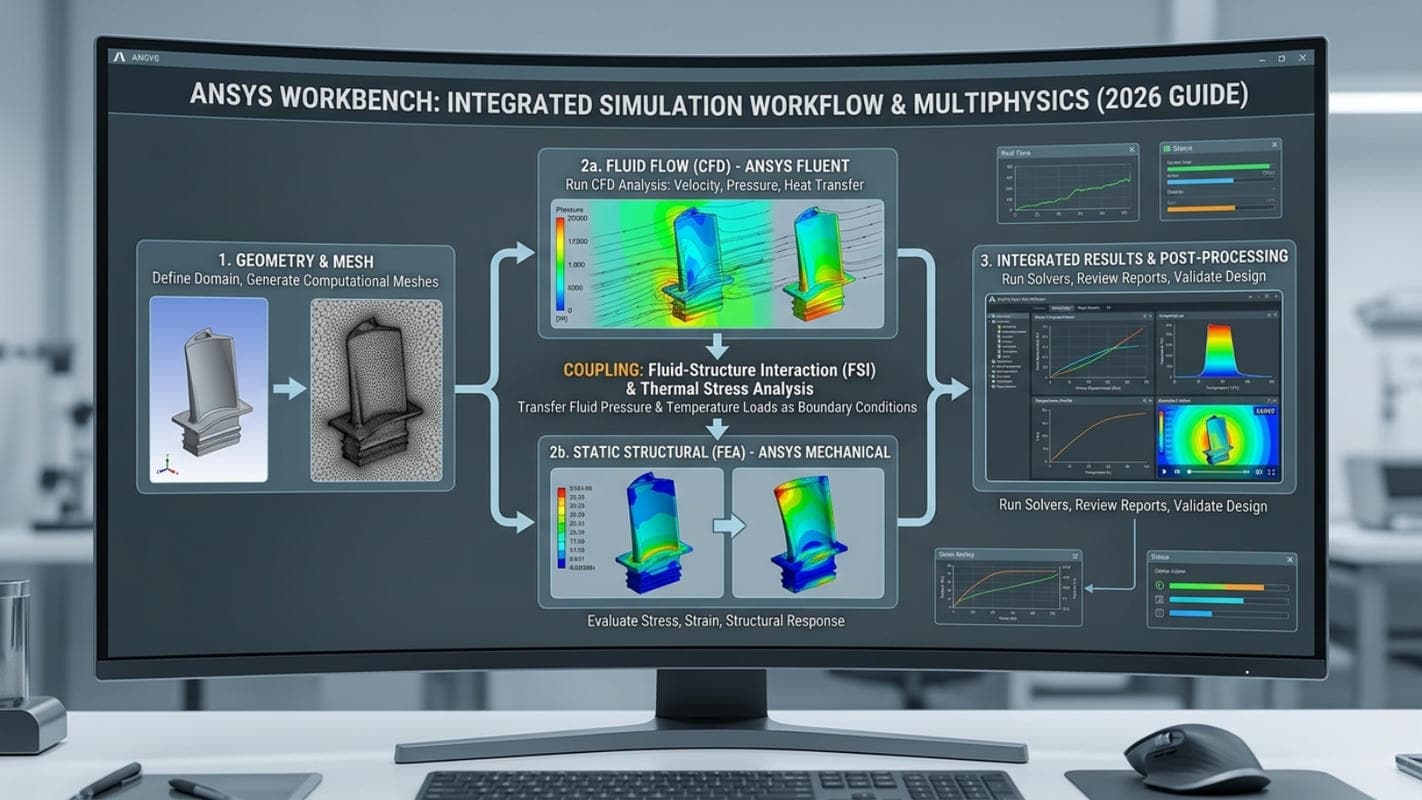
In Ansys Workbench, users can:
- Import or create geometry
- Generate computational meshes
- Define materials and boundary conditions
- Set up CFD, FEA, thermal, or coupled simulations
- Run solvers
- Review results through plots, contours, animations, and reports
- Connect multiple physics modules for multiphysics simulation
For example, an engineer can run a CFD simulation in Ansys Fluent, transfer pressure or temperature results into Ansys Mechanical, and then evaluate structural stress. This makes Ansys Workbench especially powerful for Fluid-Structure Interaction FSI, thermal stress analysis, and complete product validation.
What is Ansys Fluent?
Ansys Fluent is one of the most widely used CFD solvers within the Ansys ecosystem. It is designed for computational fluid dynamics simulations involving fluid flow, heat transfer, turbulence, reactions, combustion, and multiphase flows.
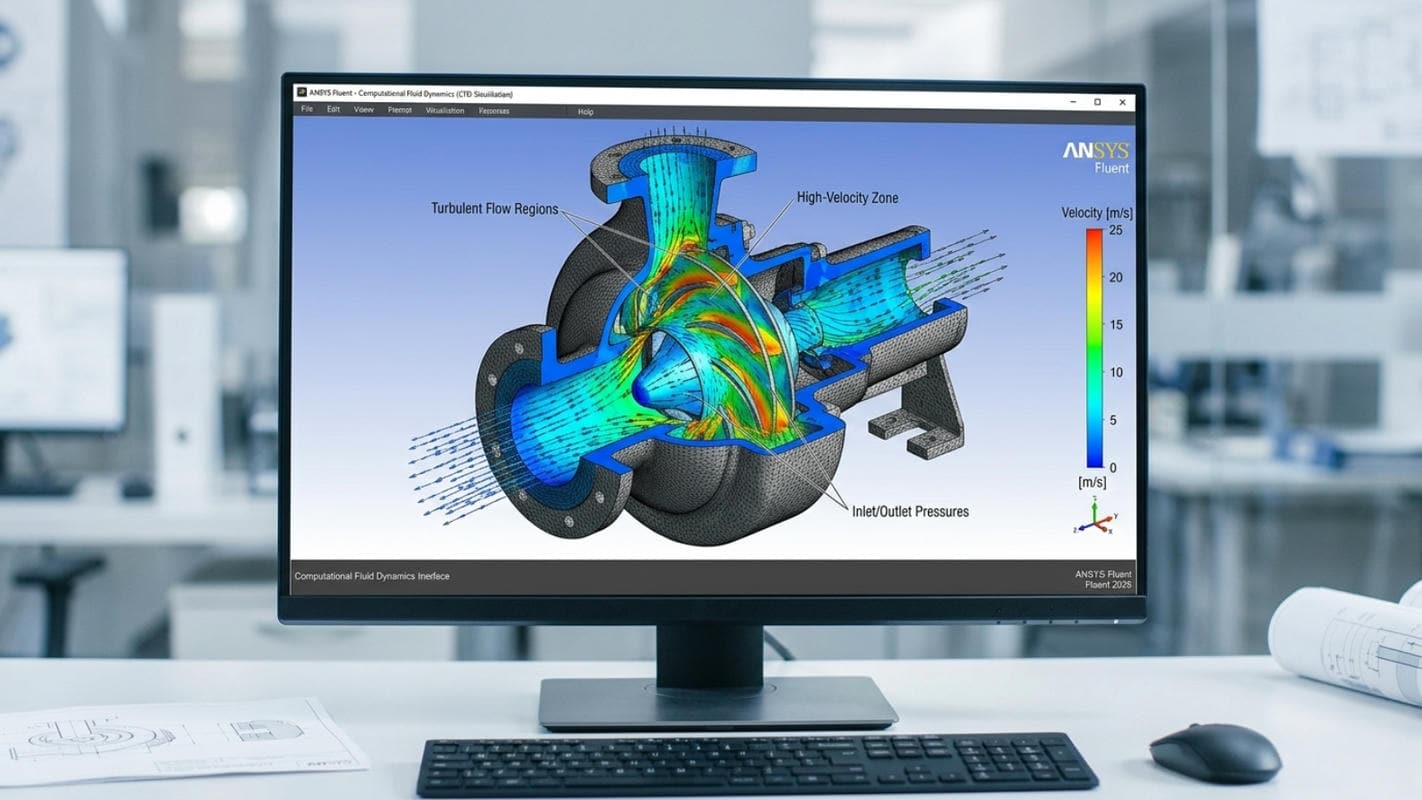
Engineers use Ansys Fluent to simulate:
- Internal and external fluid flow
- Turbulent airflow
- Laminar and turbulent pipe flow
- Heat transfer and conjugate heat transfer
- Pumps, fans, turbines, and compressors
- Combustion and reacting flows
- Sprays, droplets, and particles using Discrete Phase Model DPM
- Cavitation, boiling, evaporation, and condensation
- Fluid-Structure Interaction FSI
- Mixing tanks, separators, and process equipment
Advanced turbulence models such as k-ω SST, realizable k-epsilon, Reynolds Stress Model, DES, and LES can be used depending on the flow complexity and accuracy requirements.
For industrial projects, Fluent is often selected because it offers robust solver controls, advanced meshing compatibility, detailed post-processing, and strong validation across many engineering sectors.
Master Ansys Fluent Meshing & Setup
Stop fighting divergence errors. Learn production-ready workflows from industry experts.
What Are Ansys’ Core Strengths in Multiphysics Simulation?
The core strength of Ansys multiphysics simulation is its ability to connect multiple physical domains inside one engineering workflow. Instead of analyzing fluid flow, heat transfer, and structural behavior separately, engineers can combine them to evaluate how a real product performs as a complete system.
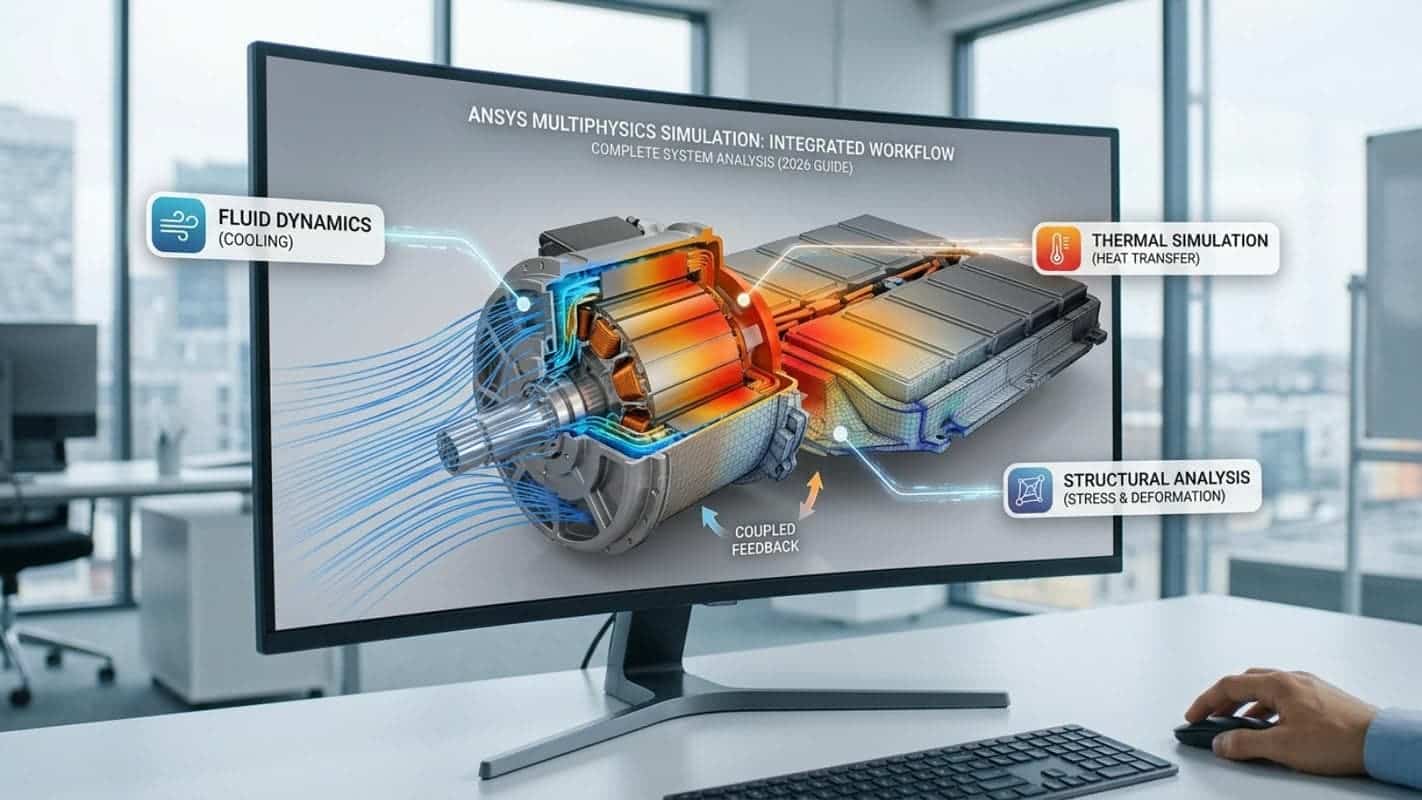
The main strengths include:
1. Coupled Fluid, Thermal, and Structural Analysis
Ansys allows engineers to connect computational fluid dynamics, thermal analysis, and Finite Element Analysis FEA. This is essential when pressure, temperature, and mechanical stress influence one another.
Example: In an HVAC system, airflow may create uneven temperature distribution across ducts or housing components. Using Ansys Fluent and Ansys Mechanical, engineers can evaluate airflow, conjugate heat transfer, and thermal stress in one connected workflow.
2. Advanced CFD Modeling
Ansys Fluent supports complex CFD physics, including turbulence, chemical reactions, combustion, rotating machinery, compressible flow, and multiphase flows. Models such as k-ω SST, Discrete Phase Model DPM, Volume of Fluid, Eulerian multiphase, and species transport allow engineers to simulate industrial-grade fluid systems.
3. Reliable FSI Workflows
With Fluid-Structure Interaction FSI, engineers can evaluate how fluid forces deform structures and how those deformations affect the flow field. This is critical for valves, flexible membranes, turbine blades, biomedical devices, offshore structures, and aerospace components.
4. Scalable Simulation for Enterprise Teams
Ansys simulation software supports workflows ranging from single-component analysis to full-system simulation. This makes it suitable for startups, R&D teams, enterprise manufacturers, and organizations needing outsourced simulation support.
5. Design Optimization and Cost Reduction
By simulating multiple design variations virtually, companies can reduce physical prototyping costs, shorten validation cycles, and improve final product performance. For some projects, simulation-led development can contribute to up to 40% cost reduction, depending on the industry, design stage, and testing requirements.
Meshing in Ansys: Why Mesh Quality Matters
Mesh generation is one of the most important steps in any Ansys simulation software workflow. A mesh divides the geometry into small computational cells or elements so the solver can calculate flow, stress, temperature, or electromagnetic behavior.
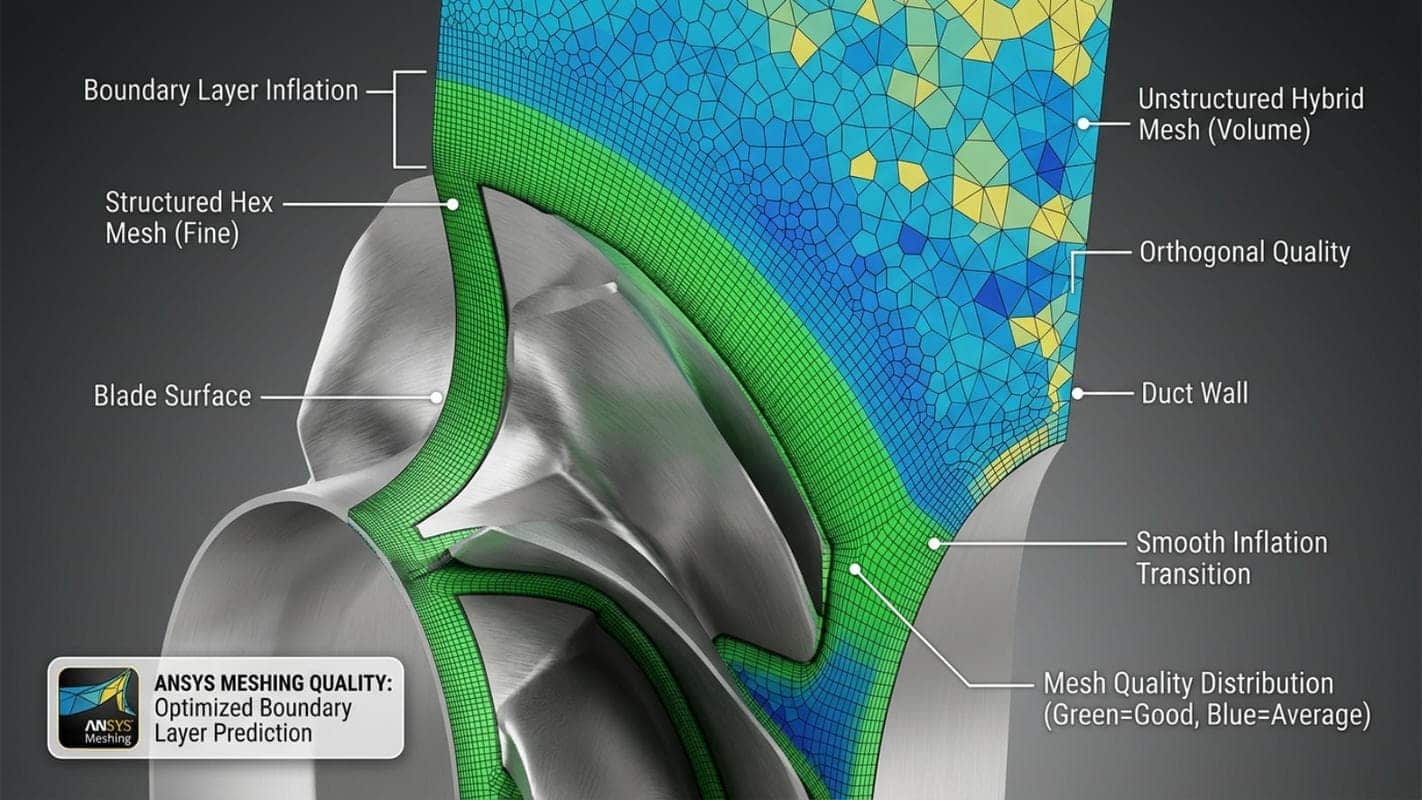
A high-quality mesh improves:
- Solver stability
- Result accuracy
- Convergence behavior
- Boundary layer prediction
- Turbulence modeling accuracy
- Pressure drop and heat transfer prediction
For CFD projects, mesh quality is especially important near walls, sharp gradients, rotating zones, narrow gaps, and boundary layers. Engineers often perform mesh independence validation to confirm that the final results are not overly dependent on mesh size.
Common meshing strategies include:
- Structured mesh
- Unstructured tetrahedral mesh
- Polyhedral mesh
- Hybrid mesh
- Inflation layers
- Boundary layer refinement
- Local sizing controls
- Adaptive mesh refinement
Turbulence Modeling in Ansys Fluent
Many industrial flows are turbulent, meaning they contain chaotic fluctuations, vortices, recirculation zones, and complex mixing behavior. Ansys Fluent provides several turbulence models to capture these effects.
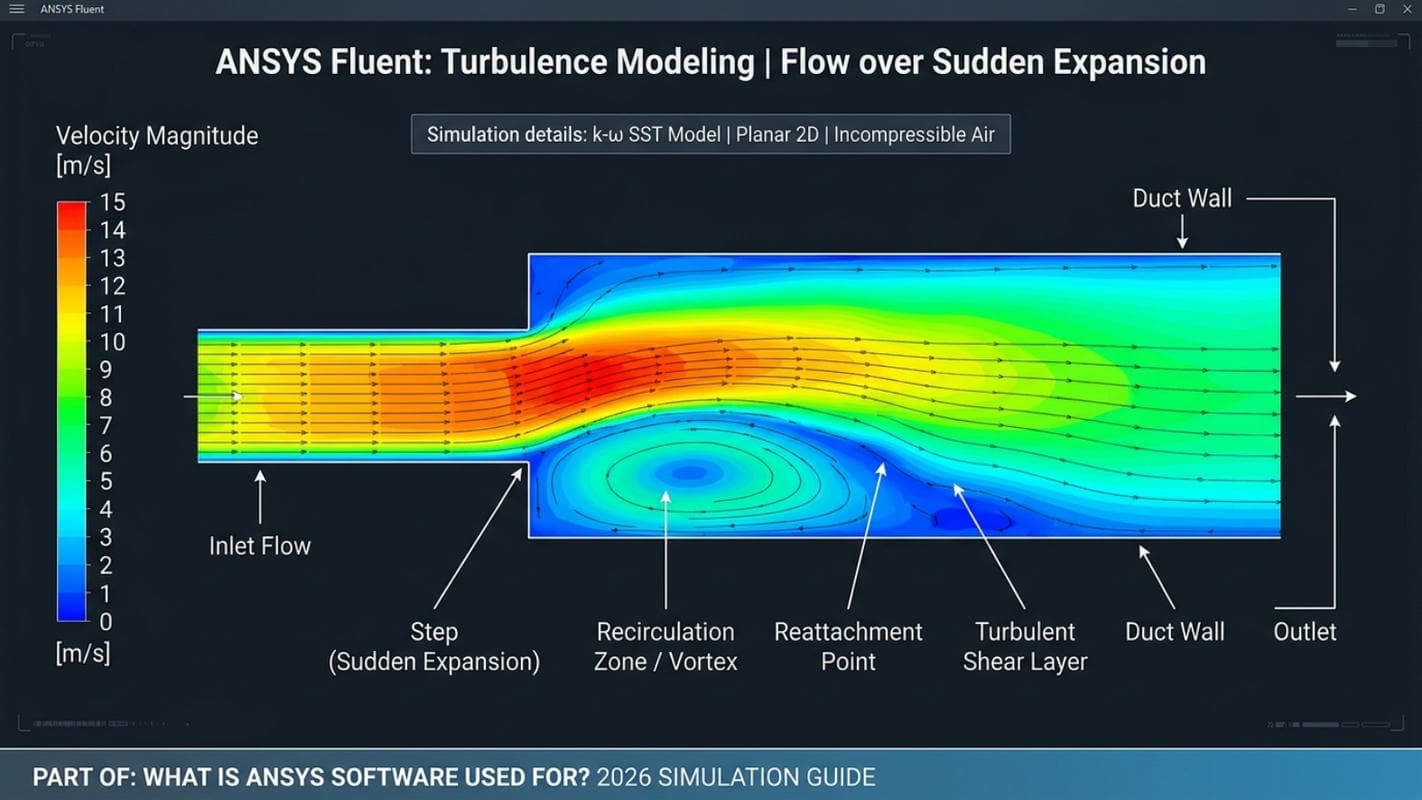
Common turbulence models include:
- Standard k-epsilon
- Realizable k-epsilon
- RNG k-epsilon
- k-ω SST
- Reynolds Stress Model
- Detached Eddy Simulation
- Large Eddy Simulation
The k-ω SST model is often used when accurate near-wall behavior, separation prediction, and adverse pressure gradients are important. It is popular in aerodynamic, turbomachinery, HVAC, and internal flow simulations.
Choosing the right turbulence model depends on the engineering objective, computational budget, flow regime, and validation requirements.
Recommended visual insert: Add a CFD velocity contour plot showing recirculation zones, turbulence intensity, or pressure distribution.
Multiphase Flow Simulation in Ansys
Multiphase flows involve more than one phase, such as gas-liquid, liquid-solid, gas-solid, or liquid-liquid systems. These simulations are common in process engineering, oil and gas, energy, chemical processing, biomedical systems, and environmental engineering.
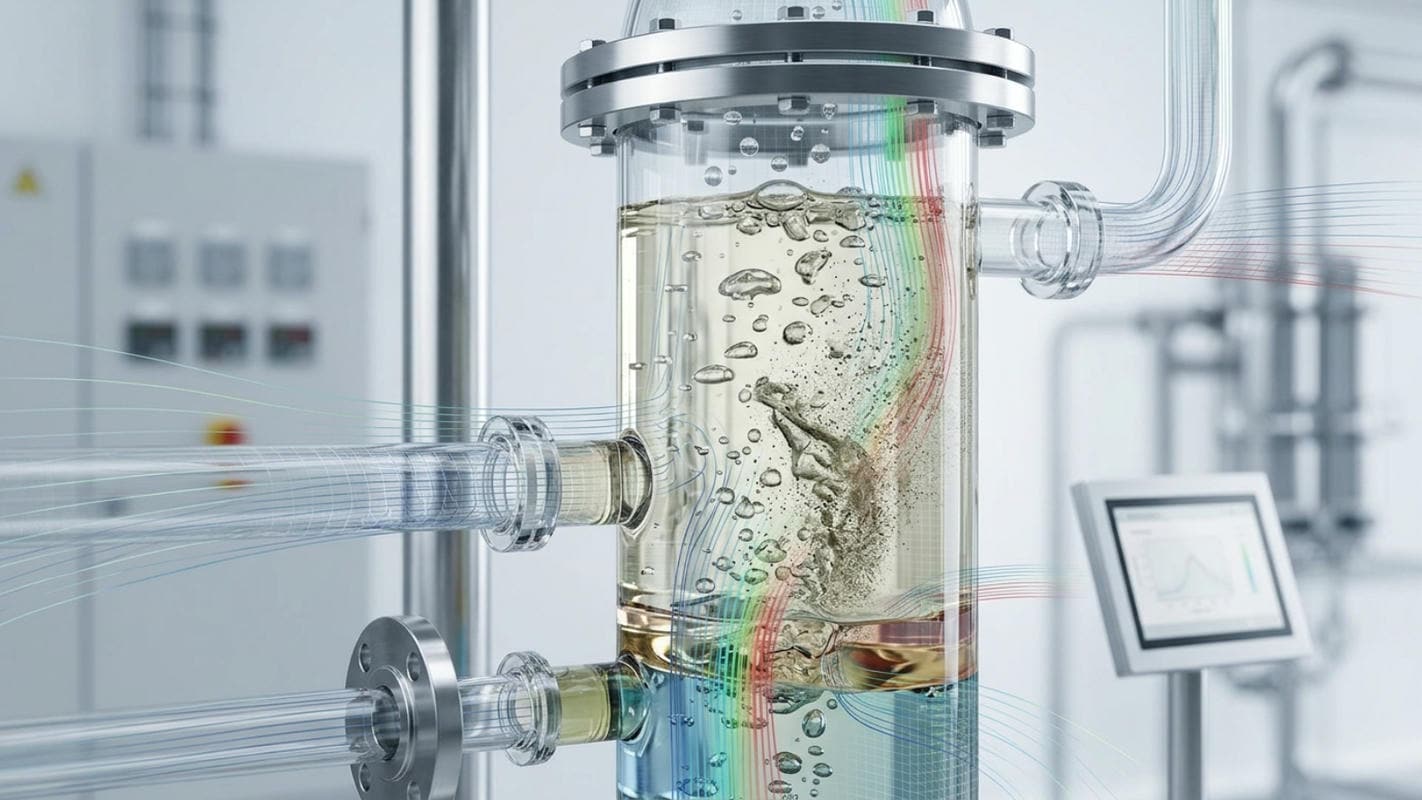
Ansys Fluent supports several multiphase models, including:
- Volume of Fluid model
- Mixture model
- Eulerian multiphase model
- Discrete Phase Model DPM
- Cavitation models
- Boiling and condensation models
- Spray and particle tracking models
Examples of multiphase flow applications include:
- Droplet separation
- Bubble columns
- Sedimentation
- Cyclone separators
- Spray cooling
- Fuel injection
- Cavitation in pumps
- Slurry transport
- Oil-water separation
Because multiphase simulation can be sensitive to mesh quality, time step size, physical models, and boundary conditions, many companies choose CFD consulting services to improve simulation reliability and reduce setup errors.
Need Accurate Multiphysics Modeling?
Get a technical assessment for your next fluid, thermal, or structural engineering project.
Real-World Applications of Ansys Simulation Software
Ansys simulation software is used across many industries where performance, safety, efficiency, and reliability are critical.
Aerospace and Defense
One of the strongest competitive advantages of Ansys in aerospace is the ability to evaluate designs before expensive wind tunnel testing or flight testing. Aerospace teams use Ansys Fluent, Ansys Mechanical, and multiphysics simulation to analyze aerodynamics, propulsion, thermal loads, structural stress, vibration, and system reliability.
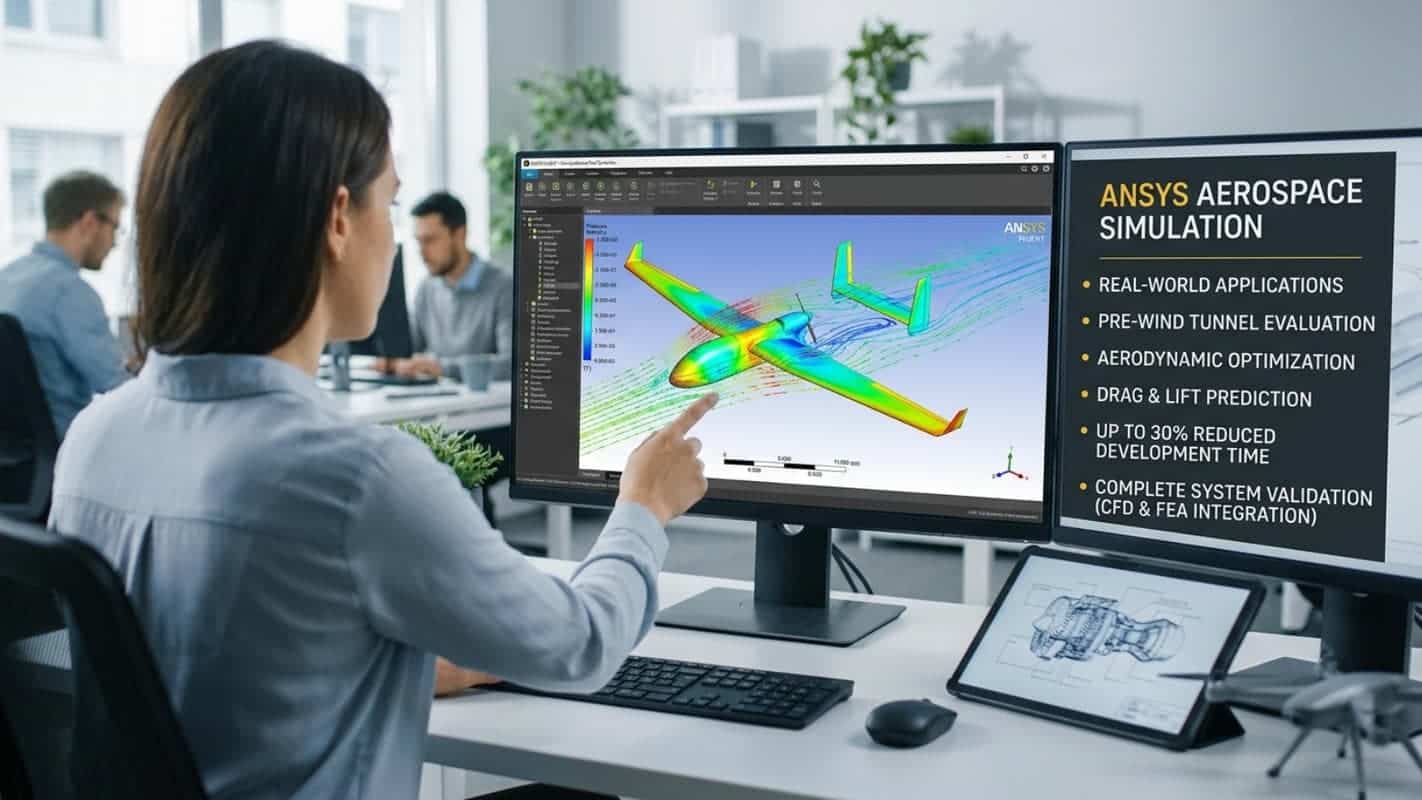
For example, an aerospace company can use CFD to compare wing, drone, or UAV design variations (UAV CFD Course Here! Join Now) before building physical prototypes. By identifying drag, lift behavior, pressure distribution, and flow separation early, teams can bypass wind tunnel bottlenecks and potentially reduce development time by up to 30%.
Key aerospace advantages include:
- Faster aerodynamic design iteration
- Reduced dependency on physical testing
- Better prediction of thermal and structural loads
- Improved fuel efficiency
- Earlier detection of design risks
- Integration of CFD and FEA for complete system validation
This makes Ansys simulation software a powerful tool for aerospace innovation, where every design improvement can influence performance, safety, and cost.
Automotive
Automotive companies use Ansys for aerodynamics, battery cooling, engine thermal management, cabin HVAC, brake cooling, crash analysis, fatigue prediction, and electric motor simulation.

Applications include:
- Vehicle drag reduction
- Battery pack cooling
- Electric motor thermal analysis
- Exhaust and combustion simulation
- Passenger cabin airflow
- Underhood thermal management
Energy and Power Generation
In the energy sector, Ansys simulation software helps engineers analyze turbines, heat exchangers, pipelines, pumps, reactors, solar systems, wind turbines, and hydrogen systems.
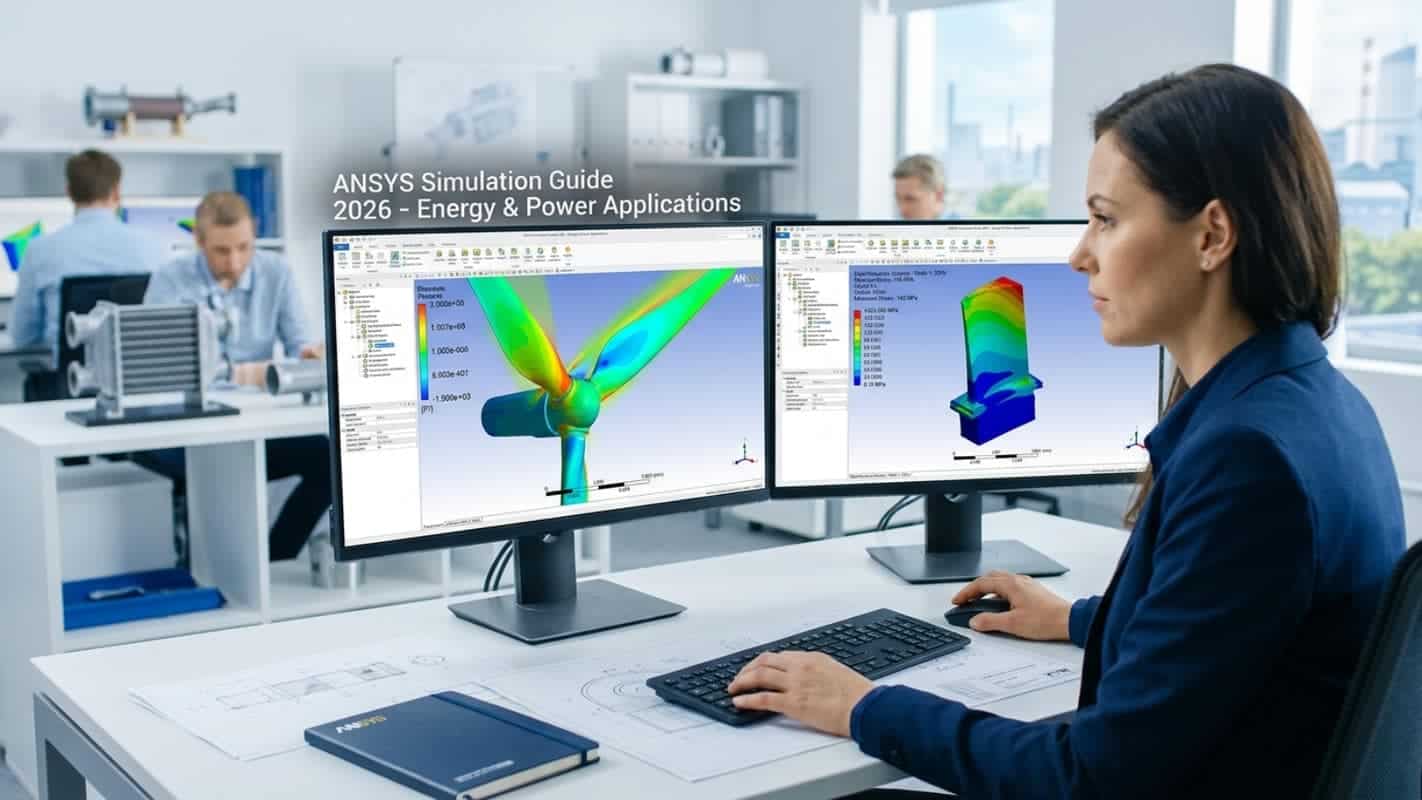
Simulation supports:
- Efficiency improvement
- Pressure drop reduction
- Thermal performance optimization
- Structural integrity assessment
- Flow-induced vibration analysis
Electronics Cooling
Electronics manufacturers use Ansys for thermal management optimization (Thermal Management Course is Here! join NOW) in chips, circuit boards, enclosures, data centers, LED systems, and battery-powered devices.
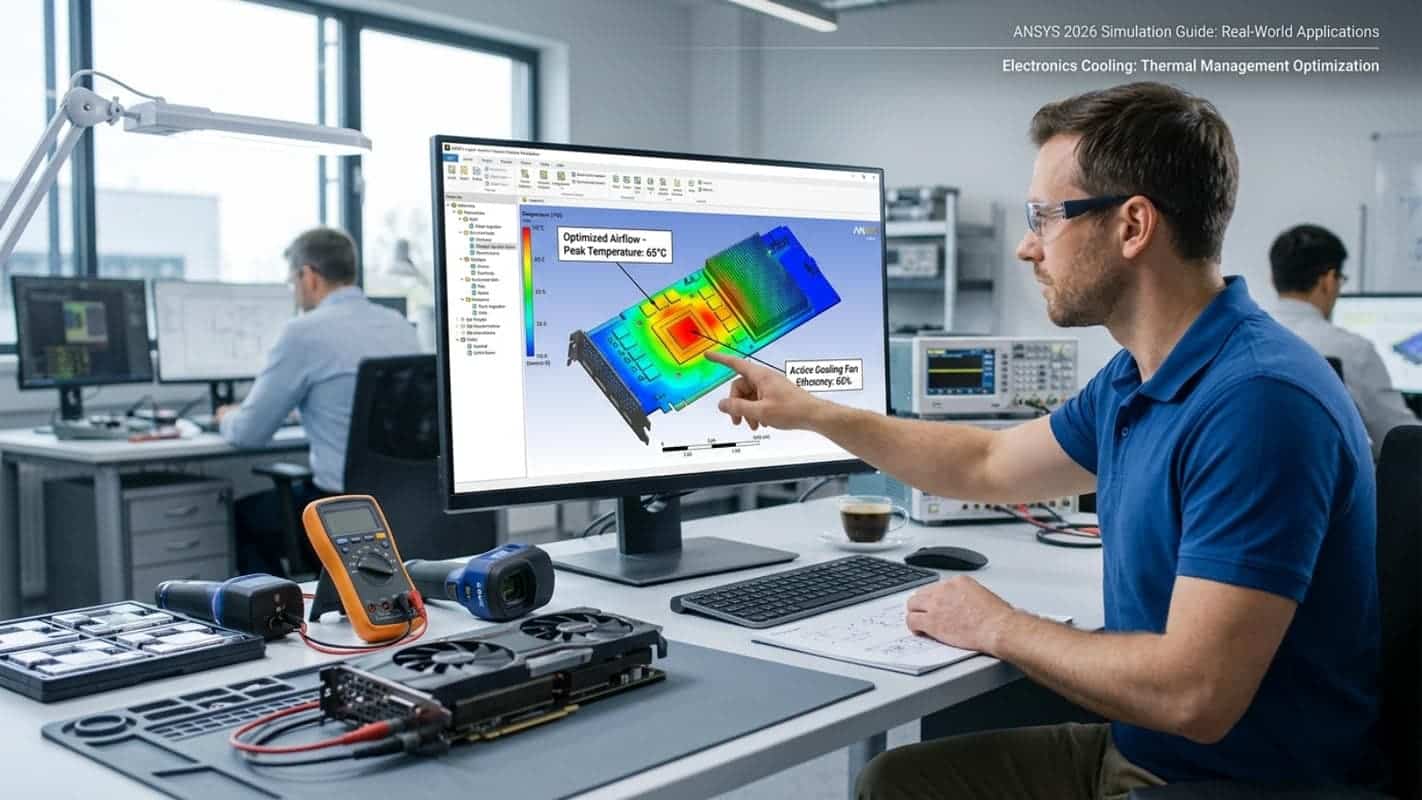
With CFD and thermal analysis, engineers can evaluate airflow paths, heat sinks, fans, liquid cooling plates, and enclosure ventilation before hardware production.
HVAC and Building Systems
HVAC engineers use Ansys Fluent to analyze airflow distribution, ventilation effectiveness, thermal comfort, contaminant transport, smoke control, and duct pressure losses.
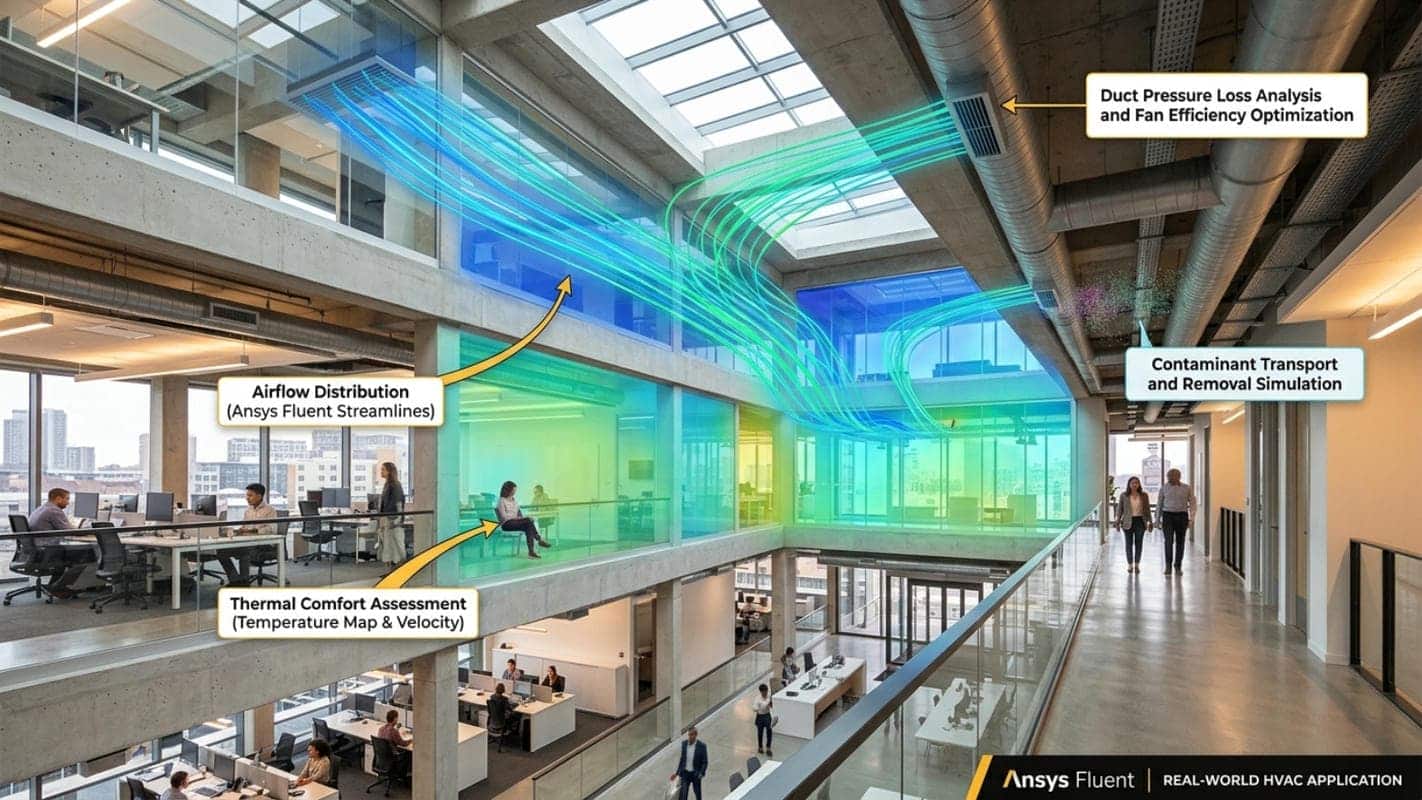
This helps improve energy efficiency, occupant comfort, and system performance.
Business Benefits of Ansys for Engineering Teams
Using Ansys simulation software is not only a technical decision. It is also a business decision. Simulation gives managers, engineers, and stakeholders better data for product development, investment planning, and risk reduction.
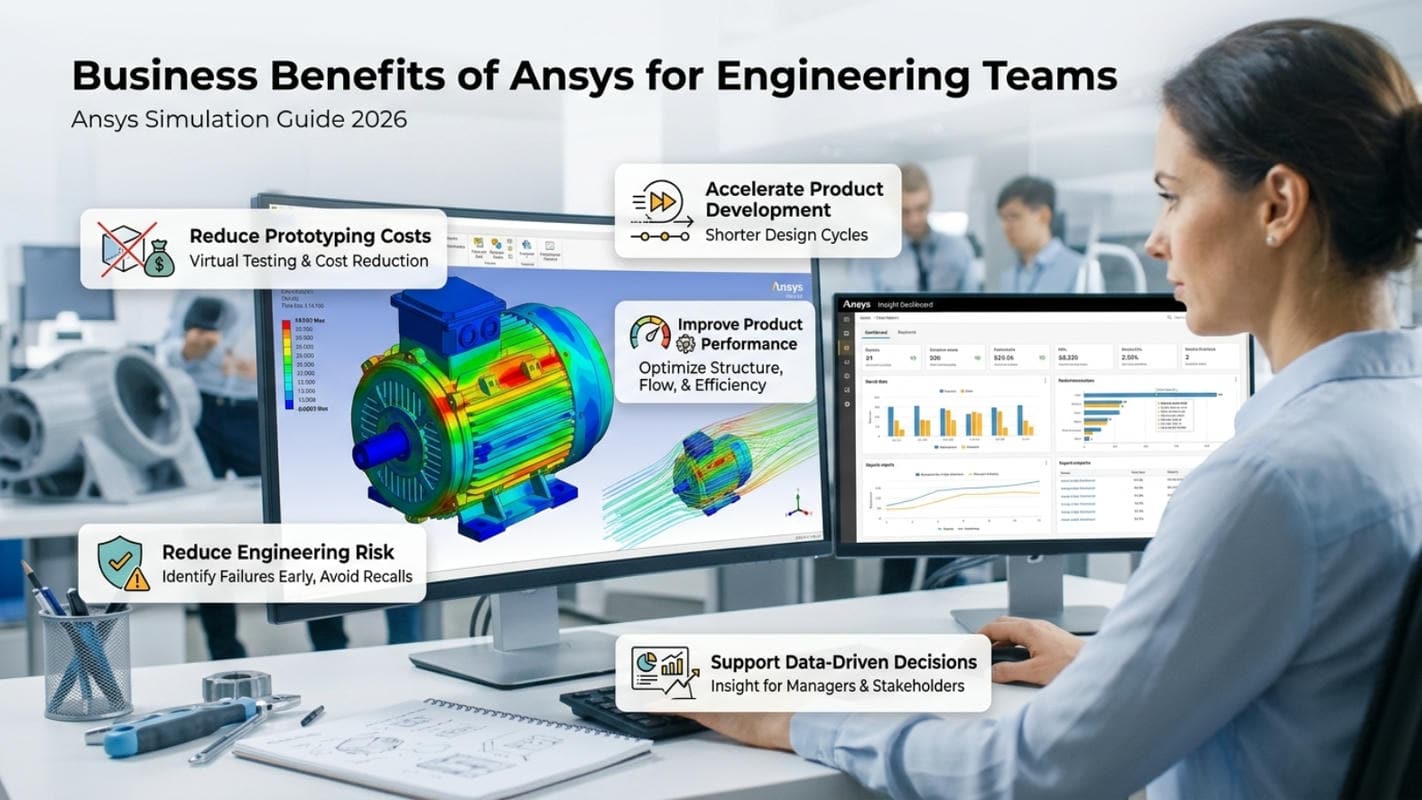
Key business benefits include:
1. Reduce Physical Prototyping Costs
Physical prototypes can be expensive, slow, and difficult to modify. With engineering simulation solutions, teams can test many design alternatives virtually before manufacturing. This can lead to up to 40% cost reduction in development and testing workflows, depending on project complexity.
2. Accelerate Product Development Cycles
By finding problems earlier, Ansys helps companies shorten design cycles and avoid late-stage redesign. Engineers can evaluate multiple concepts quickly and move forward with more confidence.
3. Improve Product Performance
Simulation allows teams to optimize pressure drop, stress distribution, heat transfer, flow uniformity, vibration response, and energy efficiency. This leads to stronger, safer, and more competitive products.
4. Support Data-Driven Engineering Decisions
Simulation results can be exported, documented, and integrated into internal reporting workflows. Engineering teams can use result data, charts, contours, and KPIs in BI dashboards or stakeholder reports to justify technical and financial decisions.
5. Reduce Engineering Risk
By identifying failure modes before production, Ansys simulation software helps reduce the risk of product recalls, field failures, warranty costs, and safety issues.
Ansys Training Courses and Consulting Services
Many companies have access to Ansys software but still struggle with accurate setup, meshing, convergence, turbulence modeling, or interpreting results. This is where expert support becomes valuable.
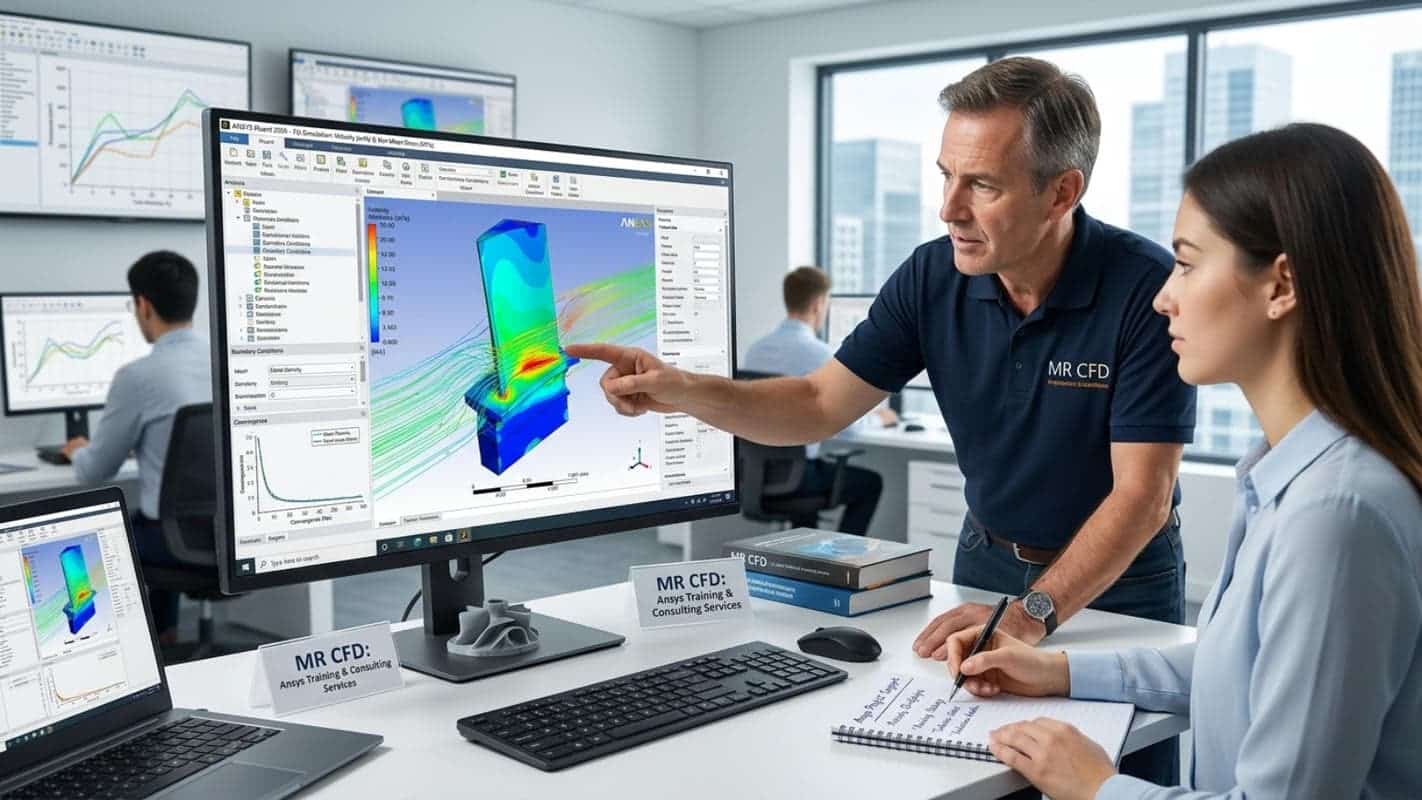
MR CFD provides:
- CFD consulting services
- Ansys beginner courses
- Ansys Fluent project support
- Advanced meshing guidance
- Turbulence model selection
- Multiphase flow simulation
- Fluid-Structure Interaction FSI
- Thermal and conjugate heat transfer analysis
- Solver troubleshooting
- Post-processing and technical reporting (free MasterClass for You)
- Outsourced simulation for industrial projects (A senior CFD lead, embedded with your team. Without the headcount.)
Whether you need a complete simulation project or want your internal team to master production-ready workflows, expert support can help you avoid costly modeling mistakes and improve result reliability.
Ready to Optimize Your Engineering Pipeline?
Partner with MR CFD for enterprise-grade simulation consulting and bespoke solver integrations.
FAQ
What is Ansys software used for?
Ansys software is used for engineering simulation, including computational fluid dynamics, Finite Element Analysis FEA, thermal analysis, electromagnetics, acoustics, and multiphysics simulation. It helps engineers test product performance virtually before manufacturing.
Is Ansys a CAD software?
No. Ansys is not a CAD software in the traditional sense. CAD software is used to create 3D models, while Ansys simulation software is used to analyze how those models perform under real-world conditions.
What is Ansys Fluent?
Ansys Fluent is a CFD solver used for computational fluid dynamics simulations. It can model airflow, liquid flow, heat transfer, turbulence, combustion, multiphase flows, particle tracking using Discrete Phase Model DPM, and conjugate heat transfer.
What is Ansys Workbench?
Ansys Workbench is the integrated environment used to organize simulation workflows. It connects geometry, meshing, solver setup, results, and coupled physics such as CFD, FEA, and thermal analysis.
What are Ansys’ core strengths in multiphysics simulation?
The main strengths of Ansys multiphysics simulation are its ability to connect fluid, thermal, structural, and electromagnetic physics in a single workflow. This helps engineers solve complex real-world problems such as Fluid-Structure Interaction FSI, thermal stress, electronics cooling, and coupled CFD-FEA analysis.
What competitive advantages does Ansys have in aerospace?
In aerospace, Ansys simulation software helps engineers reduce wind tunnel dependency, evaluate aerodynamic performance earlier, optimize structural weight, analyze thermal loads, and accelerate design cycles. This can improve performance while reducing development time and testing cost.
Can Ansys reduce prototyping costs?
Yes. By using engineering simulation solutions before physical testing, companies can reduce the number of prototypes, identify problems earlier, and optimize designs digitally. In some projects, this can contribute to up to 40% cost reduction.
Do I need Ansys training to use Fluent effectively?
For basic simulations, engineers can learn the fundamentals independently. However, advanced Ansys Fluent work involving turbulence, multiphase flows, dynamic mesh, combustion, FSI, or mesh independence validation often requires professional Ansys training courses or expert consulting support.## When should a company use CFD consulting services instead of doing simulation internally?
A company should use CFD consulting services when the simulation involves complex physics, strict deadlines, advanced turbulence modeling, multiphase flows, Fluid-Structure Interaction FSI, combustion, rotating machinery, or difficult convergence behavior. Outsourcing to experienced simulation engineers can reduce errors, improve accuracy, and accelerate project delivery.
Why is mesh independence validation important in Ansys?
Mesh independence validation confirms that simulation results are not strongly affected by mesh size. Without it, CFD or FEA results may look realistic but still be numerically unreliable. For professional Ansys simulation software projects, mesh validation is essential for engineering confidence.
Related Posts
Operating Pressure in ANSYS Fluent: Gauge, Absolute & Stagnation Pressure Explained
Operating pressure in ANSYS Fluent is the reference pressure (default 101325 Pa) to which all…

What is Conjugate Heat Transfer Simulation? Complete CHT Guide
Conjugate Heat Transfer (CHT) simulation is a CFD method that solves fluid flow and solid…
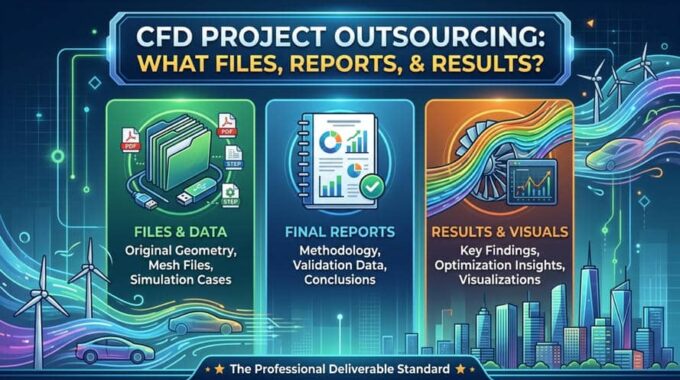
CFD Project Outsourcing: What Files, Reports, and Results Should You Expect?
When engineering teams decide to outsource CFD simulation, the conversation almost always starts with capability and…
 Talk On WhatsApp
Comments (0)