
Operating Pressure in ANSYS Fluent: Gauge, Absolute & Stagnation Pressure Explained
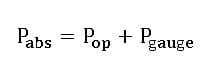
Operating pressure in ANSYS Fluent is the reference pressure (default 101325 Pa) to which all gauge pressures are relative: $P_{\text{absolute}} = P_{\text{operating}} + P_{\text{gauge}}$. Fluent computes every user-entered and calculated pressure as gauge pressure against this reference value. For anyone seeking how to learn ANSYS Fluent step by step, mastering these foundational thermodynamic settings is essential before moving on to complex solvers.

ANSYS Fluent Beginner Course for Less Than the Cost of a Lunch!
No prior experience needed. Start Learning ANSYS Fluent step-by-step with 16 hands-on, real-world projects across multiple engineering fields.
Getting this single setting wrong is one of the most common — and most avoidable — sources of divergence and inaccurate results in numerical simulations. In our engineering practice at MR-CFD, particularly when delivering specialized CFD consulting service projects to industry clients, mismatched reference pressures frequently emerge as the hidden cause of solver instability. Below, we break down every related pressure type, when to change the default, and exactly where to click in the interface.
Stagnation pressure
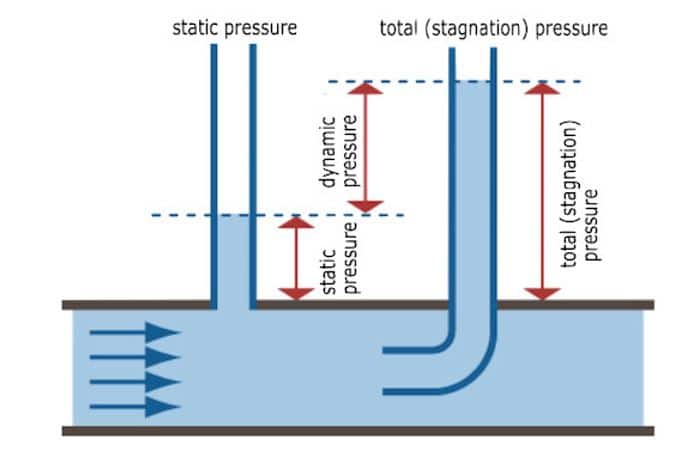
We know that total pressure equals the sum of static pressure and dynamic pressure:

- Static pressure is the pressure exerted by a fluid at rest, or by the fluid moving with the flow (measured perpendicular to flow direction).
- Dynamic pressure is the pressure attributable to the fluid’s motion — it depends on velocity and density, so as velocity or density increases, dynamic pressure increases too.
This fluid can be a liquid or a gas — the relationship holds for both incompressible and compressible flows (with different governing equations, covered below).

Premier CFD Consulting Services Using ANSYS Fluent
ANSYS Fluent simulations, validation, and defensible engineering reports across 30+ fields. Registered in 🇺🇸 USA (Delaware), 🇬🇧 UK & 🇴🇲 Oman
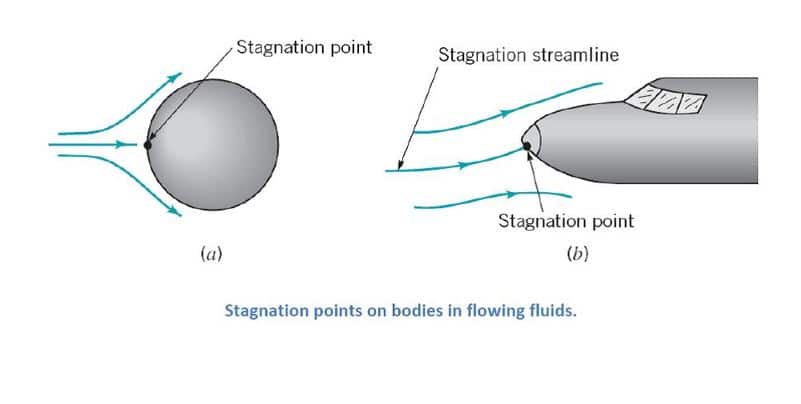
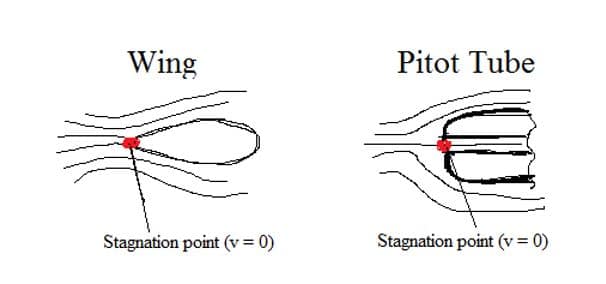
This is exactly how a pitot tube measures airspeed: the tube’s opening faces directly into the flow, bringing the fluid to rest at its tip and registering the stagnation (total) pressure, while a separate static port measures ambient static pressure. The difference between the two gives dynamic pressure — and from that, velocity.
Since dynamic pressure depends on velocity (P_dynamic = ½ρV²), and V = 0 at this point, dynamic pressure also equals zero there. All of the flow’s kinetic energy converts into a pressure rise — meaning the stagnation point experiences the maximum static pressure in the flow field, which equals the total (stagnation) pressure.
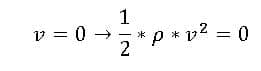
So at the specified point, we have the maximum static pressure. This point is also called the stagnation point; we have the maximum static pressure in this case. The fluid velocity V becomes zero at the stagnation point, and the kinetic energy is converted into a pressure rise.
Dynamic Pressure: Definition, Formula and Units
Dynamic pressure is the kinetic energy per unit volume of a moving fluid:
P_dynamic = ½ρV²
Where:
- ρ = fluid density (kg/m³)
- V = flow velocity (m/s)
- P_dynamic is expressed in pascals (Pa)
Worked example: For water (ρ ≈ 1000 kg/m³) flowing at 2 m/s:
P_dynamic = ½ × 1000 × (2)² = 2,000 Pa ≈ 2 kPa
For comparison, air at the same velocity (ρ ≈ 1.225 kg/m³) produces only ~2.45 Pa of dynamic pressure — density matters enormously.
Maximum dynamic pressure (aerospace context): In aerospace design, “max Q” refers to the point during ascent where dynamic pressure peaks — a critical structural design load condition, since aerodynamic forces on the vehicle are directly proportional to dynamic pressure.
When velocity approaches zero (V → 0), dynamic pressure converts entirely into static pressure — this is exactly the stagnation-point behavior described above.
Atmospheric pressure
The pressure within Earth’s atmosphere is referred to as atmospheric pressure or barometric pressure. It’s measured using a barometer — commonly a mercury barometer in labs or weather stations.
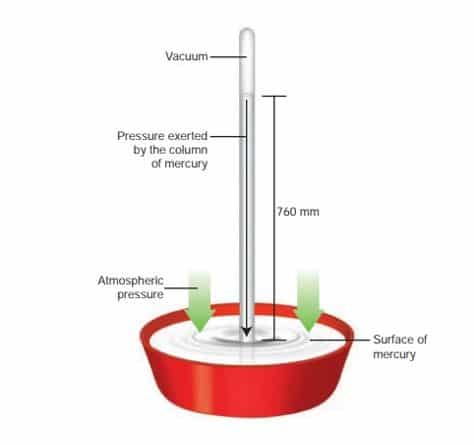
At sea level on an average day, the mercury column height is 760 mm. Using mercury’s density (13,600 kg/m³), we can calculate the pressure this column exerts — which defines one atmosphere (1 atm):

This means atmospheric pressure exerts a force of 101.325 kN on every 1 m² of surface.
One atmospheric pressure is the name given to this pressure (atm). A unit known as (bar) is also used to express such high-pressure values.
1 atm=101325 pa or 1 atm=1.01325 bar
The value is 101.325 kPa when expressed in kilopascals. This means that the force acting on each 1 m2 of the surface is 1.01325 KN.
Gauge Pressure and Absolute Pressure
The force applied to an area is known as pressure. Pressure can be measured in various ways, with gauge and absolute pressure being two of the most typical. The difference between measured and local air pressure is known as a gauge or relative pressure. If the measured pressure is less than the atmospheric pressure, the gauge pressure might have a negative value.
You can see the gauge pressure formula as below:

Most pressure gauges are calibrated to read zero at atmospheric pressure — meaning they ignore ambient air pressure entirely and only register pressure differences above or below it. If the measured pressure is below atmospheric, gauge pressure is negative.
Absolute pressure is the total force per unit area exerted on a surface by a fluid, measured relative to a perfect vacuum (true zero) rather than atmospheric pressure. The relationship connecting the two:
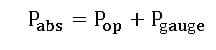
For pressures above atmospheric, gauge pressure is positive; below atmospheric, it’s negative — but absolute pressure is always ≥ 0 by definition (you cannot have negative absolute pressure in a physical sense).
Operating Pressure, Gauge Pressure, and Absolute Pressure in ANSYS Fluent software
To determine the pressure in incompressible flows, we can use Bernoulli’s formulation, and for compressible flows, also we can use the isentropic formulations.
Pressure in incompressible flow
In incompressible flows, the total pressure and static pressure in the Bernoulli equation are related to the velocity inlet.

Pressure in compressible flow
In compressible flows, we use isentropic relations for the ideal gas to establish a relationship between total pressure, stagnation pressure, and velocity at the pressure inlet boundary. Therefore, the value of total pressure entered by the user at the inlet boundary and the static pressure in the adjacent fluid element are related as follows.
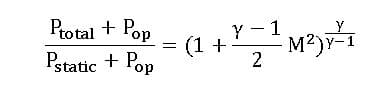
Where:
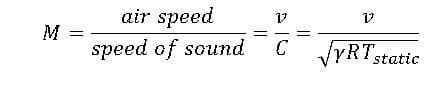
Where 
The operating pressure appears in the equation because the amount of inlet boundary conditions are in terms of pressure relative to operating pressure. As explained in Setting up: solver, in compressible flows, the density is one of our unknowns, which is calculated from the following equation.
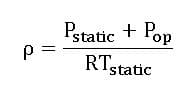
For gas mixtures of several species, the specific gas constant, R, determines using a molar or mass fraction. We can determine the amount of static temperature at the inlet by the total temperature entered by the user.
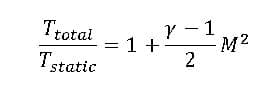
In ANSYS Fluent, all of the pressure that users determine and calculated pressures are gauge pressure.
Static vs Stagnation Pressure (Plus Dynamic, Gauge & Absolute): Comparison Table
| Pressure Type | Definition | Formula | Measured By | Fluent Field Variable |
|---|---|---|---|---|
| Static | Pressure exerted by a fluid in the direction perpendicular to flow, independent of motion | P_static | Static port / wall tap | Static Pressure |
| Dynamic | Pressure due to fluid’s kinetic energy from motion | P_dynamic = ½ρV² | Derived (Pitot − static) | Dynamic Pressure |
| Stagnation (Total) | Pressure at a point where velocity = 0; sum of static + dynamic | P_total = P_static + P_dynamic | Pitot tube (facing flow) | Total Pressure |
| Gauge | Pressure relative to a reference (operating) pressure | P_gauge = P_absolute − P_operating | Pressure gauge | Gauge Pressure |
| Absolute | Total pressure relative to a perfect vacuum (zero pressure) | P_absolute = P_gauge + P_operating | Absolute pressure sensor | Absolute Pressure (field function) |
Key relationship:
P_absolute = P_gauge + P_operating (P_atmospheric)
Static and stagnation pressure differ by the dynamic pressure term; gauge and absolute pressure differ by the operating (reference) pressure term. These are two independent pairs — don’t confuse “static vs. total” with “gauge vs. absolute.”
You can ignore air pressure frequently by pressure gauges, resulting in a reading of zero at atmospheric pressure. As a result, Gauge pressure defines as the pressure corresponding to atmospheric pressure. For pressures over atmospheric pressure, gauge pressure is positive, while for pressures below atmospheric pressure, it is negative.
The absolute value of the force per unit area exerted on a surface by a fluid is referred to as absolute pressure. The difference between absolute and atmospheric pressure shows using gauge pressure.
How to Set Operating Pressure in ANSYS Fluent (Step-by-Step)
In ANSYS Fluent, every pressure value you enter and every pressure Fluent calculates is a gauge pressure, referenced against the operating pressure you set.
Where Pressure Comes From: Incompressible vs. Compressible Flow
- Incompressible flows: Total pressure and static pressure at the velocity inlet are related through the Bernoulli equation.
- Compressible flows: Fluent uses isentropic relations for an ideal gas to relate total pressure, static pressure, and velocity at a pressure inlet boundary. The static temperature at the inlet is derived from the user-entered total temperature.
The operating pressure appears directly in these equations because all boundary condition pressure inputs are expressed relative to operating pressure. In compressible cases, density is one of the solver’s unknowns and is calculated using the ideal gas law — for gas mixtures, the specific gas constant R is determined from molar or mass fraction.
To set the operating pressure in ANSYS Fluent, apply the following path:
Physics >> operating pressure or setup >> cell zone conditions >> operating conditions…
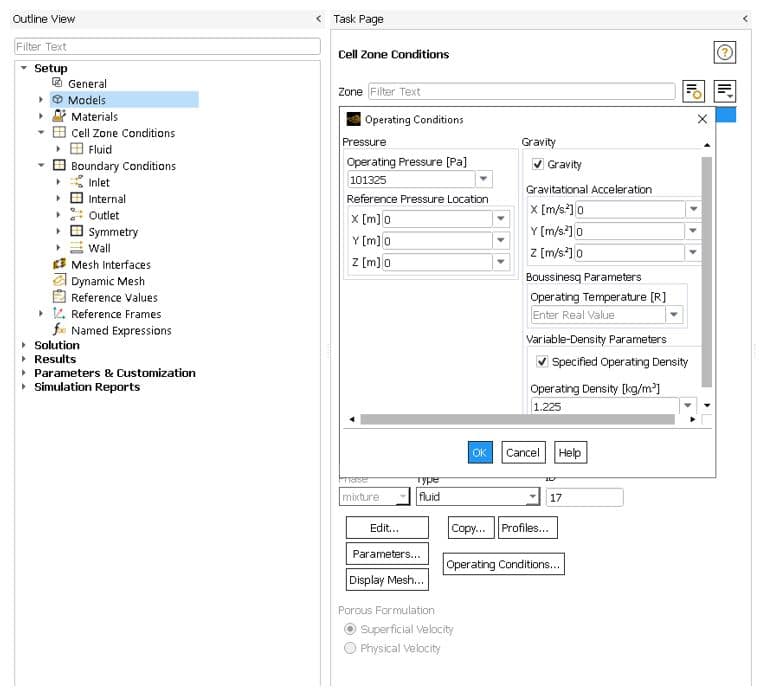
According to the above figure, the default operating pressure in ANSYS Fluent is 101325 pa.
We show the sections of operating pressure as below:
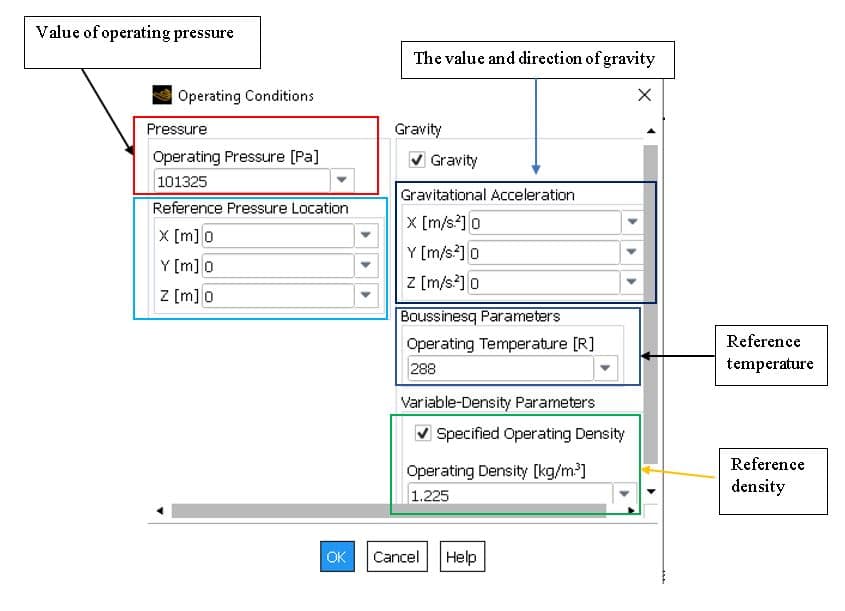
The total pressure is the same as the relative pressure (Gauge) relative to the reference pressure defined in the Operating condition panel in the figure above.
Reference pressure location with type of pressure boundary conditions and without it
When there were pressure boundary conditions like pressure inlet, etc., we didn’t need to set the Reference pressure location, but when there weren’t pressure boundary conditions, it needed that determine the reference pressure location in a point of Computational point.
Negative Gauge Pressure in Fluent: Why It Happens and 4 Fixes
Because gauge pressure is defined relative to operating pressure, it’s completely normal and expected for gauge pressure to read negative in regions where local absolute pressure is below your chosen operating pressure (e.g., low-pressure zones, suction sides, accelerated flow regions).
The actual failure mode to watch for is different: if absolute pressure drops to zero or below (P_gauge + P_operating ≤ 0) in an incompressible simulation, this is physically invalid and typically signals a real numerical problem — not just a benign negative gauge reading.
4 Fixes for Negative/Invalid Absolute Pressure
- Raise the operating pressure — if your local absolute pressure is dipping near or below zero, increasing operating pressure shifts the reference so gauge values stay in a numerically safer range.
- Fix initialization — a poor initial guess (especially hybrid or standard initialization with aggressive boundary values) can create transient negative-absolute-pressure spikes that destabilize the solver before convergence. Try a more conservative initialization or patch reasonable starting values.
- Correct the reference pressure location — if you’re not using pressure boundary conditions and haven’t set the Reference Pressure Location deliberately (see above), Fluent may be enforcing your reference at an inappropriate point in the domain, skewing the entire pressure field.
- Check your boundary conditions — verify that pressure inlet/outlet, velocity inlet, and wall conditions are physically consistent with each other. A common cause of persistent negative absolute pressure is a velocity or mass-flow boundary that’s incompatible with the pressure boundary elsewhere in the domain.
We can summarize this section as follows:
- The stationary fluid has Static Pressure.
- The fluid which has moved has Dynamic Pressure.
- Total pressure = Static pressure + Dynamic pressure.

- The total pressure in any fluid remains constant, and static and dynamic pressure changes. (example: If a fluid is flowing in a nozzle, the dynamic pressure increases and static pressure decreases).
- In incompressible flows, the total pressure and static pressure in the Bernoulli equation are related to the velocity inlet, and in compressible flows, we used isentropic relations.
Frequently Asked Questions
What is operating pressure in ANSYS Fluent?
Operating pressure is the reference pressure (default 101325 Pa) against which Fluent computes all gauge pressures. The relationship is P_absolute = P_operating + P_gauge.
What is the default operating pressure in Fluent?
The default is 101325 Pa (1 standard atmosphere), matching sea-level atmospheric pressure.
What is the difference between static and stagnation pressure?
Static pressure is the pressure of a fluid independent of its motion. Stagnation (total) pressure is the pressure at a point where velocity equals zero — it equals static pressure plus dynamic pressure (P_total = P_static + ½ρV²).
Why is Fluent showing negative gauge pressure?
Negative gauge pressure is normal when local absolute pressure is below your chosen operating pressure — it doesn’t indicate an error by itself. The real problem to check for is absolute pressure dropping to zero or below, which signals initialization, boundary condition, or reference-location issues.
When should I change the operating pressure from 101325 Pa?
Change it for compressible/ideal-gas flows (set near mean flow pressure to reduce density round-off error), for natural convection cases (set operating density, not just pressure), and for high-pressure or vacuum systems where keeping gauge values near zero improves numerical stability.
What is the stagnation point in fluid mechanics?
The stagnation point is the location in a flow field where local fluid velocity equals zero — such as at a pitot tube’s tip or an aircraft’s nose. At this point, all dynamic pressure converts to static pressure, producing the maximum static pressure (equal to total/stagnation pressure) in the flow field.
Summary
Consider fluid flowing inside a pipe at a certain speed. Per the no-slip condition, fluid velocity at the pipe wall is zero.
Using a pitot tube at the wall measures static pressure. Placing the same pitot tube facing into the flow at the pipe’s centerline instead measures total (stagnation) pressure.
Key takeaways:
- Static pressure — the pressure of a stationary (or non-decelerated) fluid
- Dynamic pressure — the pressure attributable to fluid motion (½ρV²)
- Total pressure = Static pressure + Dynamic pressure — and total pressure remains constant along a streamline, while static and dynamic pressure trade off (e.g., in a nozzle, dynamic pressure rises as static pressure falls)
- Incompressible flows relate total and static pressure via the Bernoulli equation; compressible flows require isentropic relations
- In Fluent, every value you enter or the solver calculates is a gauge pressure, referenced against your operating pressure setting — get this one setting right, and most downstream pressure confusion disappears
Related Posts

What is Conjugate Heat Transfer Simulation? Complete CHT Guide
Conjugate Heat Transfer (CHT) simulation is a CFD method that solves fluid flow and solid…

CFD Project Outsourcing: What Files, Reports, and Results Should You Expect?
When engineering teams decide to outsource CFD simulation, the conversation almost always starts with capability and…

ANSYS Fluent Consulting: Get Defensible, Audit-Ready Simulation Results
You need ANSYS Fluent results that can survive scrutiny — a design review, a client…
 Talk On WhatsApp
Comments (0)