
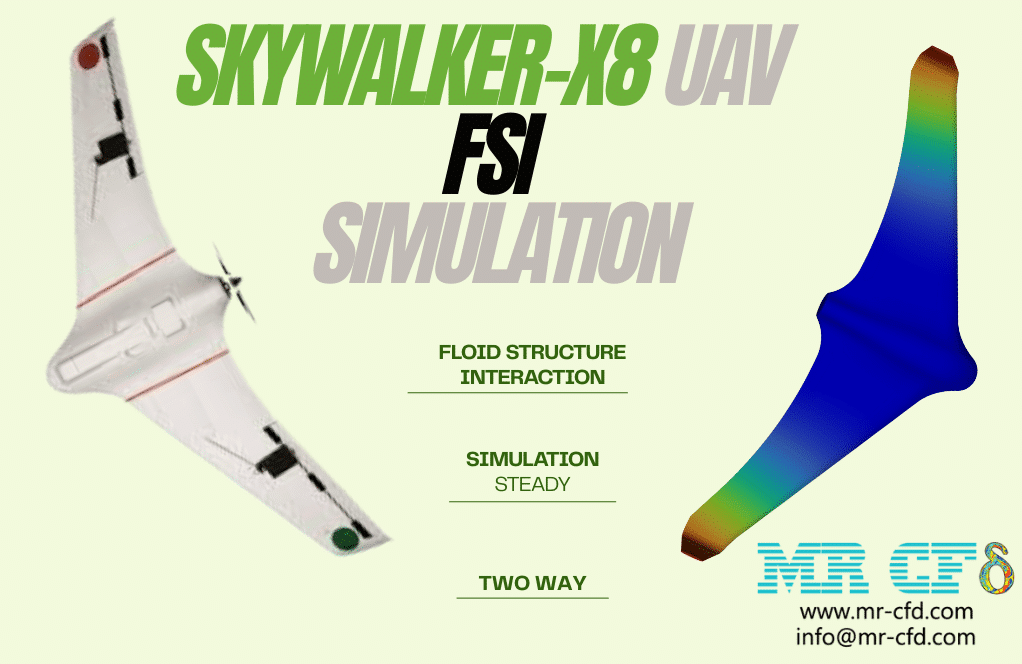
Skywalker-X8 UAV: CFD Simulation Training Package
$3,999.00 Internship
- Without solid aerodynamic data, the rest of the simulation chain is guesswork stability coefficients, structural loads, and noise sources all trace back to how well you captured the flow field.
- Stability derivatives put hard numbers on something pilots feel intuitively: how sharply the aircraft reacts when a gust hits or a control input is applied at any point in the envelope.
- Acoustic simulation shows you where the noise goes, not just how much there is and that spatial picture is what lets you make real design changes instead of just documenting the problem.
- FSI locks aerodynamics and structures into a single conversation, so deformation-driven load redistribution and frequency migration show up on screen rather than during flight test.
To Order Your Project or benefit from a CFD consultation, contact our experts via email (info@mr-cfd.com), online support tab, or WhatsApp at +44 7443 197273.
There are some Free Products to check our service quality.
If you want the training video in another language instead of English, ask it via info@mr-cfd.com after you buy the product.
Description
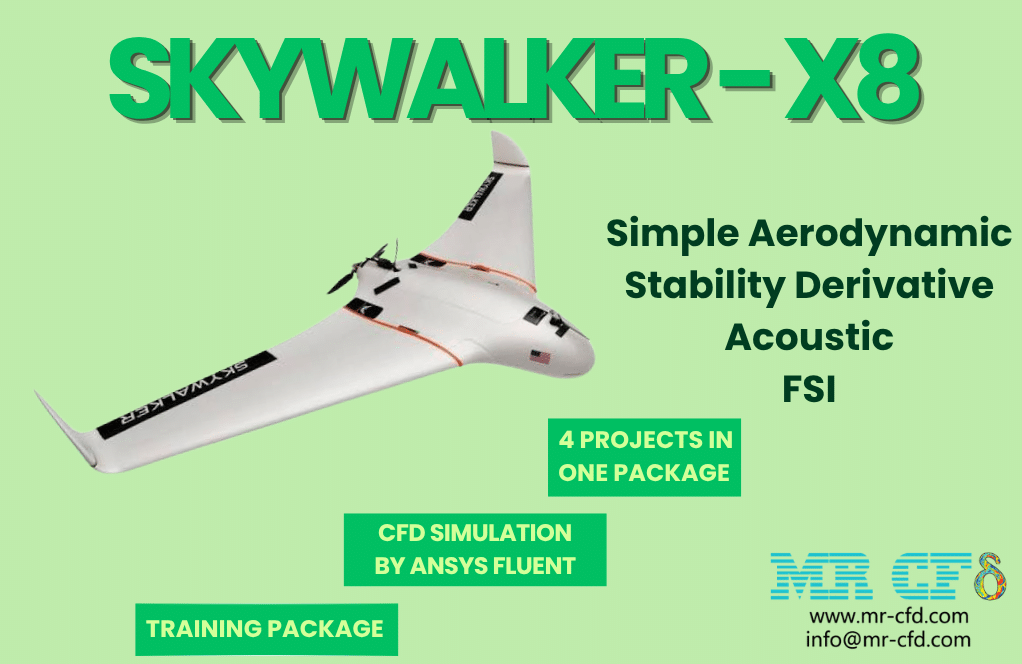
Skywalker-X8 CFD Simulation: 4 Projects In One Package
Four Focused Projects That Take You from Flow-Field Setup to Structural Sign-Off
The Skywalker-X8’s twin-boom pusher layout offers generous payload volume and a wide speed window, but extracting peak performance requires simulation work that spans multiple disciplines. This package contains four ANSYS Fluent projects arranged in a logical sequence: aerodynamic benchmarking, flight-dynamic derivative mapping, noise signature profiling, and bidirectional aeroelastic analysis. Together they form a self-contained training arc that mirrors how professional UAV teams move from early concept evaluation through to pre-flight structural clearance.
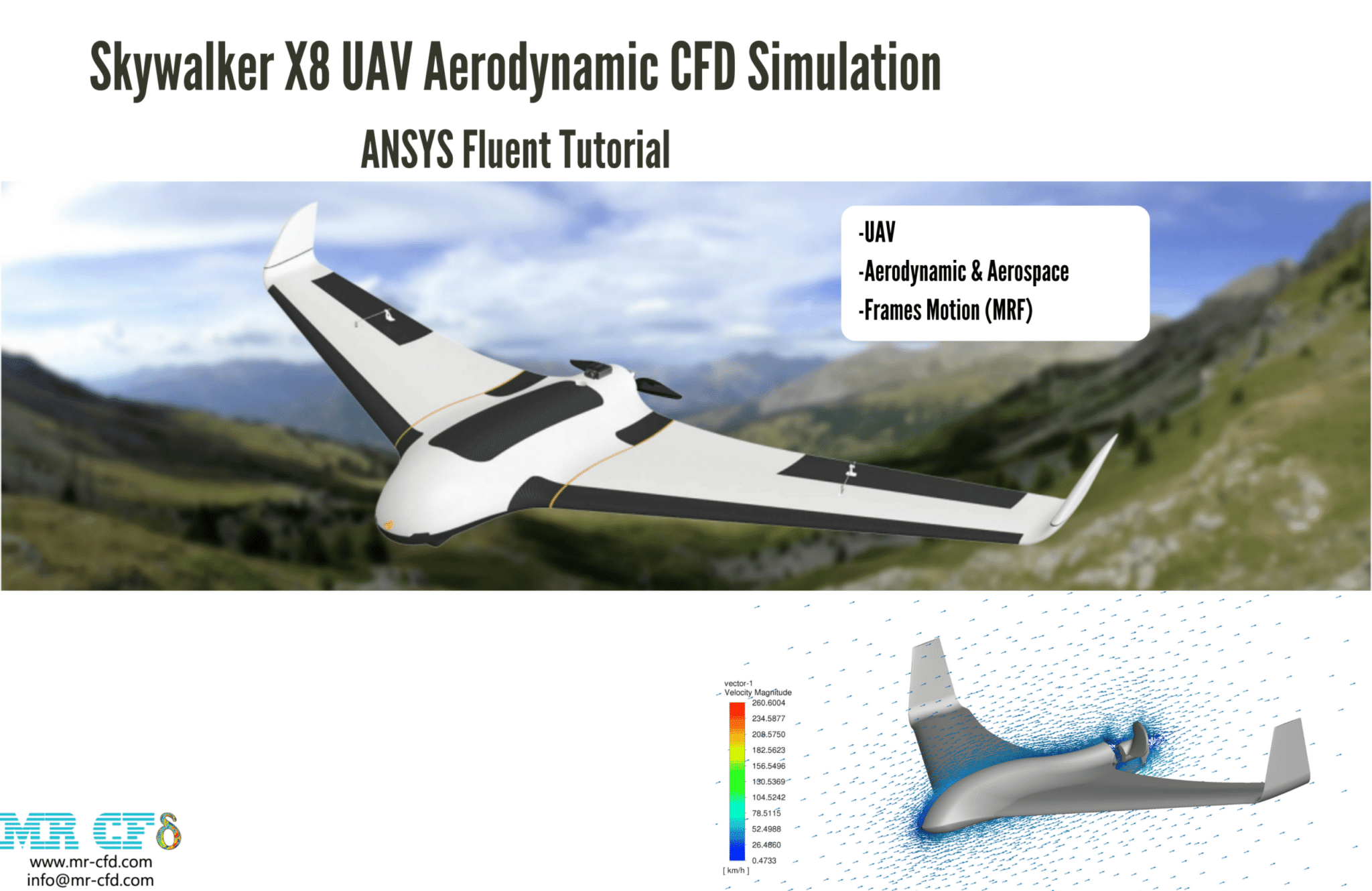
Skywalker-X8 Aerodynamic Analysis and CFD Simulation
Downstream analyses are only as reliable as the aerodynamic data they consume. This first project takes you through complete vehicle preparation in ANSYS Fluent: you will define the propeller rotation domain, set inlet velocity and outlet pressure boundaries, apply appropriate wall models, and run an organized matrix of angle-of-attack and sideslip cases. Post-processing converts raw solver output into polished lift, drag, and pitching-moment curves stored in a format that the stability, acoustic, and FSI projects reference directly. Get this right and every project that follows starts on solid ground.
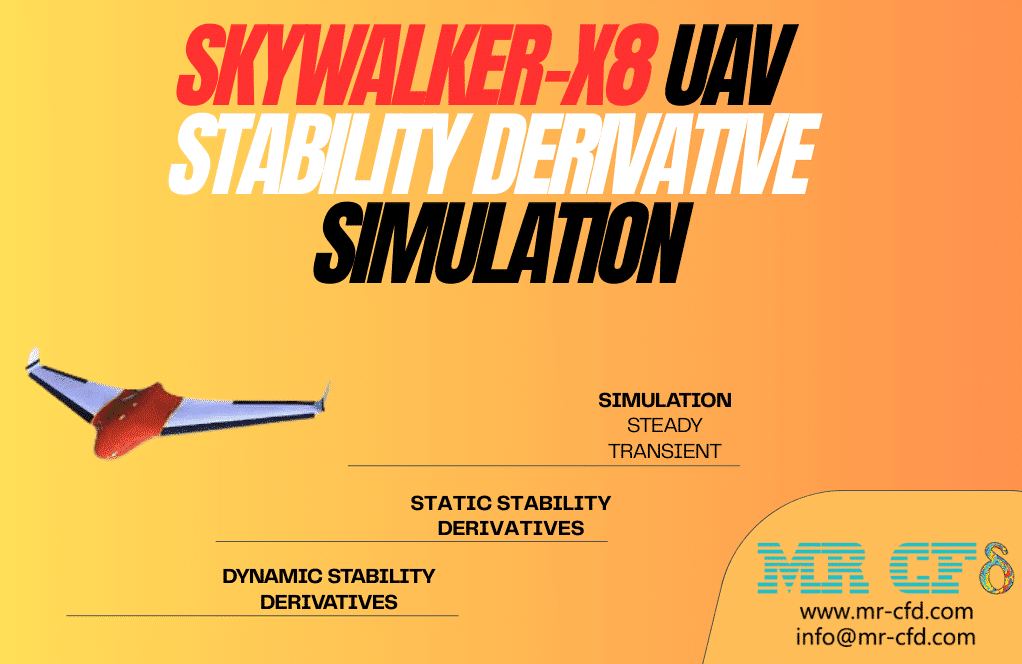
Skywalker-X8 Stability Derivatives
The twin-boom configuration introduces coupling effects between the pusher prop wash and the tail surfaces that conventional single-fuselage models do not capture well. Here you will apply small, deliberate perturbations in pitch, roll, and yaw to the converged baseline, extract the resulting moment increments, and assemble a derivative matrix covering longitudinal short-period, Dutch-roll, and spiral modes. You will tighten mesh resolution in the boom-wake interaction zone and propeller slipstream corridor to ensure the derivatives hold up under grid-independence checks. The completed dataset is formatted for direct import into flight dynamics simulators and control-law verification tools.
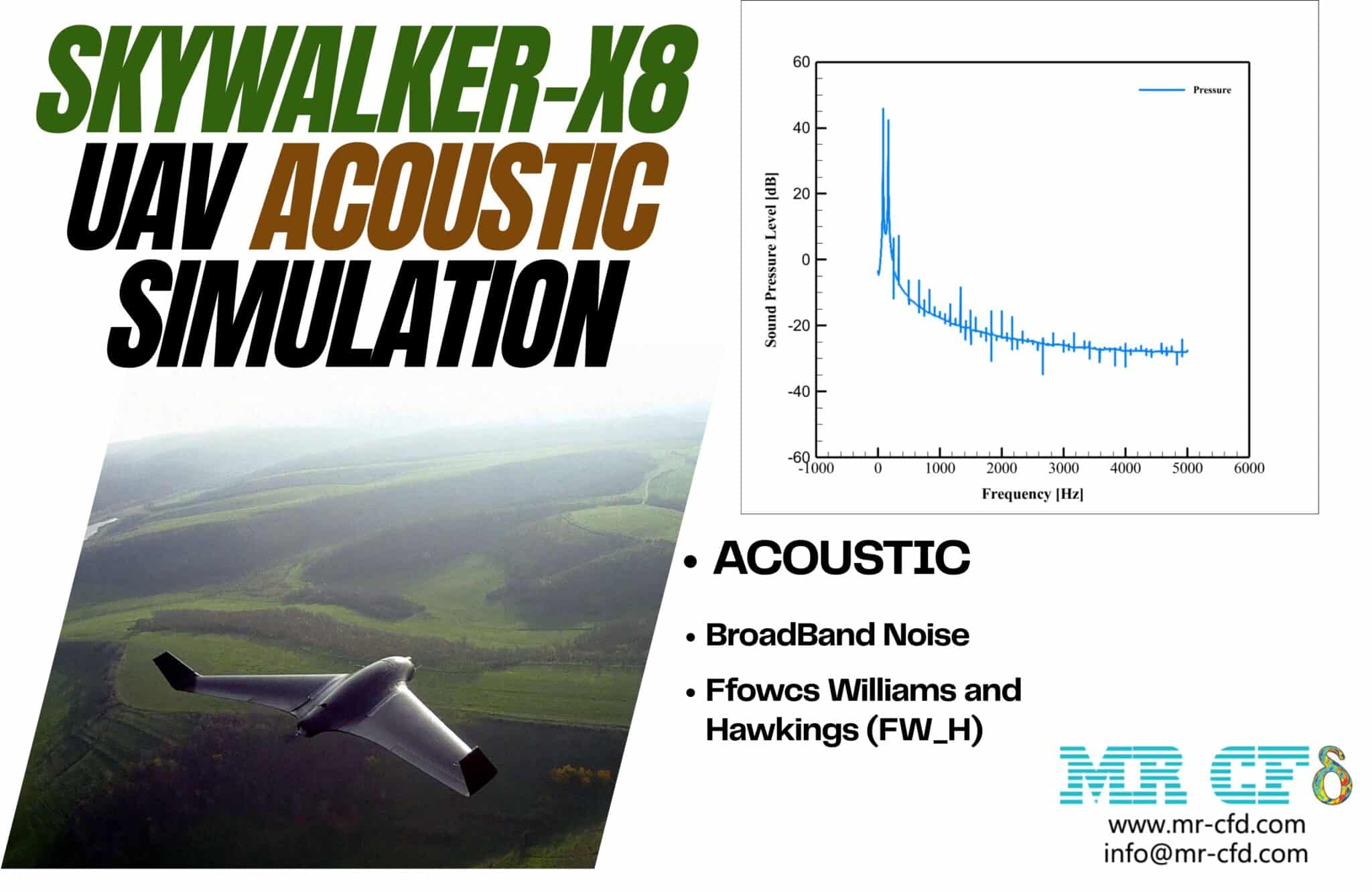
Skywalker-X8 CFD Simulation, Acoustic Analysis
From low-altitude mapping runs where acoustic discretion extends sensor dwell time to operations near populated areas where noise ordinances apply, understanding the vehicle’s sound field is a practical necessity. This project covers ANSYS Fluent’s time-accurate acoustic workflow end to end: capturing fluctuating pressures on rotating and fixed surfaces, applying analogy-based far-field propagation, and comparing tonal and broadband content at climb, cruise, and descent throttle settings. You will produce a three-dimensional noise atlas that lets you evaluate trade-offs blade count, tip speed, flight altitude against detection thresholds or regulatory ceilings, all while preserving the aerodynamic performance established earlier.
Skywalker-X8 Fluid-Structure Interaction (FSI) Simulation using ANSYS Fluent
Composite wings with long spans and narrow tails reduce weight but create elastic behavior that a rigid body CFD model cannot represent. In this final project, we simulated the structure-fluid interactions using Fluent software and a two-way method. Aerodynamic surface loads deform the structure, the deformed geometry is fed back into the flow calculation, and iterations continue until mutual equilibrium is reached. You will plot the wing bending and twisting distribution over the operating speed range, monitor the natural frequency migration against harmonic excitation of the propeller, and quantify how the total pitch and trim angle are modified by flexibility.
You must be logged in to post a review.
Related products
-
Sale

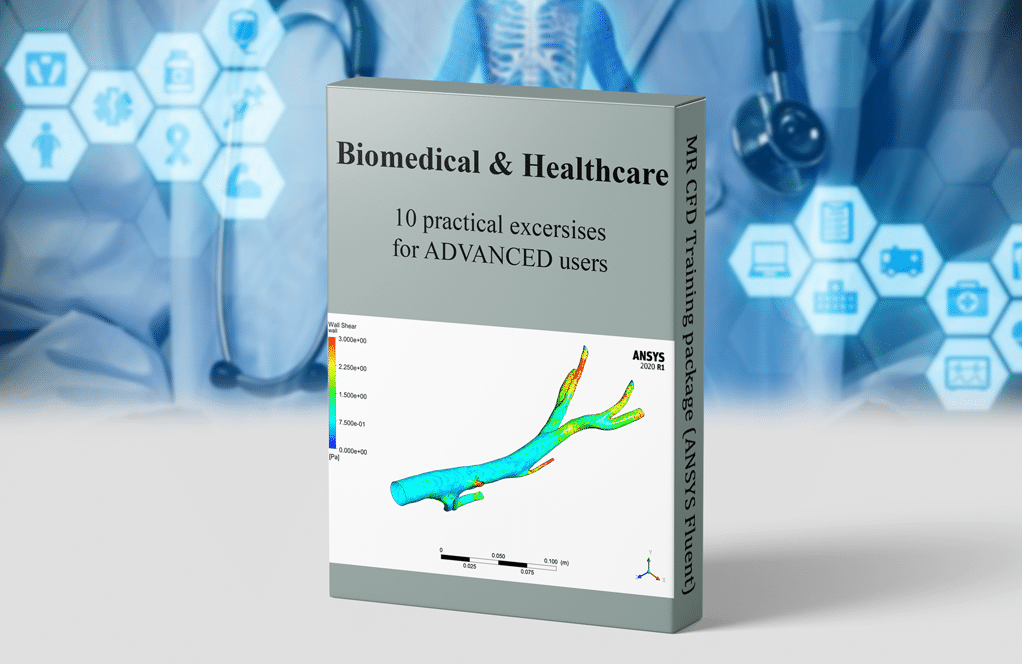
Biomedical and Healthcare Training Package, Advanced Users, 10 Projects
Original price was: $1,580.00.$399.00Current price is: $399.00. Internship -
Sale
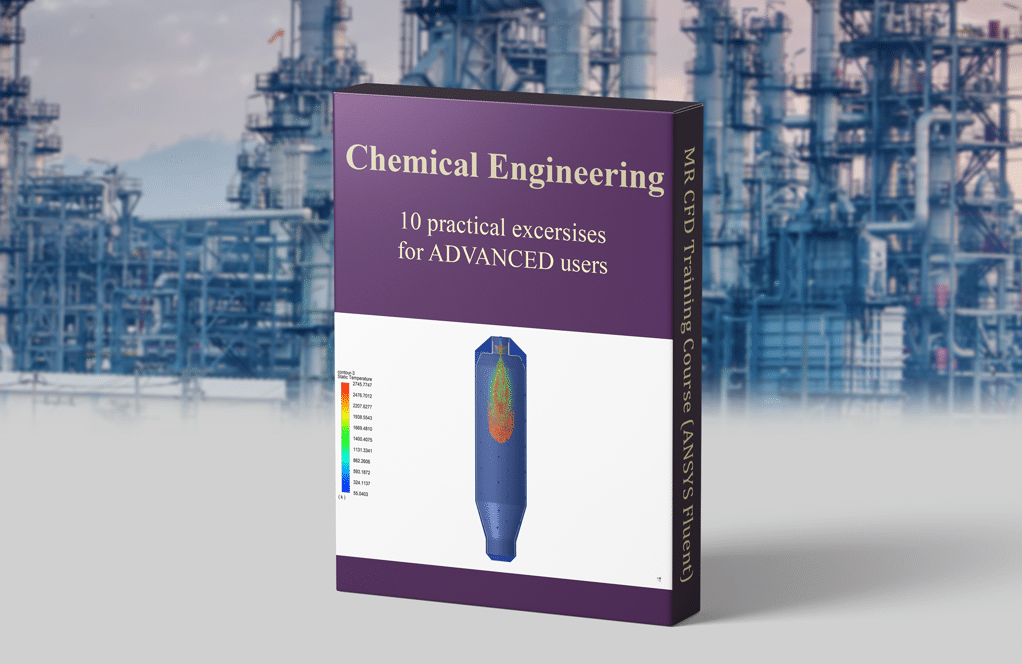
Chemical Engineering Training Package, Advanced Users, 10 Practical Exercises
Original price was: $1,660.00.$399.00Current price is: $399.00. Internship -
Sale
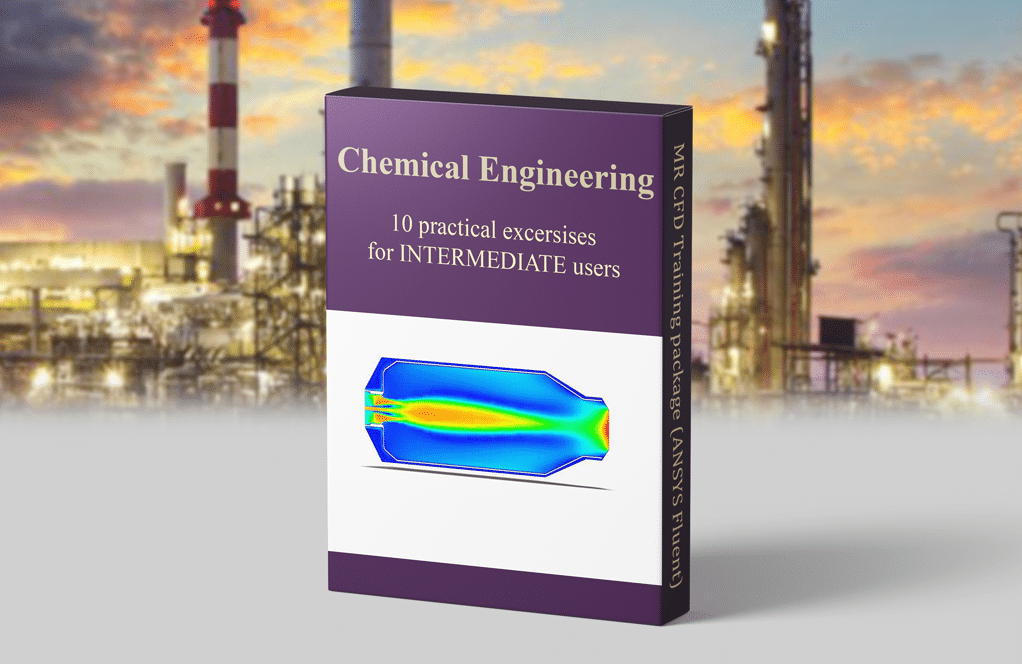
Chemical Engineering Training Package, Intermediates, 10 Practical Exercises
Original price was: $1,300.00.$299.00Current price is: $299.00. Internship
 Talk On WhatsApp
Reviews
There are no reviews yet.